How to compare LEED v4 VOC paint for occupied renovation work
Key Takeaways
- How to use auto parts sourcing intelligence to assess supplier riskAutomotive Tech Analyst
- How to choose fiber optic equipment for long-haul telecom linksIT & Security Director
- Which farm robotics innovations are ready for field-scale weeding?Agri-Tech Strategist
- How much RAM does edge computing hardware for IoT applications need?IT & Security Director
- How to evaluate precision livestock farming companies for grazing herdsAgri-Tech Strategist
- Comparing Battery Cage Quotes for Open-Sided Layer HousesAgri-Tech Strategist
- How to assess an agricultural machinery manufacturer's parts supportAgri-Tech Strategist
- What drives industrial automation cost in a new production line?Chief Civil Engineer
Industry Overview
We do not just publish news; we construct a high-fidelity digital footprint for our partners. By aligning with TNE, enterprises build the essential algorithmic "Trust Signals" required by modern search engines, ensuring they stand out to high-net-worth buyers in an increasingly crowded global digital landscape.
Why occupied renovation changes the paint decision
Paint is often treated as a finishing trade item: select a color, confirm sheen, obtain a low-VOC submittal, and schedule the crew after the major dusty work is complete. That approach is inadequate for an occupied renovation. When employees, patients, students, residents, or retail staff remain in the building, paint selection becomes an indoor-environment, logistics, and documentation decision at the same time.
For project managers evaluating LEED v4 VOC paint, the central question is not simply whether a product is “low VOC.” The practical question is whether the proposed coating system can support the applicable LEED requirements, be applied successfully in the actual space, and allow occupants to continue operating with tolerable odor, disruption, and health risk. Those are related issues, but they are not interchangeable.
A coating can have a compliant volatile organic compound content and still create an unacceptable occupied-work condition because of odor, cure behavior, inadequate ventilation, surface preparation chemicals, or poor sequencing. Conversely, a paint crew may use a product with an impressive emissions certification but fail the project’s green-building documentation because the submitted product data do not address the relevant VOC-content thresholds or because associated materials were omitted.
The strongest selection process therefore starts with the project conditions, then maps those conditions to product evidence and field controls. It does not start with a marketing label.
Separate VOC content from emissions performance
One of the most persistent sources of confusion is the assumption that “zero VOC,” “low odor,” “low emitting,” and “LEED compliant” mean the same thing. They do not.
VOC content generally concerns the amount of volatile organic compounds in the wet coating formulation, commonly reported in grams per liter. LEED-related product evaluation may reference regulatory limits and product-category requirements. The applicable basis must be checked against the rating system version, project pathway, coating category, and jurisdiction. A supplier’s statement that a product meets one regional rule is useful, but it is not a complete compliance determination for every project.
Emissions performance concerns what a finished product releases into indoor air after application and curing under test conditions. This is often supported by a recognized third-party emissions certification or test report. It matters greatly for occupant exposure, particularly in enclosed spaces or where sensitive populations are present. Yet an emissions claim alone does not prove that the wet-product VOC content meets the project requirement.
Odor is another category. Some compounds can be noticeable at concentrations below levels generally associated with toxicological concern; others may be less noticeable while still requiring exposure control. Odor complaints can derail a renovation phase even where every data sheet appears acceptable. Paint selection for occupied work should therefore treat odor as an operational variable, not as a proxy for formal compliance.
Ask manufacturers and distributors to identify, in writing, the exact product, base, tinting system, sheen, and intended application method. A product family page is not enough. Deep base versus pastel base, flat versus semi-gloss, field tinting, primers, and site-added modifiers can change the relevant documentation and, in some cases, the material characteristics.
Begin with the occupied-space risk profile
The right paint for an overnight office refresh may be the wrong choice for a hospital outpatient wing, a school renovation during term time, or a data-center control room that must remain continuously staffed. Before comparing products, define what the work zone can realistically tolerate.
- Who remains in or adjacent to the area, including employees, visitors, contractors, and occupants with elevated sensitivity?
- Can the work area be physically separated from occupied zones, and are pressure differentials or temporary barriers feasible?
- What ventilation is available during application and cure? Can outside-air rates be increased without disrupting building operations?
- What are the allowable work windows: nights, weekends, phased floor-by-floor work, or only brief shutdown periods?
- How much surface preparation is required, and what cleaners, patching compounds, primers, caulks, or coatings will be used alongside the topcoat?
- What performance demands apply: scrub resistance, moisture tolerance, antimicrobial cleaning compatibility, touch-up consistency, or rapid return to service?
These questions frequently change the procurement outcome. For example, a premium interior acrylic coating with sound emissions credentials may still be unsuitable if it requires lengthy ventilation before a classroom can reopen. In a medical environment, a lower-odor system that tolerates frequent cleaning may justify a higher unit price because it reduces closure time and the risk of repainting after early failure. In an office environment, a familiar, widely available coating may be preferable where phased work requires frequent small-batch orders and reliable color matching.
The material cost of paint is normally modest relative to the cost of disrupted operations. Project teams should resist optimizing solely for price per gallon or liter when occupant relocation, after-hours labor, HVAC adjustments, security coverage, and schedule contingency carry much larger consequences.
Build a comparison sheet around the complete coating system
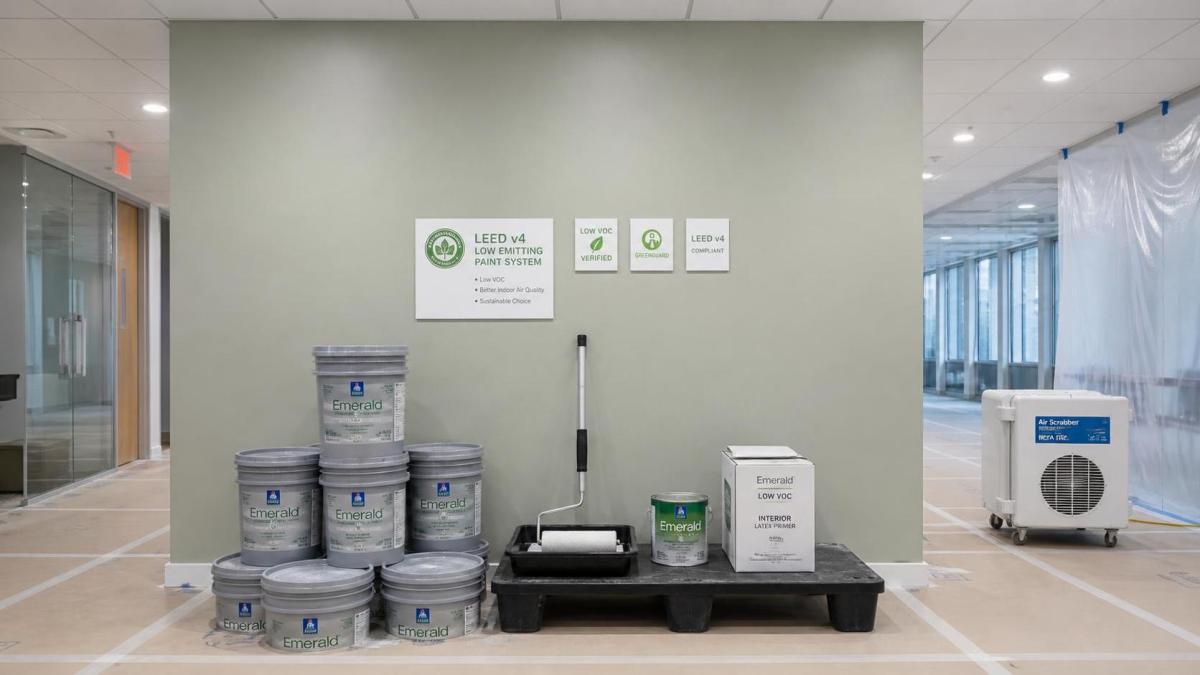
A credible evaluation does not compare only finish coats. The building receives a system: cleaning products, patching materials, sealers, primers, coatings, caulks, and sometimes specialty treatments. Any one of these can become the weak point in an indoor-air-quality strategy or the missing element in LEED documentation.
For each proposed system, create a project-specific comparison sheet with the following evidence:
- Exact product identification: manufacturer, product name, SKU where available, base, sheen, color or tinting approach, and use location.
- Technical data: recommended substrates, coverage rate, dry time, recoat time, full cure conditions, temperature and humidity limitations, and cleaning or maintenance guidance.
- VOC-content documentation: current technical data sheet, safety data sheet where relevant, and manufacturer compliance letter that identifies the basis of the claim.
- Emissions evidence: applicable third-party certification, test standard, certificate scope, and confirmation that the particular product configuration is covered.
- Application materials: primers, fillers, caulks, touch-up paint, cleaners, and any additives proposed by the contractor.
- Field controls: ventilation plan, containment approach, application method, storage location, waste handling, and planned occupancy return time.
- Supply assurance: local availability, lead times for specified colors or bases, approved substitutes, batch consistency, and distributor support.
This format has a second benefit: it forces the design team, general contractor, painting subcontractor, and sustainability consultant to work from the same product definitions. Many late-stage disputes begin when one party assumes that a generic “low-VOC paint” specification allows a different product than the one used by the documentation team.
Read manufacturer claims with the right level of skepticism
There is no reason to dismiss environmental product claims, but they must be interpreted precisely. “LEED eligible” can be a useful starting point; it is not a guarantee that the product will earn a credit or fit every LEED v4 project. Credit calculations and product pathways depend on the project’s adopted requirements and the full set of installed materials. The project team, rather than the paint manufacturer, ultimately has to establish the documentation case.
Similarly, a “zero-VOC” claim may refer to a specified calculation method, the untinted base, or VOC content excluding colorants. The practical implication is not that the claim is misleading by default. It is that project managers need to confirm whether it remains valid after tinting and for the selected sheen and base. Dark or saturated colors can create additional documentation and performance questions, depending on the colorant system.
Third-party low-emitting certification can be valuable because it reduces reliance on self-declared claims. However, verify the certificate date, the product scope, and whether the certification applies to the product sold in the project market. Product reformulations, regional manufacturing differences, and discontinued lines are routine commercial realities. An old certificate in a submittal folder should not be assumed to represent current supply.
Do not overlook biocides, antimicrobial claims, and specialty coatings. In high-cleaning or moisture-prone environments, teams may seek these features for legitimate reasons. But the added chemistry, intended use restrictions, maintenance requirements, and indoor-air implications deserve closer review. A feature claim should not displace the basic assessment of emissions, durability, and occupant exposure.
Application planning is as important as product selection
Even a well-chosen coating can cause problems if the painting plan assumes dry, empty, well-ventilated rooms that do not exist. Occupied renovations need a documented sequence that treats painting as a controlled activity.
First, place high-emission and high-odor work where it can be isolated. This often means completing intensive preparation, patching, priming, and first coats during off-hours, then reserving minor touch-up work for lower-impact periods. If work must proceed during normal operations, define a smaller work zone, protect air pathways, and establish the escalation path for odor complaints or health concerns.
Second, coordinate with facilities staff before the crew arrives. The HVAC system may need an operational plan that is different from the normal schedule. Simply turning on more air movement can spread odors beyond the work area if return-air pathways are not considered. In some buildings, the best control is temporary local exhaust and containment; in others, it is a carefully managed outside-air strategy. The appropriate approach depends on the building system and should be assessed by qualified site personnel.
Third, distinguish between dry-to-touch, recoat, and ready for normal occupancy. These milestones are not identical. A wall can look complete while its odor remains noticeable or while cure conditions have been slowed by humidity, low temperature, limited airflow, or heavy film build. Manufacturers’ instructions provide a baseline, but the site should establish a return-to-service protocol appropriate to the occupant group and renovation risk.
Finally, train field supervisors on substitution control. A crew under schedule pressure may source a locally available primer, caulk, or touch-up gallon that was never included in the submittal package. That may be harmless from a workmanship perspective but can compromise documentation or create an avoidable indoor-air complaint. Require approval before substitutions, including “equivalent” materials from the same manufacturer.
Balance green documentation against service-life performance
It is tempting to regard the lowest documented VOC number as the best choice. In occupied commercial interiors, that can be too narrow a criterion. A coating that scuffs easily, cannot withstand the required cleaning regime, or shows uneven touch-up may lead to early repainting. Rework brings another round of material consumption, labor, access disruption, and occupant exposure.
The correct comparison asks whether the system will perform over the expected maintenance cycle. Corridors, patient rooms, education spaces, food-service back-of-house areas, and multi-tenant lobbies all impose different stresses. Specify performance tests or manufacturer performance data relevant to the duty level, but avoid assuming that a high-end paint line performs identically across every sheen. Flat coatings may conceal substrate irregularities, while higher-sheen options may offer better washability but expose wall defects and demand more disciplined preparation.
Mock-ups are especially useful where the project combines a strict indoor-air-quality objective with demanding appearance or cleaning requirements. A representative trial area can reveal odor persistence, coverage behavior, flash, adhesion over existing coatings, cleaning response, and touch-up quality. It also gives occupants and facilities teams an opportunity to flag operational concerns before dozens of rooms are committed.
Procurement risks are often hidden until the renovation is underway
Paint is commonly viewed as a low-risk commodity, but occupied renovation schedules create vulnerabilities. A specified color may require a base that is temporarily unavailable. A distributor may have stock of a similar product with different emissions documentation. A reformulated product may reach the site before the specifications or submittals are updated. Color matching between batches can become visible when work is phased over months.
To limit these risks, lock down approved products early, identify at least one documented contingency option, and require the procurement team to notify the project manager before an order changes product code, base, manufacturing location, or formulation. For larger projects, retain batch and color records for each phase. This is not bureaucratic excess; it makes later warranty, touch-up, and compliance questions solvable.
Also confirm who owns the closeout record. LEED-related submissions often fail not because the materials were wrong, but because invoices, product data, certificates, and installed-product confirmations were collected inconsistently. Assign one party to maintain the live materials log, while requiring the painting subcontractor to supply current records before installation rather than after the work is buried behind an accelerated schedule.
The decision to make before issuing the purchase order
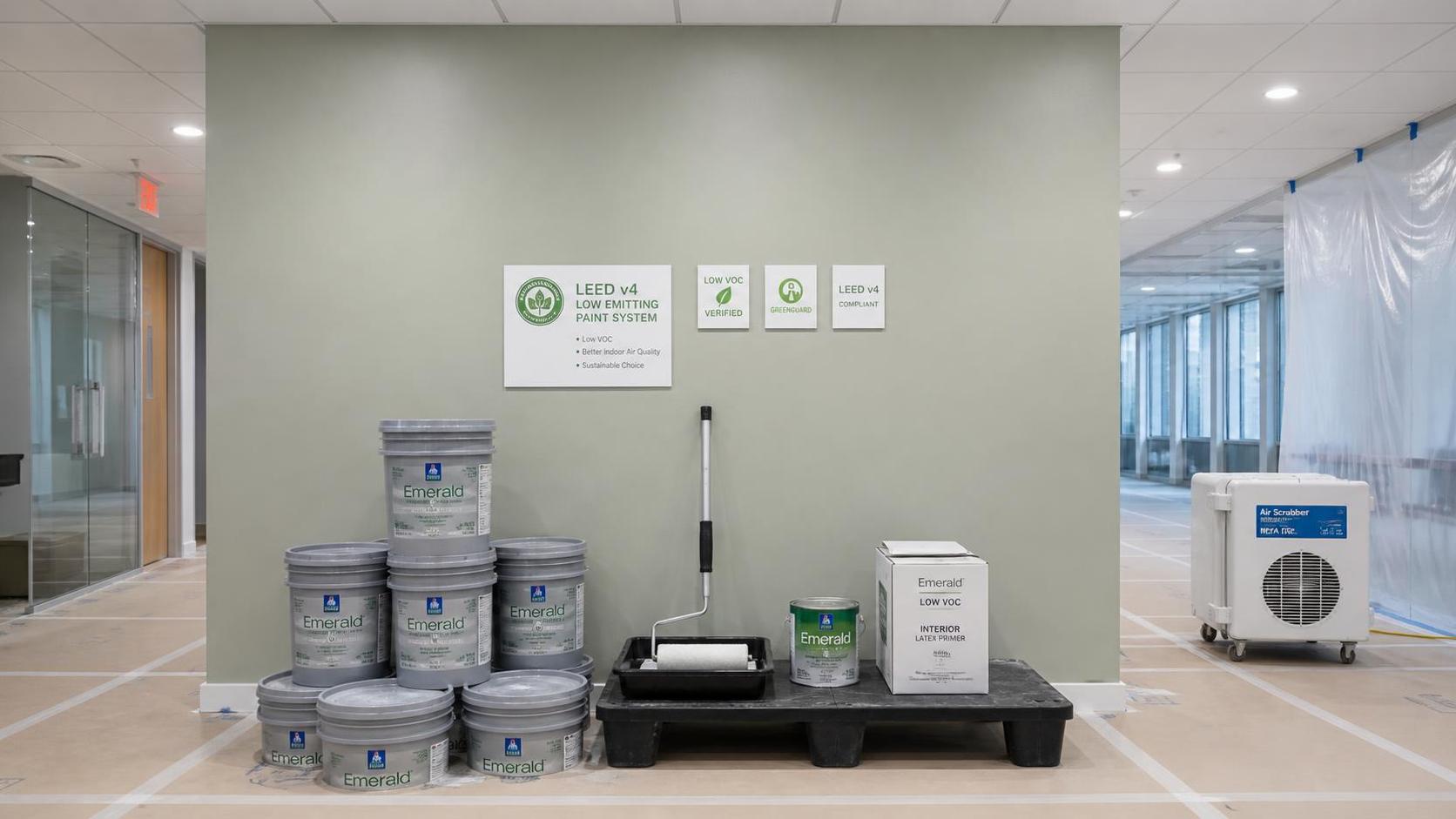
The best LEED v4 VOC paint choice for occupied renovation work is usually the coating system that meets the project’s verified compliance path, has credible emissions evidence, fits the actual ventilation and phasing plan, and can survive the building’s maintenance demands. It should also be available in the required colors and quantities without forcing undocumented substitutions.
That conclusion may lead to a conventional low-emitting interior coating for a phased office project, a more specialized and carefully trialed system for healthcare or education space, or a delayed application sequence when adequate ventilation cannot be provided. The key is to make that decision while there is still time to adjust the work plan. Once occupants are reporting odors, a crew is waiting for material, or documentation is being reconstructed at closeout, paint has stopped being a finish selection and become a project-control problem.
Deep Dive
Related Intelligence
 Green Building MatWhat Makes a Digital Landscape Strategy Effective for Green Building Mat Exporters in ASEAN?Analyst:Chief Civil Engineer
 Green Building MatAre Eco-Friendly Industrial Coatings Actually Lower in VOCs — Or Just Reformulated with New Solvent Blends?Analyst:Chief Civil Engineer
 Green Building MatGraphene Materials Bulk Order Logistics: Lead Times, Minimum Order Quantities, and Storage Requirements for Construction-Scale DeploymentAnalyst:Chief Civil Engineer