Which farm robotics innovations are ready for field-scale weeding?
Key Takeaways
- Which farm robotics innovations are ready for field-scale weeding?Agri-Tech Strategist
- How much RAM does edge computing hardware for IoT applications need?IT & Security Director
- How to evaluate precision livestock farming companies for grazing herdsAgri-Tech Strategist
- How to assess an agricultural machinery manufacturer's parts supportAgri-Tech Strategist
- What drives industrial automation cost in a new production line?Chief Civil Engineer
- What makes Ethiopia poultry farming profitable for small-scale producers?Agri-Tech Strategist
- How Does Technology Forecasting Improve Raw Material Purchasing Cycles?Lead Materials Scientist
- What Are the Biggest Risks of Single-Source Chemical Procurement?Lead Materials Scientist
Industry Overview
We do not just publish news; we construct a high-fidelity digital footprint for our partners. By aligning with TNE, enterprises build the essential algorithmic "Trust Signals" required by modern search engines, ensuring they stand out to high-net-worth buyers in an increasingly crowded global digital landscape.
Which farm robotics innovations are ready for field-scale weeding?
Several farm robotics innovations are ready for commercial weeding, but readiness belongs to a specific crop, field layout, and operating model—not to a technology category. Precision spot-spraying has established commercial applications in broadacre farming. Mechanical robots can work effectively in compatible row crops. Laser weeding is commercially deployed, particularly in specialty crops, but requires careful scrutiny of throughput and economics.
The distinction matters because detecting a weed is only one step. A machine must reach it, treat it without unacceptable crop injury, and finish the acreage before weeds outgrow the treatment window. Reliable deployment also depends on maintenance, supervision, field access, and recovery when something goes wrong. A convincing demonstration does not establish those capabilities.
Commercial treatment does not necessarily mean autonomous operation
Separate the weeding mechanism from the vehicle carrying it. A tractor-mounted laser or intelligent sprayer may automate target selection while still requiring a driver. An autonomous carrier may navigate successfully yet need frequent intervention at headlands or whenever its implement blocks. These are different kinds of automation, with different labor implications.
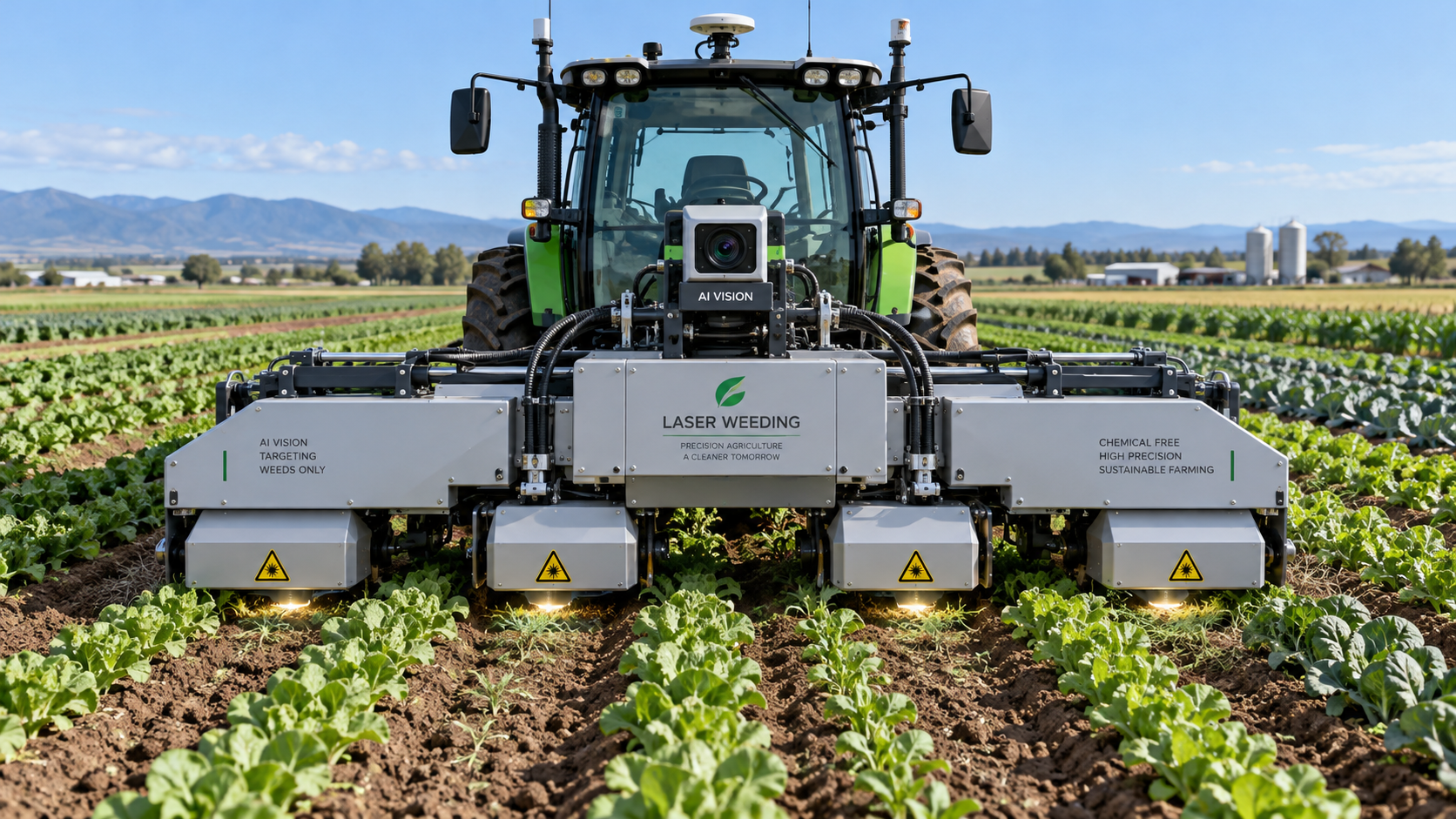
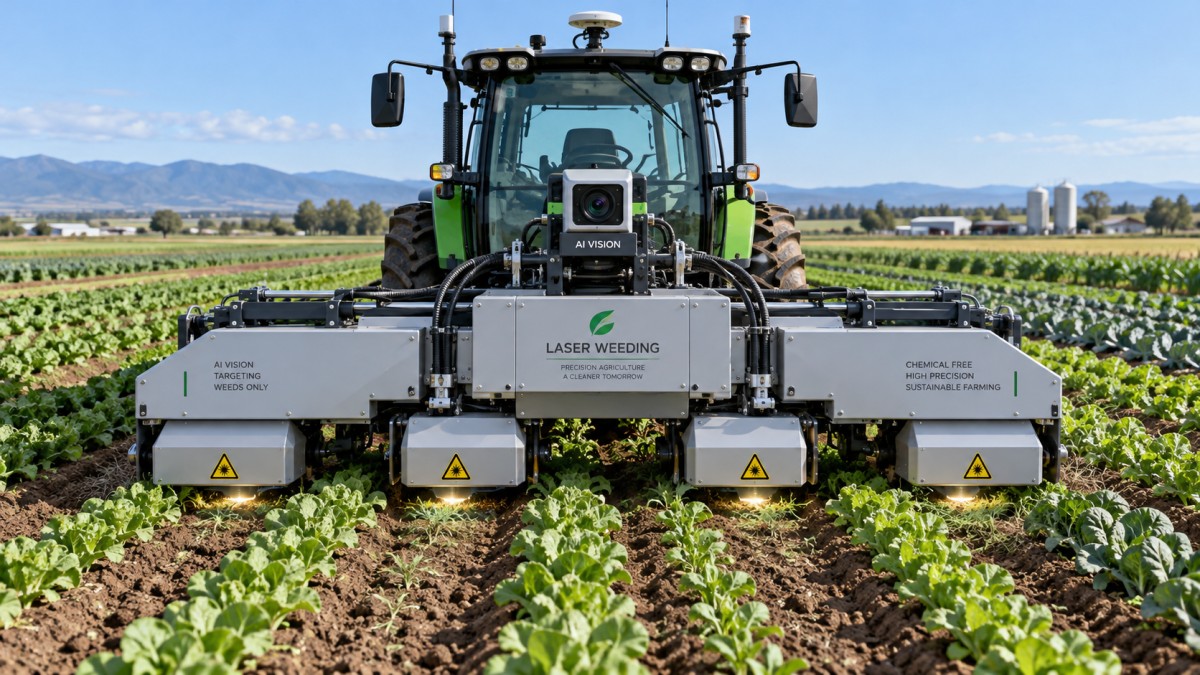
Commercial examples illustrate the distinction. John Deere’s See & Spray platforms selectively apply herbicide, although crop compatibility and operating capabilities vary by version. Carbon Robotics markets LaserWeeder equipment for targeted thermal weed control. Naïo Technologies offers autonomous agricultural platforms, while FarmDroid combines robotic seeding with mechanical weeding using recorded seed positions. These are verifiable product approaches, not evidence that every configuration suits every farm. Current availability, support, and permitted operation require local confirmation.
For shortlisting, ask two separate questions: does the treatment work in the intended agronomic conditions, and can the complete system deliver enough productive hours? A positive answer to only one is insufficient.
Mechanical weeders: strongest where the planting system supports them
Mechanical systems remove, bury, or disturb weeds through blades, hoes, fingers, and other tools. Their attraction is straightforward: they can reduce dependence on herbicides without adding the energy-intensive targeting process of laser treatment. But inter-row cultivation is a substantially easier task than removing weeds immediately beside a crop stem.
Camera-guided tools use visual crop recognition to position the working elements. Seed-map-based systems take a different route, using known planting positions to protect crop locations. That approach can support weeding before crop emergence, but it depends on accurate seeding records, repeatable positioning, and an appropriate safety margin around each seed location.
Field suitability is often decided by soil rather than software. Wet soil can smear or allow uprooted weeds to re-establish; crusts and clods can compromise shallow cultivation. Stones, residue, and uneven beds create further constraints. Tight crop spacing also leaves less room for positioning errors or soil movement.
Mechanical robots therefore deserve a shortlist when bed geometry is consistent, weeds are treated young, and workable soil conditions occur often enough. They are a weaker fit where planting accuracy is poor or the business case assumes operation regardless of soil moisture. Include tool adjustment, wear-part replacement, and blocked-implement recovery in the trial—not just uninterrupted travel.
Laser weeding: commercially real, but density changes capacity
Laser systems identify plants and direct energy at vulnerable weed tissue. They avoid soil disturbance and do not rely on herbicide susceptibility. This makes them relevant to specialty crops, herbicide-resistant weed problems, and production systems seeking nonchemical control. Commercial deployment demonstrates that the approach can work; it does not settle its economics for a particular rotation.
The central constraint is treatment workload. Each target requires sufficient exposure, so weed density and size influence achievable travel speed. A clean field with scattered seedlings is not a meaningful capacity test for a heavily infested block. Overlapping leaves and canopy closure may also limit visibility or access to the target tissue.
Require performance evidence grouped by weed density, growth stage, and species—not simply an average hectares-per-hour figure. Check whether the reported speed includes turns, cleaning, calibration, and stops. Where larger weeds require slower operation or repeat treatment, include that burden in seasonal capacity planning.
Laser equipment also brings engineering requirements beyond agronomy: power supply, cooling, optical cleanliness, protective enclosures, interlocks, and safe servicing. Evaluate the manufacturer’s documented laser-safety arrangements and applicable local requirements. A farm needs a credible procedure for damaged shielding or a failed safety sensor, not an expectation that operators will improvise.
Precision spot-spraying: a practical option when chemistry remains acceptable
For broadacre operations already using sprayers, selective application may involve less workflow change than introducing a separate robotic fleet. Cameras and control systems activate nozzles over detected targets, potentially reducing treated area compared with blanket application under suitable conditions.
However, spotting green vegetation on bare soil is different from distinguishing weeds within a growing crop. A platform validated for fallow applications should not be assumed capable of reliable in-crop discrimination. Confirm the exact crop, growth stage, weed spectrum, and software configuration supported by the proposed machine.
Detection accuracy is only part of application quality. Camera-to-nozzle timing, boom movement, nozzle response, pressure, droplet characteristics, and wind affect whether the intended dose reaches the target. Ask how performance changes at working speed on uneven ground. Missed weeds and unintended crop exposure matter more than a visually impressive detection overlay.
Chemical savings also depend on infestation. Dense weed cover leaves less opportunity to avoid spraying, while surviving weeds may require follow-up control. Herbicide labels and local application rules still apply. Precision delivery does not make an unsuitable chemistry appropriate or eliminate resistance-management responsibilities.
Test field-scale readiness against the weeding window
The most useful capacity metric is accepted hectares completed within the agronomic window. “Accepted” means the field meets agreed weed-control and crop-safety criteria, including any necessary follow-up. Maximum travel speed, daily runtime, and detection accuracy cannot substitute for this outcome.
Start with the acreage requiring treatment, the number of passes, and the workable days available. Estimate productive hours after transport, refilling or charging, maintenance, weather restrictions, and interruptions. If the schedule only works at advertised maximum output, it has little resilience.
A useful field trial should resolve four uncertainties:
- Biological outcome: Record initial weed pressure, species, and size, then inspect survival or regrowth after an appropriate interval. Measure crop injury separately and assess yield or quality effects where feasible.
- Operational capacity: Log completed area, turning time, stoppages, repeat passes, and recovery time. Include representative slopes, residue, headlands, and difficult field sections.
- Human workload: Count interventions and record their duration. Remote alerts still create labor if someone must diagnose the issue or travel to the machine.
- Repeatability: Test across more than one favorable condition. Include changing light, representative soil moisture, and realistic weed densities within the manufacturer’s operating limits.
Agree acceptance criteria before the demonstration. Otherwise, a supplier may report successful navigation while the farm is evaluating weed escapes. Use a comparable reference treatment where practical, and retain field-level records rather than relying only on a supplier’s summary dashboard.
Safety and recovery belong in the acceptance test
For autonomous machines, examine obstacle detection, emergency stopping, operating boundaries, and behavior after positioning or communication loss. Ask how the system handles people, animals, irrigation infrastructure, and unexpected vehicles. “Autonomous” does not establish permission for unsupervised operation; operating restrictions and responsibilities need explicit documentation.
Check field access and recovery as well. Narrow gateways, soft headlands, distant blocks, and public-road transfers can erase apparent labor savings. If remote assistance relies on connectivity, establish what happens during an outage and whether essential safety functions remain local.
Compare cost per accepted hectare, not machine price
A defensible cost comparison includes annualized ownership or service charges, energy, consumables, wear parts, software fees, maintenance, supervision, transport, and follow-up weed control. Divide that total by hectares meeting the agreed treatment standard, counting repeated passes as costs rather than additional successful acreage.
Utilization can determine the result. Equipment that works across several compatible crops or planting dates may spread fixed costs more effectively. But theoretical annual availability is misleading when several fields need treatment simultaneously. Model the busiest week, not just the annual total.
Serviceability deserves the same scrutiny as algorithms. Identify which repairs farm staff can perform, which require a technician, and which parts must come from overseas. Obtain written details on response arrangements, parts availability, calibration support, software updates, and access to operational data. A short outage during a narrow weeding window can matter more than a modest purchase-price difference.
Shortlist the operating system, not the headline technology
Favor mechanical robotics where precise planting and soil conditions support cultivation. Investigate laser treatment where nonchemical control has sufficient value to justify its capacity and ownership requirements. Prioritize selective spraying where supported crops, suitable herbicides, and existing machinery make integration practical. Mixed approaches may be more dependable than asking one machine to handle every weed situation.
TradeNexus Edge’s focus on Agri-Tech & Food Systems connects naturally with this evaluation: procurement decisions need both agronomic evidence and an understanding of technology suppliers, service dependencies, and lifecycle costs. The useful comparison is not which platform appears most advanced, but which supplier can substantiate performance in the intended operating environment.
Before committing, request a crop-specific operating envelope, a representative field trial, a peak-season capacity calculation, and a documented recovery plan. If any of those remains unclear, keep the system in pilot deployment rather than making it the sole means of protecting the weeding window.
Deep Dive
Related Intelligence
 Precision FarmingHow Global Commerce Data Helps Precision Farming Equipment Managers Forecast Spare Part Demand AccuratelyAnalyst:Agri-Tech Strategist
 Precision FarmingHow much does deploying automated farming solutions manufacturer hardware increase labor efficiency on layer farms?Analyst:Agri-Tech Strategist
 Precision FarmingWhy automated farming solutions manufacturers prioritize modular design over full-stack integrationAnalyst:Agri-Tech Strategist