How to assess an agricultural machinery manufacturer's parts support
Key Takeaways
- How to assess an agricultural machinery manufacturer's parts supportAgri-Tech Strategist
- What drives industrial automation cost in a new production line?Chief Civil Engineer
- What makes Ethiopia poultry farming profitable for small-scale producers?Agri-Tech Strategist
- How to Verify a New Materials Supplier’s Technical DocumentationLead Materials Scientist
- Should Buyers Switch from Petrochemical Plastics to Bio-Based Polymers?Lead Materials Scientist
- What Causes Frequent Customs Delays for Specialty Chemical Imports?Lead Materials Scientist
- When do composite materials outperform steel in heavy machinery?Chief Civil Engineer
- How nano materials for electronics improve battery energy densityAutomotive Tech Analyst
Industry Overview
We do not just publish news; we construct a high-fidelity digital footprint for our partners. By aligning with TNE, enterprises build the essential algorithmic "Trust Signals" required by modern search engines, ensuring they stand out to high-net-worth buyers in an increasingly crowded global digital landscape.
A tractor waiting for a transmission sensor during planting can cost more in lost operating time than its purchase discount saved. To assess an Agricultural Machinery Manufacturer’s parts support, verify availability for your exact models, test the route from order to delivery, and establish who is responsible when a critical part is unavailable. A large catalog or extensive dealer network does not, by itself, demonstrate dependable support.
The strongest evidence combines model-specific inventory records, clearly defined delivery performance, capable local dealers, and written commitments covering the equipment’s expected working life. Evaluate these against your operating calendar: a delivery time that is acceptable after harvest may be unusable during a narrow planting window.
Start with the parts that can stop your operation
Before requesting supplier data, build a representative parts basket for the machinery being considered. Use maintenance schedules, illustrated parts catalogs, and input from your workshop to distinguish routine consumption from failures that immobilize equipment. Otherwise, a supplier can appear strong by demonstrating availability for filters and belts while avoiding harder questions about controllers, hydraulic assemblies, or driveline components.
- Routine service items: Filters, seals, lubricants, and scheduled replacement components needed to keep maintenance on track.
- Seasonal wear items: Cutting components, bearings, chains, and other parts whose demand rises with field activity.
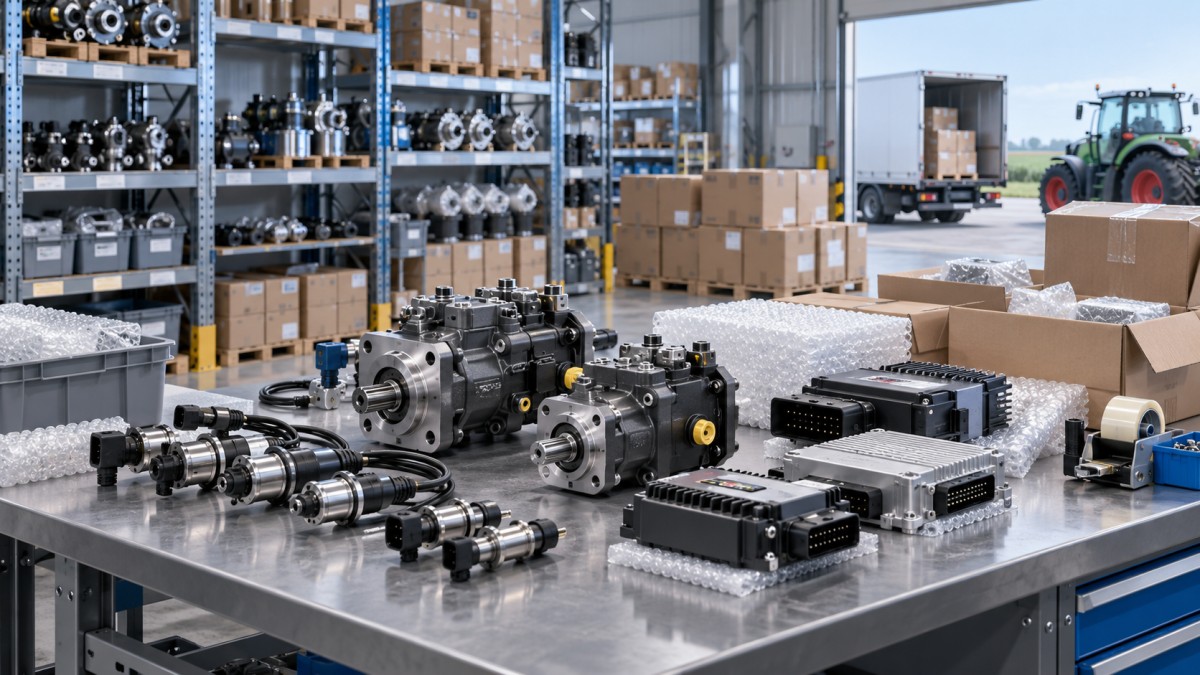
- Machine-stopping components: Pumps, sensors, electronic modules, and assemblies that can prevent safe or effective operation.
- Model-specific or older components: Parts that test support beyond the manufacturer’s current high-volume range.
Record the machine model, serial-number range, part number, required quantity, and acceptable recovery time for each item. Include attachments and implements where their support comes through a different organization. Define whether you need a loose component, a complete assembly, or an exchange unit; these can have very different availability.
Your recovery requirement should cover restoration to service, not just delivery. A controller arriving promptly may still leave the machine idle if programming, calibration, or a qualified technician is unavailable.
Verify where stock actually sits
Ask the manufacturer and proposed dealer to identify the stock location for each item in the basket. Distinguish dealer stock, regional warehouse stock, overseas stock, and parts made or purchased only after an order. “Available” can mean any of these, and the difference determines your exposure to transport delays, customs clearance, and production queues.
Request a dated inventory extract or review the ordering system together. Check whether displayed quantities are free to allocate, already reserved, or merely expected from an incoming shipment. An inventory snapshot proves availability at that moment; it does not establish consistent seasonal coverage.
For historical evidence, request results covering relevant peak periods and your intended supply region. The following measures are useful only when their definitions are clear.
Ask for the range of delivery times and the proportion of orders meeting your required window, rather than relying only on an average. Also establish whether canceled orders and unresolved shortages are excluded. Where detailed records are commercially sensitive, anonymized extracts or a supervised review can still provide evidence.
Trace an urgent order from failure to field
Walk through a hypothetical machine-down request using a part from your basket. Have the dealer explain the sequence: identify the correct component, check local stock, reserve stock elsewhere, obtain approval for emergency freight, dispatch, deliver, and arrange installation. Record the handoffs and the party accountable at each stage.
Pay particular attention to order cutoff times, weekend coverage, and seasonal opening hours. An emergency telephone number is not enough if the person answering cannot authorize a warehouse release or book transport. Confirm whether expedited service operates outside normal business hours and whether your delivery location is covered.
For imported parts, establish who handles customs documentation and clearance. Ask what happens when a shipment misses a connection or a warehouse cannot fulfill the promised quantity. A useful contingency might be transfer from another dealer, an approved exchange assembly, or access to loan equipment—but count it only when eligibility, availability, and costs are documented.
Do not treat every disruption as preventable. Instead, look for a process that detects exceptions early, communicates a revised delivery estimate, and provides a practical escalation route.
The local dealer can strengthen—or undermine—the network
A manufacturer may operate substantial central warehouses while the dealer serving your fleet carries little relevant stock. Evaluate the actual supplying branch, not just the brand’s national footprint. Ask how its stocking policy reflects installed machines, seasonal demand, and the models in your proposed purchase.
The dealer should demonstrate access to current parts catalogs, serial-number lookup, supersession records, and technical support. Selecting a visually similar component can lead to repeat orders, installation delays, or compatibility problems. Where a replacement part supersedes an older number, confirm whether additional hardware, software, or installation instructions are required.
Workshop capacity matters when a part cannot be fitted by your own team. Check access to diagnostic tools, trained technicians, field-service vehicles, and programming capability. Ask whether the manufacturer authorizes necessary work locally or requires an external specialist.
Also clarify cross-dealer access. Can your dealer buy or transfer stock from another branch, and can another authorized dealer support your equipment when it operates elsewhere? Territorial restrictions, separate inventory systems, or payment approvals can make a seemingly broad network difficult to use.
Test ordering accuracy and visibility before purchase
A controlled order trial can expose weaknesses that presentations miss. Agree on a small set of legitimate purchases or a supervised ordering demonstration; do not create false emergency orders. Include a routine item, a serial-number-dependent component, and an item requiring a warehouse transfer.
- Provide the equipment identification and request confirmation of the correct part and any supersession.
- Obtain a quote showing stock location, delivery basis, freight, taxes where applicable, and return conditions.
- Check whether the promised date means dispatch, dealer arrival, or delivery to your site.
- Observe order acknowledgment, allocation status, tracking, and notification of any change.
- Compare the received item and documentation with the original request, then review discrepancy handling.
Evaluate usability as well as speed. Your maintenance team should be able to find diagrams and distinguish variants without guessing. Procurement should be able to retain quotes, track outstanding lines, and identify urgent orders separately from routine replenishment.
A successful trial is useful evidence, not proof of year-round reliability. Combine it with historical performance and a review of peak-season capacity. A supplier unwilling to demonstrate its process should remain an unresolved risk rather than receiving the benefit of an untested claim.
Look beyond the current model range
Ask when the parts-support period begins: machine manufacture, sale, or model discontinuation. “Long-term support” is too vague for equipment expected to remain productive over many seasons. Obtain the policy in writing and identify whether it applies to all components or only selected categories.
Electronic modules deserve separate scrutiny. Continued mechanical parts supply does not guarantee access to compatible controllers, firmware, diagnostic licenses, or security credentials needed for installation. Ask how replacement modules will be configured and what happens when an original electronic component becomes obsolete.
For discontinued parts, assess the replacement route. A documented supersession, approved remanufactured assembly, or engineered retrofit is more credible than a general promise to “find an alternative.” Confirm compatibility, installation requirements, warranty treatment, and whether associated components must also change.
Check notice arrangements for discontinuation and final purchasing opportunities. Your fleet plan may require holding selected spares, but that decision should consider storage life, preservation requirements, revision changes, and capital tied up in inventory. Buying every possible component is not a substitute for dependable supply.
Compare the full cost of recovery
Use the same parts basket and delivery destination when comparing suppliers. Include standard freight, emergency premiums, exchange-unit deposits, return charges, and any programming or installation fees. Confirm quote validity and whether discounts apply equally to routine and urgent orders.
A cheap component can become expensive if incorrect identification creates a nonreturnable order. Review who bears the cost when the supplier specifies the wrong part, how damaged shipments are handled, and whether electrical items or special orders have restricted returns. For exchange assemblies, check core eligibility, return deadlines, and the conditions governing deposit refunds.
Translate support differences into operational exposure rather than pretending to predict every failure. For each critical item, compare the supplier’s evidenced recovery time with your maximum acceptable interruption. Where there is a gap, price the proposed mitigation: local stock, a service agreement, an exchange pool, or another documented option.
Turn the assessment into an award decision
Set mandatory requirements before scoring proposals. These might include correct serial-number identification, an accountable emergency contact, credible availability for selected critical components, and documented support for the intended ownership period. A low purchase price should not compensate for failure on a requirement essential to operating the machine.
Then score the remaining criteria according to your operation’s priorities. A remote fleet may place more weight on regional stock and field-service access; a fleet with a capable workshop may prioritize parts identification, diagnostic access, and direct ordering. Label evidence as verified, partially verified, or unsupported so polished claims do not receive the same credit as records and demonstrations.
Carry the accepted commitments into the purchase or support agreement. Define covered models, delivery destinations, emergency-order procedures, reporting measures, escalation contacts, and the scope of any remedies. Avoid blanket promises that cannot distinguish routine replenishment from a machine-down event.
Before award, review unresolved gaps item by item. A manufacturer with limited local stock may remain viable if a funded, documented stocking arrangement closes the critical gaps. By contrast, unexplained backorders, ambiguous delivery promises, or unavailable programming support should trigger clarification or rejection—not a higher score based on warehouse size alone.
Deep Dive
Related Intelligence
 Smart Livestock & Poultry TechGlobalizing Agri-Equipment: How Top Manufacturers are Localizing in AfricaAnalyst:Agri-Tech Strategist
 Agricultural Equipment OEMWhich poultry housing systems supplier offers the shortest lead time for climate-controlled broiler houses in Southeast Asia?Analyst:Agri-Tech Strategist
 Agricultural Equipment OEMWhich poultry housing systems supplier offers the shortest lead time for climate-controlled broiler houses in Southeast Asia?Analyst:Agri-Tech Strategist