Does LEED v4 VOC paint affect indoor air quality compliance?
Key Takeaways
- How to choose fiber optic equipment for long-haul telecom linksIT & Security Director
- Which farm robotics innovations are ready for field-scale weeding?Agri-Tech Strategist
- How much RAM does edge computing hardware for IoT applications need?IT & Security Director
- How to evaluate precision livestock farming companies for grazing herdsAgri-Tech Strategist
- Comparing Battery Cage Quotes for Open-Sided Layer HousesAgri-Tech Strategist
- How to assess an agricultural machinery manufacturer's parts supportAgri-Tech Strategist
- What drives industrial automation cost in a new production line?Chief Civil Engineer
- What makes Ethiopia poultry farming profitable for small-scale producers?Agri-Tech Strategist
Industry Overview
We do not just publish news; we construct a high-fidelity digital footprint for our partners. By aligning with TNE, enterprises build the essential algorithmic "Trust Signals" required by modern search engines, ensuring they stand out to high-net-worth buyers in an increasingly crowded global digital landscape.
Does LEED v4 VOC Paint Affect Indoor Air Quality Compliance?
For technical evaluators, selecting LEED v4 VOC paint is not simply a product-specification decision—it is a material-compliance decision with consequences for indoor air quality documentation, construction sequencing, and certification risk. A paint may be marketed as “low VOC,” yet still be unsuitable for a particular LEED pathway if its emissions data, formulation records, or product-category documentation do not align with the project requirements.
The short answer is yes: paint selection can materially affect indoor air quality compliance under LEED v4. But the decisive issue is not VOC content alone. Project teams must distinguish between the amount of volatile organic compounds in a wet coating and the chemical emissions released from the cured material into occupied indoor space. Those are related measures, but they are not interchangeable.
This distinction is where many specifications become vulnerable. A procurement team may receive a safety data sheet showing a low VOC content, while the sustainability consultant needs chamber-test evidence for a low-emitting materials credit. Meanwhile, the contractor may substitute a tint base, primer, or field-applied coating system that was not included in the original submittal. By the time the discrepancy is identified, the paint may already be on the walls.
VOC Content and VOC Emissions Answer Different Questions
VOC content generally refers to the concentration of volatile organic compounds in a paint or coating, commonly expressed in grams per litre. It is principally a formulation and regulatory-control measure. Many jurisdictions regulate VOC content in architectural coatings because these compounds can contribute to outdoor ozone formation during application and drying.
VOC emissions testing addresses a different indoor concern: what chemicals are emitted from the installed, cured product over a defined period under controlled test conditions. A coating can have a low VOC-content value but still require emissions evidence for a LEED low-emitting materials evaluation. Conversely, a product with an emissions report cannot be assumed compliant if its applicable VOC-content limit is not also met.
For LEED v4 projects, paints and coatings applied on site are typically assessed within the Indoor Environmental Quality framework for low-emitting materials. The applicable credit language, referenced testing methods, and calculation rules should always be verified against the project’s registration date, rating system, selected adaptation, and any approved addenda. LEED v4 and later refinements are related, but they are not identical compliance frameworks.
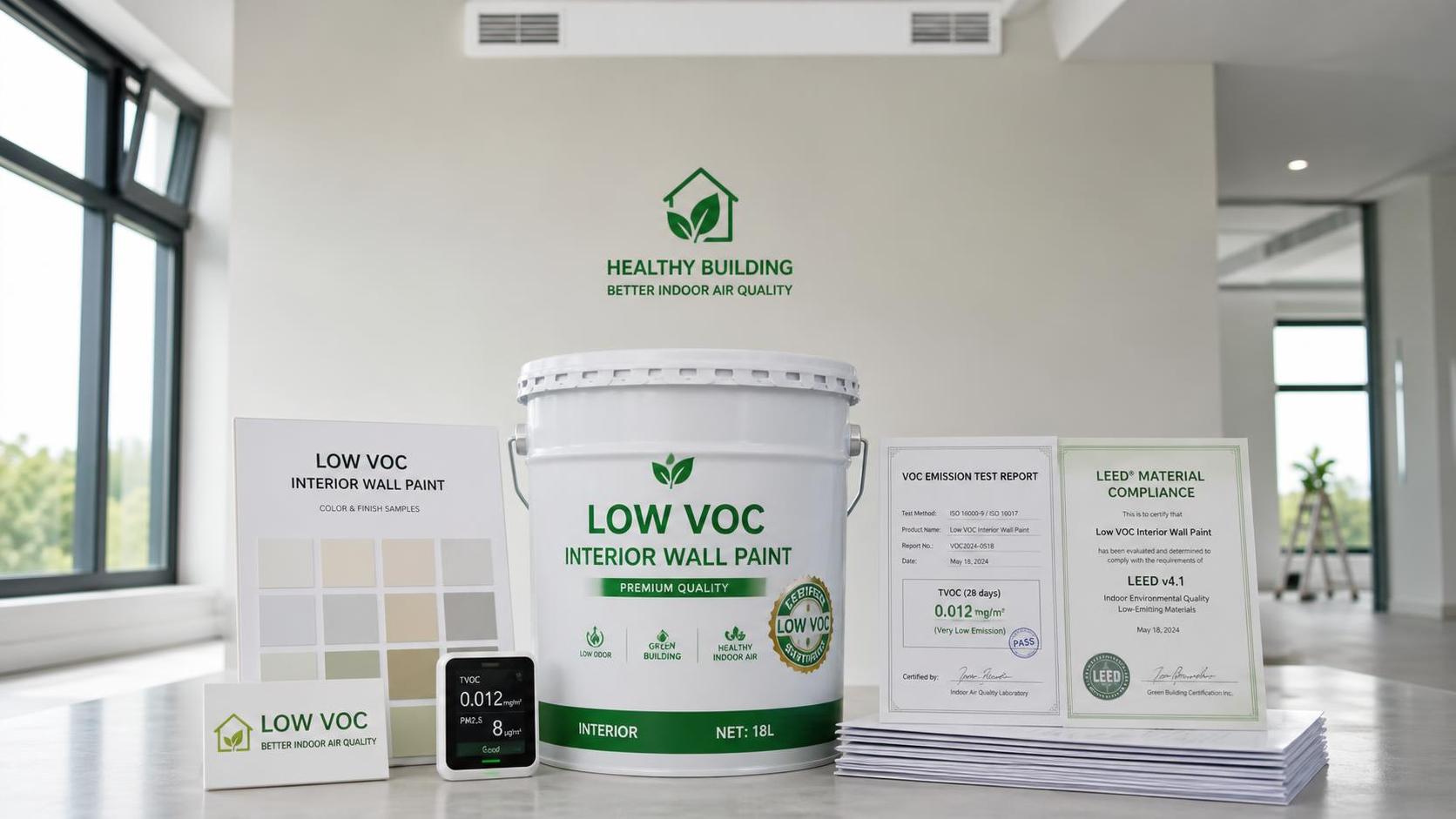
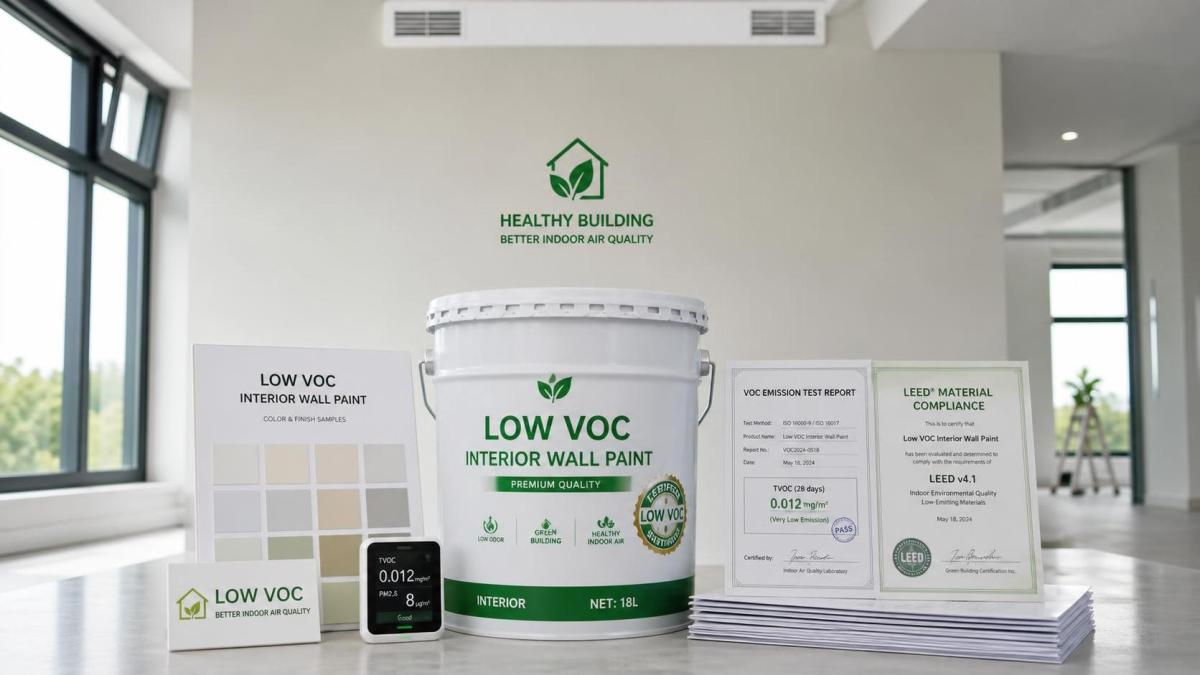
In practice, evaluators should treat “LEED v4 VOC paint” as shorthand for a package of evidence rather than a single performance claim. That package may include the manufacturer’s VOC-content declaration, a current emissions-test report, product data sheets, safety data sheets, coverage or volume information, and a clear statement identifying the exact paint system being supplied.
Why a Low-VOC Label Does Not Automatically Support LEED Compliance
“Low VOC” is useful commercial language, but it is not a universal certification category. Manufacturers may use the phrase to describe a product that meets a regional architectural-coating rule, a company threshold, or a comparison with an earlier formulation. None of those claims alone confirms compliance with a specific LEED v4 credit.
The compliance review becomes more complicated because coatings are rarely supplied as a single, unchanging product. Interior wall systems may include primer, base paint, tint colorant, clear coat, texture finish, repair compound, sealant, and touch-up paint. Each can have a different formulation and documentation trail. A white base tested by the manufacturer does not necessarily prove that every deep-tone tinted version carries the same emissions status.
Technical reviewers should also examine whether an emissions report applies to the actual product family, sheen, base, and intended use. Broad product-family claims can be valid when a recognized certification or testing protocol explicitly covers the supplied variants. They are less reliable when the documentation names only a general series with no explanation of which bases, colors, or finishes are included.
Another recurring issue is confusing a third-party environmental label with complete project evidence. A credible certification can simplify review, especially where it identifies the tested product and the relevant standard. It does not eliminate the need to confirm that the certified item is the item procured, that the certificate remains current, and that the product falls within the LEED category and project calculation method being used.
What to Verify Before a Paint Is Approved
The best time to resolve paint compliance is before purchase orders and color schedules are locked. A submittal review should not stop at a generic sustainability letter. Instead, the team should build a product-level record that connects specification, procurement, installation, and LEED documentation.
- Identify the installed coating system. Separate primers, topcoats, specialty finishes, and field-applied protective coatings rather than documenting only the visible final coat.
- Confirm the relevant VOC-content requirement. The applicable limit may depend on the coating category, jurisdictional rule, and LEED reference path used by the project.
- Review emissions evidence. Confirm the referenced chamber-testing method or recognized certification, test date, product identity, and covered variants.
- Check tinting and color selection. Establish whether the approved evidence covers the selected base and colorant system, particularly for dark or highly saturated colors.
- Record quantities and locations. Area, volume, coverage rate, and installed location may be needed for category calculations or for resolving later questions.
- Control substitutions. Require a sustainability review when a distributor proposes an “equivalent” paint, even if the coating’s appearance and performance seem comparable.
This is not administrative excess. Paint is a high-volume finish material, often selected late and installed quickly. A documentation gap can therefore affect a substantial portion of the relevant material scope. It can also create friction between the architect, general contractor, paint contractor, sustainability consultant, and facilities team if replacement is required near turnover.
Installation Practices Can Undermine a Strong Product Selection
A compliant coating is only one part of indoor air quality management. Application conditions influence odor, drying behavior, curing, and the period during which occupants may notice emissions. Poor ventilation, moisture in substrates, low temperatures, rushed recoating, or excessive film build can create performance problems even when the paint’s formal documentation is acceptable.
This does not mean that a paint automatically loses its LEED status when site conditions are imperfect. Rather, it means the project should avoid treating material compliance as a substitute for construction-phase IAQ planning. During closeout, facility managers may be more concerned with odor complaints, curing time, and ventilation readiness than with the VOC figure printed on a technical data sheet.
Coordination also matters when paints are applied alongside adhesives, sealants, flooring systems, composite wood products, furniture, and cleaning agents. Indoor air quality is cumulative. A project can specify well-documented paint but still encounter indoor-air concerns from other finish materials or from a poorly controlled flush-out, testing, or occupancy sequence.
The Version Question: LEED v4 Is Not the Same as Every “LEED-Ready” Claim
Manufacturers frequently publish declarations stating that a coating “contributes to LEED.” That wording should be read carefully. LEED points are awarded at the project level, not granted to an individual paint can. A product may support compliance with a material requirement without independently securing a credit, and its contribution depends on how the project team documents the entire applicable scope.
The rating system version is equally important. A project registered under LEED v4 may need to follow requirements different from a project pursuing LEED v4.1 or another green building program. Local code requirements can add another layer. A coating acceptable under a regional VOC rule may not provide all the evidence needed for the project’s chosen indoor-emissions path.
For this reason, evaluators should ask manufacturers and distributors direct, narrow questions: Which exact standard is cited? Does the statement cover VOC content, VOC emissions, or both? Which specific SKU, base, sheen, and tinting system does it apply to? Is the document current? Can the supplier provide a traceable link between the submitted documentation and delivered batches?
Answers framed only as “LEED compliant” are usually too broad to close the technical review.
A More Reliable Evaluation Sequence
A robust approach starts with the specification. Define the desired coating performance—washability, scrub resistance, color retention, substrate compatibility, fire or moisture considerations—alongside low-emitting material requirements. That prevents sustainability requirements from being treated as an afterthought or from forcing a late trade-off with durability.
Next, create an approved-material matrix before installation. The matrix should identify each coating type, location, manufacturer, product name, base or sheen where relevant, documentation status, and responsible reviewer. It need not be elaborate; its value lies in making substitutions visible. If a change occurs, the team can assess the replacement before it arrives on site rather than reconstructing evidence from invoices after completion.
Finally, retain closeout records in a form that the owner can use. Future repainting is often handled by a facilities team or local contractor who was not involved in certification. A clear record of approved products, colors, and documentation can help the building maintain a healthier-materials strategy without assuming that every successor product has the same emissions profile.
The Practical Decision for Technical Teams
LEED v4 VOC paint does affect indoor air quality compliance, but it should not be evaluated through a single number or label. The defensible question is whether the installed paint system meets the project’s applicable VOC-content and emissions requirements, with documentation that remains traceable from specification through delivery and installation.
For organizations navigating global construction-material supply chains, this is a useful example of why material intelligence must extend beyond catalog claims. TradeNexus Edge tracks the technical and supply-chain questions that sit between material selection and real project delivery, particularly where standards, testing evidence, and regional market practices intersect. In a paint review, the most valuable next step is usually not finding another “green” label; it is confirming the exact standard, evidence set, product variant, and installation scope before the approval becomes irreversible.
Deep Dive
Related Intelligence
 Sustainable BuildingBuilding insulation rated R-30 — does real-world performance match lab-tested values?Analyst:Chief Civil Engineer
 Sustainable BuildingPrefabricated houses with structural insulated panels — how fire-rated are the joints?Analyst:Chief Civil Engineer
 Sustainable BuildingStrategic Link Partnerships in Precision Farming Rarely Include Shared Firmware UpdatesAnalyst:Chief Civil Engineer