How to verify whether a primer meets LEED v4 VOC limits
Key Takeaways
- How much RAM does edge computing hardware for IoT applications need?IT & Security Director
- How to evaluate precision livestock farming companies for grazing herdsAgri-Tech Strategist
- How to assess an agricultural machinery manufacturer's parts supportAgri-Tech Strategist
- What drives industrial automation cost in a new production line?Chief Civil Engineer
- What makes Ethiopia poultry farming profitable for small-scale producers?Agri-Tech Strategist
- What Are the Biggest Risks of Single-Source Chemical Procurement?Lead Materials Scientist
- Are Cloud Procurement Platforms Worth It for Chemical Sourcing?IT & Security Director
- How to Verify a New Materials Supplier’s Technical DocumentationLead Materials Scientist
Industry Overview
We do not just publish news; we construct a high-fidelity digital footprint for our partners. By aligning with TNE, enterprises build the essential algorithmic "Trust Signals" required by modern search engines, ensuring they stand out to high-net-worth buyers in an increasingly crowded global digital landscape.
How to Verify Whether a Primer Meets LEED v4 VOC Limits
For quality-control and safety managers, confirming that a coating product satisfies LEED v4 requirements is more than checking a “low-VOC” label. A primer may be marketed as environmentally preferable, water-based, low odor, or suitable for green building projects and still fail the applicable LEED documentation review. The question is not whether the product sounds compliant. It is whether its reported VOC content, product classification, test basis, and project documents line up with the relevant LEED v4 requirement.
That distinction matters most when coatings are approved under time pressure. A subcontractor may submit a technical data sheet showing “VOC: 95 g/L,” while the safety data sheet lists a different figure, the product label identifies a broader coating category, and the actual primer is being used on a substrate not covered by the submitted documentation. Those gaps are where otherwise avoidable LEED credit disputes tend to begin.
For a LEED v4 VOC primer review, the practical task is to establish a documented chain: correct product, correct category, correct VOC limit, correct calculation method, and correct evidence for the exact material delivered to site.
Start with the LEED v4 requirement—not the marketing claim
Under LEED v4’s Low-Emitting Materials credit framework, wet-applied paints and coatings are evaluated against VOC-content limits by coating category. For these products, LEED v4 references the VOC limits in South Coast Air Quality Management District (SCAQMD) Rule 1113, using the version identified in the LEED reference path. This is a product-content requirement. It is different from indoor air quality emission testing, which addresses emissions from installed products over time.
That difference is easy to miss. A manufacturer may provide a chamber-emissions certification, which can be relevant to another part of a low-emitting materials review, but it does not automatically prove that a wet-applied primer meets the VOC-content cap. Conversely, a primer that falls below the applicable VOC-content limit may still need separate project documentation if the design team is pursuing other low-emitting material pathways.
For the primer, sealer, and undercoater category, the commonly cited LEED v4 VOC-content limit is 100 g/L. The number alone is not enough. The product must actually belong in that category, and the VOC value must be reported on the appropriate regulatory basis. A 100 g/L limit should not be casually applied to every liquid product placed under a finish coat.
Classify the material before comparing any number
“Primer” is a functional term used loosely in construction specifications. In practice, the material might be a drywall primer, masonry conditioner, concrete bonding agent, rust-inhibitive metal coating, waterproofing sealer, epoxy floor primer, wood sealer, or a specialty adhesion promoter. These are not necessarily evaluated under the same VOC category.
A good review begins with the manufacturer’s intended-use statement. Read the technical data sheet rather than relying on the product name. Look for the stated substrate, use conditions, recommended topcoats, film-building function, and regulatory category. If the product is promoted as both a primer and a waterproofing coating, or as a primer and industrial maintenance coating, it needs closer scrutiny. The lowest or most convenient category should not be selected simply because it makes the submittal work.
For example, a standard interior wall primer is often straightforward. A corrosion-control primer used on structural steel may not be. A floor-system “primer” can also be problematic because it may be part of a multi-component coating system with a category and VOC calculation that differs from conventional architectural primer. When the intended application is unusual, ask the manufacturer to identify the applicable SCAQMD Rule 1113 category in writing and explain the basis for that classification.
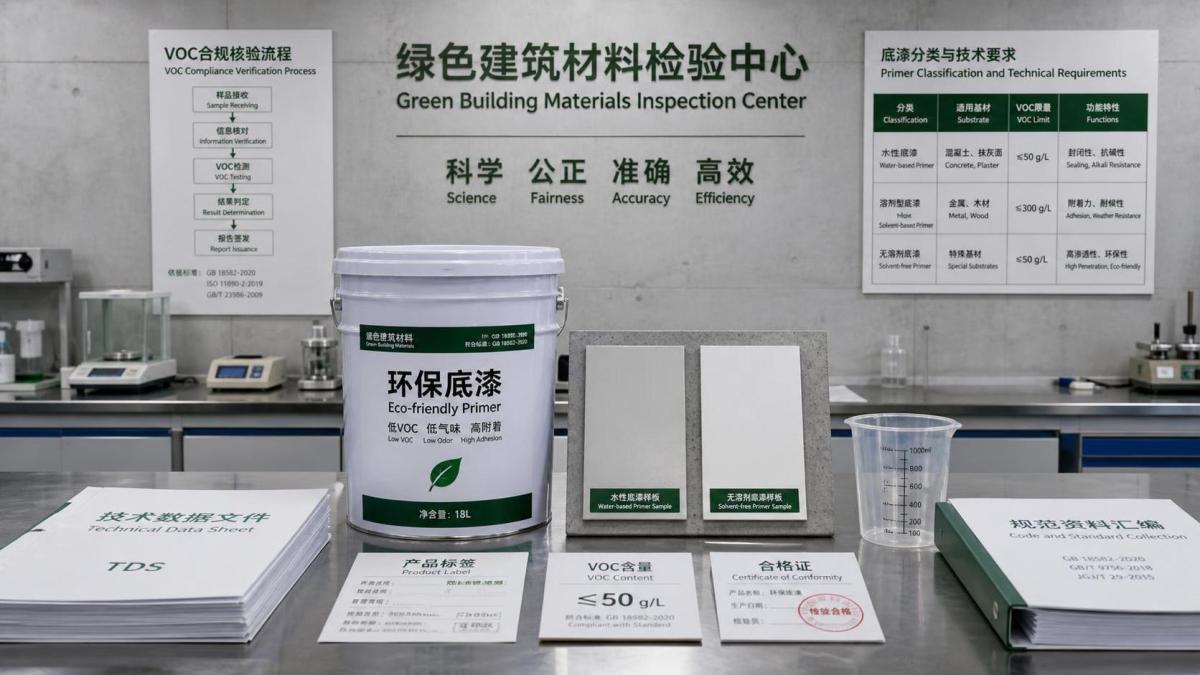
Read VOC figures carefully: “less water and exempt compounds” is the key phrase
VOC values appear in several forms, and they are not interchangeable. A data sheet may state VOC in grams per liter “as supplied,” “as mixed,” “less water,” or “less water and exempt compounds.” Some documents report weight percentage instead of g/L. Others provide a regulatory VOC value alongside a separate total volatile content value. Only one of these may be appropriate for the LEED v4 VOC-content comparison.
For the relevant architectural coating limits, the VOC content is generally evaluated in grams per liter of coating, excluding water and exempt compounds. That is why a figure that looks comfortably low can still be unusable if the document does not state its calculation basis. A value reported as “VOC, actual” or “VOC, material” may include or exclude different components. Without the basis, the reviewer cannot reliably compare it against the limit.
The safest document wording is specific: product name, product code, color or base where relevant, VOC content in g/L, the applicable calculation basis, and the coating category. If the manufacturer uses a formulation-dependent range, obtain the value for the exact base, tint system, or component combination being purchased. Deep-base and specialty colors can matter in some coating lines, while two-component products may have a different VOC value after mixing than either component has on its own.
Do not substitute SDS information for a VOC compliance statement
Safety data sheets are essential for hazard communication, storage controls, worker protection, and spill response. They are not always ideal LEED compliance documents. Section 9 of an SDS may list VOC content, but the value can be presented in a format intended for occupational safety or transport information rather than architectural-coating regulation. The SDS may also cover a product family, multiple colors, or an older formula revision.
Use the SDS as a cross-check, not as the only proof. If the SDS and technical data sheet conflict, do not average the figures or select the lower number. Ask the manufacturer’s regulatory or technical team to reconcile the discrepancy. In many cases, the difference is explainable: one value may be weight-based, another volume-based, or one may include water and exempt solvents. But it needs to be explained in writing before the material is released for installation.
Build a document package that can survive a project audit
The strongest submittal is not necessarily the thickest one. It is a short set of documents that agree with each other and clearly identify the actual product. For each primer, retain the current technical data sheet, current SDS, manufacturer VOC declaration or regulatory letter, product label or product data identifying the SKU, and purchase records showing what was delivered. If the product is mixed on site, retain mixing instructions and records for the actual components used.
Third-party certifications can add confidence, especially when they identify the specific product and current formulation. However, certification logos should be treated as supporting evidence rather than a shortcut around the LEED review. Confirm what the certification covers: VOC content, emissions performance, manufacturing practices, or a broader product standard. A logo without a product listing, certificate scope, or current documentation is weak evidence when a project reviewer asks for traceability.
Version control deserves more attention than it usually gets. Manufacturers reformulate products, change raw-material sources, update label language, and issue revised data sheets. A declaration dated years before procurement may not match the material received today. The product code, revision date, and formulation status should be checked before approval, especially on projects with long construction schedules.
A practical verification sequence for QC and safety teams
The following sequence is useful because it separates technical eligibility from paperwork quality. It also prevents a common site problem: approving a generic coating system early, then discovering that the installed product is a different base or an unapproved substitute.
- Identify the exact product: manufacturer, product name, SKU, color/base, batch where available, and whether the primer is one- or two-component.
- Confirm its intended function and substrate. Determine whether “primer, sealer, undercoater” is the defensible category or whether another Rule 1113 category applies.
- Obtain a manufacturer statement reporting VOC content in g/L on the relevant regulatory basis, ideally naming the category and applicable limit.
- Compare the reported value with the applicable LEED v4 limit. For a conventional primer, sealer, or undercoater, the review point is typically 100 g/L.
- Cross-check the technical data sheet, SDS, product label, and procurement records for mismatched names, revisions, or VOC figures.
- Document any substitutions before installation. A “same or equivalent” decision is not evidence of LEED compliance.
If a product sits exactly at the stated limit, do not assume there is comfortable compliance margin. Reported values may depend on batch, tint, mixing ratio, or the test/calculation convention used. In that situation, request a direct manufacturer confirmation for the specific product configuration. Where the project has stricter owner requirements, local air-quality rules, or a LEED version variation with different documentation expectations, the project requirement controls.
Watch for the recurring failure points
The most frequent issue is category drift. A team sees the word “primer” and applies the 100 g/L threshold without checking whether the product is actually a waterproofing sealer, industrial maintenance coating, or specialty coating. The second is a unit mismatch: percent by weight is compared directly with g/L, which is not valid without density and calculation context. The third is assuming that low odor means low VOC. Odor is not a compliance metric.
Another issue appears when coatings are procured globally. A product may meet a regional VOC regulation or carry a low-VOC claim in one market, while the documentation supplied for a North American LEED project does not identify the SCAQMD-based category or reporting basis. Global sourcing is entirely possible, but the evidence must be translated into the project’s compliance framework rather than treated as automatically equivalent.
This is one reason materials intelligence platforms such as TradeNexus Edge focus on context alongside product information. For high-barrier sourcing decisions, product data, regulatory language, supply-chain documentation, and end-use conditions have to be read together. A searchable listing can help locate suppliers; it cannot replace a project-level review of the coating actually being installed.
Keep LEED v4, local rules, and project specifications separate
A primer can satisfy one requirement and fail another. Local VOC regulations may impose limits that differ by jurisdiction, product category, or date. A project specification may be stricter than LEED. Some owners also require emissions certifications, ingredient disclosures, or restricted-substance documentation in addition to VOC-content compliance. None of these requirements should be assumed to replace the others.
It is also worth confirming the rating-system version named in the project documents. “LEED v4” and later updates are often discussed together in the market, but their referenced standards, pathways, and documentation conventions should not be treated as identical without checking the project’s stated requirements. When a credit template, owner standard, or consultant instruction conflicts with a generic manufacturer claim, escalate the question early.
A defensible approval record is fairly simple: identify the primer precisely, assign the category based on intended use, verify the VOC figure on the correct basis, and preserve the manufacturer evidence tied to the material delivered. That disciplined approach is more reliable than relying on a green label—and far easier to defend when the project team asks why a particular primer was approved.
Deep Dive
Related Intelligence
 Sustainable BuildingBuilding insulation rated R-30 — does real-world performance match lab-tested values?Analyst:Chief Civil Engineer
 Sustainable BuildingPrefabricated houses with structural insulated panels — how fire-rated are the joints?Analyst:Chief Civil Engineer
 Sustainable BuildingStrategic Link Partnerships in Precision Farming Rarely Include Shared Firmware UpdatesAnalyst:Chief Civil Engineer