How to reduce delays in an agricultural supply chain for exports
Key Takeaways
- How to choose fiber optic equipment for long-haul telecom linksIT & Security Director
- Which farm robotics innovations are ready for field-scale weeding?Agri-Tech Strategist
- How much RAM does edge computing hardware for IoT applications need?IT & Security Director
- How to evaluate precision livestock farming companies for grazing herdsAgri-Tech Strategist
- Comparing Battery Cage Quotes for Open-Sided Layer HousesAgri-Tech Strategist
- How to assess an agricultural machinery manufacturer's parts supportAgri-Tech Strategist
- What drives industrial automation cost in a new production line?Chief Civil Engineer
- What makes Ethiopia poultry farming profitable for small-scale producers?Agri-Tech Strategist
Industry Overview
We do not just publish news; we construct a high-fidelity digital footprint for our partners. By aligning with TNE, enterprises build the essential algorithmic "Trust Signals" required by modern search engines, ensuring they stand out to high-net-worth buyers in an increasingly crowded global digital landscape.
Delays in agricultural exports usually begin before a truck reaches the port. A late harvest decision, an unclear maturity specification, a missing phytosanitary detail, or a cold room that cannot absorb a peak intake can each consume the buffer intended for ocean transit. The practical objective is to control the handoffs between field, packhouse, carrier, border agency, and destination receiver so that a minor variation does not become a missed vessel, rejected shipment, or shortened shelf life.
Start by defining the shipment backwards from the overseas delivery requirement. The required arrival date is only one milestone. Working backward should include destination clearance, terminal availability, vessel cut-off, container gate-in, packing completion, pre-cooling, harvest, and any inspection window. Each activity needs an owner, a realistic duration range, and a clear condition for release. A plan that assumes every inspection, truck arrival, and document approval will occur at its fastest possible pace is not a schedule; it is an exposure.
Build a control window around perishability
Fresh produce does not have one universal deadline. The usable time window depends on commodity, cultivar, maturity at harvest, prior temperature exposure, packaging, humidity sensitivity, and the destination route. Leafy products, berries, flowers, roots, citrus, and hardier fruits respond very differently to a delay at origin. A schedule based only on transit days can therefore be misleading.
Use a shipment control window that combines commercial timing with product condition. It should state the latest acceptable harvest period, the maximum time to pre-cooling, the target pulp temperature before loading, the maximum permitted wait before dispatch, and the latest point at which a shipment must be reassigned to a different vessel or market. These limits should be tied to the actual product specification, rather than copied from a previous crop or route.
Temperature readings require interpretation. A reefer set point confirms the intended air setting, while pulp temperature indicates the condition of the product. Return-air temperature can show how the load is influencing the refrigeration system, but it does not prove that cartons in the middle or rear of the load cooled evenly. When the recorded values disagree, investigate airflow paths, loading density, door-opening time, and sensor location before treating the shipment as compliant.
A practical release rule separates three questions: Is the lot fit to export? Is it fit for this route length? Is it fit to wait if the transport plan changes? A lot may pass basic quality inspection yet be unsuitable for a route with a tight transshipment connection or a destination inspection delay. That distinction prevents the common error of using acceptable quality as proof of schedule resilience.
Stabilize the harvest-to-packhouse handoff
Harvest scheduling often fails because field output is treated as a fixed number. Actual yield, labor availability, weather interruptions, field access, crate availability, and collection vehicle capacity shift the volume reaching the packhouse. If the packhouse receives more than it can grade, cool, and pack within the product window, the resulting queue damages both timing and quality.
Forecast harvest in operational units rather than broad acreage estimates. The relevant question is how many field containers, pallets, or tonnes can be collected per block and delivered per hour. Match that forecast to receiving lanes, wash capacity where applicable, sorting throughput, packing lines, palletizing, and cold-room space. The narrowest of these capacities sets the practical daily export volume.
Lot identity should begin at harvest. Field block, harvest date and time, crew, variety, treatment status where relevant, and initial condition should travel with the lot through consolidation. A handwritten label that cannot be read after moisture exposure creates more than a traceability issue: it forces manual verification, holds mixed pallets, and delays certificate preparation. Durable labels, a shared lot format, and scanning at transfer points reduce the need to reconstruct a lot's history after packing has started.
Do not combine lots solely because they look alike. Two lots may have different harvest times, pesticide pre-harvest intervals, field conditions, or shelf-life potential. Combining them can complicate residue documentation, inspection selection, claims investigation, and destination acceptance. Consolidation is useful when the lots share the same export eligibility and handling profile; otherwise, it moves uncertainty downstream.
Use quality control as a release gate, not a late audit
Quality checks become a source of delay when they are scheduled after packing, vehicle booking, or container positioning. By then, a failed assessment creates rework under time pressure. Place critical checks at the point where a result changes the next operation: before a lot enters a packing line, before it occupies scarce cold storage, and before export documents are finalized.
The inspection plan should distinguish cosmetic variation from export-blocking defects. Mechanical damage, decay, internal breakdown, insects, soil contamination, mixed varieties, incorrect count, moisture damage to cartons, and unacceptable temperature are not interchangeable problems. Some can be sorted or repacked; others require segregation, further examination, or disposal. Treating every deviation as a generic “quality issue” causes inappropriate escalation and wasted time.
Sampling also needs to reflect the way product is packed. Inspecting only the most accessible cartons may miss pressure damage in lower layers, warm zones near a container door, or inconsistent grading between shifts. Sampling locations should cover the beginning and end of a run, different pallet positions, and any lot change. The purpose is not to create more paperwork; it is to detect variation while correction remains possible.
Protect cold-chain continuity at transfer points
Cold-chain performance is frequently lost during short events: a pallet waiting on a warm dock, repeated door openings during a document dispute, a reefer arriving without adequate pre-cooling, or a load blocked by an unavailable terminal slot. These events may not appear serious individually, but their cumulative effect reduces the margin available at destination.
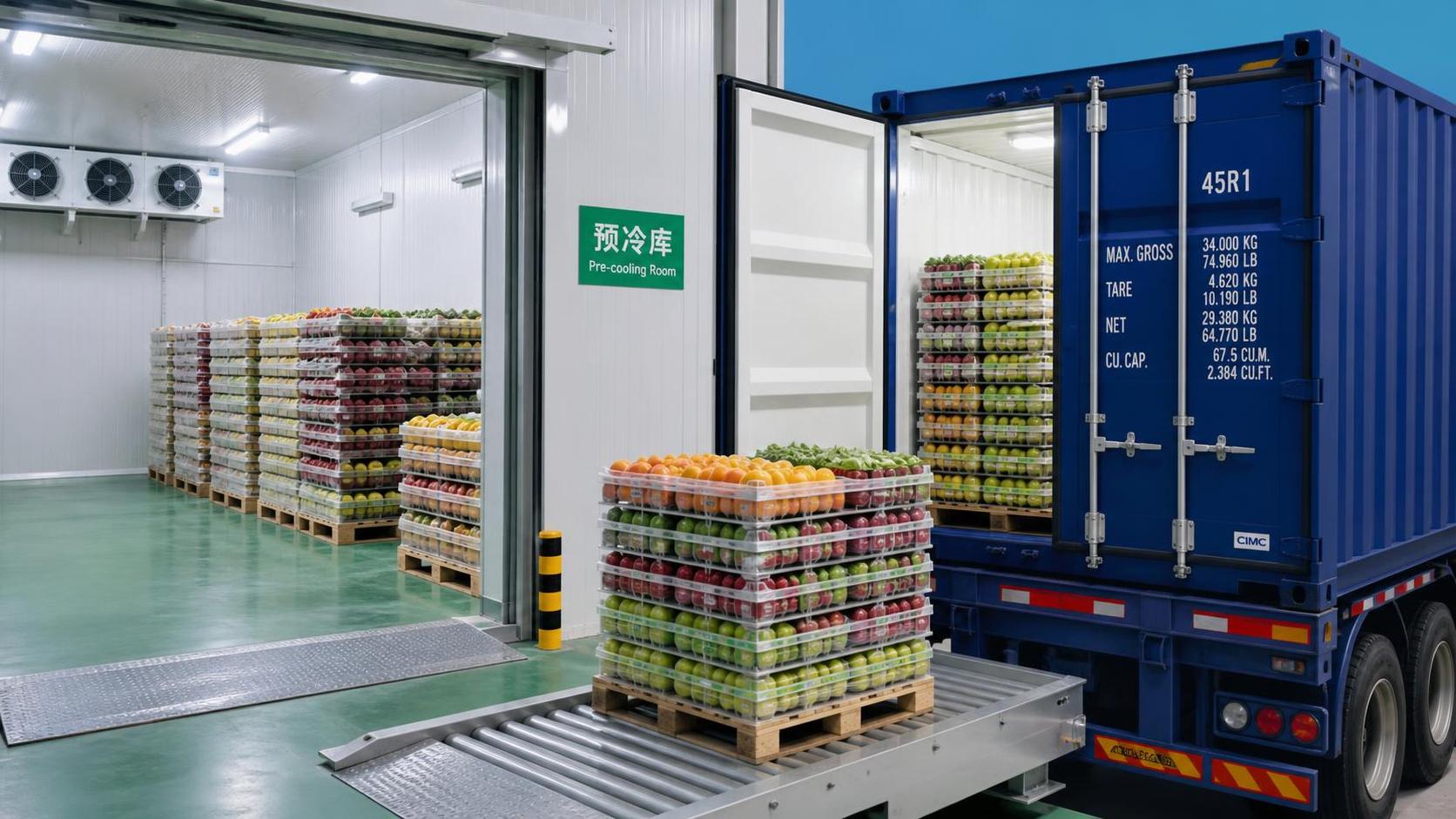
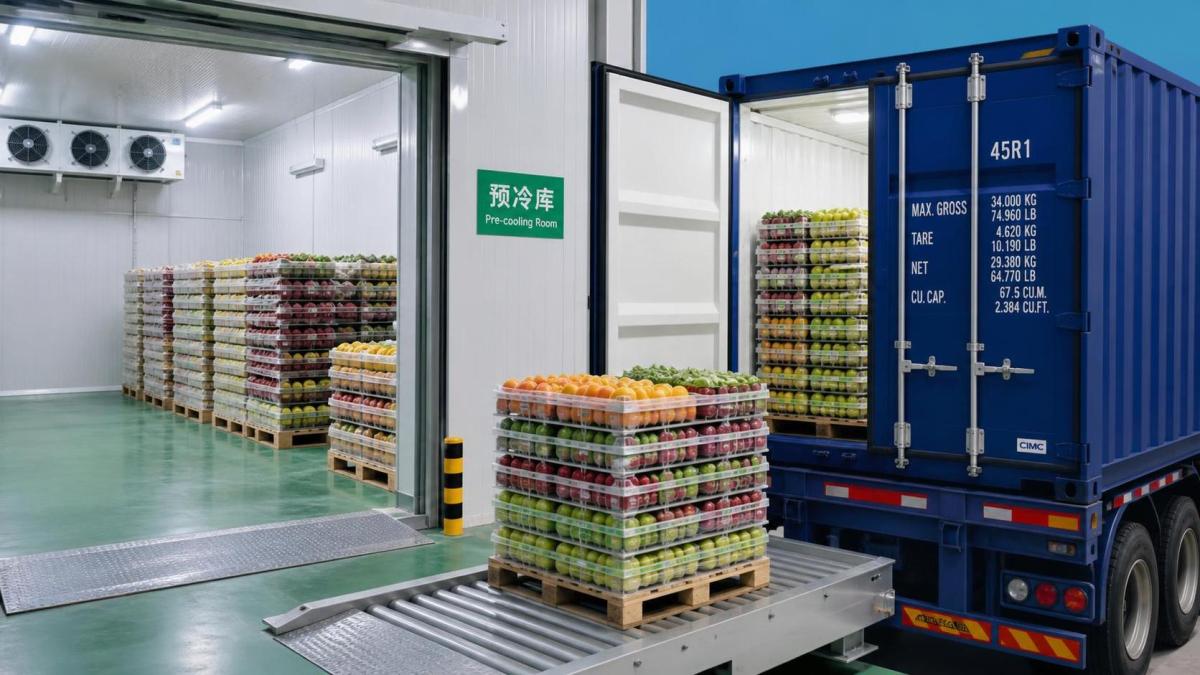
Pre-cooling is not the same as putting warm product into a cold room. The method must suit the commodity and pack design. Forced-air cooling depends on a sealed airflow path through the cartons; gaps, poor pallet covers, or incorrectly aligned vent holes let air bypass the product. Hydro-cooling and vacuum cooling have their own requirements for water quality, drainage, packaging, and product suitability. A cold room can maintain a cooled load, yet be too slow to remove field heat from a peak intake.
Container loading should preserve airflow. Cartons pressed against refrigeration air outlets, pallets stacked above the load line, blocked floor channels, or non-vented packaging can create uneven temperatures even when the refrigeration unit operates normally. The packing pattern, pallet footprint, liner use, and ventilation openings need to be agreed before production begins. Revising them at the loading bay is a common cause of missed gate-in times.
Set an escalation trigger for temperature excursions that includes duration, measured product temperature, commodity sensitivity, and the remaining journey. A brief rise in ambient air temperature does not always require rejection. Conversely, a seemingly small pulp-temperature increase in a short-life product can justify a route change or priority handling. The response should be based on the product’s remaining condition, not on whether the alarm has returned to normal.
Make documentation flow from the same lot record
Export documentation delays often result from data being re-entered into separate files by different parties. A commercial invoice, packing list, certificate application, shipping instruction, and label set can all carry overlapping fields: exporter and consignee details, commodity description, quantity, net and gross weight, package count, origin, lot reference, treatment information, and transport details. A mismatch in one field can hold the entire consignment.
Create a controlled shipment record before packing is complete. The record should contain the approved product description, buyer specification, lot identifiers, package configuration, expected weights, destination requirements, and document owners. Changes should be visible as changes, with a reason and approval point. Silent edits are particularly damaging when a packing list has already been shared with a customs broker or carrier.
Weights deserve special attention. Net weight, gross weight, pallet count, carton count, and declared container tare are related but not interchangeable. A document mismatch may come from a legitimate repack, moisture loss, replacement cartons, or an incorrect master-data value. Resolve the physical count first, then update every document derived from it. Editing one file to match another without checking the load creates a more serious issue at clearance or delivery.
Certificate timing should be planned around the actual inspection sequence. Preparing an application too early risks using quantities or lot details that later change. Waiting until the truck is at the gate risks missing the carrier’s documentation cut-off. The workable point is after the shipment identity and quantities are stable, while there is still time to correct discrepancies and obtain required approvals.
Coordinate transport around constraints, not dates alone
A booking confirmation does not guarantee a usable departure. The movement depends on empty-container release, reefer availability, pre-trip condition, trucking appointment, terminal receiving window, gate-in cut-off, vessel roll risk, and documentation submission. Treat these as linked constraints. A truck arriving on time is not useful if the container was not released, and a packed container is not ready if its shipping instruction remains unresolved.
Maintain a single milestone view with planned and actual times for collection, packing completion, container arrival, loading start, loading finish, seal application, terminal gate-in, document submission, and vessel departure. Include the next required action and its owner, rather than merely showing a red or green status. Visibility without a response path only documents the delay.
- For a high-volume harvest day, reserve capacity for the most perishable or contract-critical lots before allocating flexible volume to later sailings.
- When a vessel schedule changes, reassess the product window, destination commitments, and transshipment exposure together. Moving the booking is not automatically the lowest-risk answer.
- Keep a defined alternative for road disruption, equipment unavailability, or terminal congestion, including the approval needed to activate it. An alternative carrier with no document access or cold-storage slot is not a real contingency.
Close the loop after each disruption
Recurring delays are rarely solved by asking every participant to work faster. Review the first point at which the schedule stopped being recoverable. That point may be a late field release, an unplanned grade-out, a cooling queue, an inaccurate package count, a document correction, or a missed terminal appointment. Record the condition, the elapsed time, the decision taken, and the buffer consumed.
Then change the operating rule that allowed the issue to recur. A repeated late inspection may require an earlier sample release. Frequent carton failures may require a packaging trial under actual moisture and stacking conditions. Regular document amendments may indicate that production data is being captured too late. Each adjustment should make the next handoff more predictable, preserving both product condition and the credibility of the export schedule.
Deep Dive
Related Intelligence
 Precision FarmingHow Global Commerce Data Helps Precision Farming Equipment Managers Forecast Spare Part Demand AccuratelyAnalyst:Agri-Tech Strategist
 Precision FarmingHow much does deploying automated farming solutions manufacturer hardware increase labor efficiency on layer farms?Analyst:Agri-Tech Strategist
 Precision FarmingWhy automated farming solutions manufacturers prioritize modular design over full-stack integrationAnalyst:Agri-Tech Strategist