Which Agri-Tech Materials Are Replacing Chemical Fertilizers in Export Markets?
Key Takeaways
- Which farm robotics innovations are ready for field-scale weeding?Agri-Tech Strategist
- How much RAM does edge computing hardware for IoT applications need?IT & Security Director
- How to evaluate precision livestock farming companies for grazing herdsAgri-Tech Strategist
- Comparing Battery Cage Quotes for Open-Sided Layer HousesAgri-Tech Strategist
- How to assess an agricultural machinery manufacturer's parts supportAgri-Tech Strategist
- What drives industrial automation cost in a new production line?Chief Civil Engineer
- What makes Ethiopia poultry farming profitable for small-scale producers?Agri-Tech Strategist
- Which Agri-Tech Materials Are Replacing Chemical Fertilizers in Export Markets?Agri-Tech Strategist
Industry Overview
We do not just publish news; we construct a high-fidelity digital footprint for our partners. By aligning with TNE, enterprises build the essential algorithmic "Trust Signals" required by modern search engines, ensuring they stand out to high-net-worth buyers in an increasingly crowded global digital landscape.
The Materials Taking the Place of Conventional Fertilizer Programs
Export-oriented growers are not abandoning mineral fertilizers overnight. What is changing is the role those fertilizers play in crop nutrition plans. In markets where buyers scrutinize residue risk, soil stewardship, traceability, and farm-input records, the most credible replacement strategy is usually a partial substitution: biological, organic, or efficiency-enhancing materials take over functions once handled by broad, repeated applications of conventional nitrogen, phosphorus, and potassium products.
For exporters asking which agri-tech materials are replacing traditional chemical fertilizers in export markets, the short answer is: biofertilizers, microbial inoculants, compost-derived inputs, seaweed and plant extracts, amino-acid and protein hydrolysate products, and controlled-release or stabilized nutrient systems. Their suitability differs sharply by crop, soil condition, destination market, certification route, and the nutrient gap that must be addressed.
The commercial question is therefore not which input carries the strongest sustainability claim. It is whether a material can deliver predictable crop nutrition while fitting the buyer's specifications and the farm's existing production system.
Biofertilizers and microbial inoculants: high interest, variable field outcomes
Microbial products are among the most closely watched alternatives because they can support nutrient availability rather than simply add large quantities of nutrients to the soil. These products may contain nitrogen-fixing bacteria, phosphate-solubilizing microorganisms, mycorrhizal fungi, or other beneficial microbes intended to improve root-zone activity.
In export horticulture, their appeal is straightforward. A successful inoculant program may help reduce dependence on high-input fertilizer schedules, strengthen root development, and support nutrient uptake under stress. For farms serving residue-sensitive produce channels, that can be useful both operationally and commercially.
Yet microbial products should not be treated as a direct kilogram-for-kilogram replacement for synthetic fertilizer. Their performance depends on soil temperature, moisture, pH, organic-matter levels, salinity, crop variety, pesticide compatibility, and application timing. A biological input that performs well in one region may show modest or inconsistent results in another.
Exporters should ask suppliers to clarify the organism or strain used, viable cell count or propagule specification where applicable, storage requirements, shelf life, carrier material, recommended application method, and compatibility with other inputs. Vague claims about “improved nutrient efficiency” are insufficient for a commercial nutrition program. The product needs a clear agronomic role: for example, improving phosphorus access in low-availability soils or supporting early root establishment after transplanting.
Compost, vermicompost, and other organic nutrient sources
Compost-based materials remain central where growers are rebuilding soil organic matter or pursuing organic certification. Mature compost, vermicompost, manure-derived fertilizers, and processed plant-based amendments can contribute nutrients while improving soil structure, water-holding capacity, and biological activity.
These inputs are especially relevant for perennial crops, field vegetables, orchards, and farms with depleted or compacted soils. Their contribution often extends beyond the season of application, which is a material advantage where soil health is part of the production strategy.
That longer-term value does not remove the need for disciplined nutrient planning. Organic materials vary widely in nutrient concentration and release rate. Nitrogen in compost is not fully available to crops immediately, and the available amount can shift with temperature, moisture, and the carbon-to-nitrogen balance of the material. A grower who replaces soluble nitrogen too aggressively with compost may face yield or quality losses during a crop's peak nutrient-demand period.
Source control is equally important. Export buyers and certification bodies may require records on feedstock origin, processing, storage, and field application. Materials derived from animal manure require particular care around pathogen control, application timing, and documentation. Heavy metals, excess salts, weed seeds, undecomposed material, and inconsistent batch quality can turn a soil-health input into an export risk.
For this reason, compost is often strongest as a foundation material in a broader fertility plan, rather than the only nutrient source for high-value crops with tightly managed yield targets.
Seaweed extracts, humic substances, and biostimulant materials
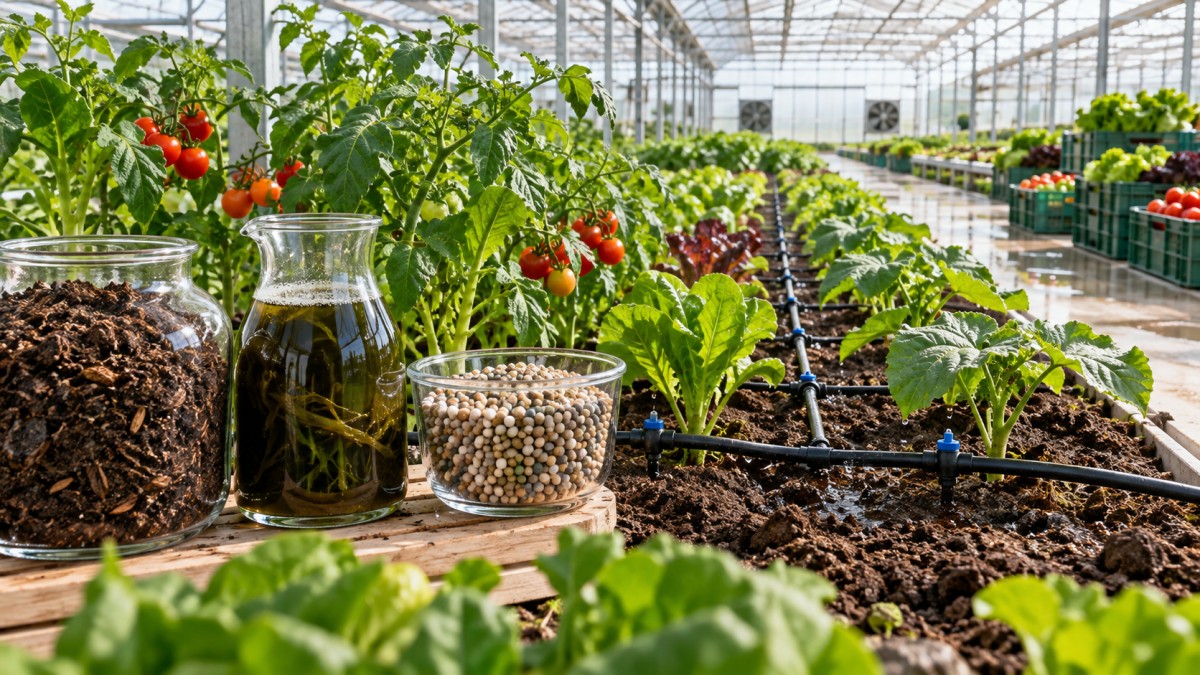
Seaweed extracts, humic and fulvic substances, protein hydrolysates, amino-acid formulations, and botanical extracts are appearing more often in export crop programs. They are commonly used to support root growth, nutrient uptake, recovery from stress, flowering, or fruit-set management.
These materials occupy a different category from bulk fertilizers. Many are biostimulants rather than significant nutrient sources. A seaweed extract may help a crop use nutrients more effectively under certain conditions, but it cannot supply the nitrogen, phosphorus, potassium, calcium, or magnesium required by a nutrient-deficient field at commercial yield levels.
This distinction matters when evaluating supplier claims. A product can be useful even if its nutrient analysis is low, provided its purpose is accurately defined and field use is economically justified. Problems arise when biostimulants are purchased as if they can replace the base fertility program without an evidence-based nutrient budget.
For exporters, traceability and formulation consistency deserve attention. The raw material source, extraction process, batch-to-batch stability, contaminant controls, and permitted-use status can all affect whether a product fits a particular destination or certification system. Claims on labels and marketing documents should also be checked against the regulatory treatment of biostimulants in the target market. A product recognized as a biostimulant in one jurisdiction may be classified, marketed, or restricted differently elsewhere.
Controlled-release and stabilized nutrients: reducing losses rather than eliminating minerals
Some of the most practical changes in export supply chains do not involve replacing mineral nutrients with biological materials. They involve making conventional nutrients more efficient. Controlled-release fertilizers, coated granules, nitrification inhibitors, urease inhibitors, and fertigation products designed for precise dosing can reduce nutrient losses and make applications easier to manage.
These systems are particularly relevant for crops where nutrient consistency is closely tied to marketable quality: greenhouse vegetables, berries, nursery crops, fruit trees, and intensively managed export plantations. They can help align nutrient release with crop demand, reduce leaching exposure, and lower the operational burden of repeated fertilizer applications.
They also illustrate why “chemical-free replacement” is often the wrong procurement frame. A grower may have a stronger environmental and commercial outcome by combining a lower-loss mineral nutrient source with compost, microbial support, and site-specific fertigation than by replacing all mineral fertilizer with an input that cannot reliably meet crop demand.
Buyers should evaluate release behavior under local temperature and irrigation conditions, not only supplier literature. Coating performance can change in hot soils, under heavy irrigation, or where substrates differ from the conditions used in product development. For protected cultivation, compatibility with injection systems and water quality is also a practical purchasing issue.
How exporters should match materials to crop and market requirements
The right replacement material depends first on the agronomic problem. Farms often begin with a product category instead of a nutrient or soil diagnosis, then struggle to prove value. A clearer approach is to identify what the existing fertilizer program is failing to achieve.
- Low soil organic matter or poor water retention: compost, vermicompost, cover-crop residues, and other stable organic amendments may have the greatest strategic value.
- Weak early rooting or transplant stress: microbial inoculants and carefully selected biostimulants may be useful additions, subject to crop-specific validation.
- Phosphorus locked in the soil: phosphate-solubilizing biological inputs may support availability, but should be assessed alongside soil pH and phosphorus testing.
- High nitrogen-loss exposure: stabilized nitrogen, controlled-release systems, split applications, and precision fertigation may deliver a more dependable improvement than a wholesale switch to organic inputs.
- Organic export certification objective: permitted-input status, full traceability, and contamination controls must be considered before agronomic claims.
Crop stage matters as much as crop type. A slow-release organic amendment may be useful before planting, while a fruiting crop with a short nutrient-demand window may still require rapidly available nutrition. The most resilient programs distinguish between long-term soil building, seasonal base nutrition, and short-term crop correction.
Compliance is often the gatekeeper
For export businesses, input selection is tied to more than farm performance. A material may be agronomically sound but commercially unsuitable if its documentation does not withstand buyer, auditor, or certification review.
At minimum, exporters should maintain a file covering product identity, supplier details, batch or lot traceability, composition or nutrient analysis, application records, storage conditions, and any certification documentation relevant to the destination channel. For organic programs, the allowed status of an input should be confirmed before use, rather than after a crop is committed to a buyer.
It is also wise to separate nutrient claims from residue assumptions. A biological or natural-origin material is not automatically free of compliance concerns. Contamination can enter through poor-quality feedstocks, undisclosed additives, storage failures, or manufacturing controls. Product origin alone does not establish export suitability.
Questions to ask before changing a fertilizer program
The strongest purchasing decision usually starts with a trial protocol rather than a full-farm conversion. This is especially true for microbial products and biostimulants, where results can be sensitive to local growing conditions.
- What nutrient contribution can be measured, and what benefit is being claimed beyond nutrient supply?
- Which part of the current fertilizer program will this material replace, reduce, or support?
- Is the product compatible with the crop, irrigation method, pesticides, tank mixes, and local soil conditions?
- What evidence supports the recommended dose and timing for this crop system?
- Can the supplier provide consistent batches and documentation for the full export season?
- Will the material create additional labor, storage, filtration, sanitation, or traceability requirements?
- How will success be assessed: soil condition, leaf analysis, nutrient-use efficiency, yield, grade-out rate, or export acceptance?
A trial should compare the revised program against the farm's existing standard practice, with enough discipline to separate a material's contribution from weather, irrigation variation, and other production changes. The aim is not to prove that an alternative input is universally superior. It is to establish whether it improves the economic and compliance position of a particular export crop.
The direction of travel: integrated nutrition, not simple substitution
Export markets are creating stronger incentives for nutrient programs that are traceable, resource-efficient, and easier to defend under sustainability scrutiny. Biofertilizers, compost-derived products, seaweed extracts, and microbial inoculants will continue to attract attention because they can address soil and crop-health concerns that conventional fertilizer alone does not solve.
But the replacement of traditional chemical fertilizers is likely to remain selective. High-performing export systems will combine materials according to their actual function: organic amendments for soil condition, biologicals for root-zone and nutrient-availability support, biostimulants for targeted crop responses, and precision mineral nutrition where reliable nutrient delivery remains essential.
For growers and exporters, the practical test is simple: choose inputs that improve crop performance without creating an unmanageable documentation, consistency, or compliance burden. That is a more useful standard than chasing a single “fertilizer replacement” label.
Deep Dive
Related Intelligence
 Precision FarmingHow Global Commerce Data Helps Precision Farming Equipment Managers Forecast Spare Part Demand AccuratelyAnalyst:Agri-Tech Strategist
 Precision FarmingHow much does deploying automated farming solutions manufacturer hardware increase labor efficiency on layer farms?Analyst:Agri-Tech Strategist
 Precision FarmingWhy automated farming solutions manufacturers prioritize modular design over full-stack integrationAnalyst:Agri-Tech Strategist