Feed Spillage at Poultry Feeding Troughs: Causes and Adjustments
Key Takeaways
- Crusoe and Araico Plan 106 MW AI Cloud Infrastructure Project in ParaguayIT & Security Director
- Is an SDS enough to verify chemical compliance for polymers?Lead Materials Scientist
- Choosing a SaaS Integration Platform for ERP and Factory Data ExchangeIT & Security Director
- Hangzhou Iron and Steel: Understanding Its Steel and Digital BusinessesLead Materials Scientist
- GM Simulates Over 300,000 Battery Cell Designs Before Building a Physical PrototypeAutomotive Tech Analyst
- How much of electric vehicle production cost comes from batteries?Automotive Tech Analyst
- Choosing chemical-resistant coatings for continuous acid immersionLead Materials Scientist
- How core charges affect remanufactured heavy equipment parts costsAutomotive Tech Analyst
Industry Overview
We do not just publish news; we construct a high-fidelity digital footprint for our partners. By aligning with TNE, enterprises build the essential algorithmic "Trust Signals" required by modern search engines, ensuring they stand out to high-net-worth buyers in an increasingly crowded global digital landscape.
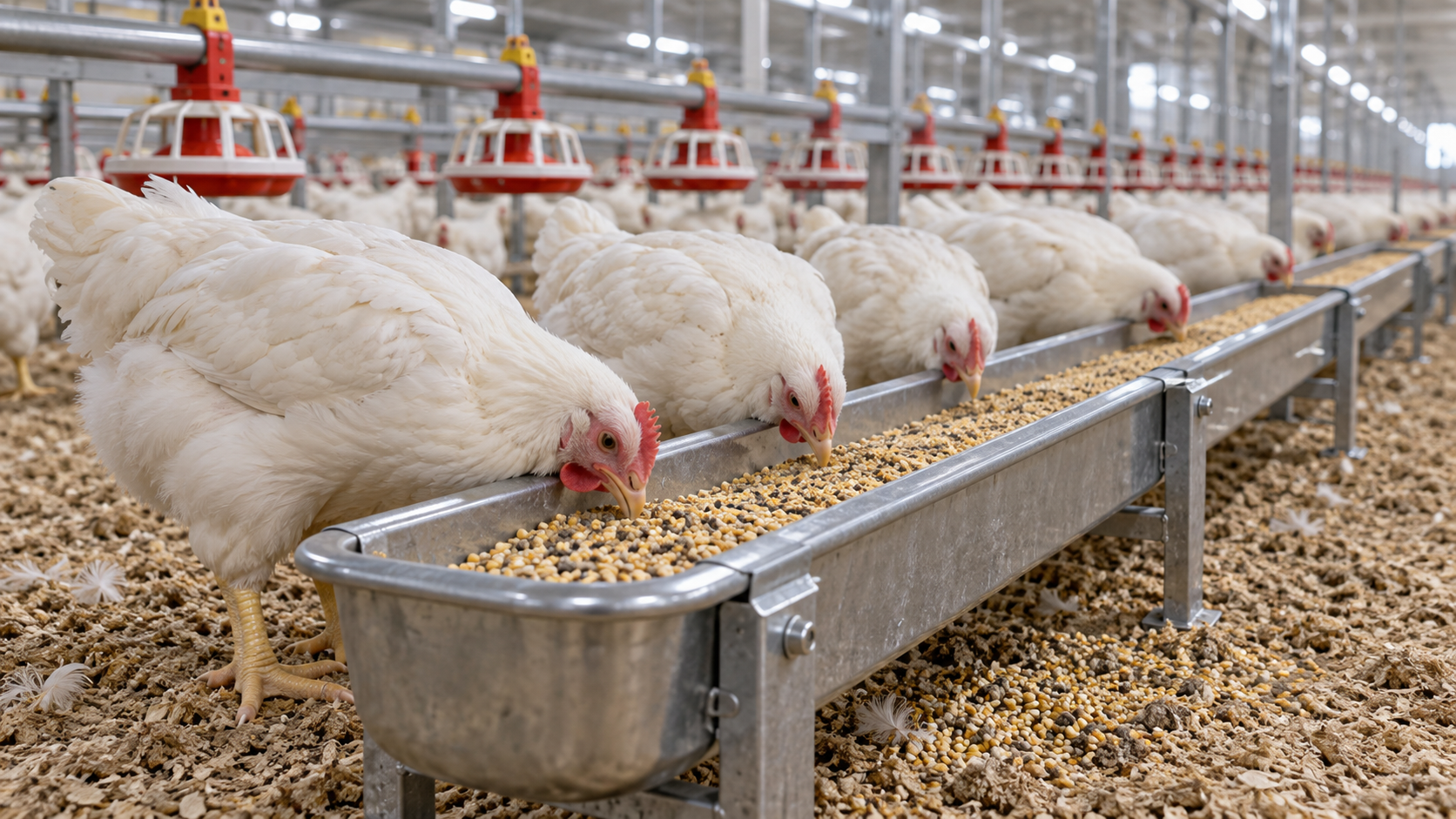
Feed accumulating beneath poultry troughs often points to overfilling, poor feeder height, uneven distribution, or birds flicking feed out as they eat. The right adjustment depends on when and where the loss occurs. A spill that appears during filling needs a different response from one that develops only after birds begin feeding.
Loose feed also affects more than the feed bill. Material mixed into litter becomes difficult to measure, may attract pests, and can contribute to sanitation problems if it becomes damp. Yet reducing the amount offered without checking access can leave smaller or less competitive birds short of feed. The operating goal is to keep feed accessible inside the equipment while limiting avoidable loss—not simply to make the floor look cleaner.
Identify the spill pattern before changing settings
Inspect the feeding area immediately before delivery, during filling, and after birds have eaten. These observations help separate equipment leakage from feeding behavior. If possible, watch several locations along the same line rather than judging the system from the area nearest the feed inlet.
Look for patterns that narrow the diagnosis:
- Feed directly below joints or end caps: suspect loose connections, gaps, cracks, or leakage during operation.
- A continuous strip along the feeding edge: check fill depth, lip geometry, feeder height, and birds’ head movements.
- Heavy deposits near the inlet: investigate delivery rate, local overfilling, or uneven movement along the line.
- Scattered feed where birds gather: observe crowding, scratching, competition, and whether birds can stand comfortably while eating.
- Mainly fine particles outside the trough: examine feed texture and selective feeding rather than assuming all loss comes from excessive filling.
Remove existing deposits from a small, defined inspection area so new losses can be distinguished from older material. Use clean collection trays only where they will not obstruct birds, contaminate feed, or create an injury hazard. In cage systems, accessible surfaces beneath a line may help locate losses; in litter houses, spilled feed can disappear into bedding quickly.
Record bird age, feed form, feeder settings, and the stage of the feeding cycle. A photograph taken from the same position can help compare changes. Do not treat feed found on the floor as safe to return to the system, particularly after contact with litter, droppings, moisture, or pest activity.
Correct overfilling without restricting feed access
A deep layer leaves little space between the feed surface and the retaining edge. When birds move their beaks sideways or lift their heads, particles can cross that edge. Excessive filling can also conceal distribution problems: the inlet section looks full while distant sections receive less feed.
Reduce the operating fill level in small steps using the equipment’s intended adjustment mechanism. Follow the feeder manufacturer’s guidance and the flock’s feeding program rather than applying a universal depth or percentage. The appropriate setting depends on trough profile, bird size, feed form, and whether feed is continuously available or delivered in controlled meals.
After lowering the setting, check the whole line during peak demand. Birds at the far end should still have access, and the feed should not disappear so rapidly that competition increases. In restricted-feeding programs, do not change the prescribed ration to address spillage. Correct containment and distribution while preserving the planned allocation.
A feeding trough performs two connected jobs: presenting feed where birds can reach it and retaining that feed during normal feeding movements. Its usable depth, edge shape, and distribution arrangement should be evaluated together. A deeper section is not automatically better if operators routinely fill it to the rim or if smaller birds cannot comfortably reach the remaining feed.
Match feeder height and stability to the flock
A feeder positioned too low can allow birds to step into it, scratch at the contents, or make broad sideways movements that scatter feed. One positioned too high may force birds to stretch, reduce access for smaller individuals, or encourage awkward feeding movements. Either condition can create loss, although the visible pattern may differ.
Use the equipment guidance for the species, age, and housing system. For many suspended systems, operators assess the feeding edge relative to the birds’ backs, but this is a starting check rather than a universal rule. Observe actual posture: birds should reach feed without sustained stretching, crouching, or pressure against an obstructive edge.
Mixed body size complicates adjustment. Setting the line only for the largest birds can exclude smaller flock members. Check access at several locations and look for birds repeatedly attempting to feed without succeeding. Chick-start equipment and early feeding arrangements require different settings from equipment used later in growth.
Also inspect suspension cables, brackets, and floor supports. A swinging, tilted, or sagging section can spill even when its nominal height is correct. Feed depth should remain reasonably consistent along the line. Isolate moving equipment before repairs or mechanical adjustments, following the farm’s safety procedures.
Check distribution, timing, and bird competition
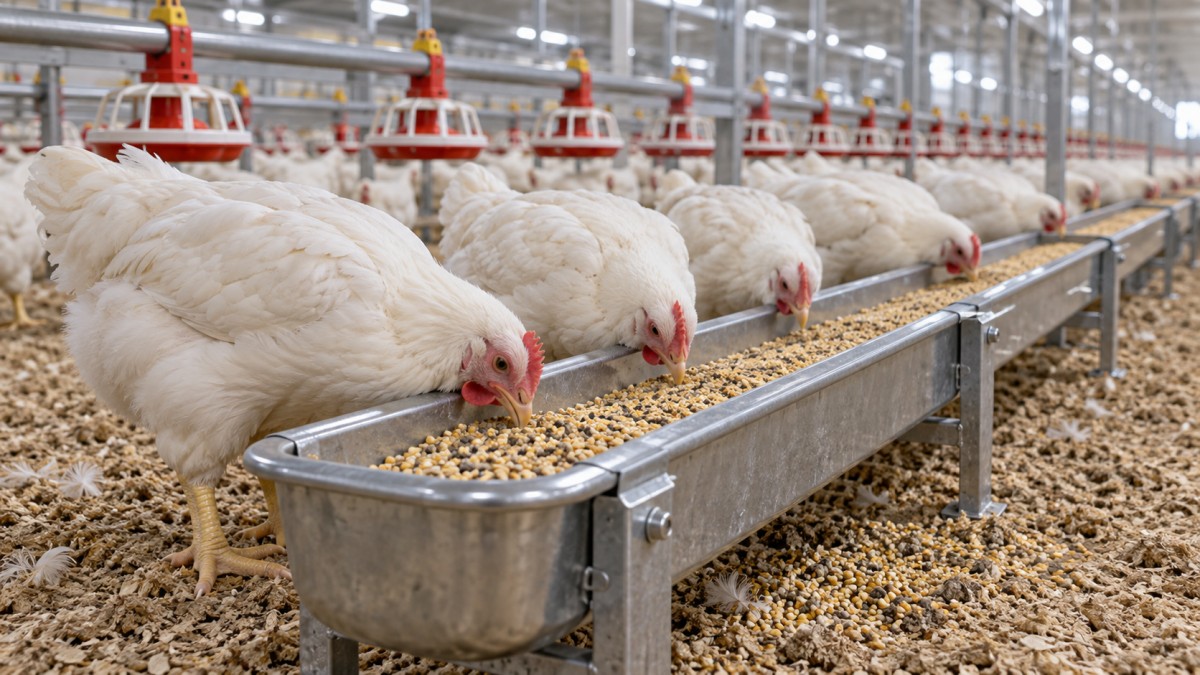
Feed loss during delivery often comes from the way feed enters and moves through the system. Check hopper outlets, gates, drive operation, and any obstructions. A partly blocked section can leave one area short while feed builds up elsewhere. Damaged joints may leak only when the conveyor runs, making them easy to miss during a static inspection.
Where chain or auger equipment is used, inspect wear and alignment according to the maintenance instructions. Do not compensate for mechanical faults by increasing delivery time indefinitely. That may overfill sections that already receive sufficient feed without correcting the underlying shortage.
Competition can produce a different problem. If many birds converge on limited usable feeding space, jostling and repeated displacement may push feed outside the trough. Nominal feeder length does not always equal usable access: blocked sections, poor placement, corners, or damaged guards can reduce the space birds can actually use.
Watch the flock during its busiest feeding period. Check whether birds spread along the line or cluster around a few preferred areas. Investigate uneven feed availability, obstructions, and unsuitable access openings before assuming the birds simply need more feed.
Lighting transitions and delivery timing may influence how abruptly birds gather, especially under controlled feeding schedules. Any change should remain consistent with the flock management program. Avoid solving a spill problem by disrupting established feeding opportunities or reducing access without monitoring the effect.
Separate feed-quality problems from equipment problems
Feed texture affects how readily material stays inside the trough. Fines can accumulate after larger particles have been eaten, and birds sorting through the remaining material may scatter it. Fragile pellets may break during transport, storage, or mechanical conveying. Mash presents different handling characteristics and should not be judged against pellet behavior alone.
Compare samples from the delivered feed, the hopper, and several points along the line. If the proportion of fines appears to increase through the system, investigate handling and conveying conditions. If feed already arrives with an unexpected texture, retain a representative sample and discuss it with the feed supplier or nutrition adviser. Visual checks can identify a change, but they do not establish nutritional adequacy.
Dampness and clumping also deserve attention. Water leaks, condensation, or unsuitable storage can interrupt flow and create uneven presentation. Clear the moisture source and manage affected feed under the farm’s feed-safety procedures. Do not break up visibly spoiled material and put it back into circulation.
A ration or feed-form change should not be used casually as a mechanical remedy. Pellet size, crumble characteristics, and mash texture must suit the birds and the nutrition program. The useful question is whether the equipment can present the intended feed consistently—not whether a different feed happens to spill less.
When trough design or wear limits adjustment
Some equipment cannot retain feed adequately because its profile, condition, or access arrangement no longer suits the flock. Rounded retaining edges, inward returns, or properly designed anti-waste features may reduce outward movement, but their effectiveness depends on bird access and fill level. A guard that retains feed while obstructing eating is not a successful correction.
Check for bent lips, rough surfaces, corrosion, cracked plastic, open seams, and worn attachment points. Damage can create leakage paths or injure birds. Temporary repairs should not introduce sharp edges, loose fragments, or surfaces that cannot be cleaned effectively.
Material choice involves practical trade-offs. Metal sections may offer rigidity but require attention to corrosion and damaged edges. Plastic sections avoid rust, although resistance to impact, cleaning chemicals, and sunlight varies with material and installation. Neither material guarantees low waste; profile, support, and maintenance remain important.
Before replacing equipment, document the conditions the replacement must handle:
- The species, growth stages, and expected range of bird sizes.
- The feed form and delivery method, including controlled or continuous feeding.
- The required usable access space and available installation height.
- The adjustment range, retaining-edge design, and compatibility with existing components.
- Access for cleaning, inspection, and replacement of worn parts.
During installation checks, inspect alignment, secure joints, stable supports, and smooth bird-contact surfaces. Confirm operation with the intended feed and observe birds before committing to the same configuration throughout the house. A replacement that fits the mounting points may still be unsuitable for the feeding conditions.
Verify the result rather than relying on a cleaner floor
Change one likely cause at a time where practical. Correct an obvious leak immediately, but avoid simultaneously changing height, feed depth, delivery timing, and guards unless safety or bird access demands it. Otherwise, the farm may be unable to identify which adjustment helped—or which one created a new problem.
Compare observations over equivalent feeding cycles. Keep the inspected area, collection method, and timing consistent. A smaller deposit is useful evidence, but it must be considered alongside feed availability and bird behavior. Estimated spilled feed multiplied by feed cost can indicate the direct value of avoidable loss; it does not capture sanitation costs or establish an improvement in feed conversion.
Monitor access, feed disappearance, body-weight trends, and flock uniformity within the normal management program. Lower spillage accompanied by empty sections, persistent competition, or birds struggling to reach feed is not an acceptable outcome.
The practical endpoint is a stable setting that retains feed while allowing the whole flock to eat as intended. Recheck it as birds grow, feed batches change, or equipment wears. When spillage returns, start with its location and timing rather than repeating the last adjustment automatically.
Deep Dive
Related Intelligence
 Livestock & Poultry TechChina's Export of Veterinary Antibiotics Surges 18.7% YoY in Q1 2026: Key Industry Impacts and ResponsesAnalyst:Agri-Tech Strategist
 Livestock & Poultry TechChina Feed Industry Association Initiates Revision of Microbial Fermented Feed Additives Group StandardAnalyst:Agri-Tech Strategist
 Livestock & Poultry TechNational Feed Quality Inspection Center Releases Q1 2026 Feed Safety Report: Key Impacts and Industry ResponsesAnalyst:Agri-Tech Strategist