Choosing chemical-resistant coatings for continuous acid immersion
Key Takeaways
- Crusoe and Araico Plan 106 MW AI Cloud Infrastructure Project in ParaguayIT & Security Director
- Is an SDS enough to verify chemical compliance for polymers?Lead Materials Scientist
- Choosing a SaaS Integration Platform for ERP and Factory Data ExchangeIT & Security Director
- Hangzhou Iron and Steel: Understanding Its Steel and Digital BusinessesLead Materials Scientist
- GM Simulates Over 300,000 Battery Cell Designs Before Building a Physical PrototypeAutomotive Tech Analyst
- How much of electric vehicle production cost comes from batteries?Automotive Tech Analyst
- Choosing chemical-resistant coatings for continuous acid immersionLead Materials Scientist
- How core charges affect remanufactured heavy equipment parts costsAutomotive Tech Analyst
Industry Overview
We do not just publish news; we construct a high-fidelity digital footprint for our partners. By aligning with TNE, enterprises build the essential algorithmic "Trust Signals" required by modern search engines, ensuring they stand out to high-net-worth buyers in an increasingly crowded global digital landscape.
Select a coating for continuous acid immersion only when the complete lining system has documented suitability for the actual acid composition, concentration range, temperature, and substrate. A splash-resistance rating does not establish immersion performance. Neither does a chemical-resistance chart that omits exposure duration or the condition of the tested film.
Continuous contact gives acid and water time to penetrate a coating, reach interfaces, and expose weaknesses in curing or application. Products described as chemical-resistant coatings, including “chemisch resistente coatings” in Dutch-language specifications, therefore require evaluation as installed systems: primer, lining, reinforcement where specified, and treatment of joints and penetrations.
Define the exposure before comparing materials
The service description should capture normal operation and credible departures from it. “Sulfuric acid tank” is insufficient: concentration, dilution events, temperature, contaminants, and cleaning chemistry determine whether a particular lining is suitable.
Acid resistance does not necessarily improve as concentration falls. Dilution changes water content, acid activity, and transport through the lining. Concentrated sulfuric acid also introduces different chemical attack mechanisms from dilute solutions. A rating at one concentration should not be extended across an entire operating range without supporting evidence.
Mixed streams need particular attention. An acid containing an oxidizing contaminant or an organic solvent can attack a resin differently from the pure acid used in a laboratory test. Hydrofluoric acid introduces a separate concern because it attacks silica-containing constituents, making the composition of fillers, reinforcement, and the underlying substrate relevant alongside the binder.
A useful exposure specification records:
- Composition and variability: each acid, its concentration range, and process contaminants that could affect the lining.
- The normal liquid temperature, maximum credible temperature, duration of excursions, and heating or cooling cycles.
- Cleaning fluids and procedures, including hot rinses, alkaline washes, and any steam exposure.
- Whether the equipment stays full, drains between batches, or develops deposits that retain concentrated liquid against the surface.
Separate the liquid zone, liquid line, and vapor space where their conditions differ. Condensation can expose the upper vessel to a different acid concentration and temperature from the bulk liquid. Agitation and incoming feed also create local conditions that a single average temperature will miss.
Use resin families to build a shortlist
Resin chemistry helps narrow the options, but formulations within one family differ substantially. Cure agents, fillers, reinforcement, and application method influence performance. The following comparisons identify questions to resolve; they do not establish compatibility for an unspecified acid service.
These options also involve different installation processes. A liquid-applied thermoset, bonded rubber sheet, and fabricated fluoropolymer lining require different equipment details and inspection methods. Their suitability cannot be ranked from chemical-resistance labels alone.
Flake-filled coatings deserve scrutiny beyond the phrase “barrier protection.” Properly distributed flakes increase the path that permeating molecules must travel. That benefit relies on filler compatibility, wetting, orientation, and application quality. Flakes do not correct pinholes, incomplete cure, or unsuitable resin chemistry.
Read immersion data for its limits
A resistance chart is a screening tool. Its rating becomes useful only when linked to the tested product, concentration, temperature, duration, and acceptance criteria. “Recommended” might describe unchanged appearance, acceptable weight change, or retained mechanical properties. Those outcomes provide different levels of confidence.
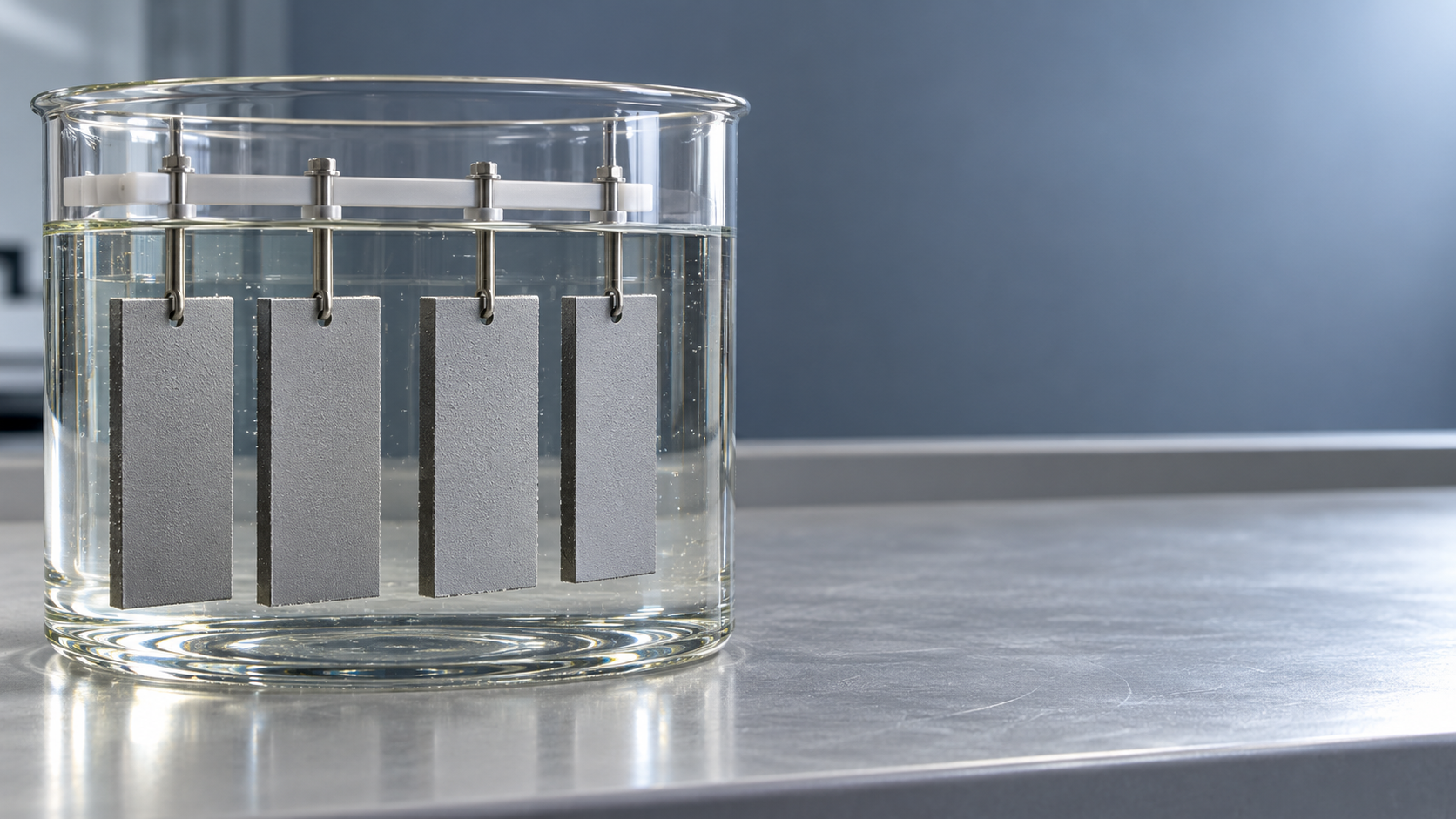
Request the underlying test conditions for shortlisted systems. Establish whether testing used a free film, a coated metal panel, or the proposed system on a representative substrate. Free-film testing reveals material response, but cannot establish adhesion retention at the substrate interface. Reinforced laminates and thin coatings likewise should not be treated as interchangeable specimens.
Distinguish visible condition from retained performance
Discoloration alone does not prove functional failure. Conversely, a smooth surface does not establish that a lining remains protective. Absorption can soften the film or weaken adhesion before blistering becomes visible.
Useful evidence connects appearance with measurements such as mass or dimensional change, hardness, adhesion, and examination for cracking or blistering. Measurements taken immediately after exposure and after a defined recovery period help distinguish persistent damage from reversible swelling. Recovery after drying does not establish acceptability during continuous wet service.
Exposure geometry matters. A specimen immersed on all sides experiences different conditions from a tank lining exposed on one face. A bonded panel with sealed edges answers a different question from one with exposed edges. The report should make these details clear enough to judge relevance.
Do not convert accelerated testing directly into service life
Higher-temperature tests can reveal weaknesses and support comparisons, but temperature can change the failure mechanism. Resin softening, accelerated diffusion, and chemical degradation do not necessarily increase at the same rate. A short hot exposure therefore cannot establish a specific operating life without a validated relationship to field service.
Where laboratory data leave a significant gap, representative testing should reproduce the proposed substrate, preparation, thickness, cure, and process liquid. Comparable operating references add value when their chemistry and temperature history are documented. A reference described only as “acid service” resolves little.
Permeation changes the meaning of an intact film
A coating can resist dissolution while still allowing water or acid species to migrate through it. Once those species reach the interface, corrosion or loss of adhesion can develop beneath an apparently sound surface. On concrete, acid reaching the substrate attacks the cementitious matrix and undermines support for the lining.
Temperature gradients deserve explicit consideration. Where hot process liquid contacts a lining over a cooler substrate, permeation and interfacial accumulation can become more severe than uniform-temperature immersion testing suggests. External cooling, intermittent heating, and the vessel’s insulation arrangement can therefore change the assessment.
Greater thickness is not an unlimited remedy. Within a validated system, additional thickness can improve barrier performance. Beyond the permitted range, it can introduce solvent retention, curing problems, internal stress, or cracking. A nominal thickness also conceals local thin spots around welds, corners, and difficult access points.
The specification should state the permitted dry-film thickness range and the method for verifying coverage. Multiple coats can reduce the chance of aligned defects, but introduce interfaces whose adhesion depends on cleanliness and recoat timing. Each coat must belong to the approved system and follow its application requirements.
Make substrate condition part of the selection
A lining that performs well on a laboratory panel may fail on equipment that cannot be prepared to the same condition. Material selection should therefore account for access, surface condition, and the ability to control the application environment.
For steel, the preparation specification needs to address surface cleanliness, profile, soluble contamination, weld condition, and sharp edges. Residual salts can draw water toward the interface and contribute to osmotic blistering. Sharp edges and irregular welds produce thin coverage and local stress; stripe coats and appropriate detailing address these vulnerable areas.
Concrete presents different problems. Surface strength, moisture condition, pores, existing acid damage, and cracks affect adhesion and continuity. Applying a strong film over weakened concrete leaves a weak foundation beneath it. Moving joints require a compatible movement detail because a rigid lining cannot reliably bridge unrestricted movement.
Existing linings complicate refurbishment. Remaining material may retain absorbed chemicals, conceal corrosion, or react poorly with a new system. Overcoating needs evidence of compatibility and sound adhesion throughout the retained layers. A small successful trial establishes only the condition of the area tested unless broader investigation supports it.
Cure and inspection determine readiness for immersion
Application conditions should be assessed before committing to a candidate. A system that needs tightly controlled curing conditions may be unsuitable for a vessel where those conditions cannot be maintained. Substrate temperature and condensation control matter throughout application and cure, not just when work begins.
Dry-to-touch condition does not establish chemical readiness. Some systems require extended curing or a specified post-cure before acid immersion. Low temperature, incorrect mixing, excessive thickness, or poor ventilation can leave a film incompletely cured even when its surface feels hard.
Inspection should cover the stages that become inaccessible later. Surface preparation and environmental records establish the starting condition. Thickness measurements assess coverage. Holiday testing identifies discontinuities where the method is appropriate, with equipment settings matched to the system, thickness, substrate, and specified procedure. Excessive test voltage can damage a lining.
Repairs require the same attention as the original application. Surface preparation, overlap dimensions, cure, and retesting need defined acceptance criteria. Filling a visible defect without establishing sound surrounding material risks leaving a weak interface around the patch.
Resolve the remaining differences before specification
When several systems remain technically credible, compare the gaps in their evidence. A product with excellent pure-acid data but no information on the actual contaminant mixture carries a different uncertainty from one with documented chemical resistance but demanding site-curing requirements. Those gaps should drive additional testing or installation trials.
The final specification should identify the exact system, exposure envelope, substrate preparation, thickness range, cure requirements, inspection criteria, and repair method. Any supplier qualification should state its assumptions, especially exclusions involving temperature excursions, cleaning, vacuum, or changes in concentration.
If the process changes after qualification, reassess the affected conditions before returning equipment to service. A new cleaning fluid, hotter feed, or altered dilution sequence can invalidate the original selection even when the principal acid remains unchanged.
Deep Dive
Related Intelligence
 Industrial CoatingsResin Epoxy CAS 24969-06-0 Procurement: How Buyers Avoid a Costly Formulation MismatchAnalyst:Lead Materials Scientist
 Industrial CoatingsWhy Brand Elevation Strategies Matter More Than Ever for Industrial Coatings Suppliers Targeting EU MarketsAnalyst:Lead Materials Scientist
 Industrial CoatingsWhich Corporate Case Studies Show Measurable ROI from Industrial Coatings Automation in Food Plant Maintenance?Analyst:Lead Materials Scientist