Is an SDS enough to verify chemical compliance for polymers?
Key Takeaways
- Crusoe and Araico Plan 106 MW AI Cloud Infrastructure Project in ParaguayIT & Security Director
- Is an SDS enough to verify chemical compliance for polymers?Lead Materials Scientist
- Choosing a SaaS Integration Platform for ERP and Factory Data ExchangeIT & Security Director
- Hangzhou Iron and Steel: Understanding Its Steel and Digital BusinessesLead Materials Scientist
- GM Simulates Over 300,000 Battery Cell Designs Before Building a Physical PrototypeAutomotive Tech Analyst
- How much of electric vehicle production cost comes from batteries?Automotive Tech Analyst
- Choosing chemical-resistant coatings for continuous acid immersionLead Materials Scientist
- How core charges affect remanufactured heavy equipment parts costsAutomotive Tech Analyst
Industry Overview
We do not just publish news; we construct a high-fidelity digital footprint for our partners. By aligning with TNE, enterprises build the essential algorithmic "Trust Signals" required by modern search engines, ensuring they stand out to high-net-worth buyers in an increasingly crowded global digital landscape.
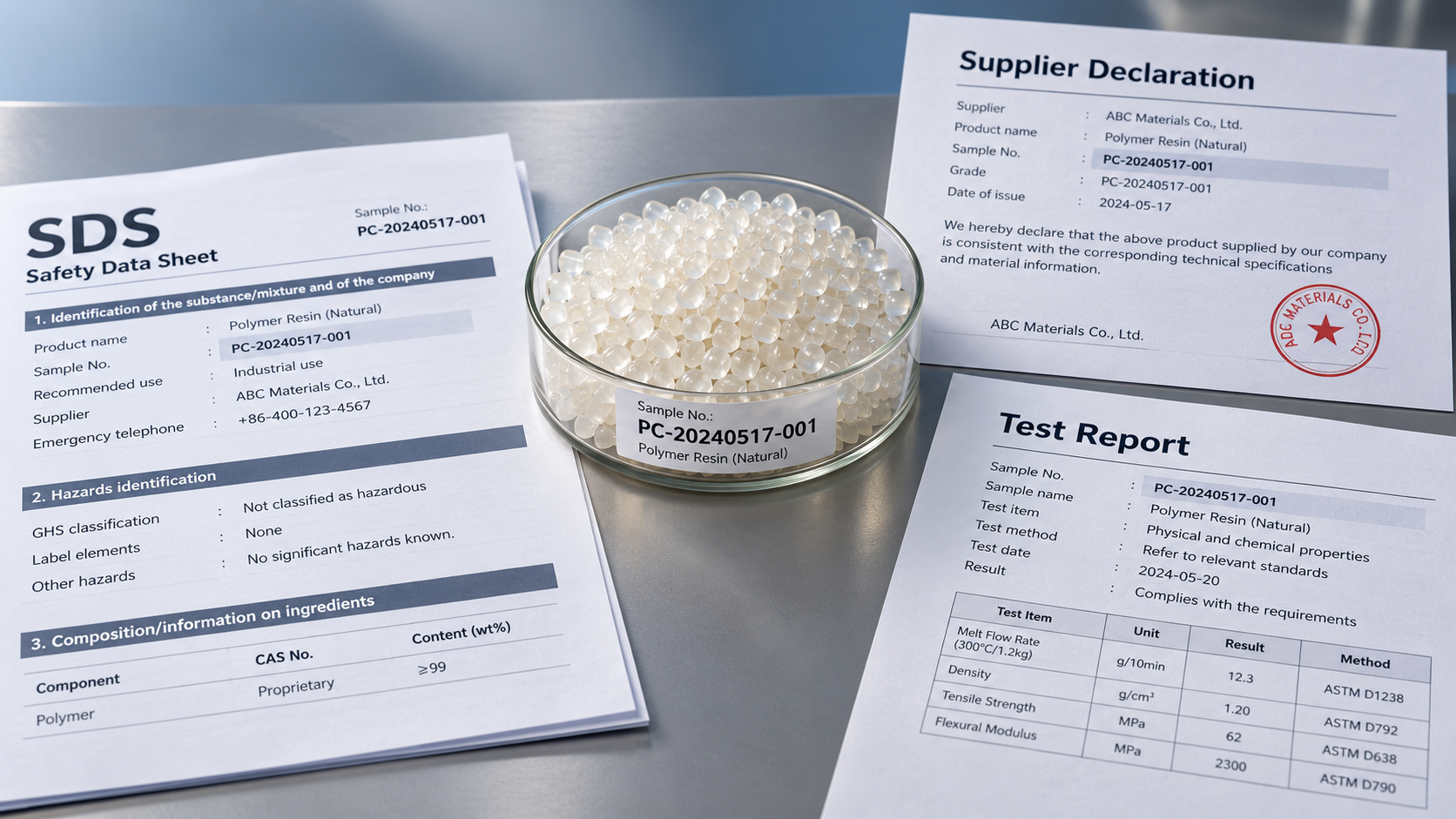
No. A safety data sheet (SDS) alone is generally not enough to verify chemical compliance for polymers. It communicates hazards and safe handling requirements, but it does not establish that a particular polymer grade satisfies every substance restriction, market-access obligation, or end-use requirement. An SDS can support approval; it should not be treated as a universal compliance certificate.
The gap often appears when a resin arrives with a current SDS stating that the material is not classified as hazardous. That may support workplace handling decisions, yet leave unanswered whether a colorant contains restricted substances, a food-contact application is supported, or the imported material has the necessary regulatory status. Releasing the grade without resolving those questions can lead to blocked shipments, unsuitable material selection, or unsupported customer declarations.
Separate hazard communication from product approval
An SDS answers questions such as: What hazards are known? What protective measures are needed? How should spills, storage, and disposal be managed? Its required content depends on the applicable jurisdiction. It is not designed to disclose every ingredient or assess every downstream use.
Polymer compliance involves several distinct questions:
- Supply legality: Can the substance or mixture be manufactured, imported, or supplied under the relevant chemical-control system?
- Restricted substances: Does the material meet applicable prohibitions, concentration limits, or conditions of use?
- Application suitability: Is there adequate evidence for the intended use, such as food contact or an electrical component?
- Operational safety: Can the material be processed safely under the actual production conditions?
These questions overlap, but passing one does not resolve the others. A resin may be safe to handle in pellet form while lacking evidence for food-contact use. Conversely, a material supported for a specific food-contact application may still require controls for dust or thermal decomposition during processing.
Read the SDS for evidence—and for its limits
Start by matching the SDS to the exact supplied product. Confirm the supplier, trade name, grade, revision date, and jurisdiction. A document for a base resin does not necessarily cover a flame-retarded, reinforced, colored, or recycled version.
“Not classified as hazardous” does not mean “contains no restricted chemicals.” SDS disclosure thresholds and product restriction limits serve different purposes and may differ. Some substances may not appear because disclosure is not required under the relevant rules; permitted confidential-business-information provisions can also limit detail.
A blank regulatory entry is not evidence of compliance. Nor does a recent revision date prove that the supplier checked every relevant restriction. Read what the statement actually covers rather than inferring approval from the document’s appearance.
Define the requirement before requesting more documents
A request for “all compliance certificates” often produces a large document bundle without answering the release question. Build the assessment around the supplied material, destination market, and intended use. Record whether the product is resin, compound, masterbatch, or a finished article, because legal obligations can change with product form.
Chemical inventory and registration status
For the EU, polymers may be exempt from REACH registration, but that does not remove all REACH obligations. Relevant monomers or other substances can carry registration obligations when the applicable conditions are met. Restrictions and other duties may also remain relevant. A statement saying only “polymer exempt” is therefore insufficient to establish the entire supply chain’s compliance position.
For the United States, request confirmation of the applicable Toxic Substances Control Act status and any relevant restrictions or conditions. Inventory listing or an exemption does not automatically authorize every use. Where import obligations apply, the responsible importer needs evidence appropriate to its role, not simply a foreign supplier’s generic assurance.
Restricted substances and customer specifications
Identify the actual legal instrument or customer requirement, its current scope, and the relevant threshold basis. For EU REACH Candidate List substances, the implications differ between substances, mixtures, and articles. The article communication threshold should not be applied indiscriminately to resin pellets or used as a substitute for reviewing restrictions.
RoHS is another frequent source of confusion. Its restrictions concern electrical and electronic equipment within scope, with concentration limits generally assessed at homogeneous-material level. A supplier declaration for a polymer can support the equipment manufacturer’s technical documentation, but it does not make the resin universally “RoHS certified.” Applicable exemptions and their conditions also matter.
Food-contact use
An SDS cannot establish food-contact suitability. Evidence must address the destination market, composition, and intended contact conditions. Food type, time, temperature, repeated use, and the finished article’s construction can affect the assessment.
For EU plastic food-contact applications, obtain the applicable declaration of compliance and supporting information needed to assess the finished article. Under US requirements, check the relevant authorization basis and its limitations. Neither a general “food grade” label nor a migration report for a different formulation resolves those conditions.
These examples are not an exhaustive regulatory list. They show why the evidence request must follow the application rather than the polymer family name.
Build a grade-specific evidence file
Once the requirements are defined, organize the file so that a reviewer can connect each approval decision to a specific document. The critical link is between the evidence and the material actually supplied.
- Lock the material identity. Record the grade, color, manufacturing source where relevant, formulation revision, and recycled-content status. Include masterbatches or additives introduced during conversion.
- Record the approval boundary. State the destination markets, intended application, processing conditions relevant to compliance, and customer restrictions. An approval without boundaries is difficult to defend.
- Map each obligation to evidence. Use the SDS for hazard communication, targeted declarations for regulatory status, and supporting technical documentation or tests where needed. Do not expect one document to perform all three functions.
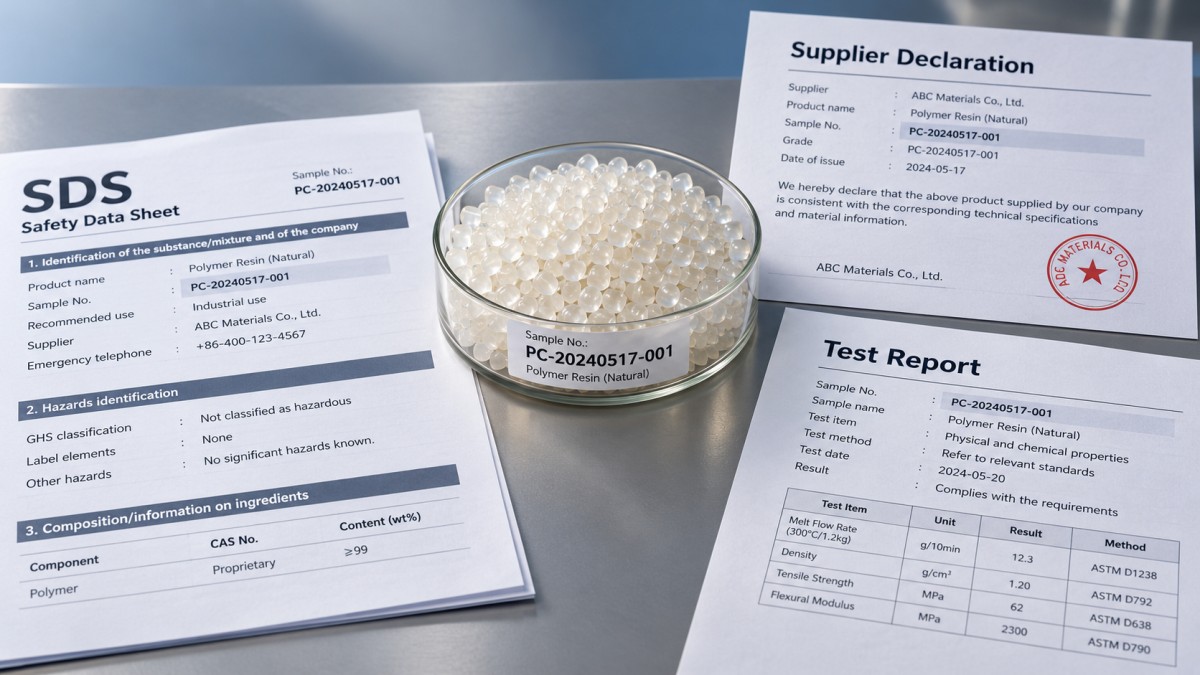
- Check scope and traceability. Declarations should identify the covered product, issuing entity, requirements addressed, and assessment date. Test reports should identify the sample, methods, results, and reporting limits.
- Document unresolved gaps. Assign responsibility for clarification and prevent release into unsupported applications until the relevant gap is closed.
A substance declaration does not always need to reveal the full proprietary formulation to the purchaser. A sufficiently specific supplier statement, supported by confidential disclosure to an appropriate assessor where necessary, may provide usable evidence. However, “proprietary” is not an adequate answer to whether a regulated substance exceeds an applicable limit.
Also distinguish a certificate of analysis from a compliance declaration. A batch certificate reporting melt flow, moisture, or mechanical properties verifies those stated characteristics. Unless it includes the relevant chemical assessment, it does not demonstrate restricted-substance conformity.
Use testing to close a defined gap
Testing is valuable when it answers a specific question. It is less useful when commissioned as a broad “compliance scan” without a substance list, decision limit, or suitable sampling plan. No single laboratory panel can prove compliance with every chemical requirement.
Choose additional testing according to the evidence weakness. Recycled feedstock with uncertain history, incomplete additive declarations, a new pigment package, or inconsistent supplier documents can justify targeted analysis. A stable virgin grade with credible, current formulation controls may support a different verification approach. Neither category should receive automatic approval or rejection.
Before commissioning work, agree on:
- The substance or substance group being assessed and the applicable limit.
- The sample identity and whether pellets, individual materials, or finished parts must be tested.
- A method suitable for the polymer matrix, with reporting limits adequate for the decision.
- The treatment of measurement uncertainty where a result is close to the limit.
- Whether the result represents one batch or supports a broader, justified sampling strategy.
Screening results need careful interpretation. For example, elemental screening may indicate bromine but cannot, by itself, identify a particular restricted brominated flame retardant. Likewise, a “not detected” result means the analyte was not detected under the stated method conditions; it does not prove absolute absence.
Food-contact migration testing has a different purpose from total-content testing. Low total concentration does not automatically establish acceptable migration, and a passing migration result does not resolve every compositional requirement. The test conditions must represent or appropriately cover the intended use.
Make the release decision explicit
A practical approval record should distinguish three outcomes. Approved means the defined requirements are supported for the stated use. Restricted approval means the material may be used only within documented boundaries, such as specified markets or non-food-contact applications. On hold means a material evidence gap prevents the intended release.
Contradictions deserve more attention than missing formatting. If an SDS identifies an additive that conflicts with a supplier’s substance declaration, request a documented reconciliation. If a test report covers natural resin but the purchase is for a black compound, establish whether the pigment and other formulation differences are covered. Do not assume that a shared polymer name makes the evidence transferable.
Keep workplace safety review connected to, but separate from, market-access approval. Processing outside the documented temperature range, generating respirable dust, or introducing additional chemicals can require further exposure assessment even when the supplied grade meets the relevant substance restrictions.
Finally, define review triggers: formulation changes, manufacturing-source changes, revised recycled feedstock, updated regulatory lists, new intended uses, and contradictory test results. Request supplier change notification and recheck affected evidence before extending an existing approval. Chemical compliance for polymers is demonstrated by a traceable match between requirements, material identity, and supporting evidence—not by possession of an SDS alone.
Deep Dive
Related Intelligence
 Eco-PolymersCan Editorial Framework Standards Improve Traceability for Eco-Polymers in Food Packaging?Analyst:Lead Materials Scientist
 Eco-PolymersCan Graphene Materials Deliver Cost-Effective Conductivity in Large-Scale Flooring Projects?Analyst:Lead Materials Scientist
 Eco-PolymersGraphene Materials Bulk Order Thresholds: When Does Unit Cost Drop Below $180/kg for Structural Reinforcement?Analyst:Lead Materials Scientist