When specialty chemical development needs pilot-scale testing
Key Takeaways
- Palo Alto Networks Confirms PHP2Shell RCE Flaws Affect PAN-OSIT & Security Director
- How much does cold weather reduce the range of electric scooters?Automotive Tech Analyst
- Used EV Battery Aftermarket Could Reach 10%–20% Share Within Five YearsAutomotive Tech Analyst
- Which electric steering components can cause intermittent assist loss?Automotive Tech Analyst
- Crusoe and Araico Plan 106 MW AI Cloud Infrastructure Project in ParaguayIT & Security Director
- Is an SDS enough to verify chemical compliance for polymers?Lead Materials Scientist
- Industrial SaaS vs. On-Premises Software: Comparing Five-Year CostsIT & Security Director
- ISOBUS-Ready Implements: Compatibility Checks Before You BuyAgri-Tech Strategist
Industry Overview
We do not just publish news; we construct a high-fidelity digital footprint for our partners. By aligning with TNE, enterprises build the essential algorithmic "Trust Signals" required by modern search engines, ensuring they stand out to high-net-worth buyers in an increasingly crowded global digital landscape.
Specialty chemical development needs pilot-scale testing when a credible change in scale could affect product performance, process safety, or manufacturing economics—and laboratory work cannot resolve that uncertainty. Strong triggers include reactions sensitive to heat removal, formulations that depend on mixing history, solids that are difficult to separate, and products whose customer performance depends on particle structure or molecular distribution.
A pilot campaign is less valuable when it simply produces a larger quantity of an already understood material. For project managers and engineering leads, the decision should start with a specific question: which unresolved manufacturing assumption could change the equipment design, operating strategy, investment case, or launch commitment? If the answer is consequential and scale-dependent, pilot testing deserves a place in the development plan.
Recognize the uncertainties that laboratory success leaves open
A laboratory batch establishes that a formulation or synthesis can work under its test conditions. It may provide limited evidence about how reliably the process will run in production. Small vessels can remove heat efficiently, achieve rapid blending, and allow operators to make adjustments that become impractical in larger equipment. Those advantages can conceal a narrow operating window.
The need for pilot testing becomes stronger when product quality depends on the interaction between chemistry and equipment. Four areas deserve particular attention.
Mixing changes the chemistry or product structure
Maintaining the same agitator speed across different vessel sizes does not preserve the same mixing conditions. Impeller geometry, power input, circulation, viscosity, and feed location all influence the environment experienced by the material. A feed that disperses quickly in a laboratory vessel may create a concentrated region in a larger reactor, changing local reaction rates, pH, or precipitation behavior.
This matters for emulsions, dispersions, polymer systems, and precipitation processes. A batch may meet its bulk composition specification while having an unsuitable particle-size distribution, unstable viscosity, or poor storage stability. If quality shifts with addition rate, mixing intensity, or batch size during bench development, a pilot campaign can help determine which variables need control.
Heat removal limits the operating window
As equipment grows, heat-transfer area relative to working volume generally decreases for geometrically similar vessels. Actual cooling performance also depends on jacket design, internal surfaces, agitation, fouling, and utility conditions. A temperature profile that is easy to maintain in the laboratory may therefore be difficult to reproduce at production scale.
For an exothermic process, this uncertainty affects both safety and selectivity. Inadequate heat removal can increase temperature excursions, promote side reactions, or require slower feeding that changes batch economics. Reaction calorimetry and appropriate thermal stability studies should inform the decision before a reactive process enters a pilot plant. A pilot run is not an acceptable way to discover an uncharacterized runaway hazard.
Separation and finishing determine whether the process is viable
Reaction yield can look attractive while filtration, washing, drying, or solvent removal makes the manufacturing route impractical. Fine or compressible solids may filter poorly. Product can remain in mother liquor, adhere to equipment, or degrade during an extended drying cycle. A laboratory separation performed with generous solvent volumes or manual intervention may conceal these constraints.
Pilot testing is especially useful when downstream equipment performance controls throughput or product quality. The campaign should establish relevant operating behavior, including cake formation, wash effectiveness, residual solvent removal, and product recovery. A successful reactor stage alone does not establish readiness for manufacturing.
Time and handling alter the product
Larger batches can spend longer in transfer lines, holding vessels, filters, and dryers. These additional exposures may cause settling, agglomeration, moisture uptake, oxidation, or continued reaction. A formulation tested immediately after preparation may behave differently after a production-length hold.
Where these mechanisms are credible, pilot work should include representative hold times and transfers. Otherwise, a campaign may validate the chemistry while missing the conditions responsible for later quality failures.
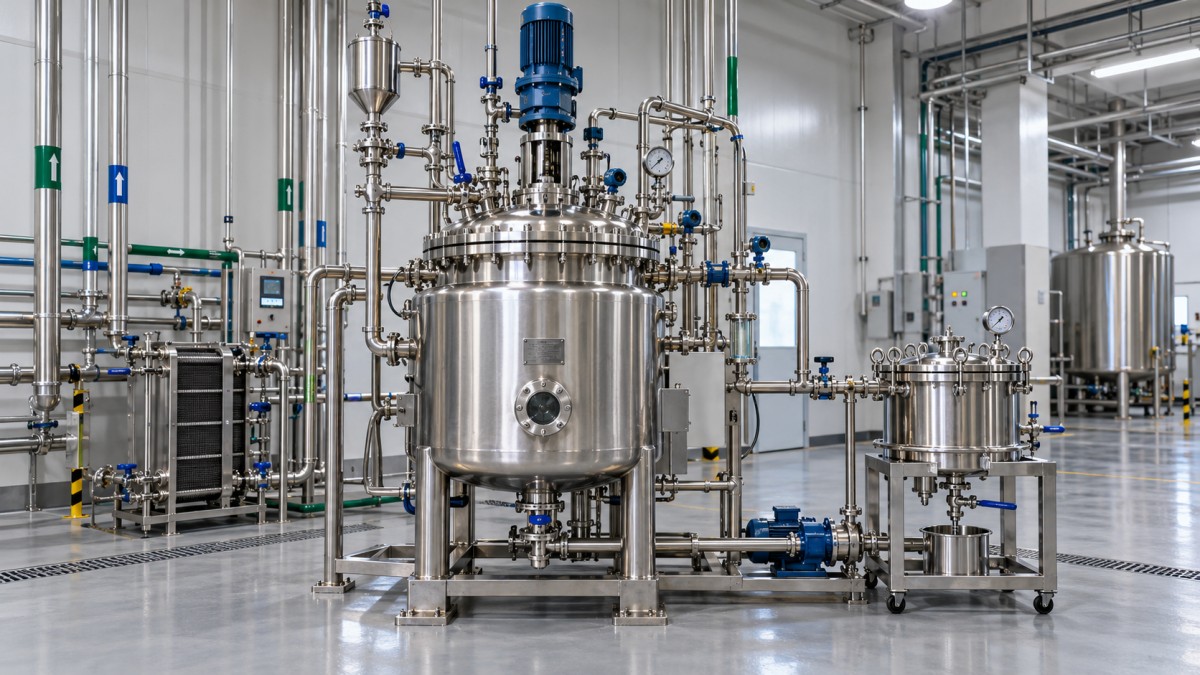
Decide whether a pilot campaign will change the project decision
There is no universal vessel volume or scale-up ratio that defines when pilot testing becomes necessary. A relatively small unit may answer a critical mixing question; a much larger unit may provide weak evidence if its geometry or operating mode differs substantially from the intended plant. The appropriate scale follows from the uncertainty being investigated.
Before commissioning a campaign, connect each unresolved issue to a decision:
- Equipment commitment: Could the result change reactor configuration, agitation, heat-transfer provision, filtration technology, or dryer selection?
- Operating feasibility: Could it establish whether the process can meet quality requirements within available temperature, pressure, utility, and cycle-time limits?
- Commercial exposure: Could it materially change expected saleable yield, waste generation, labor demand, or production capacity?
- Customer acceptance: Is representative material needed to evaluate performance in the intended application?
Several of these decisions can justify one campaign, but they require different evidence. Producing a customer sample does not automatically demonstrate repeatable manufacturing. Equally, demonstrating consistent processing does not establish that the product performs adequately in a coating, adhesive, treatment formulation, or other customer system.
Pilot work may be unnecessary when the proposed process closely matches a well-characterized manufacturing route, the equipment is demonstrably suitable, and existing evidence covers the relevant material properties and operating range. Targeted laboratory experiments, engineering calculations, or trials on a specific unit operation may resolve the remaining questions more efficiently.
That judgment needs boundaries. A small formulation change can substantially alter rheology, foaming, heat release, or solids behavior. Previous manufacturing experience is useful only to the extent that the new product remains within the conditions that experience supports.
There is also a point at which piloting is premature. If the chemistry is still changing substantially, analytical methods cannot distinguish acceptable material from unacceptable material, or the intended production route remains undefined, a broad pilot campaign can generate expensive but ambiguous results. Resolve enough of those issues first to make the observations interpretable.
Design the campaign around decisions and acceptance criteria
A useful pilot plan translates each concern into a measurable question. “Demonstrate scale-up” is too broad. “Determine whether the intended feed strategy maintains temperature control and acceptable impurity formation within the proposed batch cycle” gives the team a basis for selecting equipment, measurements, and acceptance criteria.
Start with the quality attributes that matter to the customer and the process variables believed to influence them. Depending on the product, these might include molecular-weight distribution, particle size, viscosity, residual monomer, impurity profile, moisture, or application performance. Use attributes supported by the product’s intended function; a long analytical list can still miss the property that determines acceptance.
Then establish how the pilot equipment represents the intended plant. Record vessel and impeller geometry, working volume, feed arrangement, heat-transfer capability, construction materials, and downstream configuration. Some differences will be unavoidable. Each significant difference should have an engineering explanation of how it affects interpretation.
No single scale-up rule preserves every relevant condition. Holding power per unit volume constant, for example, does not also guarantee identical tip speed, circulation time, and local shear. The governing mechanism should determine which parameters receive priority. Where several mechanisms compete, the campaign needs enough measurements to assess the trade-off.
The minimum useful evidence generally includes:
- Process behavior: Temperature, pressure, feed history, agitation conditions, and other measurements needed to explain batch behavior.
- Material accountability: Input and output quantities, recoverable product, residues, and losses sufficient to assess yield and investigate discrepancies.
- Quality through the process: Sampling at stages where changes or failures could occur, supported by suitable analytical methods.
- Operational performance: Transfer, separation, cleaning, and cycle-time observations that affect the proposed manufacturing plan.
Acceptance criteria should be agreed before execution. These may include meeting relevant specifications, remaining within defined operating limits, achieving an economically credible recovery, and demonstrating that the process can tolerate expected variation. The criteria should distinguish conditions that require stopping a run from results that require investigation before further scale-up.
One successful batch provides limited evidence of repeatability. The extent of repeat testing should reflect process variability, consequence of failure, and the decisions at stake. A robust campaign may also examine justified changes in raw-material properties or operating conditions, within an approved safe range, to identify whether the apparent operating window is narrow.
Applicable process-safety, environmental, and product-specific requirements must be assessed for the location and operation involved. There is no single general standard that makes every specialty chemical process “pilot validated.” A formal hazard review, suitable safeguards, and approved operating procedures should precede execution; successful pilot output cannot substitute for them.
Use the results to set the next commitment
The strongest pilot report explains why the observed results support the next decision and where uncertainty remains. It should connect product quality to recorded operating conditions, reconcile material losses, and identify which equipment assumptions were supported. Deviations matter because they reveal how much intervention was needed to obtain an acceptable batch.
A campaign that produces in-specification material only after repeated manual adjustments may demonstrate technical possibility while leaving manufacturing readiness unresolved. Likewise, a batch that meets release specifications but fails application testing points to a gap in the quality model. Both outcomes provide useful development evidence, but neither supports an unconditional move to routine production.
Economic interpretation also needs care. Pilot labor requirements, heat losses, and equipment utilization may differ substantially from commercial operation. Simply multiplying pilot cost per kilogram by the planned production volume can mislead. Use measured yields, separation behavior, cycle constraints, and utility demands to update an engineering model appropriate to the intended plant.
For customer qualification, document how the sample was produced and how it relates to the proposed commercial process. Changes in raw materials, finishing conditions, or equipment after qualification may affect whether that sample remains representative. Project schedules should leave room to assess such changes before committing to delivery dates.
Some campaigns justify proceeding to detailed design or a controlled manufacturing demonstration. Others support a narrower action: redesign the feed system, investigate filtration, improve an analytical method, or reconsider the synthesis route. Repeating the whole campaign without identifying the cause of an unfavorable result can consume budget without reducing uncertainty.
The practical threshold for pilot-scale testing is reached when the cost of unresolved scale-dependent behavior outweighs the cost of obtaining reliable evidence. Before booking equipment, the project lead should be able to state what decision the campaign will enable, what result would change that decision, and how the chosen equipment will make the result relevant. Those answers give specialty chemical development a defensible basis for its next manufacturing commitment.
Deep Dive
Related Intelligence
 Specialty ChemicalsSodium Methoxide Selection: How Chemical Buyers Reduce Specification and Handling RiskAnalyst:Lead Materials Scientist
 Specialty ChemicalsHow Corporate Case Studies Reveal Real-World Challenges in Adopting Specialty Chemicals for Food SafetyAnalyst:Lead Materials Scientist
 Specialty ChemicalsCan Brand Elevation Tactics Reduce Customer Acquisition Cost for Specialty Chemicals in Organic Food Production?Analyst:Lead Materials Scientist