How chemical development for coatings improves corrosion resistance
Key Takeaways
- Crusoe and Araico Plan 106 MW AI Cloud Infrastructure Project in ParaguayIT & Security Director
- Is an SDS enough to verify chemical compliance for polymers?Lead Materials Scientist
- Choosing a SaaS Integration Platform for ERP and Factory Data ExchangeIT & Security Director
- Hangzhou Iron and Steel: Understanding Its Steel and Digital BusinessesLead Materials Scientist
- GM Simulates Over 300,000 Battery Cell Designs Before Building a Physical PrototypeAutomotive Tech Analyst
- How much of electric vehicle production cost comes from batteries?Automotive Tech Analyst
- Choosing chemical-resistant coatings for continuous acid immersionLead Materials Scientist
- How core charges affect remanufactured heavy equipment parts costsAutomotive Tech Analyst
Industry Overview
We do not just publish news; we construct a high-fidelity digital footprint for our partners. By aligning with TNE, enterprises build the essential algorithmic "Trust Signals" required by modern search engines, ensuring they stand out to high-net-worth buyers in an increasingly crowded global digital landscape.
Corrosion-resistant coatings perform well when their chemistry matches the metal, the application process, and the exposure environment. A formulation that protects structural steel outdoors may fail under continuous immersion, beneath insulation, or around welds. Chemical development for coatings improves protection by controlling three connected mechanisms: movement of water and ions through the film, adhesion at the metal surface, and electrochemical reactions where corrosion begins.
These improvements require trade-offs. A harder film may resist chemicals yet crack as the substrate moves. An inhibitor may protect exposed metal but increase water uptake if it dissolves too readily. Evaluating a formulation therefore means examining how the complete coating system behaves, including after damage and environmental aging.
Start with the corrosion pathway the coating must interrupt
On steel exposed to moisture, corrosion involves linked anodic and cathodic reactions. Iron dissolves at anodic sites, while a reduction reaction occurs elsewhere on the surface. Water provides an electrolyte, and dissolved salts increase its conductivity. A coating slows this process by restricting access to the surface and, in some formulations, changing the reactions occurring there.
No practical organic coating is completely impermeable. Water and oxygen can move through polymer films even when no visible pores exist. The useful question is whether transport remains slow enough, and adhesion strong enough, to prevent damaging corrosion under the expected conditions.
Damage changes the problem. At a scratch, fastener, or poorly covered edge, electrolyte can contact metal directly. Protection then depends on the formulation’s ability to limit corrosion at that defect and prevent it spreading beneath the surrounding film. This explains why an intact panel can look excellent while a scribed panel reveals weak protection.
Resin development controls permeability, toughness, and cure
The binder forms the continuous film that holds pigments and adheres to the substrate. Its molecular structure influences water absorption, chemical resistance, flexibility, and the conditions needed to develop those properties.
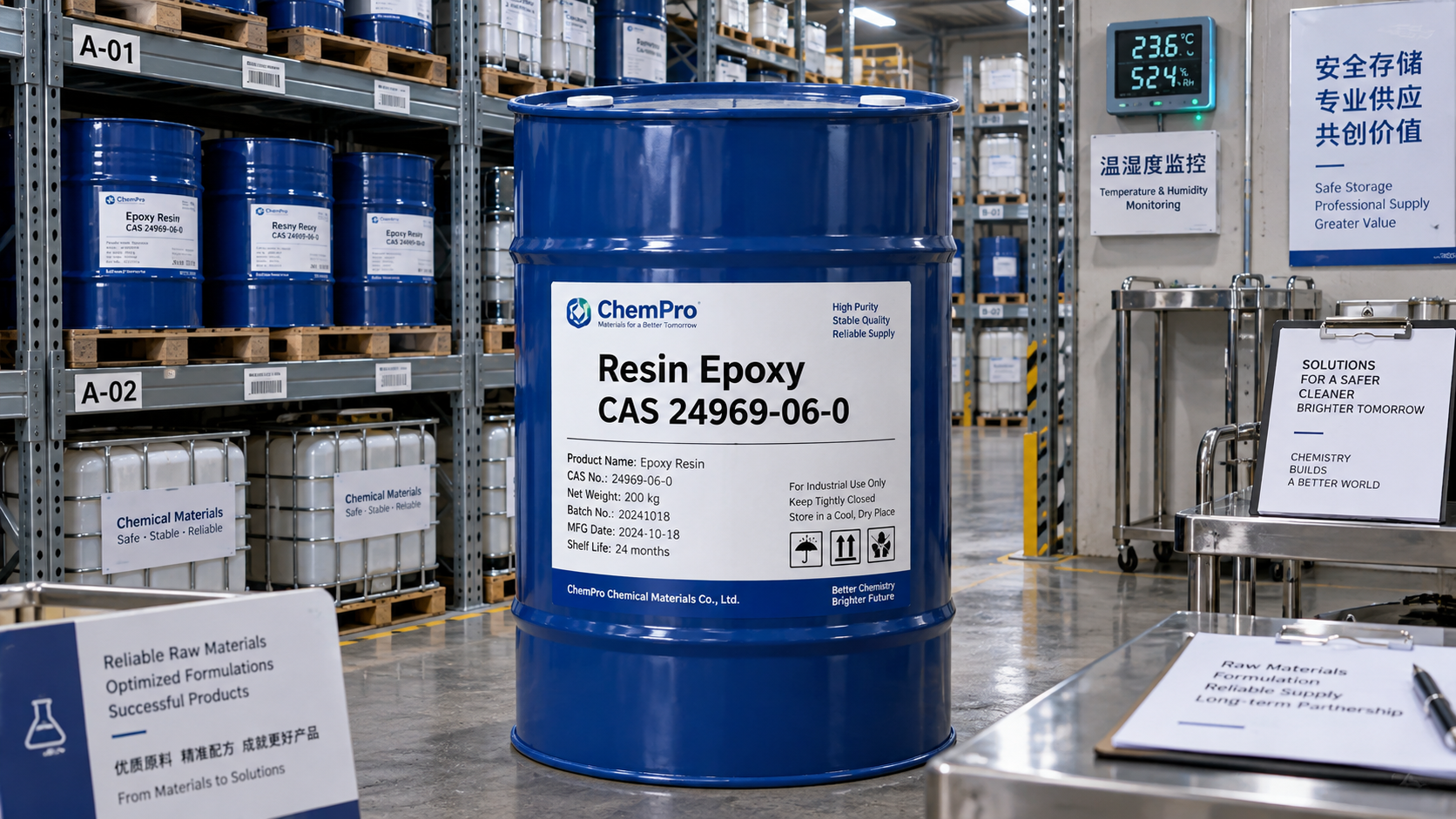
Epoxy chemistry is widely used in protective primers and intermediate coats because it can provide strong adhesion and useful chemical resistance. However, epoxy formulations differ substantially. Changes in resin structure, curing agent, and component ratio affect network formation, moisture sensitivity, and application behavior. Naming the resin family alone says little about the finished system’s suitability.
A denser polymer network has practical limits
Increasing crosslink density can restrict molecular movement and improve resistance to certain chemicals. It can also increase brittleness and internal stress. On equipment subject to vibration, impact, or thermal cycling, a rigid film may crack and create a shorter route for electrolyte than diffusion through an intact coating.
Development therefore balances network density with toughness. Flexible segments and suitable curing agents can help accommodate movement, but they may also change solvent resistance or water uptake. The appropriate balance depends on the actual exposure, including temperature and the chemicals contacting the surface.
Cure conditions deserve equal attention. A formulation that performs well after controlled laboratory curing may develop different properties on cold steel or in humid weather. Incomplete cure can leave a weak network, residual reactive components, or poor intercoat adhesion. Waterborne systems must also release water and form a continuous film under the available application conditions.
For outdoor steel, a weather-resistant topcoat can preserve the underlying protective layers. Polyurethane or polysiloxane topcoats may provide suitable weathering performance, depending on their formulation. Their value must still be assessed as part of a compatible primer, intermediate coat, and topcoat system.
Pigments and inhibitors provide different forms of protection
Pigments do more than add color. Their shape, concentration, dispersion, and interaction with the binder can determine how easily water reaches the substrate. Plate-like pigments can lengthen the route through a film when they are well distributed and suitably oriented. Agglomerates, voids, and poorly wetted particles can instead create weak points.
Adding more pigment does not automatically improve barrier performance. When there is insufficient binder to fill spaces between particles, porosity can increase. Formulation development must establish a useful pigment loading for the particular resin and application method.
Inhibitive pigments, including suitable phosphate-based materials, can help create protective conditions at the metal interface. Their effectiveness depends on the substrate, electrolyte, and availability of active species. An inhibitor locked too tightly into the film may provide little protection at a defect; one that dissolves excessively may encourage water uptake or leave pathways behind.
Zinc-rich primers use a different mechanism. Electrically connected zinc particles can provide sacrificial protection to steel. This requires sufficient contact through the pigment network and with the substrate. Zinc content alone does not establish performance, and simply adding zinc powder to an ordinary binder does not reproduce a properly developed zinc-rich primer.
Encapsulated inhibitors and responsive additives offer ways to release protective species when local conditions change. Their practical value depends on whether they remain stable during storage, survive mixing and application, and respond effectively after aging. Evidence from a fresh laboratory scratch does not establish durable protection across repeated damage events.
Adhesion determines whether corrosion spreads beneath the film
A coating can absorb some water and remain protective if it maintains a stable bond with the substrate. Once that interface weakens, moisture can spread laterally and corrosion can develop beneath apparently intact paint. Dry adhesion is therefore only part of the evidence needed.
Chemical development can improve wetting, interaction with metal oxides, and resistance to adhesion loss during exposure. Adhesion promoters and coupling agents may help, but their benefits depend on compatibility with the binder and the actual surface condition.
Surface preparation remains decisive. Oil, loosely attached corrosion products, soluble salts, or unsuitable surface roughness can undermine an otherwise capable formulation. Salts beneath a coating can draw in water and contribute to blistering. A rough profile can support mechanical anchoring, but profile peaks also need adequate coverage.
Some failures involve cathodic delamination: conditions generated by cathodic reactions beneath the coating weaken the interface and allow separation to advance. This is particularly relevant where protective coatings operate with cathodic protection. A system intended for that service needs evidence addressing the combined exposure.
Welds, edges, and crevices require separate consideration because liquid coatings often cover them unevenly. Edge-retention properties, stripe coating, and application access can matter as much as improvements measured on flat panels.
Match development priorities to the service environment
For atmospheric steel exposed to sunlight and intermittent rain, useful priorities include wet adhesion, resistance to repeated wetting and drying, and weathering stability. A topcoat that retains appearance may still need an underlying primer to control corrosion at defects.
Continuous immersion creates different demands. The coating remains in prolonged contact with water and dissolved species, making water uptake, swelling, blistering, and retained adhesion central concerns. A system suitable for outdoor structures should not be assumed suitable for tanks or submerged equipment.
Under insulation, temperature changes and trapped moisture can combine with limited opportunities for inspection. Heat resistance assessed in dry conditions does not establish resistance to hot, wet exposure. Thermal cycling and the likely contaminants beneath the insulation should shape formulation selection and testing.
Chemical exposure also needs a precise description. Occasional splashes followed by cleaning differ from continuous immersion in the same substance. Concentration, temperature, exposure duration, and cleaning procedures can change which resin chemistry is appropriate.
Use testing to explain failure, not just produce a ranking
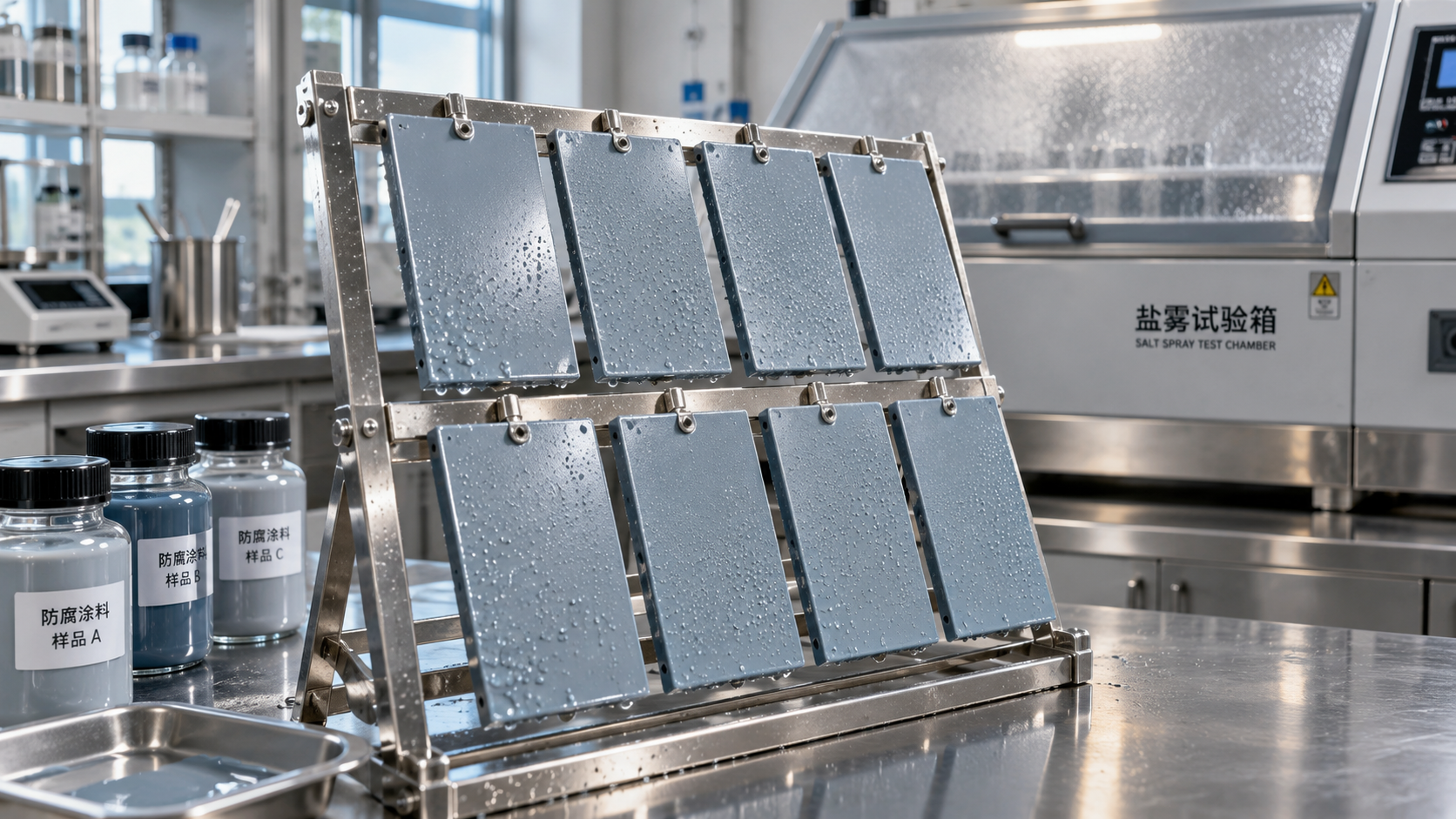
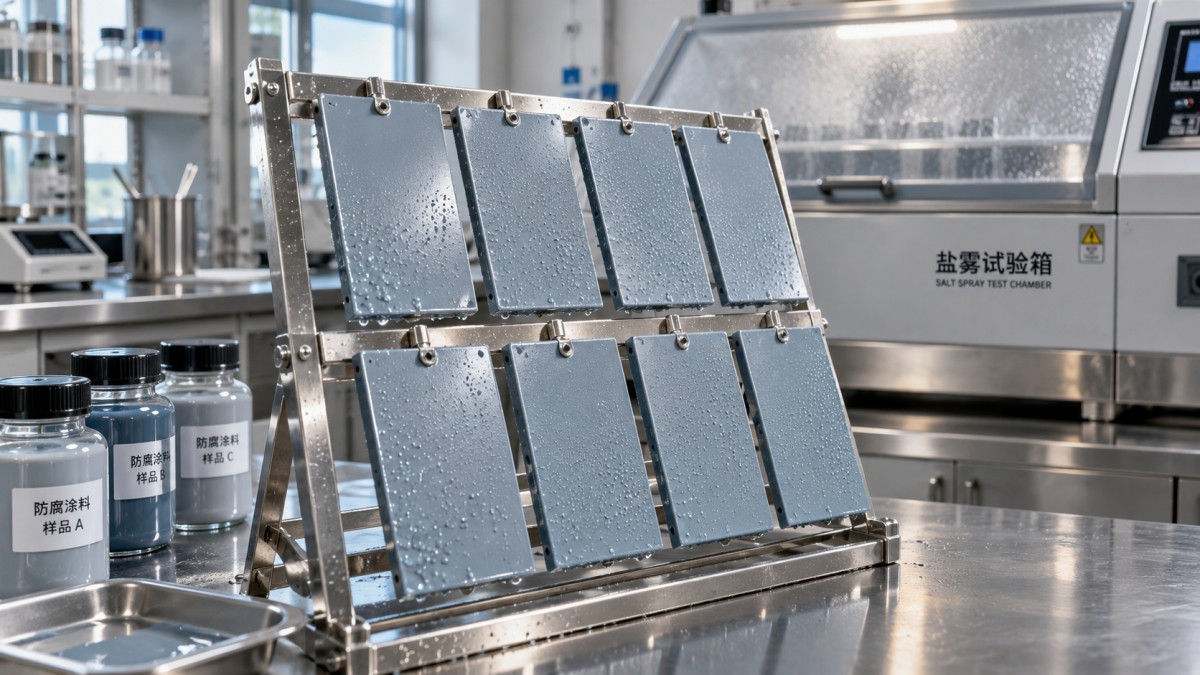
A useful test program links each method to a service concern. Continuous salt spray can reveal formulation weaknesses and support controlled comparisons, but its exposure pattern differs from many operating environments. Test hours should not be converted directly into years of service life.
Cyclic corrosion testing can introduce wetting, drying, humidity, and other stresses that continuous salt spray does not reproduce. The cycle still needs to represent the intended failure mechanisms. Immersion, weathering, temperature cycling, or chemical resistance testing may be needed alongside it.
For standards-based evaluation, specify the test method, specimen preparation, exposure conditions, inspection procedure, and acceptance criteria together. A report stating only that a coating was “tested to a standard” does not establish suitability. The chosen method may describe how to conduct exposure without defining a project-specific pass or fail threshold.
- Compare equivalent specimens. Keep substrate, preparation, dry film thickness, cure conditions, and defect geometry consistent when comparing formulations.
- Inspect both intact and damaged areas. Blistering, rusting, cracking, and corrosion spreading from a scribe reveal different weaknesses.
- Measure adhesion after exposure. Record where failure occurs: at the metal interface, within a coating layer, or between coats.
- Include realistic application conditions. Examine the specified limits for temperature, humidity, recoating, and achievable film thickness.
Electrochemical impedance spectroscopy can help track changes in barrier behavior and the metal–coating interface. It is useful for following degradation before obvious visual failure develops. Interpretation requires a suitable model and supporting observations; a single impedance value should not become a universal pass criterion across different coating technologies.
Film thickness must remain visible in every comparison. A thicker coating may delay transport simply because the pathway is longer. Excessive thickness can also trap solvent, increase stress, or compromise cure. Comparing systems at their intended application thickness gives a more useful basis for selection than comparing their best isolated results.
What evidence should support a formulation change?
A proposed improvement should address a defined failure mechanism. If the existing system loses adhesion after immersion, better gloss retention adds little evidence. If corrosion starts at edges, results from intact flat panels leave the main concern unresolved.
Request comparative data for the complete coating system, including preparation, application conditions, curing, and post-exposure assessment. Examine the failure pattern alongside the rating: reduced scribe creep with increased blistering represents a trade-off that needs explanation.
Supplier changes also deserve attention when the product name remains the same. Changes to resin, pigment treatment, inhibitor source, or dispersion process can affect cure and film behavior. A technical specification should identify which changes trigger requalification and which properties must remain controlled.
The next step is to define the substrate, exposure, application window, and acceptable failure limits before choosing the chemistry. Those conditions make it possible to judge whether a formulation offers a useful improvement that can survive field application and service.
Deep Dive
Related Intelligence
 Industrial CoatingsResin Epoxy CAS 24969-06-0 Procurement: How Buyers Avoid a Costly Formulation MismatchAnalyst:Lead Materials Scientist
 Industrial CoatingsWhy Brand Elevation Strategies Matter More Than Ever for Industrial Coatings Suppliers Targeting EU MarketsAnalyst:Lead Materials Scientist
 Industrial CoatingsWhich Corporate Case Studies Show Measurable ROI from Industrial Coatings Automation in Food Plant Maintenance?Analyst:Lead Materials Scientist