Uneven Water Supply in Layer Cage Systems: What to Check First
Key Takeaways
- How Do You Fix Missing Material Specs in a BIM Handover Model?Chief Civil Engineer
- SpaceX Completes $40 Billion Debt Financing for GPU PurchasesIT & Security Director
- How to identify supplier risks with supply chain cybersecurity analysisIT & Security Director
- Palo Alto Networks Confirms PHP2Shell RCE Flaws Affect PAN-OSIT & Security Director
- How much does cold weather reduce the range of electric scooters?Automotive Tech Analyst
- Used EV Battery Aftermarket Could Reach 10%–20% Share Within Five YearsAutomotive Tech Analyst
- Which electric steering components can cause intermittent assist loss?Automotive Tech Analyst
- Crusoe and Araico Plan 106 MW AI Cloud Infrastructure Project in ParaguayIT & Security Director
Industry Overview
We do not just publish news; we construct a high-fidelity digital footprint for our partners. By aligning with TNE, enterprises build the essential algorithmic "Trust Signals" required by modern search engines, ensuring they stand out to high-net-worth buyers in an increasingly crowded global digital landscape.
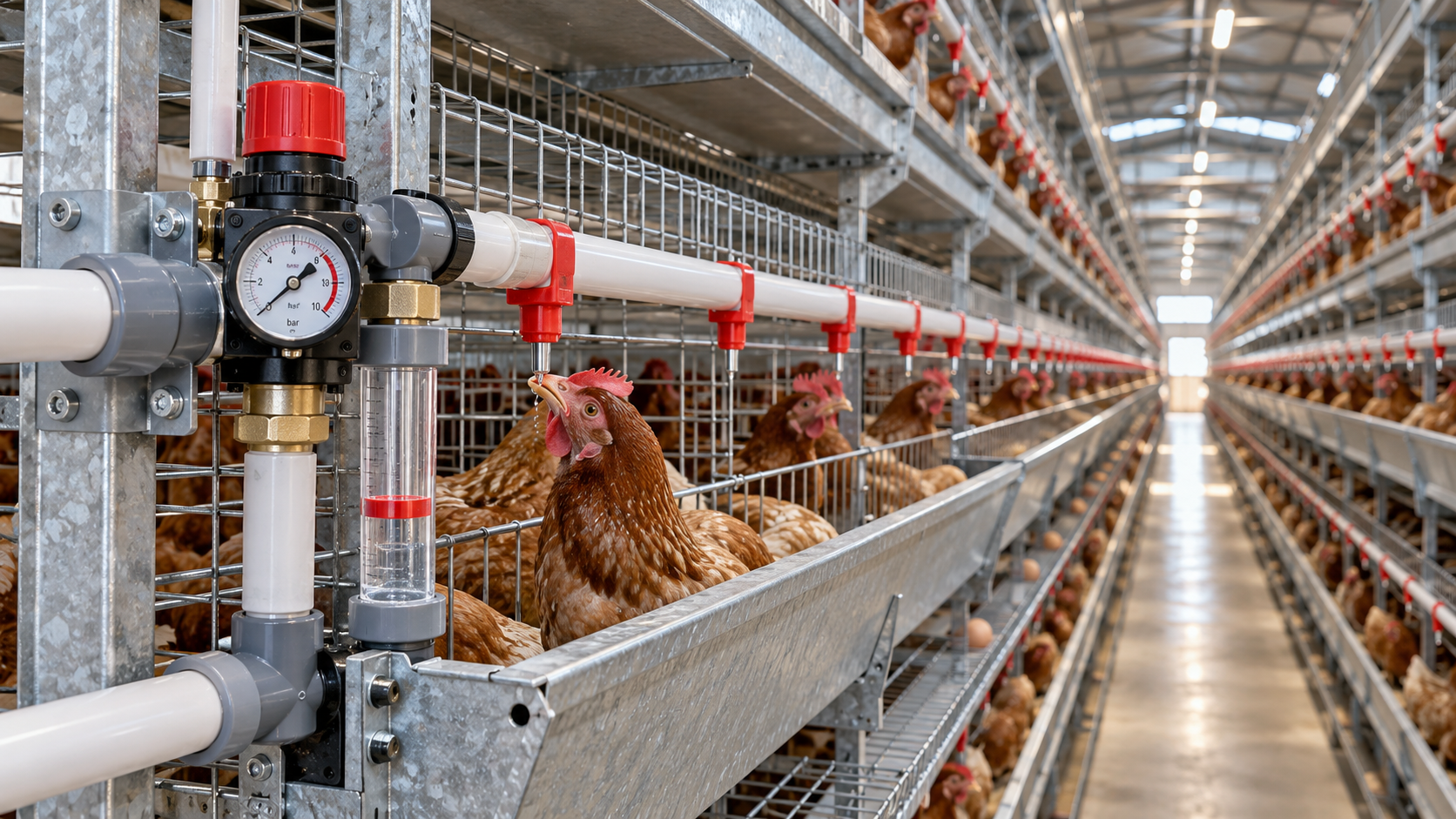
When nipples at the far end of a layer cage row deliver less water than those near the inlet, changing drinkers is rarely the best starting point. Check the extent of the problem, confirm the supply under demand, and compare delivery at matched points along the affected lines. A normal pressure reading while birds are inactive does not establish that the system can maintain supply during heavier use.
For after-sales maintenance staff, the immediate task is to separate a house-wide supply limitation from a tier, branch, or individual nipple fault. That distinction determines whether the next action belongs at the pump, filter, regulator, distribution pipe, or drinking line. It also prevents unnecessary adjustments that leave some cages short of water while others develop leaks and wet manure.
Map the shortage before adjusting anything
Ask the operator where the problem appears, when it occurs, and what changed before it started. A shortage following filter replacement suggests a different inspection route from one that appears after a line extension or only during periods of heavy drinking. Record these observations as clues, not proof of a cause.
Walk the affected row and compare it with an apparently healthy row supplied from the same header. Identify whether the complaint concerns low measured nipple delivery, poor bird access, intermittent supply, or an apparent difference based only on visual observation. These conditions can look similar from the aisle but require different corrections.
If birds cannot obtain water, coordinate an immediate response with the farm manager under the farm’s welfare procedures. Avoid taking an entire drinking circuit out of service merely to make diagnosis easier. General flock guidance treats water availability, equipment adjustment, and water quality as linked management issues, rather than isolated maintenance tasks. [1]
Check the supply while water is moving
The first mechanical check should normally be upstream of the cage lines. Confirm the available tank level or source supply, valve positions, pump status, and the condition of shared filtration equipment. Include recently serviced components: a partially reopened valve or an incorrectly seated filter element can become a misleading “cage equipment” complaint.
Distinguish static pressure from pressure under flow. Static pressure is measured with little or no water moving. It may appear satisfactory even where a restriction limits delivery. Compare readings at suitable service points while the system is supplying water under representative demand. Use installed test connections or manufacturer-approved methods; do not improvise fittings on a pressurized line.
Where gauges are available before and after a filter, compare their readings under the same flow condition. A pressure difference can help locate a restriction, but the acceptable differential depends on the filter and operating conditions. Follow the filter manufacturer’s service criteria rather than applying an arbitrary replacement threshold.
Include dosing equipment, backflow devices, and branch isolation valves in the inspection path. A component that allows enough water through at low demand may still restrict the circuit when several rows draw simultaneously. If the whole house is affected, adjusting individual row regulators before resolving the upstream limitation can obscure the original fault.
Compare regulators and tiers without chasing a universal setting
Once the shared supply is satisfactory, inspect the affected branch regulator. Check its inlet supply, adjustment position, installation orientation, and any serviceable strainer or vent specified by the manufacturer. Compare it with a functioning regulator of the same type, while allowing for differences in elevation and connected load.
There is no single pressure setting suitable for every nipple assembly. Required operating conditions depend on the drinker design, line arrangement, bird stage, and manufacturer’s instructions. A setting copied from another house may produce leakage without restoring adequate delivery at the far end.
In a multi-tier installation, elevation affects the pressure relationship between supply points. Independently regulated tiers should be checked individually; a reading at the main header does not describe conditions at every drinking line. Where a standpipe indicates water head, read it according to the equipment instructions and confirm that the indicator itself is clear and functioning.
Change only one setting at a time and record the original position. If raising the regulator setting improves end-of-line delivery but causes upstream nipples to leak, investigate the distribution problem instead of accepting the higher setting as a repair.
Measure nipple delivery with a repeatable method
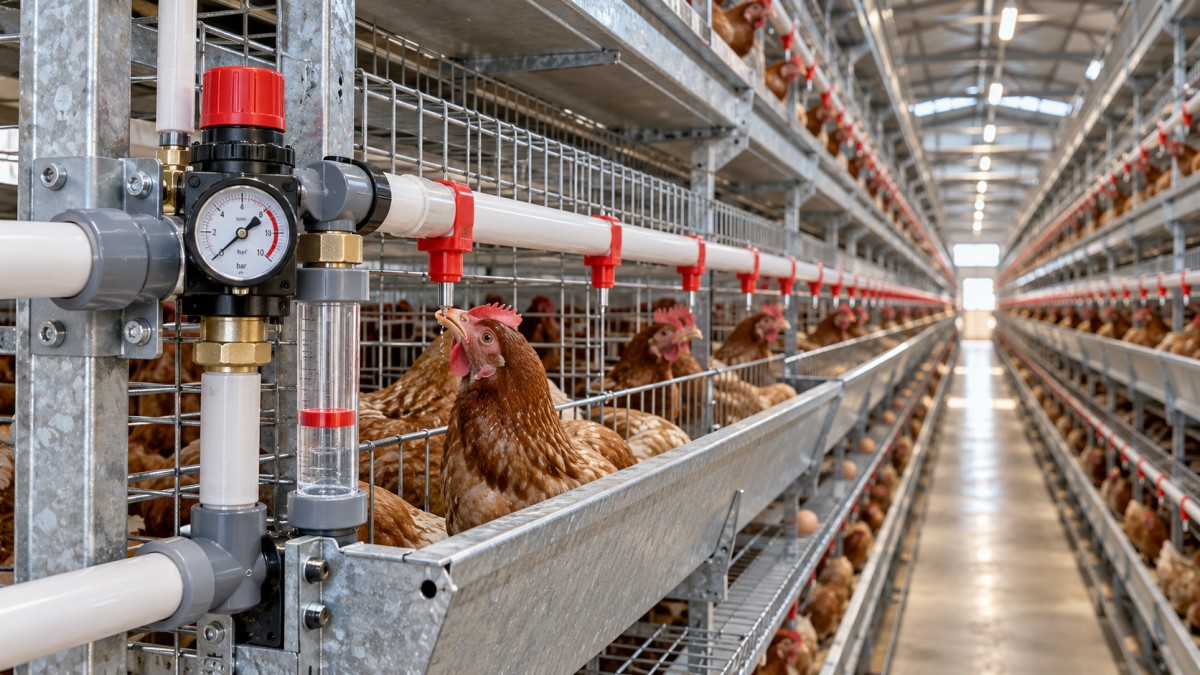
A hand check can identify a completely dry nipple, but it is a poor basis for comparing small differences. Use the drinker manufacturer’s recommended test method, a suitable collection container, and a consistent collection interval. Keep activation direction and force consistent because differences in how the pin is operated can distort the result.
Sample the inlet area, middle, and end of the affected line, then repeat the comparison on a healthy line of similar configuration. Record nipple type, regulator condition, test location, and whether other water use was occurring. Repeat suspicious readings before replacing components.
The pattern matters more than an isolated result:
- A gradual decline along the row suggests checking pressure loss, line condition, and supply capacity.
- A sharp change after one location directs attention to a fitting, valve, kink, or obstructed section near that point.
- One weak nipple among normal neighbors supports inspection of that nipple or its local connection.
- Results that change between tests call for checking intermittent supply, regulator behavior, air, and inconsistent testing technique.
These are diagnostic directions, not definitive findings. Several faults can coexist, particularly after repairs or prolonged service. Compare delivery against the specifications for the installed nipple, not a generic flow figure taken from a different drinking system. Also distinguish mechanical discharge from usable access: a nipple can pass a collection test while remaining poorly positioned for the birds.
Inspect the line before ordering replacement drinkers
Follow the pipe physically from inlet to terminal assembly. Look for sagging supports, unintended high points, pinched flexible connections, installation debris, and fittings that reduce the internal passage. Check whether repairs have introduced components with different bore sizes or whether an extension has changed the original line arrangement.
Trapped air is worth investigating when delivery is erratic, especially after draining, repairs, or supply interruptions. Inspect the intended venting and terminal arrangements rather than opening random connections. A flush outlet that passes water does not, by itself, demonstrate that every nipple operates correctly.
Deposits and accumulated material may restrict either the pipe or individual nipple mechanisms. If fouling is suspected, retain representative observations or samples before cleaning removes the evidence. A water-quality investigation may be needed when blockages recur, particularly where source conditions or treatment practices have changed. Poultry water guidance addresses both microbial quality and mineral-related concerns; a visual check alone cannot establish suitability. [1, 2]
Flush and clean only according to the installed equipment instructions and the farm’s approved treatment procedure. Confirm chemical compatibility, dosing requirements, and any restrictions affecting bird access. Do not mix cleaning products or improvise concentrations. After treatment, verify the required return-to-service conditions rather than assuming that clear-looking discharge proves the system is ready.
Replace nipples when inspection and comparative testing support that decision. Keep a removed component identified by location so that wear, deposits, or mechanical damage can be examined. Replacing scattered parts without retaining the pattern can make a recurring problem harder to diagnose.
Recognize when the fault is in the layout
Some service calls expose a mismatch between the original arrangement and the way the house now operates. Added cages, longer rows, altered tier connections, or changes in the shared supply can leave a previously adequate branch unable to serve its revised load. Repeated regulator adjustment cannot correct every distribution limitation.
When reviewing a layer battery poultry cage system, assess the cage layout and drinking-water distribution together. Row length, tier arrangement, regulator location, branch routing, and service access all influence where measurements can be taken and how a fault can be isolated. The cage configuration provides context; the drinking equipment documentation must establish the permitted hydraulic arrangement.
For a suspected layout problem, obtain the as-built drawing and compare it with the installation. Request the drinking-line manufacturer’s limits for line length, inlet conditions, connected drinkers, and flushing arrangements where applicable. Missing documentation should be recorded as an unresolved information gap, not filled with assumptions based on another farm.
A proposed modification should identify what it changes: available supply, branch pressure loss, independent regulation, or maintenance access. Increasing pipe capacity may address a distribution restriction, while replacing nipples may address local wear. Neither is a substitute for the other.
Prove the repair under the conditions that caused the complaint
A successful quiet-period test is insufficient if the shortage occurred during heavier use. Recheck the affected locations under representative operating demand, coordinating the work so that testing does not compromise water availability. Confirm both restored delivery and the absence of new leakage elsewhere.
The service record should contain enough detail for another technician to repeat the assessment:
- Affected rows, tiers, and nipple locations.
- Before-and-after pressure or water-head readings, with test conditions.
- Nipple delivery results and the collection method used.
- Valve positions, regulator adjustments, cleaning work, and replaced components.
- Any unresolved supply, layout, water-quality, or documentation issue.
Where the fault was intermittent, agree on a follow-up observation period with the operator. Ask for records of when the symptom returns and what other water-consuming equipment is operating. That information is more useful than another unrecorded adjustment.
The practical priority is to locate where supply becomes uneven before changing parts. Start with the shared supply under demand, narrow the investigation to the affected branch, and then test the drinking line consistently. Close the call only when the original shortage has been checked under comparable conditions and the correction has not transferred the problem to another tier or row.
Sources
[1] Hy-Line International, Commercial Layers Management Guide, water management and drinking-water guidance. Use the guide applicable to the flock alongside the installed equipment manufacturer’s instructions.
[2] University of Georgia Cooperative Extension, Poultry Drinking Water Primer, Bulletin 1301. Reference for poultry drinking-water quality, potential contaminants, and water-system management.
Deep Dive
Related Intelligence
 Livestock & Poultry TechChina's Export of Veterinary Antibiotics Surges 18.7% YoY in Q1 2026: Key Industry Impacts and ResponsesAnalyst:Agri-Tech Strategist
 Livestock & Poultry TechChina Feed Industry Association Initiates Revision of Microbial Fermented Feed Additives Group StandardAnalyst:Agri-Tech Strategist
 Livestock & Poultry TechNational Feed Quality Inspection Center Releases Q1 2026 Feed Safety Report: Key Impacts and Industry ResponsesAnalyst:Agri-Tech Strategist