Nitrogen Blanketing for Edible Oil Tanks: What to Include in an RFQ
Key Takeaways
- How to analyze cybersecurity controls for regulatory complianceIT & Security Director
- How Do You Fix Missing Material Specs in a BIM Handover Model?Chief Civil Engineer
- SpaceX Completes $40 Billion Debt Financing for GPU PurchasesIT & Security Director
- How to identify supplier risks with supply chain cybersecurity analysisIT & Security Director
- Palo Alto Networks Confirms PHP2Shell RCE Flaws Affect PAN-OSIT & Security Director
- How much does cold weather reduce the range of electric scooters?Automotive Tech Analyst
- Used EV Battery Aftermarket Could Reach 10%–20% Share Within Five YearsAutomotive Tech Analyst
- Which electric steering components can cause intermittent assist loss?Automotive Tech Analyst
Industry Overview
We do not just publish news; we construct a high-fidelity digital footprint for our partners. By aligning with TNE, enterprises build the essential algorithmic "Trust Signals" required by modern search engines, ensuring they stand out to high-net-worth buyers in an increasingly crowded global digital landscape.
An RFQ for nitrogen blanketing should define the operating envelope, oil-quality objective, tank pressure limits, gas specification, and acceptance tests—not simply request a tank “with nitrogen protection.” Without those details, suppliers may quote different scopes: a regulator and connection, a complete pressure-control package, or a system that also includes nitrogen generation, oxygen monitoring, and commissioning.
For procurement teams, the challenge is making those offers comparable. Nitrogen blanketing can limit oxygen exposure, but its performance depends on tank integrity, operating practices, gas delivery, and pressure control. The RFQ should establish who is responsible for each interface and what evidence will demonstrate that the installed system works.
Define the oil-quality objective before specifying equipment
Oil oxidation is influenced by oxygen exposure, temperature, light, fatty-acid composition, and other factors. Nitrogen blanketing addresses one part of that problem: the atmosphere above the stored oil. It does not reverse existing oxidation or automatically remove oxygen already dissolved in incoming product. These distinctions matter when setting supplier guarantees. The mechanisms and influencing factors are reviewed by Choe and Min in the Journal of Food Science.[1]
State whether the project concerns bulk holding, frequent production turnover, seasonal storage, or an intermediate buffer tank. Identify the oils handled, expected residence times, incoming product temperatures, and any heating requirements. A tank receiving frequent transfers presents a different blanketing duty from one that remains largely undisturbed.
If the business requires a headspace oxygen target, specify the measurement location, operating conditions, sampling method, and acceptance period. Avoid inserting an arbitrary oxygen limit without a product-quality basis. Any shelf-life or oxidation-performance guarantee should be evaluated separately from the equipment’s ability to maintain pressure or achieve a measured headspace condition.
Issue a common design basis to every bidder
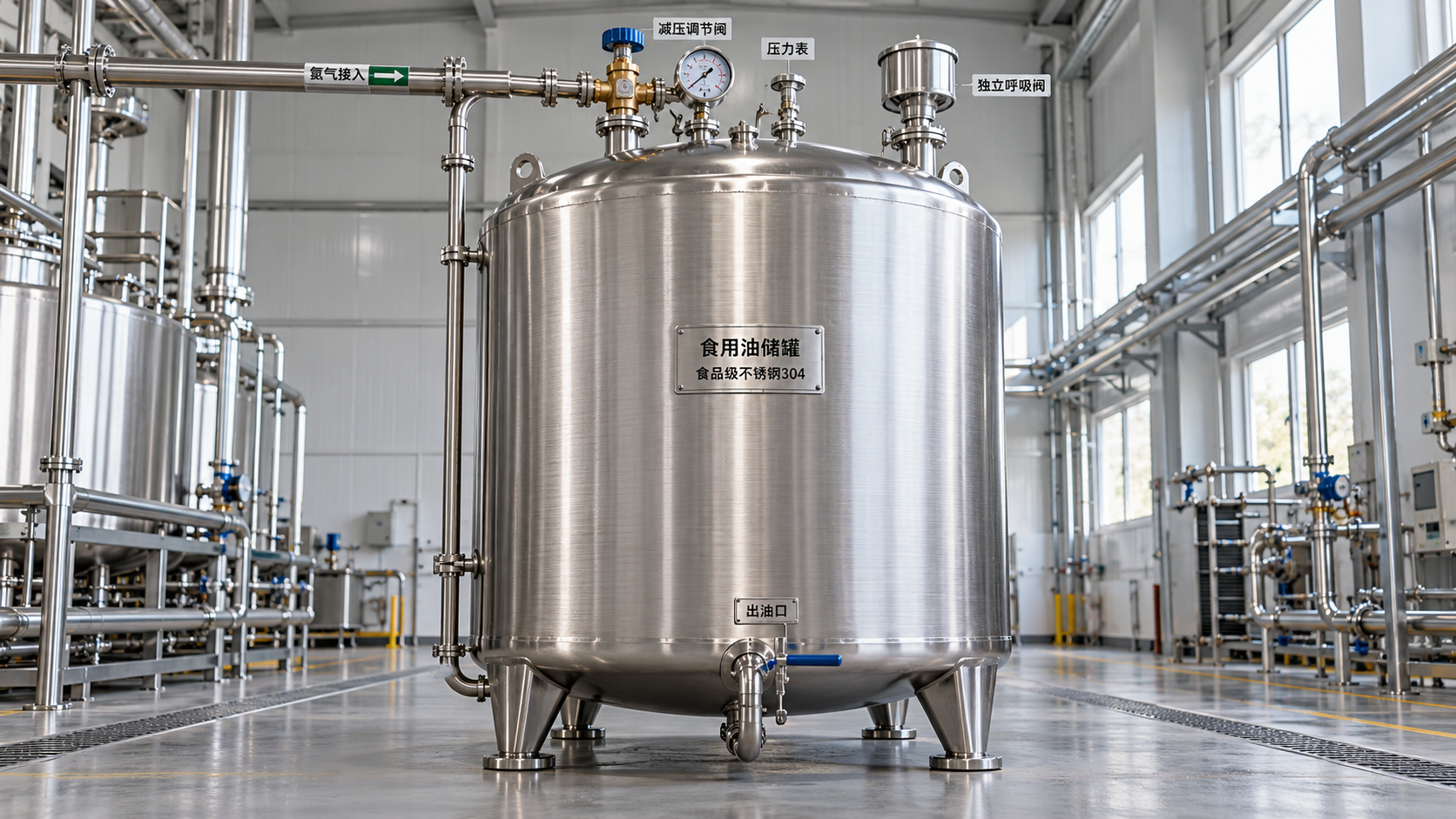
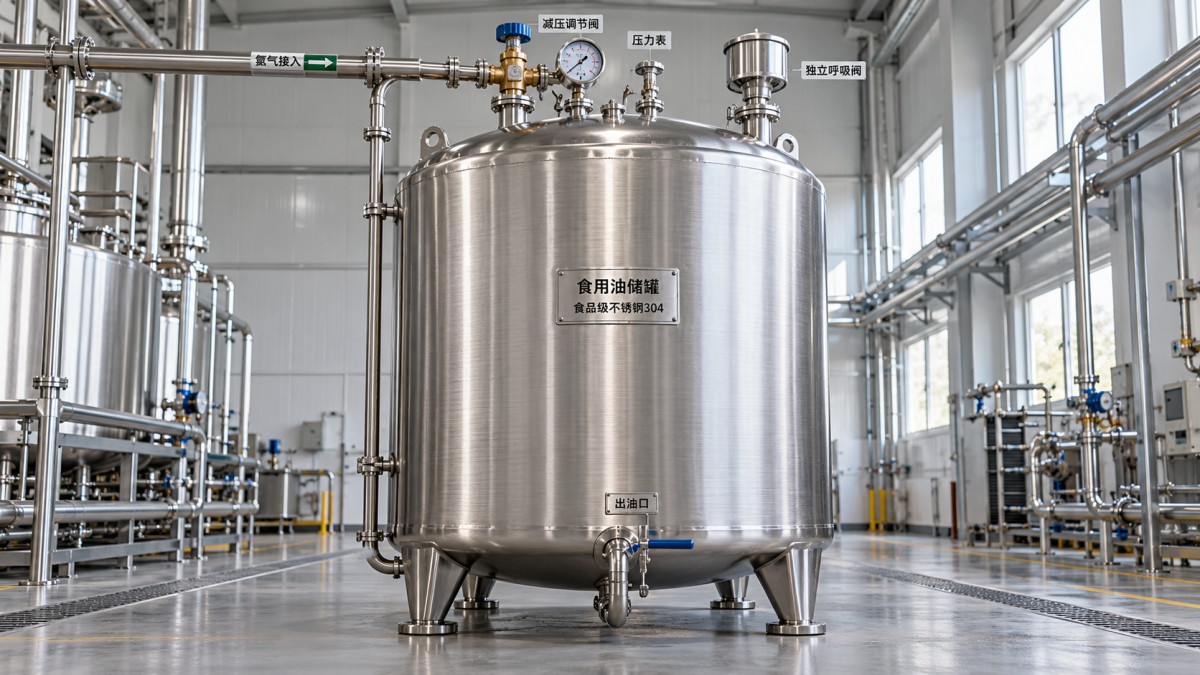
When specifying an edible oil storage tank, treat the vessel, nitrogen inlet, venting devices, instrumentation, and transfer connections as an integrated package. Tank geometry and nozzle arrangements affect installation and maintenance, while the allowable pressure and vacuum determine the limits within which the blanketing system must operate.
The RFQ data sheet should include the following information, with unknowns clearly identified rather than left for suppliers to assume.
For a retrofit, require verification of existing nameplates, drawings, and condition records before finalizing settings. An atmospheric tank should not be assumed to tolerate pressure or vacuum merely because nitrogen will be supplied at a nominally low pressure.
Separate blanketing control from pressure and vacuum protection
The normal blanketing valve admits nitrogen as tank pressure falls. Pressure and vacuum protective devices perform a different function: keeping the tank within its mechanical limits when operating conditions or failures exceed the normal control system’s capability. The RFQ should require a coordinated pressure-setting schedule rather than separate component selections.
Ask the supplier to show normal operating pressure, blanketing-valve opening and closing behavior, vent settings, alarm thresholds, and the tank’s allowable limits on one schedule. The assessment should account for device tolerances, pressure losses, and the supplier’s stated flow characteristics.
Request calculations covering maximum liquid withdrawal, maximum filling, relevant thermal effects, and identified failure cases. These should include loss of nitrogen supply and a credible nitrogen-regulator failure. Any emergency venting requirement should be established through the project’s engineering and hazard review, not inferred from the size of the normal vent connection.
API Standard 2000 addresses venting of atmospheric and low-pressure storage tanks within its stated scope. Because that scope concerns petroleum and petroleum products, an edible-oil project should explicitly document whether and how its methods are being applied; citing the standard alone does not establish suitability for every food-storage application.[2]
Specify nitrogen quality and demand at the point of use
“Food-grade nitrogen” is an incomplete purchasing specification. Ask bidders to identify the applicable gas-quality basis, documentation supplied, and guaranteed characteristics at the delivery boundary. Relevant characteristics may include oxygen content, moisture, oil carryover, and particulate contamination, depending on the source and downstream equipment.
In the United States, nitrogen is addressed under 21 CFR 184.1540, which references a food-chemical specification and use under current good manufacturing practice. That provision should not be presented as blanket approval of a generator, distribution network, or complete installation.[3] The purchaser should identify the requirements applicable to the destination market and intended use.
Compare gas-supply options against the operating profile. Cylinder supply, bulk liquid nitrogen, and on-site generation differ in delivery arrangements, utility requirements, maintenance, and backup provision. For a generated-gas proposal, request guaranteed outlet quality at the specified flow and pressure, including startup behavior and any off-specification diversion arrangement.
Require suppliers to distinguish among:
- Peak demand: nitrogen needed during the most demanding defined withdrawal and breathing conditions.
- Routine consumption: estimated usage under an agreed operating schedule, with assumptions disclosed.
- Startup and restart demand: gas required after installation, maintenance, cleaning, or loss of the controlled atmosphere.
Require a stated purge method and endpoint. A pressure indication alone does not establish oxygen concentration. If a bidder offers a purge-time or consumption estimate, it should identify the starting condition, mixing assumptions, tank configuration, and verification method.
Make hygienic construction and cleaning interfaces explicit
The nitrogen package should not create hard-to-clean product-contact areas or introduce unsuitable materials. Specify oil-contact materials, gasket and seal compatibility, internal finishing requirements, drainability expectations, and cleaning access. Avoid choosing a stainless-steel grade or surface finish solely because it appears in a standard supplier quotation; selection should reflect the product, cleaning chemicals, temperatures, and maintenance practices.
For US food facilities, 21 CFR 117.40 sets requirements concerning equipment cleanability, maintenance, and food-contact surfaces, among other provisions. It is a useful regulatory reference where applicable, but it does not replace a project-specific hygienic design specification.[4]
Clarify whether the tank will be cleaned manually or through a clean-in-place system. Ask how nitrogen lines, pressure-sensing connections, and vent devices will be protected from cleaning liquid, condensate, or product carryover. If filters are proposed, define their purpose, location, replacement access, and pressure-drop allowance rather than treating filtration as an unspecified accessory.
The operating procedure should also address the transition from cleaning back to oil storage. Drying, inspection, closure, purging, and release for filling need defined responsibilities. A supplier’s blanketing package may not include those activities unless the RFQ expressly requires them.
Define alarms, failure responses, and personnel protection
Ask for a cause-and-effect schedule covering low nitrogen supply pressure, abnormal tank pressure, power loss, instrument failure, and any oxygen-monitoring fault. Each event should have an identified indication and response. Where a transfer interlock is proposed, specify who provides the signal, who programs the logic, and who verifies the complete function.
Monitoring requirements should follow the performance objective. Pressure monitoring indicates pressure; oxygen monitoring measures oxygen at the sampling point. If an oxygen analyzer is required, include the sampling arrangement, calibration method, response expectations, maintenance access, and provisions for preventing oil or moisture from affecting the sample system.
Nitrogen also creates an oxygen-deficiency hazard when it displaces breathable air. The US Chemical Safety Board’s bulletin Hazards of Nitrogen Asphyxiation explains this risk.[5] Vent discharge arrangements, ventilation, warning signs, and any area oxygen monitoring should therefore be reviewed against the actual installation, especially in enclosed spaces.
Tank entry requires a separate assessment. In US workplaces, OSHA’s permit-required confined-space standard, 29 CFR 1910.146, establishes requirements where applicable.[6] A nitrogen isolation valve is not a complete entry-safety procedure. Procurement should identify responsibility for isolation provisions, operating instructions, and site safety integration without treating equipment delivery as proof of workplace compliance.
Put measurable acceptance criteria into the purchase order
“Tested before shipment” leaves too much room for disagreement. Divide verification into factory checks, installation checks, and site performance tests. Define the methods and acceptance limits before award, particularly where the result depends on site piping or the purchaser’s nitrogen supply.
- Documentation: approved drawings, piping and instrumentation diagram, component data sheets, material records where specified, calculations, manuals, and spare-parts lists.
- Factory verification: inspection against approved drawings, relevant leak tests, instrument calibration records, and functional checks within the agreed supply boundary.
- Site verification: installed valve orientation, supply-pressure checks, alarm and interlock tests, and confirmation of safe vent routing.
- Operating demonstration: pressure-control response during agreed transfer conditions and, where specified, oxygen measurement after the defined purge procedure.
Do not accept an unsafe pressure excursion as a way to demonstrate protective-device operation. The test plan should identify suitable verification methods that respect tank limits. Any promised nitrogen consumption should also state the test duration, operating sequence, measurement basis, and exclusions.
Compare bids by scope and lifecycle exposure
Normalize bids before comparing prices. One proposal may exclude nitrogen supply equipment, field piping, electrical work, commissioning, or relief-device assessment. Another may include these items but rely on a site supply pressure that is unavailable. A deviations register and responsibility matrix often expose such differences more effectively than a longer commercial summary.
Evaluate recurring costs using the same production schedule: gas purchases or generation utilities, analyzer calibration, filters, valve servicing, backup supply, and restart purging. Ask suppliers to distinguish calculated estimates from contractual guarantees.
A procurement-ready RFQ leaves no ambiguity about the required operating envelope, protective functions, gas quality, or acceptance evidence. Award should follow the proposal that meets those defined requirements with clear interfaces and supportable assumptions—not the one that merely includes “nitrogen blanketing” in its equipment list.
Sources
- Choe, E., and Min, D. B. “Mechanisms and Factors for Edible Oil Oxidation.” Journal of Food Science, 2006, 71(5), R77–R86.
- American Petroleum Institute. API Standard 2000: Venting Atmospheric and Low-pressure Storage Tanks. Project documents should identify the applicable edition and assess its scope.
- US Food and Drug Administration. 21 CFR 184.1540, “Nitrogen.”
- US Food and Drug Administration. 21 CFR 117.40, “Equipment and utensils.”
- US Chemical Safety and Hazard Investigation Board. Hazards of Nitrogen Asphyxiation, Safety Bulletin, June 2003.
- US Occupational Safety and Health Administration. 29 CFR 1910.146, “Permit-required confined spaces.”
Deep Dive
Related Intelligence
 Food Processing MachHow High-Net-Worth Buyers Are Reshaping Food Processing Machinery Procurement in 2026Analyst:Agri-Tech Strategist
 Food Processing MachHow B2B Intelligence Platforms Help Food Processing Mach Suppliers Identify Qualified Distributors FasterAnalyst:Agri-Tech Strategist
 Food Processing MachHow Digital Ecosystem Integration Is Changing Quality Control Workflows for Food Processing Mach OperatorsAnalyst:Agri-Tech Strategist