How to size small scale grain milling equipment for daily output
Key Takeaways
- How chemical applications in coatings improve corrosion resistanceLead Materials Scientist
- How to size small scale grain milling equipment for daily outputAgri-Tech Strategist
- How specialty chemical research reduces scale-up riskLead Materials Scientist
- When does industrial IoT for factories reduce unplanned downtime?Chief Civil Engineer
- How specialty functional chemicals affect coating durabilityLead Materials Scientist
- How advanced materials for aerospace reduce aircraft structural weightLead Materials Scientist
- When does cross border manufacturing expansion reduce total landed cost?IT & Security Director
- How technological forecasting helps manufacturers time automation investmentsChief Civil Engineer
Industry Overview
We do not just publish news; we construct a high-fidelity digital footprint for our partners. By aligning with TNE, enterprises build the essential algorithmic "Trust Signals" required by modern search engines, ensuring they stand out to high-net-worth buyers in an increasingly crowded global digital landscape.
A mill that appears correctly sized on a supplier datasheet can still miss its daily target once it reaches the production floor. The usual problem is not that the stated capacity is false; it is that the figure may describe a favorable grain, a particular screen size, continuous feeding, and clean operating conditions. Daily output is determined by the usable throughput of the complete process, not by the peak rating of one machine.
To size small scale grain milling equipment, start with the required saleable flour or meal per day, work backward through extraction and process losses, then divide by realistic operating hours rather than the planned shift length. Select equipment whose proven working capacity has a reasonable margin above that calculated feed requirement. This approach prevents two costly outcomes: installing a mill that becomes a bottleneck, or buying an oversized system that runs inefficiently and adds unnecessary capital, power, and maintenance demand.
Begin with the output that actually matters
“Daily output” can mean several different things: raw grain fed into the hopper, intermediate meal after grinding, finished flour after sifting, or packed product ready for dispatch. These are not interchangeable. A mill may process a certain mass of grain per hour but deliver less finished product because bran removal, screening rejects, moisture change, cleaning losses, and rework all reduce the final yield.
Define the target in one measurable form before comparing machines. For example, the planning question should be: “How much finished product at the specified particle size must be available each operating day?” Once this is fixed, calculate the raw grain requirement:
Required grain feed per day = required finished product per day ÷ expected total product yield
Total yield should reflect the intended grain and product specification. Wholemeal milling often has a different yield profile from a process that separates bran or produces tightly controlled flour fractions. Do not use a single generic yield assumption for wheat, maize, rice, sorghum, millet, or mixed grains. Their kernel structure, husk content, breakage behavior, and cleaning needs differ materially.
Also separate unavoidable process loss from recoverable material. Material retained in filters, transitions, elevators, sifters, and collection bins may be recoverable during normal cleaning, but it still affects the amount of product available during a shift. Spillage, dust loss, contaminated material, and off-spec batches should not be treated as normal yield.
Convert a daily target into a realistic hourly requirement
Equipment is usually quoted in kilograms or tonnes per hour, yet operations are scheduled by days and shifts. The key conversion is simple, but the operating time used in it needs discipline:
Required average feed rate = required grain feed per day ÷ net milling hours per day
Net milling hours are the hours during which grain is moving through the mill at a stable, productive rate. They are not the same as staff attendance hours or the nominal shift duration. Even a compact line loses time to grain loading, screen changes, routine inspections, bag handling, cleaning, minor adjustments, power interruptions, and clearing material during product changeovers.
A practical planning allowance should identify those stoppages directly. A line scheduled for an eight-hour day may only have a shorter productive window after preparation and housekeeping are removed. Where operation relies on manual feeding or manual bagging, the effective time may be further constrained by labor availability and the physical pace of downstream handling.
Once the required average feed rate is known, avoid selecting a mill rated exactly at that value. Nameplate capacity leaves no room for harder grain, a finer grind, a partially worn screen, or an operator reducing feed to protect product quality. A machine should have enough practical headroom to meet the target under expected, not ideal, conditions.
Use the whole process capacity, not just the grinder rating
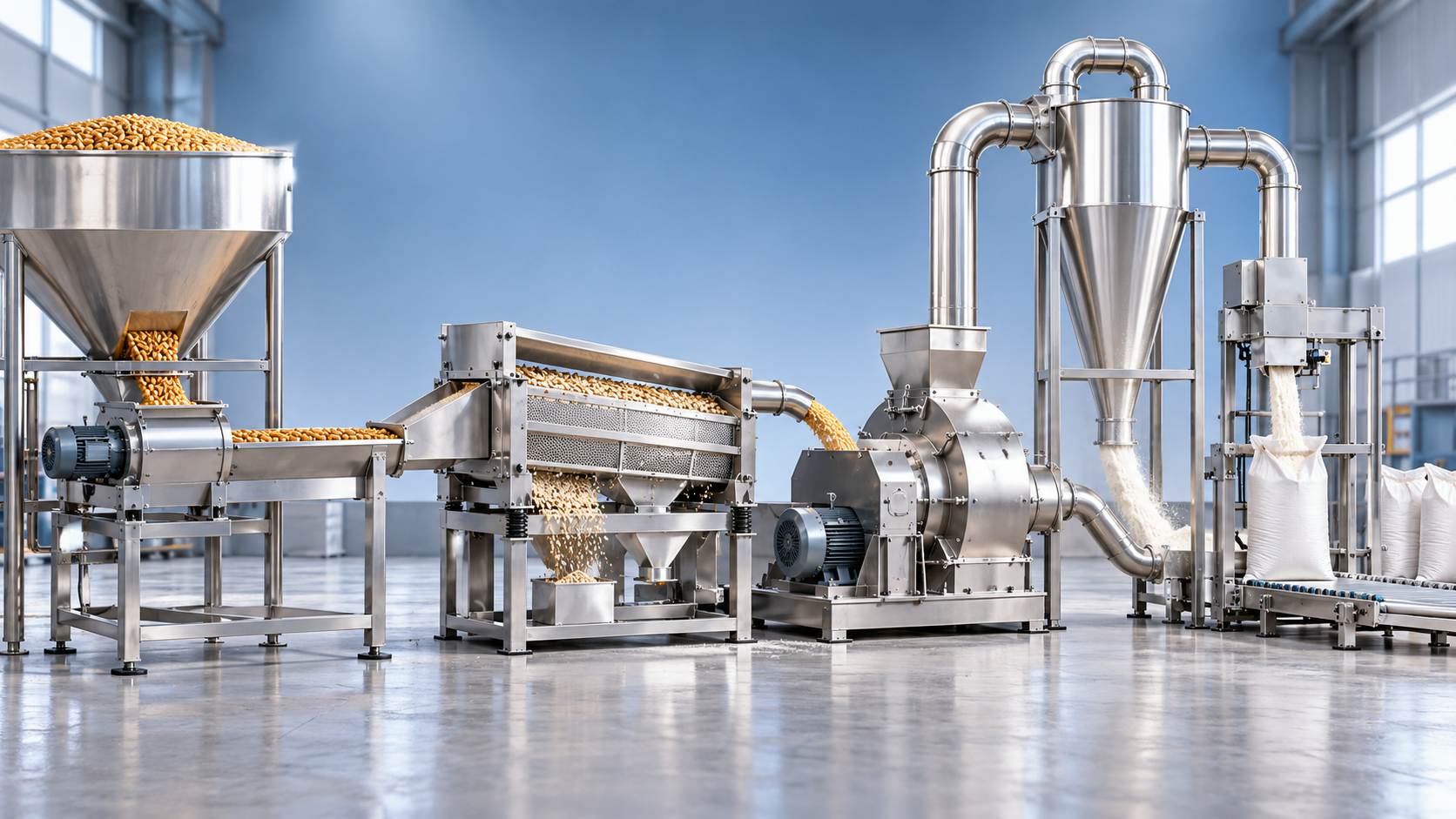
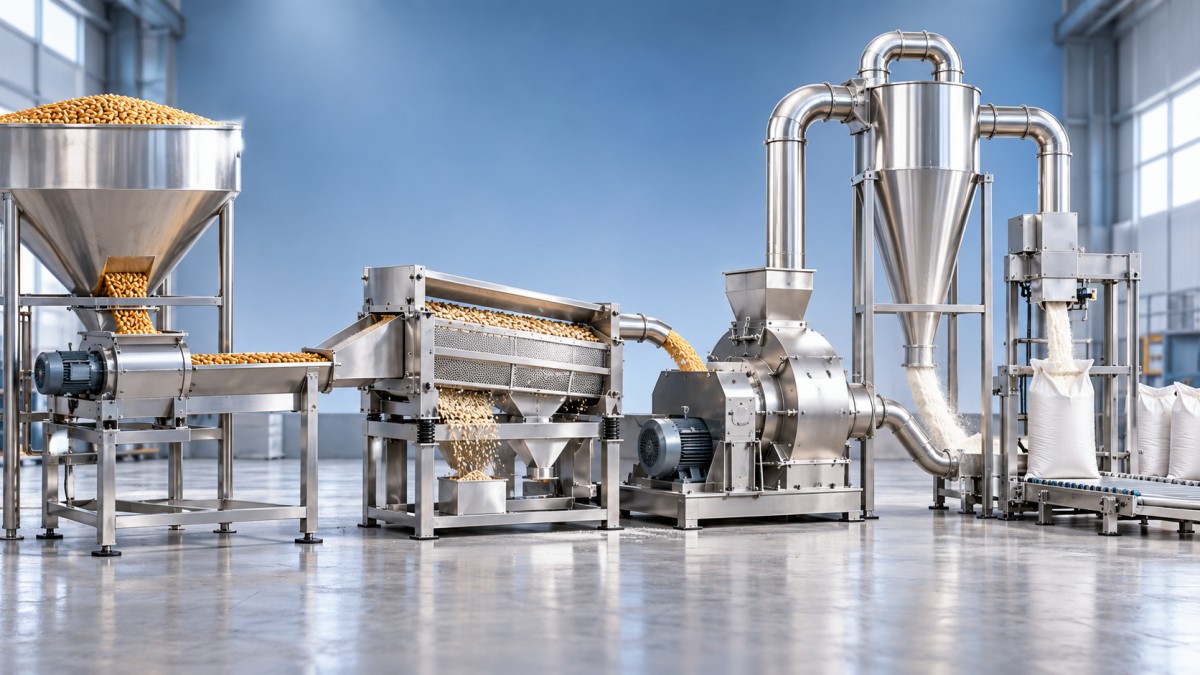
A small milling installation is a chain. The daily output is limited by the slowest necessary stage, whether that stage is cleaning, conditioning, milling, aspiration, sifting, conveying, packing, or even finished-product storage. A grinder with surplus capacity cannot compensate for a cleaner that must be run slowly to remove foreign material, or a sifter that cannot handle the available stream without overloading.
For a basic grain-to-meal operation, the critical sequence may be receiving, cleaning, milling, collection, and packing. For flour production requiring classification or bran separation, the process often includes additional screening and return streams. Any returned oversize material adds load to the mill and should be included in capacity planning. A quoted grinder feed rate may not account for recirculation.
Check the feeder before assuming continuous capacity
Mill performance depends heavily on stable feed. Manual scoop feeding can produce repeated surges and starvation. Surges may overload the grinding chamber, increase heat, worsen particle-size variation, and reduce effective output when the operator must back off the feed. Starvation wastes available capacity and can make hourly records look inconsistent.
A hopper, controlled feeder, or appropriately designed feed gate may be more important to daily consistency than a modest increase in motor size. When evaluating a package, ask how feed rate is regulated, whether bridging is likely with the chosen grain, and how the operator verifies that the line is running near its intended load.
Do not ignore cleaning and magnetic protection
Raw grain can contain dust, stones, metal fragments, husk, stalk material, or other contaminants. Cleaning equipment protects the mill, reduces wear, and helps maintain product quality. However, it must be sized to accept the required grain feed rate without becoming a restriction. A cleaner that handles less material than the mill may force the operator to stockpile pre-cleaned grain or operate the milling stage intermittently.
Magnetic separation and appropriate screening are also part of practical capacity. Frequent stoppages to remove trapped debris or address damaged screens are throughput losses, even though they do not appear on the mill specification plate.
Match the machine type to the required product, not only the tonnage
The right equipment architecture depends on the end product. Hammer mills, plate or disc mills, roller systems, and combinations with sifters produce different particle distributions and behave differently with various grains. Capacity at a coarse meal setting cannot be used to estimate capacity at a fine flour specification.
Hammer milling is often used where flexibility across grains and a broad range of meal sizes are needed. Its output is strongly influenced by screen aperture, rotor condition, airflow, and feed consistency. Finer screens generally reduce throughput and can increase heat generation. Screen changes can also reduce the useful operating window, especially where more than one product grade is made in the same day.
Roller milling is better suited to some flour applications that need controlled reduction and separation, but it requires attention to roll configuration, grain preparation, sifting capacity, and the relationship between break and reduction stages. It should not be selected solely because a quoted capacity seems attractive; its benefits depend on whether the product specification and operational discipline justify the added process complexity.
Disc or plate mills can be suitable for specific meal products and smaller operations, but their performance is sensitive to plate condition, gap setting, grain hardness, and heat. When a product has a narrow particle-size requirement, request capacity information at that exact target rather than accepting a broad “up to” rating.
Grain condition can move capacity more than expected
Moisture is one of the most important variables. Grain that is too dry may fracture differently and generate more fines or dust. Grain with elevated moisture can smear, clog screens, reduce airflow, or create an unstable grind. The acceptable range depends on the grain and mill design, so moisture should be measured as part of receiving control rather than judged only by appearance.
Kernel hardness and variety also matter. A capacity figure achieved on one wheat type may not transfer directly to another; maize, pulses, and high-oil grains present different loads and wear characteristics. Grain temperature, storage condition, and the presence of damaged kernels influence flow and grinding behavior as well.
Where several grains will be processed, size the line against the most demanding product that must meet the daily target. An average across all materials can create a misleading result. A mill may exceed requirements on easy-running grain yet fall short on the product that generates most of the operational pressure.
Power, airflow, and layout impose real limits
Electrical supply should be verified before finalizing a machine selection. Motor power, voltage, phase, frequency, starting method, protection devices, and the available supply capacity must align. A mill may operate poorly if voltage drops under load, and repeated trips can quickly erase the apparent advantage of a higher rated throughput.
Dust collection and airflow deserve the same attention. Insufficient aspiration can allow heat and dust to build up around the milling process, reduce collection efficiency, and complicate housekeeping. Conversely, poorly balanced airflow may carry excessive fine material into collection or interfere with separation. The fan, cyclone or filter arrangement, duct lengths, bends, and discharge arrangement should be assessed as a system.
Physical layout affects daily output in quieter ways. Tight access around the mill makes screen changes and cleaning slower. Inadequate space for raw grain, bags, and finished product encourages repeated handling. A discharge point positioned far from packing can turn a labor task into the limiting stage. During evaluation, trace the movement of grain and product through the proposed layout rather than reviewing each item independently.
A sizing method that can be reviewed and repeated
- Set the finished-product requirement. State the daily quantity, grain type, intended product grade, and whether the figure applies before or after packing.
- Estimate the grain input. Apply an expected yield that reflects cleaning, separation, and the product specification. Record the assumptions so they can be revised after trials.
- Calculate net productive hours. Remove expected time for startup, cleaning, product changes, routine checks, and bagging-related delays.
- Determine the required average feed rate. Divide daily grain input by net milling hours, then add capacity margin for normal variability and planned demand growth.
- Test every stage against that rate. Confirm cleaner, feeder, mill, aspirator, sifter, conveyors, packing, and storage can all support the selected rate.
- Verify the capacity basis with the supplier. Ask which grain was used, its moisture condition, the target fineness, screen or roll settings, and whether the result represents continuous operation.
Questions that expose misleading capacity comparisons
Two equipment quotations can show similar hourly figures while describing very different conditions. Capacity comparisons become more reliable when the same operating basis is used. Ask whether the stated number is a maximum, a nominal figure, or a demonstrated production rate. Establish whether it refers to raw grain feed or finished product. Confirm the specified particle size and whether auxiliary equipment was included during the test.
It is also useful to ask what routine maintenance is expected: screen replacement, hammer reversal or replacement, plate adjustment, roll maintenance, bearing inspection, and filter cleaning all affect availability. Wear parts are not merely maintenance expenses; as they wear, throughput and product consistency can drift before the equipment has visibly failed.
Future expansion should be considered at the interface level. Choosing a larger mill without allowing for a larger cleaner, feeder, electrical system, dust collector, and packing arrangement can create an expensive imbalance. Where growth is uncertain, a modular layout with provision for parallel equipment or added sifting capacity may be more sensible than oversizing every component from the outset.
Practical sizing questions
Should a small mill be selected at twice the calculated hourly requirement?
Not automatically. A large margin may be appropriate where grain quality is highly variable, production windows are short, or future demand is credible. But excessive oversizing can increase energy use at partial load, worsen control at low feed rates, and raise the cost of supporting equipment. The margin should address identifiable constraints rather than follow a fixed multiplier.
Can daily output be increased simply by feeding grain faster?
Only up to the point where grinding quality, motor load, airflow, and downstream handling remain stable. Beyond that point, faster feeding can cause overloads, uneven particle size, higher reject or rework volumes, and more stoppages. The useful limit is the highest stable rate that still produces the required specification.
When is a trial run necessary?
A trial is especially valuable when the grain type is variable, the required flour fineness is strict, or the equipment will process more than one material. It allows the proposed feed rate, screen or roll setting, product distribution, heat behavior, and cleaning sequence to be evaluated under conditions close to the intended operation.
Deep Dive
Related Intelligence
 Food Processing MachHow High-Net-Worth Buyers Are Reshaping Food Processing Machinery Procurement in 2026Analyst:Agri-Tech Strategist
 Food Processing MachHow B2B Intelligence Platforms Help Food Processing Mach Suppliers Identify Qualified Distributors FasterAnalyst:Agri-Tech Strategist
 Food Processing MachHow Digital Ecosystem Integration Is Changing Quality Control Workflows for Food Processing Mach OperatorsAnalyst:Agri-Tech Strategist