How to verify supplier credentials in global chemical sourcing
Key Takeaways
- OpenRouter Removes Three AI Inference Providers After Prompt TheftIT & Security Director
- How to verify supplier credentials in global chemical sourcingLead Materials Scientist
- National Cybersecurity Standards Committee Seeks Feedback on Three GuidelinesIT & Security Director
- How to verify specialty chemical exporters in IndiaLead Materials Scientist
- Trump Fires National Cyber Director, Names Kirsten Davies Acting DirectorIT & Security Director
- Can mobile POS systems accept payments without internet access?IT & Security Director
- Malaysia and US Deepen Sovereign AI Cloud Cooperation, With $50 Million in US SupportIT & Security Director
- How chemical recycling is reshaping plastics technology in EuropeLead Materials Scientist
Industry Overview
We do not just publish news; we construct a high-fidelity digital footprint for our partners. By aligning with TNE, enterprises build the essential algorithmic "Trust Signals" required by modern search engines, ensuring they stand out to high-net-worth buyers in an increasingly crowded global digital landscape.
A low quotation for a chemical may look attractive until the buyer discovers that the company on the invoice is not the manufacturer named on the certificate, or that the proposed grade cannot legally be imported for the intended use. In global chemical sourcing, verify the legal entity, the actual production site, product-specific quality evidence, and applicable regulatory obligations before committing to an order.
Start with independent records and trace every document back to the entity, facility, material, and batch it claims to cover. A business registration proves that an entity exists; it does not prove that the entity manufactures the chemical, controls its quality, or can supply it lawfully in the destination market.
Establish who is selling and who is making the material
Ask for the supplier’s full legal name, registration number, registered address, operating address, and the name of the contracting entity. Check these details against the relevant official business registry where access is available. Review the company’s status and registration information, and investigate discrepancies rather than assuming that a familiar trading name belongs to the registered entity.
Then identify the manufacturer and the precise production site. A distributor can be a legitimate and useful source, but its role should be transparent. Request documentation showing its relationship with the manufacturer and its authorization to supply the proposed product where applicable. Confirm the relationship through an independently obtained manufacturer contact, not solely through an email address supplied in the same document.
Compare the legal entity on the quotation, contract, invoice, bank account, and shipping documents. Different names are not automatically a problem: a group company, trading arm, or third-party logistics provider may have a legitimate role. Ask for a written explanation and supporting records before approving payment. Treat a last-minute bank account change as a separate verification event, using a previously verified contact channel.
Match credentials to the product and site
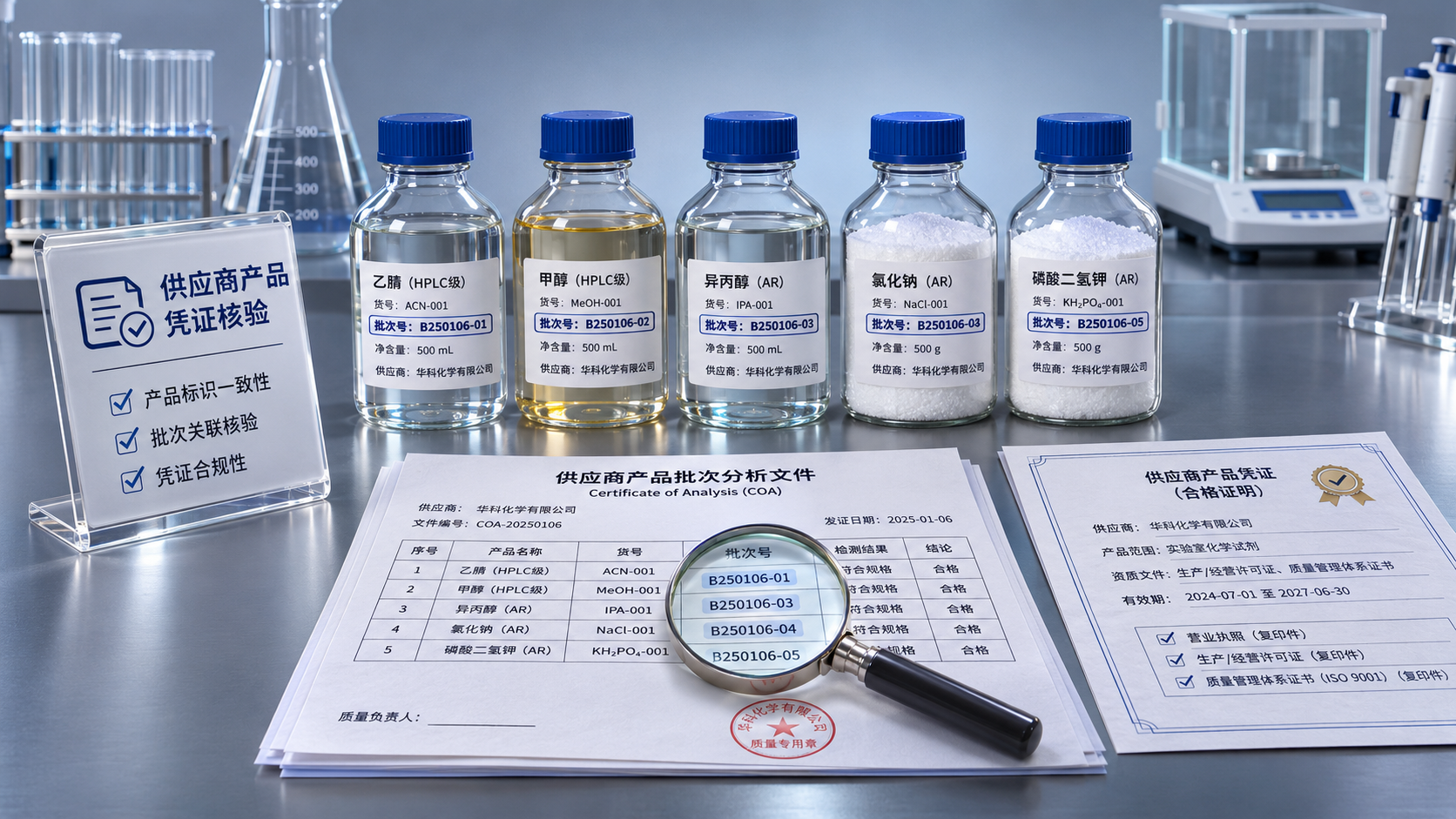
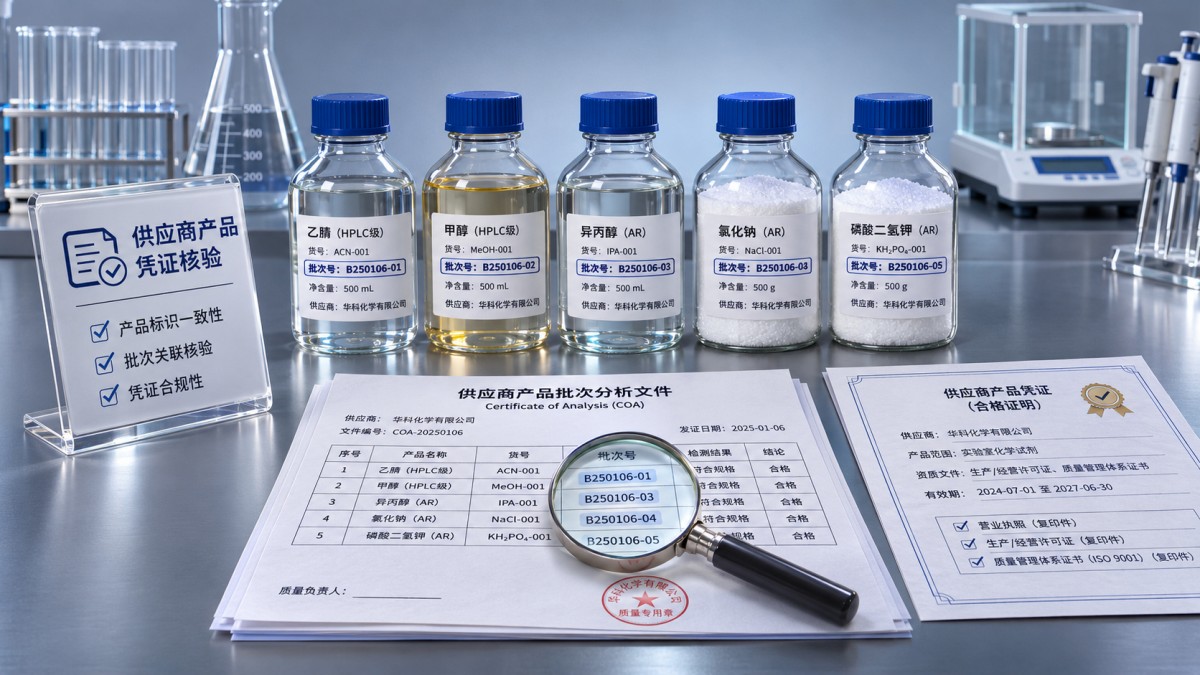
Collect a product specification, safety data sheet (SDS), representative certificate of analysis (CoA), and the relevant quality-system certificates. These documents answer different questions and should not be treated as interchangeable.
- Product specification: Defines the agreed properties and acceptance limits for the grade being purchased. Check test methods, units, and any critical impurity limits.
- CoA: Reports test results for a defined batch. Match its batch number to the containers and shipping records when the order is dispatched.
- SDS: Communicates hazard, handling, storage, and emergency information. Check the product identity, revision date, supplier details, and suitability for the destination market.
- Quality-system certificate: Describes a certified management system within a stated scope. Check the legal entity, site, activities, validity dates, and issuing certification body.
Verify certification status through the issuing body’s directory or by contacting it through independently sourced details. Where relevant, also check whether the certification body is accredited for the applicable scope. A certificate for a sales office does not establish that a particular factory is certified; an expired certificate or a scope that excludes manufacturing may require further investigation.
Align the chemical name, CAS number where applicable, concentration, grade, and intended use across the documents. Mixtures, formulations, and substances with similar names can create ambiguity. A certificate for a related grade is not evidence that the quoted grade meets your specification. If a document omits a critical property, ask whether it is controlled, how it is tested, and whether the result can be included on the batch CoA.
Test the manufacturing claim
Marketing material and equipment photographs are useful leads, not proof of capacity. Ask the supplier to describe the production route at a level it can disclose, identify the site performing each relevant operation, and explain which activities are subcontracted. For a blender or repacker, clarify where the underlying material is made and which organization controls formulation, testing, packaging, and batch release.
Request a process flow or site overview, examples of batch records with confidential information removed, and an explanation of incoming-material controls, in-process checks, and release testing. A credible answer should connect the promised specification to actual controls. For example, if moisture is critical to your process, establish how it is measured, what packaging protects the material, and how the supplier controls exposure during filling and storage.
Capacity statements also need context. Ask about normal lead time, available production slots, minimum order quantity, maintenance shutdowns, and reliance on a single raw-material source. Claimed annual capacity alone does not establish that the requested volume is available when needed. For a business-critical material, an on-site audit or a suitably scoped independent audit can help verify the site, equipment, records, and management controls. Agree on audit access and confidentiality before relying on an audit report.
Confirm the compliance route before placing the order
Regulatory responsibility depends on the substance or mixture, its use, the countries involved, shipment quantities, and the parties’ roles. Identify who is the manufacturer, exporter, importer, and, where applicable, the entity responsible for registration or notification. Do not accept a generic statement that a product is “fully compliant” without identifying the obligation it addresses.
Ask for evidence relevant to the transaction, such as the applicable registration or notification details, product-specific declarations, and destination-appropriate SDS and labels. Where a registration number or proprietary information cannot be shared directly, establish a suitable verification route with the responsible party or its authorized representative. A number on an SDS is not, by itself, proof that your particular import and use are covered.
Check transport classification separately from product quality. Confirm the proposed classification, packaging, labeling, and shipping documentation with the responsible logistics parties. For controlled, hazardous, or restricted chemicals, determine whether permits or other approvals apply before agreeing to dispatch. Involving regulatory and transport specialists is appropriate when the legal position or classification is uncertain; an attractive price cannot compensate for an unresolved import obligation.
Use samples and batch evidence to reduce commercial risk
A sample is useful only when its identity and relationship to future production are clear. Record the grade, source site, batch number, specification, and test methods. Ask whether it is taken from routine commercial production or prepared separately, and whether the eventual shipment will use the same manufacturing route and controls.
Agree on qualification testing against the properties that affect your process and end use. Depending on the material, these may include purity, impurity profile, particle size, viscosity, moisture, or stability. A sample that passes a laboratory test does not guarantee that later batches will perform identically, so define batch acceptance limits and document how out-of-specification material will be handled.
For a first order, consider a volume and delivery arrangement proportionate to the unresolved risk. A smaller initial shipment can limit exposure while the parties test documentation, logistics, packaging, and batch consistency. It may carry a higher unit or freight cost; compare that cost with the potential expense of rejected material, production disruption, return transport, or disposal. Do not assume that a trial shipment substitutes for regulatory checks or a necessary site audit.
Turn verification findings into purchasing terms
Put the approved manufacturer, production site, product identity, specification, test methods, packaging, and documentation requirements in the purchasing agreement or its referenced quality agreement. Require advance notice and, where appropriate, approval for changes to the site, manufacturing process, raw-material source, formulation, or test method. Without a change-control provision, evidence collected during qualification may no longer describe the material delivered later.
Define the documents required with each shipment, including the batch CoA and applicable transport records. Agree on sampling procedures, the period for reporting a suspected nonconformity, and how disputed results will be investigated. Clarify responsibilities for replacement, return, disposal, and associated costs, subject to the negotiated contract and applicable law.
Build the comparison around total landed and qualification cost rather than quoted material price alone. Include freight, insurance, duties where applicable, testing, audit expenses, inventory, and the cost of managing longer lead times. A lower quotation may be less competitive if the supplier cannot provide batch evidence, requires extensive retesting, or cannot support the delivery schedule.
Decide when a discrepancy blocks approval
Not every inconsistency is fraud. A changed company name, different operating address, or distributor-issued invoice may have a documented explanation. Record the issue, obtain evidence from an independent or authoritative source where possible, and assign an owner and deadline for resolution. Keep the approval conditional while a material issue remains open.
Pause the transaction when the supplier cannot establish the contracting entity, refuses reasonable verification of the production site, provides certificates that do not match the product or facility, or cannot explain conflicting batch information. An unverified bank change or an unresolved import restriction also warrants a hold. If the gap concerns a critical safety, legal, or quality requirement and cannot be closed, do not convert uncertainty into acceptance simply to preserve the quoted price or delivery date.
Keep the evidence with the supplier record and set review triggers: certificate expiry, ownership or site changes, significant quality incidents, new intended uses, and changes to the destination market. Reverification should focus on what has changed and whether the original approval still covers the material being ordered.
Deep Dive
Related Intelligence
 Specialty ChemicalsSodium Methoxide Selection: How Chemical Buyers Reduce Specification and Handling RiskAnalyst:Lead Materials Scientist
 Specialty ChemicalsHow Corporate Case Studies Reveal Real-World Challenges in Adopting Specialty Chemicals for Food SafetyAnalyst:Lead Materials Scientist
 Specialty ChemicalsCan Brand Elevation Tactics Reduce Customer Acquisition Cost for Specialty Chemicals in Organic Food Production?Analyst:Lead Materials Scientist