How to verify specialty chemical exporters in India
Key Takeaways
- OpenRouter Removes Three AI Inference Providers After Prompt TheftIT & Security Director
- How to verify supplier credentials in global chemical sourcingLead Materials Scientist
- National Cybersecurity Standards Committee Seeks Feedback on Three GuidelinesIT & Security Director
- How to verify specialty chemical exporters in IndiaLead Materials Scientist
- Trump Fires National Cyber Director, Names Kirsten Davies Acting DirectorIT & Security Director
- Can mobile POS systems accept payments without internet access?IT & Security Director
- Malaysia and US Deepen Sovereign AI Cloud Cooperation, With $50 Million in US SupportIT & Security Director
- How chemical recycling is reshaping plastics technology in EuropeLead Materials Scientist
Industry Overview
We do not just publish news; we construct a high-fidelity digital footprint for our partners. By aligning with TNE, enterprises build the essential algorithmic "Trust Signals" required by modern search engines, ensuring they stand out to high-net-worth buyers in an increasingly crowded global digital landscape.
A reliable specialty chemical exporter should be able to show that the legal entity selling the material, the site producing it, and the documents accompanying it all match the proposed transaction. For a procurement team assessing chemical exports from India, a low quotation or polished catalog is only a starting point: the decision depends on whether the supplier can consistently deliver the required grade, document its origin, and meet the import requirements of the destination market.
Begin with the product and application, then verify the exporter and its manufacturing chain against that requirement. A distributor can be a sound choice if its role and upstream controls are clear; a manufacturer may still be unsuitable if it cannot control the impurity profile or provide the records your application requires. The level of due diligence should rise with the consequences of a failed batch, a delayed shipment, or a compliance problem.
Start with the material, not the supplier’s catalog
Before requesting documents, define what a successful delivery must look like. Specialty chemicals sold under a similar commercial name can differ in concentration, residual solvents, trace impurities, water content, particle size, or stability. Those differences may affect formulation performance even when the headline purity appears acceptable.
Give potential exporters a controlled specification that identifies the chemical name and relevant identifiers, the intended grade, critical acceptance limits, analytical methods where relevant, packaging requirements, and expected order volume. State any application constraints, such as sensitivity to particular impurities or a requirement for a defined manufacturing origin. If some information is commercially sensitive, use a confidentiality agreement before sharing it.
Ask each supplier to respond against that specification rather than relying on a generic product sheet. A useful response identifies which limits it routinely controls, which tests it performs for each batch, and where the proposed material differs from your requirements. This makes quotations comparable and exposes gaps early, before a sample has been approved on incomplete criteria.
Separate requirements into three groups: limits that determine whether the material can be used, supporting data needed for technical review, and preferences that can be negotiated. For example, a packaging format may be negotiable, while an impurity limit that affects a downstream reaction may not be. Procurement and the technical owner should agree on that distinction before negotiating price.
Establish who is selling, manufacturing, and exporting
Request the exporter’s full legal name, registered address, tax registration details where applicable, and Importer Exporter Code (IEC). Check the details through the relevant official Indian government systems, including the Directorate General of Foreign Trade for IEC information and the Ministry of Corporate Affairs where the entity is a registered company. The available records and search methods differ by entity type; a company registry check alone will not establish the status of every kind of business.
Match the legal name against the quotation, invoice, contract, bank beneficiary, and export documents. Differences are not automatically disqualifying: a group company, trading arm, or authorized distributor may have a legitimate role. Ask for an explanation and supporting documentation before accepting the arrangement, particularly if payment is requested to an unrelated party.
Next, identify the actual production site for the quoted grade. Ask whether the exporter manufactures the material, buys it from a named producer, or uses a contract manufacturer. For a trader, request the manufacturer’s identity and site, the scope of the trading relationship, and how batch traceability will be maintained. If commercial confidentiality limits disclosure, decide whether the remaining evidence is sufficient for the risk of the purchase.
Corporate registration and an IEC help establish that an entity exists and has an export identity; neither demonstrates that it can manufacture your grade or that every product is authorized for export. Product-specific restrictions, licenses, and destination rules should be checked separately for the actual substance and transaction.
For a high-impact material, corroborate the site through an independent audit, a qualified third-party assessment, or a visit by your own technical team. A remote review can be useful for screening, but documents and video alone may leave questions about the production line, testing capability, and segregation controls unanswered.
Test the evidence behind manufacturing and quality claims
A credible supplier should be able to connect its process controls to the properties that matter in your application. Ask for a description of the production route at a level appropriate to confidentiality, including critical control points, the source of key inputs where relevant, and how the site manages contamination and process changes. You do not need a supplier’s proprietary formula to understand whether it has a method for controlling a critical impurity.
Review the quality system at the site that will make or handle the product. If a supplier presents an ISO certificate, check the issuing certification body, validity, site address, and scope. A certificate covering a different facility or activity gives limited assurance about the proposed order. Certification is helpful evidence of a management system, but it does not establish that a particular batch meets your specification.
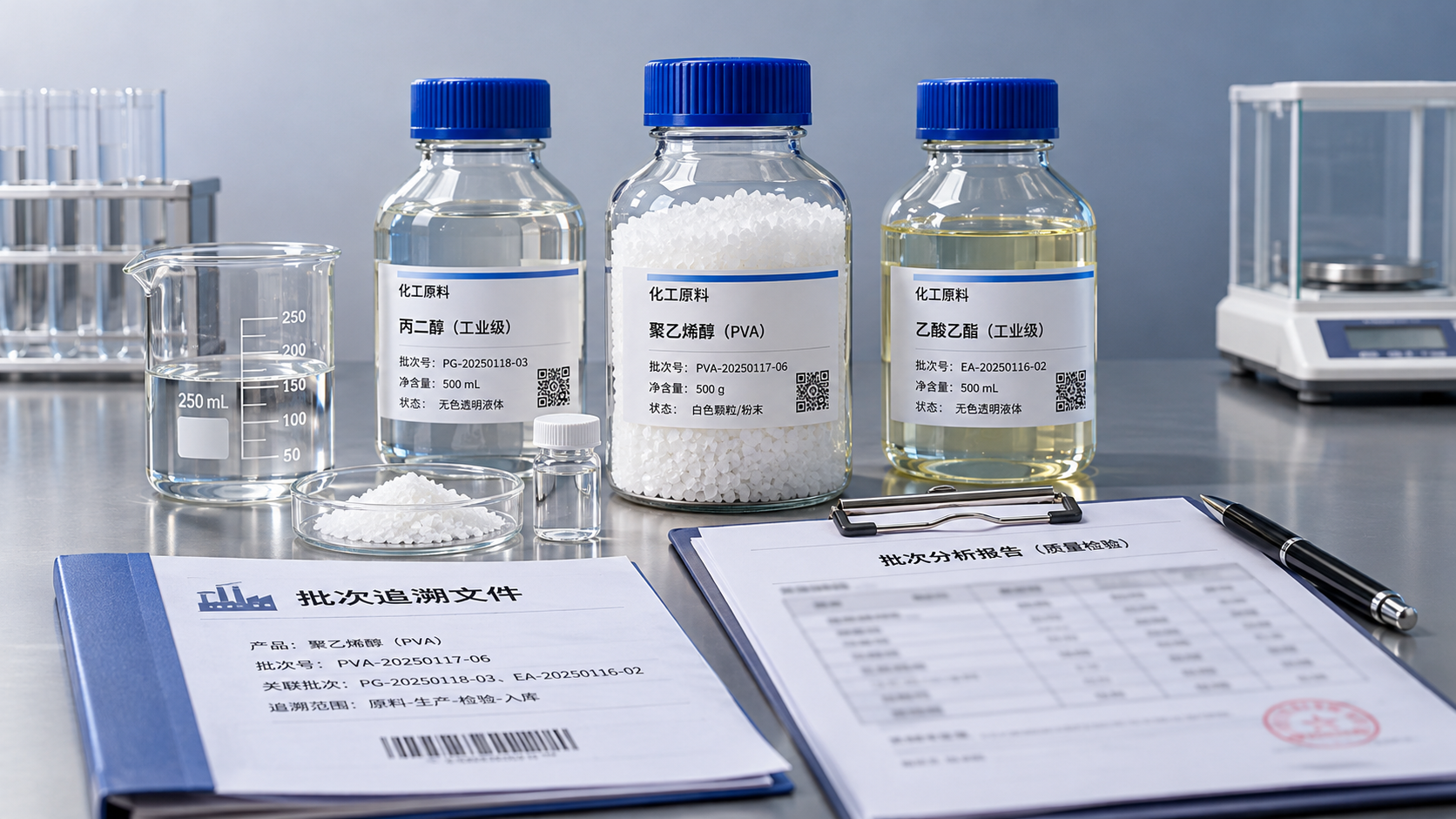
Request representative certificates of analysis (CoAs) for the proposed grade, with commercially sensitive information redacted if necessary. Examine the test items, units, acceptance limits, methods, and issuing laboratory. Then compare them with your specification. If a critical impurity is absent from the CoA, ask whether it is tested separately, controlled through the process, or not routinely measured. Each answer implies a different level of risk.
Discuss the following points with the supplier’s quality and technical teams:
- Batch consistency: How are batches identified, released, and traced from production through shipment? Can the supplier link the delivered containers to the relevant CoA?
- Testing capability: Which tests are performed in-house, and which are outsourced? For critical results, request the method and information about the laboratory’s competence.
- Change control: Will the supplier notify you before changing the production site, process, raw material source, test method, or specification? Define which changes require your approval.
- Deviation handling: What happens when a batch is outside specification, a customer reports a problem, or a shipment is suspected of contamination?
- Continuity: What capacity and lead time can the supplier commit to for your grade, and what alternatives exist if the proposed site cannot produce?
Capacity claims deserve particular care. A plant’s total output does not necessarily represent available capacity for your specific chemistry, packaging format, or quality grade. Ask for a production and delivery plan that reflects your expected order pattern, including the lead time for repeat orders and any constraints around campaign production.
Use samples to qualify a process, then challenge it at commercial scale
A sample can establish whether the material is promising, but it is a weak basis for approving the entire supply chain. Confirm that the sample represents the proposed commercial grade and site, and obtain its batch identifier and CoA. Test it against the agreed specification and, where relevant, in the actual formulation or process. A material that passes basic identity and purity tests may still cause filtration problems, color variation, or reduced yield in use.
If the sample succeeds, consider a trial order sized to test normal production, packing, transport, receiving inspection, and use. Agree in advance on acceptance criteria and who pays for testing, delays, replacement, or disposal if the shipment fails. The point is to expose differences between a laboratory sample and a commercial batch while the financial and operational exposure remains manageable.
Check export and import obligations for the actual shipment
Regulatory suitability depends on the chemical’s identity, concentration, use, quantity, route, and destination. Give the exporter enough information to prepare the correct documentation, but retain responsibility within your own organization for checking import and use requirements. Depending on the substance and jurisdiction, the transaction may involve chemical registration, notification, permits, controlled-substance rules, or restrictions on the intended application.
Ask for a safety data sheet appropriate to the destination and review it against the product being purchased. Confirm the proposed classification, labeling, packaging, storage conditions, and transport arrangements with qualified personnel and the carrier. A chemical can be nonhazardous for one purpose yet subject to specific requirements under another regulatory framework; do not infer transport or import status from a product’s commercial description alone.
Before the first order, agree on the document set and the party responsible for each item. It may include the commercial invoice, packing list, CoA, safety data sheet, transport documents, and origin documentation where required or contractually relevant. Check that product descriptions, batch references, quantities, and consignee details are consistent. An error in the paperwork can delay customs clearance or prevent a quality team from releasing otherwise acceptable material.
Agree on the customs classification through the appropriate customs expertise rather than accepting a code solely because it appears on a supplier quote. Classification can affect duties, documentation, and clearance. If preferential tariff treatment is part of the cost calculation, establish whether the goods meet the applicable origin rules and what proof must accompany them.
Compare landed cost with the risks allocated in the contract
A lower unit price can disappear once testing, freight, insurance, duties, customs charges, storage, and working capital are included. Compare suppliers on the same delivery basis and shipment size. State the Incoterms rule and named place in each quote, then identify which costs and risks remain with the buyer. Incoterms do not replace agreement on product quality, payment, title, or remedies for a defective batch.
Build the commercial agreement around the specification and approved supply chain. Name the manufacturing site where that is a condition of approval, define the documents required with each shipment, and establish a process for notification and approval of material changes. Include inspection and claim periods that give your receiving and technical teams enough time to perform the agreed tests.
For an unfamiliar supplier, payment terms should reflect the evidence available and the size of the exposure. Independently verify any change to bank details using a previously established contact channel. A sudden request to pay a different beneficiary should pause the transaction until the relationship and instructions are substantiated.
Decide when the evidence is enough
A supplier is ready for a first commercial order when its legal identity and role are clear, the production site and grade are traceable, the agreed specification can be demonstrated, and the parties understand the applicable documentation and commercial responsibilities. For a critical material, that decision may also require a satisfactory site assessment, application testing, and an approved trial batch.
Escalate or pause if the exporter will not identify the manufacturing arrangement, provides inconsistent legal or banking details, cannot explain gaps in test data, or treats changes to the production site as solely its own decision. A missing document may have a reasonable explanation; an inability to resolve the discrepancy is the more consequential signal.
After approval, keep the specification, site, test requirements, and change-control commitments tied to repeat orders. Reassess the supplier when the product, manufacturing route, destination rules, or observed performance changes. That record gives the next buyer and technical reviewer a clear basis for deciding whether the same source still fits the purchase.
Deep Dive
Related Intelligence
 Specialty ChemicalsSodium Methoxide Selection: How Chemical Buyers Reduce Specification and Handling RiskAnalyst:Lead Materials Scientist
 Specialty ChemicalsHow Corporate Case Studies Reveal Real-World Challenges in Adopting Specialty Chemicals for Food SafetyAnalyst:Lead Materials Scientist
 Specialty ChemicalsCan Brand Elevation Tactics Reduce Customer Acquisition Cost for Specialty Chemicals in Organic Food Production?Analyst:Lead Materials Scientist