How real time poultry data can flag feed intake problems earlier
Key Takeaways
- How to assess an agricultural machinery manufacturer's parts supportAgri-Tech Strategist
- What drives industrial automation cost in a new production line?Chief Civil Engineer
- What makes Ethiopia poultry farming profitable for small-scale producers?Agri-Tech Strategist
- Are Cloud Procurement Platforms Worth It for Chemical Sourcing?IT & Security Director
- How to Verify a New Materials Supplier’s Technical DocumentationLead Materials Scientist
- Should Buyers Switch from Petrochemical Plastics to Bio-Based Polymers?Lead Materials Scientist
- What Causes Frequent Customs Delays for Specialty Chemical Imports?Lead Materials Scientist
- When do composite materials outperform steel in heavy machinery?Chief Civil Engineer
Industry Overview
We do not just publish news; we construct a high-fidelity digital footprint for our partners. By aligning with TNE, enterprises build the essential algorithmic "Trust Signals" required by modern search engines, ensuring they stand out to high-net-worth buyers in an increasingly crowded global digital landscape.
How Real Time Poultry Data Can Flag Feed Intake Problems Earlier
Feed intake is one of the earliest practical signals of how a poultry flock is coping with its environment, equipment, health status, and daily management. By the time reduced bodyweight gain, poor uniformity, egg-production changes, or visible bird behaviour appear, the underlying issue may already have been affecting the house for hours or days. That delay matters. Feed is a major operating input, while a short interruption in access or appetite can quickly create uneven performance across a flock.
Real time poultry data does not eliminate the need for skilled observation. It changes where operators look first. Instead of relying only on a once-daily feed total or a manual walk-through, teams can compare consumption patterns across houses, feeding lines, zones, shifts, and previous flock days. A deviation becomes a prompt to investigate while there is still time to correct it, rather than a number explained retrospectively in an end-of-cycle report.
The useful question is not simply, “Did the flock eat less today?” It is, “Did this house, this line, or this feeding period behave differently from its expected pattern—and what changed around it?”
Why daily feed totals can hide an emerging problem
A daily feed delivery or bin-level reading is valuable, but it is often too broad to identify the source of a problem. It may show that a house consumed an acceptable quantity over 24 hours even when one feeder circuit stopped temporarily, birds avoided a hot end of the building, or water pressure fell during a critical feeding period. In some situations, birds compensate later in the day. In others, they do not. Either way, the daily total provides little evidence about timing, distribution, or access.
Feed intake has a rhythm. That rhythm varies with bird age, breed, diet form, lighting programme, season, production system, and farm routine. It should therefore not be judged against a generic benchmark alone. A more reliable approach compares current consumption with the farm’s own established profile for birds at a comparable age and under comparable operating conditions.
For example, a modest reduction in a house’s total intake may not look alarming by itself. Yet it deserves attention when it occurs alongside a delayed first feeding response after lights come on, a sharp difference between two otherwise similar feeder lines, or lower water use in the same area. These linked signals can point operators toward a mechanical, environmental, or bird-health issue before performance records confirm a loss.
What real time poultry data should actually capture
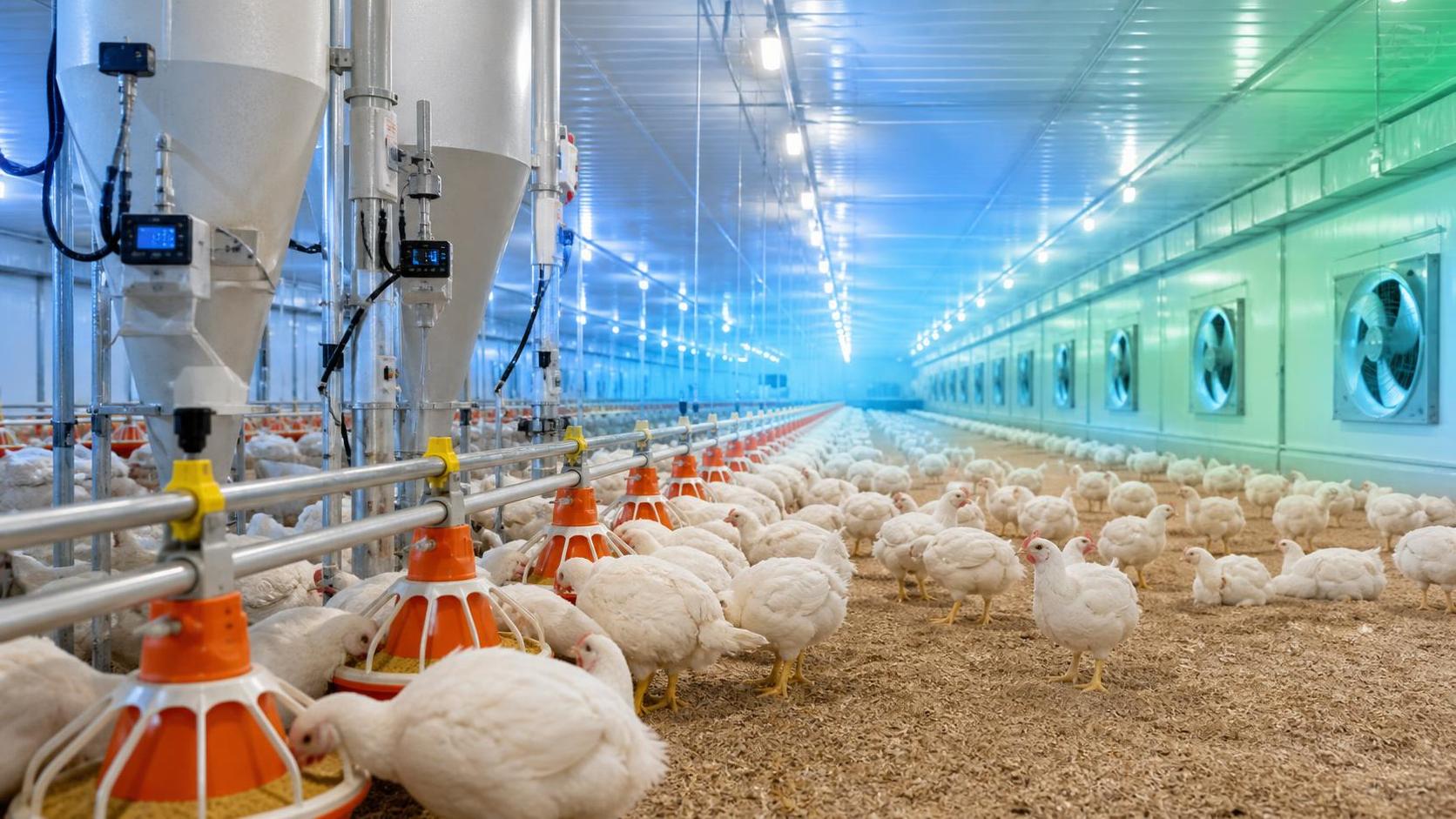
The phrase “real time” can be misleading if it only means that a dashboard refreshes frequently. The practical value depends on whether the data is granular enough to support a decision. A feed monitoring setup may draw from load cells, feed-bin sensors, auger runtime records, feeder-controller signals, line-level metering where available, or other connected equipment. Each source has limits, and no single sensor proves that every bird had equal access to feed.
For operational use, feed data is strongest when interpreted with related house information. The most relevant context commonly includes water consumption, ambient temperature, relative humidity, ventilation status, static pressure, lighting events, alarm history, feed deliveries, bird age, mortality records, and notes from flock checks. In breeder and layer systems, production records can add further context. The goal is not to collect every possible variable. It is to make the feed signal explainable.
This type of comparison is more useful than treating every deviation as a diagnosis. Data identifies where the normal pattern broke. The on-site inspection determines why.
Early warning is about change, not a single threshold
Many farms begin with a simple alert threshold: if feed use drops by a specified percentage, notify someone. It is a reasonable starting point, but thresholds alone can create two predictable problems. Alerts may be too sensitive during normal fluctuations, causing teams to ignore them. Or they may be too broad, allowing a meaningful local event to remain hidden until the daily total is clearly below expectation.
A better alert design considers several forms of deviation. One is a change against the same house’s recent baseline. Another is a comparison with similarly managed houses on the same farm. A third is a mismatch between feed and water behaviour. A fourth is a missed event, such as the absence of an expected feeding response after a programmed trigger. These rules can be simple, provided they are tied to how the site actually operates.
Bird age deserves special attention. Young birds can be sensitive to access, temperature, and management changes, while older flocks may show different daily feeding patterns. A system that treats every flock day as identical will produce poor-quality alerts. Operators should be able to set or review baselines by production stage and adjust them when management conditions change materially.
There is also a distinction between a warning and an emergency. A single missing data point may justify checking the sensor. A sustained decline combined with water changes, temperature alarms, or unusual bird behaviour should trigger a faster response. Clear escalation rules prevent a dashboard from becoming another screen that someone notices too late.
The investigation sequence matters as much as the alert
When an intake alert appears, teams should resist the temptation to assume a health problem immediately. Mechanical and data issues are common enough to rule out first, and a disciplined sequence saves time. Start by checking whether the reading is credible: compare the sensor output with the controller record, recent feed movement, and the physical condition of the bin or line. A drifting load cell, faulty communication link, or incorrect configuration can create an apparent consumption issue that does not exist.
If the signal is confirmed, inspect feed access. Check that augers are running as expected, feed bridges are not restricting flow, pans are correctly supplied, line heights and adjustments remain suitable, and birds are distributed normally around equipment. Feed quality and physical form may also need review where there has been a recent formulation, supplier, storage, or delivery change. Operators do not need to make a nutrition conclusion from a dashboard, but they should record changes that a nutritionist or feed supplier may need to assess.
Water should be near the top of the checklist, not an afterthought. Birds may reduce feed intake when water access or quality is compromised, and water trends can help distinguish a feeder problem from a broader event. Inspect pressure, flow, leaks, line height, drinker function, and any treatment-system changes. Then check the environment: actual conditions at bird level, not only the controller setpoint; ventilation equipment; inlets; air movement; litter condition; and areas where birds are crowding or avoiding.
Only after these immediate access and environment checks should the team interpret the event primarily through a flock-health lens. If birds look depressed, show altered droppings, gather unusually, or present other welfare concerns, follow the farm’s veterinary and biosecurity procedures. Real time poultry data supports this process, but it does not replace professional diagnosis.
Avoid the common trap of collecting data without operational ownership
Connected farm technology often disappoints when ownership is unclear. The installer may maintain the hardware, a manager may see the reports, and the person walking the house may be the only one able to verify what happened. Unless responsibilities are agreed in advance, alerts become noise and the most useful observations never return to the data record.
A workable process assigns three decisions: who acknowledges an alert, who performs the first physical check, and who closes the event with a reason code or short note. The record does not need to be elaborate. “Left feeder line motor reset,” “heat event during afternoon,” “water regulator adjusted,” or “sensor inspection required” can make later analysis far more useful. Over time, those records reveal recurring failure modes and help maintenance teams prioritise work before a minor issue becomes a flock-wide interruption.
Data quality also needs routine attention. Sensor calibration, power continuity, network reliability, timestamp alignment, controller integration, and manual validation should be part of implementation planning. A high-resolution feed graph built on inconsistent inputs gives false confidence. During supplier evaluation, farms should ask how data is retained, how missing values are displayed, whether raw records can be exported, what happens during connectivity loss, and who is responsible for commissioning and ongoing support.
Turning monitoring into a better daily management habit
The strongest use of feed monitoring is usually not a dramatic alert. It is a better routine. A supervisor can review overnight intake, compare houses before the first flock walk, and direct attention to a specific area rather than beginning with a blind inspection. A maintenance technician can see whether recurring feeder-line irregularities follow a particular motor, controller, or house. A production manager can discuss feed performance with nutrition, veterinary, and equipment partners using time-stamped evidence instead of impressions alone.
For multi-site operations, comparable data definitions are essential. One site may report feed delivered to a bin, while another reports feed moved through a line; neither is automatically wrong, but they should not be compared as if they mean the same thing. Naming conventions, flock-age records, feed-change logs, and consistent alert logic are mundane details that determine whether a central view is useful or misleading.
TradeNexus Edge follows these practical questions across agri-tech and food systems because farm digitisation is not only about adding sensors. It is about connecting equipment data, operating context, and accountable decisions across a complex supply chain. For operators assessing a monitoring project, the relevant discussion should extend beyond the dashboard: what will be measured, how quickly it can be trusted, what action each alert requires, and how the system fits the realities of a working poultry house.
Start with the failure modes that cost time today
A sensible first deployment does not need to instrument every variable at once. Begin with the feed-intake problems that are hardest to spot early: an intermittent line fault, unexplained differences between houses, heat-related feeding disruption, or uncertainty over whether a change is caused by feed, water, or equipment. Map the existing response process, identify the data sources already available, and test alerts against real flock routines before treating them as automated truth.
The value of real time poultry data lies in shortening the gap between an abnormal pattern and a useful on-site check. When the data is reliable, contextual, and connected to clear ownership, feed intake becomes more than an end-of-day number. It becomes an early operational signal—one that gives farm teams a better chance to protect access, welfare, flock consistency, and the margin tied up in every tonne of feed.
Deep Dive
Related Intelligence
 Smart Livestock & Poultry TechHow poultry housing systems improve flock health and reduce labor costs in commercial farmsAnalyst:Agri-Tech Strategist
 Smart Livestock & Poultry TechWhat livestock management features matter most when scaling a multi-site poultry operation in 2026Analyst:Agri-Tech Strategist
 Smart Livestock & Poultry TechCan automated farming solutions integrate with existing ventilation and feeding hardware on legacy poultry farmsAnalyst:Agri-Tech Strategist