A supplier’s technical dossier can look convincing while leaving procurement risks unresolved. Buyers should approve materials only when documentation connects the supplied grade to its intended use.
For buyers navigating biodegradable polymer international compliance requirements, certificates alone are insufficient. Material specifications, batch traceability, test methods, and destination-market obligations must support the purchasing decision.
A biodegradability claim does not automatically establish industrial compostability or food-contact suitability. This guide helps procurement, quality, and technical teams distinguish credible evidence from incomplete assurances.
What Must the Supplier’s Documents Actually Prove?
Begin with a defined application, rather than a certificate collection. Documentation becomes useful when it answers whether this material can satisfy your product’s specific requirements.
Record the destination markets, manufacturing process, expected service conditions, disposal claim, and any food-contact use. Include critical dimensions, additives, colors, and foreseeable exposure to temperature or moisture.
These details determine which evidence matters. A compostable packaging film, an agricultural mulch film, and an injection-molded component can require substantially different assessments and supporting records.
Your initial review should connect four elements: material identity, demonstrated performance, applicable obligations, and ongoing production control. Missing connections create uncertainty even when individual documents appear authentic.
For example, evidence for an uncolored resin may not cover a finished package containing pigments, adhesives, or coatings. Processing and thickness can also affect performance.
Ask suppliers to organize their dossier around the exact commercial grade and proposed application. This makes omissions visible and reduces time spent reviewing irrelevant certificates.
Does the Evidence Match the Grade You Will Receive?
Check identity before interpreting results. Every important document should identify the relevant manufacturer, production site where applicable, material grade, document version, and issue or test date.
Compare those identifiers with the quotation, sample labels, proposed purchase order, and certification listing. Similar trade names can conceal differences in formulation, manufacturing location, or authorization.
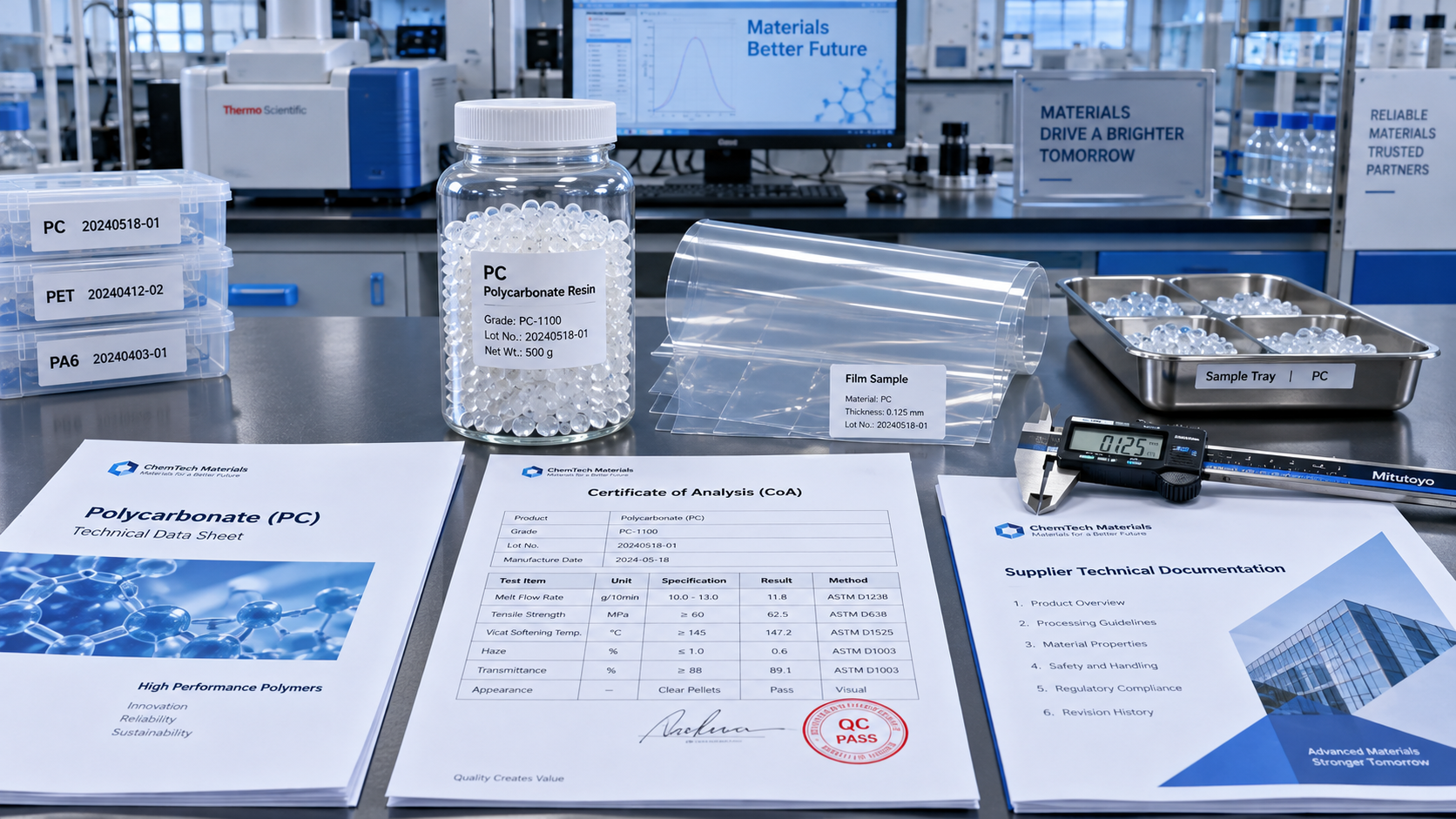
A technical data sheet usually describes typical properties. Unless incorporated into an agreed specification, its values may not constitute acceptance limits for every delivered batch.
A certificate of analysis should report results or conformity against defined requirements for an identifiable lot. Confirm which characteristics are tested and which are inferred.
A safety data sheet communicates hazards and handling information within its applicable legal framework. It does not, by itself, establish food-contact suitability or compostability claims.
Confidential formulations may require a nondisclosure agreement or disclosure to an independent assessor. Buyers still need enough information to evaluate restricted substances and relevant formulation changes.
If a distributor supplies the documents, confirm its relationship with the manufacturer. Establish who can answer technical questions, maintain traceability, and provide updated compliance evidence.
Which Biodegradability Claims Can You Rely On?
Biobased content, biodegradability, and compostability describe different attributes. A polymer can contain renewable feedstock without biodegrading under the disposal conditions relevant to your finished product.
Require suppliers to name the claimed environment: industrial composting, home composting, soil, freshwater, or another setting. Results from one environment do not automatically establish performance elsewhere.
Ask which standard, edition, test conditions, and acceptance criteria support the claim. A degradation percentage without temperature, duration, and methodology provides little purchasing assurance alone.
For packaging, EN 13432 is a commonly used European industrial compostability standard. ASTM D6400 addresses plastics designed for aerobic composting in municipal or industrial facilities.
ASTM D6868 addresses qualifying end items incorporating plastics or polymers with substrates such as paper. Standard selection should reflect the actual product construction and claim.
Industrial compostability assessments generally consider biodegradation, disintegration, and effects on compost quality, including relevant chemical limits. One successful biodegradation test does not demonstrate every requirement.
Inspect certificate scope for formulation, product category, maximum thickness, and permitted additives. Determine whether your converted article is covered or requires additional testing and certification.
Home compostability requires separate supporting evidence because conditions differ from industrial facilities. Likewise, industrial compostability evidence does not substantiate marine biodegradation or agricultural soil performance.
Finally, distinguish demonstrated performance from collection availability. A technically compostable package may lack acceptance within the destination market’s actual organic-waste collection and treatment systems locally.
How Do You Check International Compliance Without Assuming One Certificate Covers Everything?
Biodegradable polymer international compliance requirements depend on destination, application, formulation, and claims. Build a market matrix instead of treating a supplier’s global compliance statement as sufficient.
Separate chemical obligations, food-contact requirements, environmental claims, labeling rules, and waste-management restrictions. Different authorities and evidence requirements can apply to each part of the assessment.
For European markets, assess relevant REACH obligations, restrictions, and substance communication requirements. The assessment must reflect whether the supplied material is a substance, mixture, or article.
For EU plastic food-contact applications, Regulation (EU) No 10/2011 can be relevant alongside the framework Regulation (EC) No 1935/2004 and applicable good manufacturing practice requirements.
Request the applicable declaration of compliance and supporting assessment. Examine restrictions, intended food types, contact duration, temperature, and migration testing representative of the final application.
Non-intentionally added substances may also require assessment. A statement that all intentionally added ingredients appear on an authorized list does not resolve every food-contact question.
In the United States, ask suppliers to identify the legal basis for each relevant food-contact substance and intended use. Broad “FDA approved” wording is insufficient.
Where a food contact notification supports use, verify its manufacturer or supplier coverage and conditions. Do not assume another producer can rely on that notification.
Environmental claims need a separate review against applicable advertising and labeling rules. A technically valid test does not automatically justify unrestricted wording on retail packaging.
Packaging legislation also changes over time. Check effective dates, transition periods, and product-specific obligations against official sources before approving launch plans or renewing supply agreements.
Are the Test Reports Strong Enough to Support a Purchase?
Read complete reports rather than summaries. Confirm specimen identity, sampling information, method version, conditioning, test conditions, results, deviations, and conclusions before accepting the supplier’s interpretation.
Laboratory accreditation to ISO/IEC 17025 can strengthen confidence, but verify the accreditation scope covers the relevant method. An accredited laboratory may also perform unaccredited tests.
Check certificates through the issuing organization’s public register or direct verification channel. Confirm current status, authorized holder, covered products, and whether any limitations affect your application.
Compare laboratory conditions with production realities. Resin tested under ideal conditioning may behave differently after drying variations, repeated heat exposure, moisture uptake, or extended storage.
For example, a film converter should examine thickness, mechanical performance, sealing behavior, and aging. A molding operation may prioritize processing stability, dimensional consistency, and impact resistance.
Request independent verification when evidence is incomplete or consequences are substantial. Testing should resolve specific uncertainties, such as migration under intended conditions or finished-product disintegration.
Agree acceptance criteria before commissioning tests. Without predetermined requirements, both parties may interpret the same result differently, creating delays and disputes after materials have arrived.
Can the Supplier Maintain Compliance Across Batches and Changes?
Documentation assessment should extend beyond the first sample. A successful qualification does not establish that later batches will retain the same composition, properties, or compliance status.
Require lot identifiers that connect deliveries to manufacturing and quality records. Define retention periods, retained samples where appropriate, and how quickly records must be retrievable.
Clarify how the supplier controls incoming ingredients, subcontracted production, and nonconforming material. Ask who authorizes release and how deviations are communicated before shipment to buyers.
Change notification deserves explicit contractual treatment. Relevant changes can include feedstock source, additives, formulation, production site, manufacturing process, or certification status affecting the approved application.
Specify which changes require prior written approval and possible requalification. Advance notice matters because even small formulation changes can affect migration, processing behavior, or environmental claims.
Assess complaint handling using evidence of corrective-action procedures. Buyers should understand how affected lots are identified, containment occurs, and recurrence is prevented after a confirmed defect.
Keep documentation obligations in the supply agreement, with named responsibilities and response times. This turns initial assurances into operating requirements that purchasing and quality teams can enforce.
When Should You Approve, Hold, or Reject a Supplier?
Use decision gates based on evidence quality and business consequences. Mandatory legal or safety requirements should not be offset by attractive pricing or strong commercial references.
- Approve: Material identity is consistent, mandatory requirements are supported, application testing passes, and traceability and change controls meet agreed purchasing conditions.
- Hold: Gaps appear resolvable, but approval depends on missing reports, clarified certification scope, additional testing, or a documented corrective-action commitment.
- Reject: Documents are unverifiable, essential requirements fail, material identity remains inconsistent, or the supplier refuses information necessary for a defensible assessment.
Assign each unresolved issue an owner, required evidence, and deadline. Distinguish information needed before trials from requirements that must be closed before commercial shipment begins.
Estimate qualification costs alongside purchase price: testing, engineering trials, certification work, delays, and potential scrap. A cheaper resin can become expensive when documentation requires substantial remediation.
For higher-risk applications, involve procurement, materials engineering, quality, and regulatory specialists in approval. Their combined review helps connect technical evidence with commercial exposure and manufacturing constraints.
A dependable supplier dossier supports a clear decision: this identified material meets defined requirements for this application and market, with controls that preserve confidence over time.
Approve suppliers when those connections are verifiable. Hold purchases when essential evidence remains incomplete, and treat unsupported claims as questions to resolve before committing business resources.