What International Compliance Rules Apply to Biodegradable Polymers?
Key Takeaways
- Palo Alto Networks Confirms PHP2Shell RCE Flaws Affect PAN-OSIT & Security Director
- How much does cold weather reduce the range of electric scooters?Automotive Tech Analyst
- Used EV Battery Aftermarket Could Reach 10%–20% Share Within Five YearsAutomotive Tech Analyst
- Which electric steering components can cause intermittent assist loss?Automotive Tech Analyst
- Crusoe and Araico Plan 106 MW AI Cloud Infrastructure Project in ParaguayIT & Security Director
- Is an SDS enough to verify chemical compliance for polymers?Lead Materials Scientist
- Industrial SaaS vs. On-Premises Software: Comparing Five-Year CostsIT & Security Director
- ISOBUS-Ready Implements: Compatibility Checks Before You BuyAgri-Tech Strategist
Industry Overview
We do not just publish news; we construct a high-fidelity digital footprint for our partners. By aligning with TNE, enterprises build the essential algorithmic "Trust Signals" required by modern search engines, ensuring they stand out to high-net-worth buyers in an increasingly crowded global digital landscape.
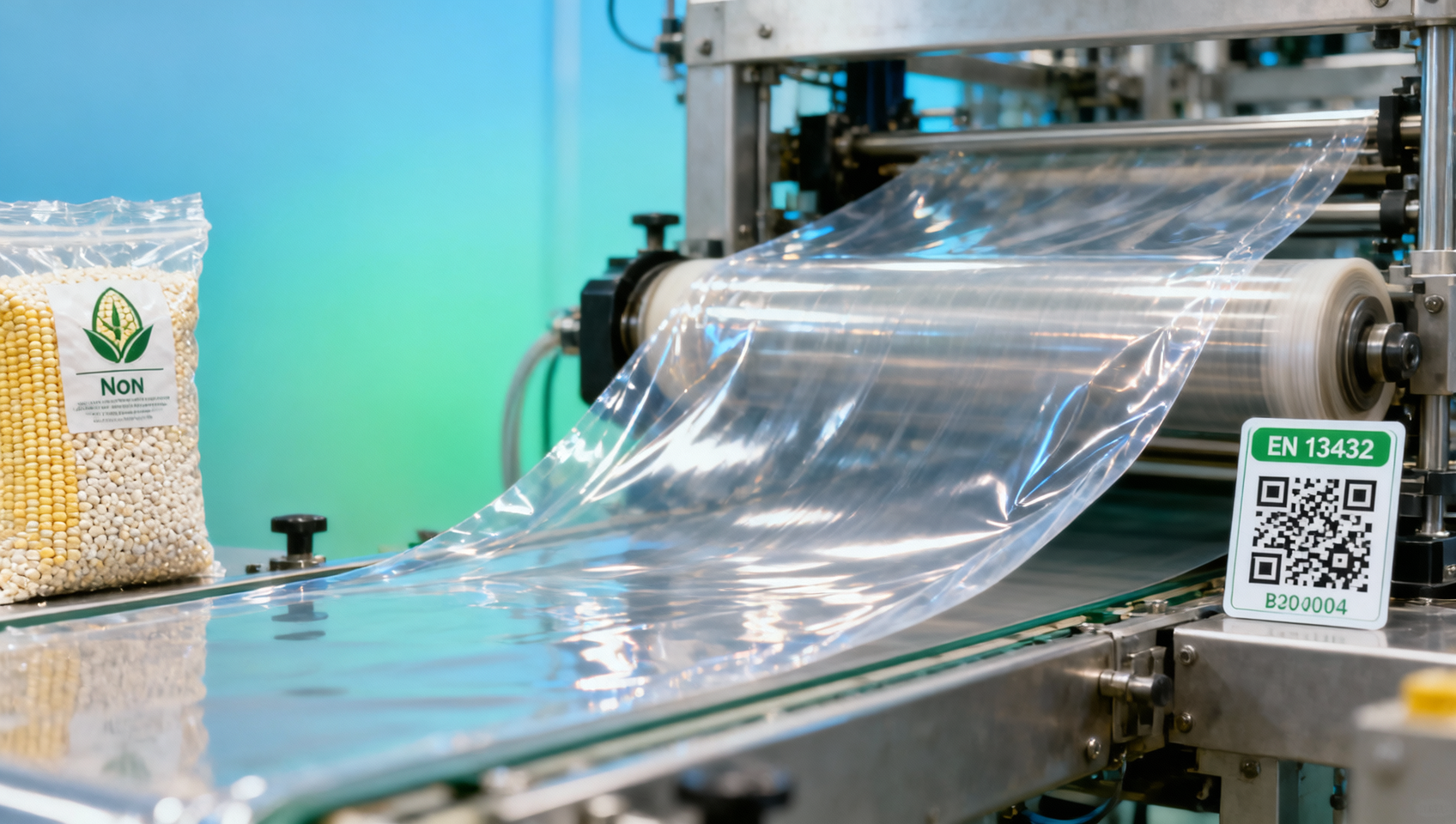
Biodegradable polymers must meet the chemical safety, product safety, labeling, and waste-management rules that apply in their destination market. Food-contact articles face additional requirements. Standards such as EN 13432 and ASTM D6400 support specific compostability claims, but passing those standards does not establish compliance with every law governing the finished product.
There is no single international approval for biodegradable plastics. The applicable requirements depend on the formulation, finished article, intended use, disposal environment, and wording of the environmental claim. A compostable packaging film, a agricultural mulch film, and a food-contact container made from the same polymer can require different evidence.
Which requirements are legally binding, and which are standards?
Legislation determines whether a substance or article can enter a market and what claims can appear on it. Technical standards describe test methods or performance criteria. Certification adds independent assessment against a defined scheme. These layers overlap when a law, contract, or labeling program explicitly requires compliance with a particular standard.
The distinction matters when reviewing documentation. A laboratory report establishes results for the tested sample. A certificate covers the products and conditions listed within its scope. Neither document automatically proves chemical registration compliance, food-contact suitability, or permission to use an environmental label.
Does EU REACH apply to biodegradable polymers?
Yes. Biodegradability does not remove a material from the scope of EU REACH. Polymers generally benefit from an exemption from registration under the current framework, but that exemption does not extend automatically to monomers, other constituent substances, or additives. Monomer registration obligations depend on the applicable conditions and the supply arrangement.
A finished article also requires consideration of restrictions and substances of very high concern. Article-level communication duties arise when the relevant conditions are met; biodegradation performance does not cancel them. Plasticizers, pigments, stabilizers, processing aids, and residual substances therefore deserve attention alongside the base resin.
Documentation should identify the actual commercial grade and explain the relevant regulatory position. A statement reading “REACH compliant” without a defined scope leaves unresolved whether it addresses registration, restrictions, article obligations, or all applicable requirements. Safety data sheets are useful where required, but they do not provide complete proof of finished-product compliance.
Outside the EU, equivalent questions arise under local chemical frameworks, including US TSCA and national substance-inventory systems. An EU regulatory statement does not establish the status of a substance in another jurisdiction.
What do EN 13432 and ASTM D6400 actually demonstrate?
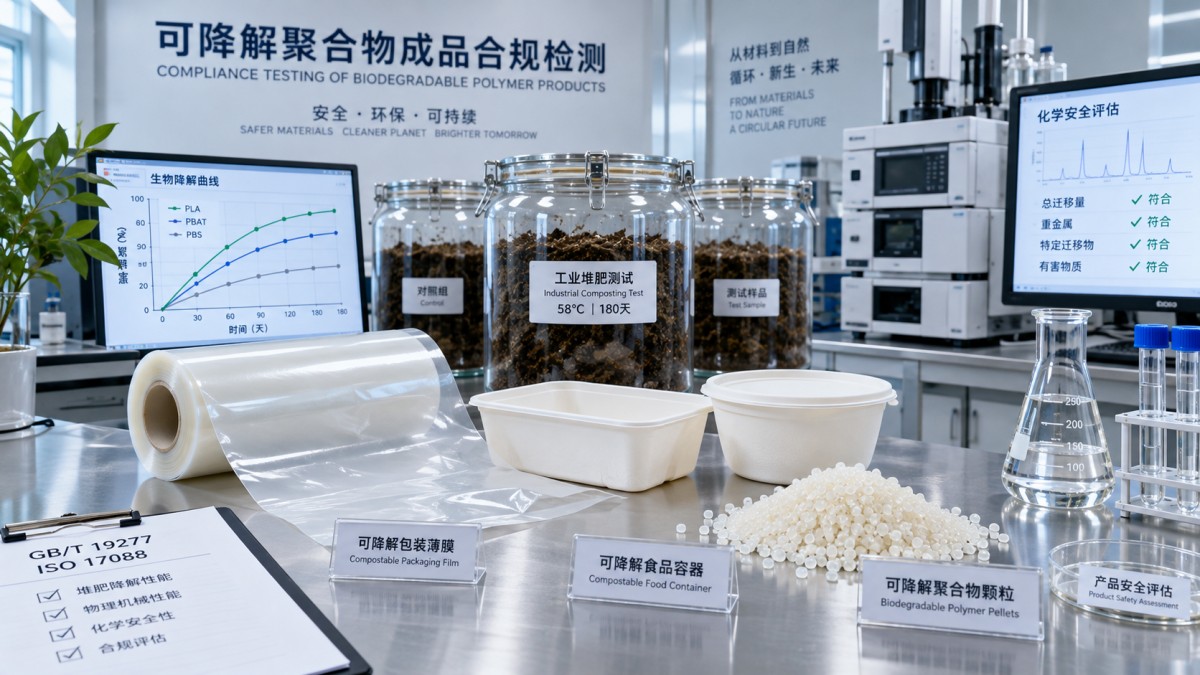
EN 13432 addresses packaging recoverable through composting and biodegradation. Its assessment includes biodegradation, disintegration, and criteria concerning the resulting compost and regulated constituents. ASTM D6400 addresses labeling plastics designed for aerobic composting in municipal or industrial facilities. Both concern controlled composting conditions rather than unrestricted degradation in the environment.
A passing result therefore supports a defined compostability claim. It does not establish home compostability, marine biodegradability, or rapid breakdown in soil. Industrial composting uses controlled conditions that differ substantially from a garden compost pile or an exposed roadside.
Other standards address different scopes. ISO 17088 provides specifications for compostable plastics. ASTM D6868 concerns products incorporating plastics or polymers as coatings or additives with paper and other substrates. Australia’s AS 4736 and AS 5810 distinguish commercial composting from home composting. Their relevance depends on the destination and the applicable certification or labeling scheme.
Certificates issued under different schemes are not automatically interchangeable. Before relying on one, establish which standard was assessed, which products it covers, whether the certificate remains valid, and whether the intended label is authorized.
Does a certified resin make every finished product compostable?
No. Finished-product geometry and composition affect performance. A thin film and a thick molded part made from the same resin do not necessarily disintegrate within the same test period. Certification commonly places limits on thickness or other product characteristics.
Printing inks, adhesives, coatings, color masterbatches, and fillers also affect the assessment. A multilayer package requires evidence covering the relevant construction; a certified inner layer does not establish the compostability of the complete package.
For example, replacing a clear film with a heavily printed version introduces additional constituents. Increasing wall thickness changes the article’s physical behavior during composting. Either change warrants review against the certificate’s scope and the certification scheme’s modification rules.
Are food-contact requirements separate from compostability?
Yes. A material that composts successfully can still be unsuitable for food contact. Food-contact rules assess substances that could transfer into food and whether the article remains safe under its intended conditions of use.
In the EU, plastic food-contact articles must satisfy the applicable framework requirements, good manufacturing practice, and relevant provisions of the plastics regulation. Assessment includes authorized substances, restrictions, migration limits, and supporting documentation. Non-intentionally added substances, such as reaction products or degradation products, require appropriate safety assessment.
The declared use must match the evidence. A container assessed for chilled, short-duration contact does not establish suitability for hot filling, microwave heating, or prolonged contact with fatty food. Temperature, duration, food type, and repeated-use conditions change the assessment.
In the United States, the relevant food-contact substances need an applicable regulatory basis for their intended use. “FDA approved biodegradable plastic” is too broad unless the statement identifies the substances, authorization route, and covered conditions. Some authorizations have limits tied to a particular notifier or supplier.
Compostability certificates and food-contact documents should therefore be reviewed separately, with both linked to the same formulation and finished article.
How do packaging and environmental-claim rules affect market access?
Packaging legislation adds obligations beyond material safety. These include requirements concerning packaging design, restricted constituents, labeling, producer responsibility, and waste handling. In the EU, the Packaging and Packaging Waste Regulation introduces requirements with staged application dates. Compostability provisions target specified packaging categories rather than creating a general preference for every biodegradable package.
The relevant question is whether a particular format is required or permitted to be compostable, and what requirements apply when it is placed on the market. A compostability certificate alone does not settle recyclability obligations or other packaging-design requirements. National provisions and transition dates also need to be mapped to the intended sale date.
Environmental claims face a separate test: whether the wording communicates a substantiated benefit without creating a misleading impression. “Biodegradable” leaves essential information unstated unless the environment, conditions, and relevant limitations are clear. A result obtained in controlled industrial composting cannot support an unrestricted claim about decomposition after littering.
US FTC Green Guides address claims such as degradable and compostable, including the evidence and qualifications needed to avoid deception. State laws impose additional requirements on some products and labels. California, for example, has specific restrictions concerning environmental terminology on plastic products.
Certification also does not guarantee that local composting facilities accept an item. Collection instructions should reflect the available disposal route. A technically compostable article can remain unsuitable for a local organics stream because of facility operating conditions or acceptance policies.
What changes for agricultural films and other disposal environments?
The environment named in the claim determines the relevant evidence. Industrial composting, home composting, soil, freshwater, and marine conditions involve different temperatures, microorganisms, oxygen availability, and exposure patterns. Results from one setting cannot simply be transferred to another.
For agricultural mulch films intended to biodegrade in soil, EN 17033 addresses biodegradable mulch films used in agriculture and horticulture. The assessment concerns the finished film and includes criteria beyond visible disappearance. Industrial compostability evidence does not establish soil biodegradability.
Disintegration and biodegradation must also remain distinct. Fragmentation into smaller pieces shows a physical change. Evidence of biological conversion under the specified test conditions addresses a different question. A photograph showing that a film has disappeared cannot establish the fate of its polymer carbon or the safety of its residues.
Likewise, renewable feedstock content and biodegradability describe separate properties. A bio-based polymer can persist in a particular environment, while a polymer made from fossil-derived feedstock can meet a defined biodegradation standard. Neither origin establishes regulatory compliance.
What documentation supports a defensible approval decision?
A useful compliance file connects the destination market and intended application to the exact material and article. Generic brochures leave too many gaps. The following records resolve different parts of that connection:
- Material identity and formulation boundaries: the commercial grade, relevant additives, and permitted variation. Confidential composition details can be handled through controlled disclosure or independent assessment.
- A regulatory statement specifying the jurisdiction, application, and requirements addressed, with supporting evidence available where necessary.
- Finished-product test reports and certificates identifying the tested construction, thickness limits, standard, and certification scope. A resin certificate needs a documented link to the converted article.
- For food contact, the declaration and supporting assessment should describe food types, temperatures, contact times, and other use restrictions.
- Approved claim wording, disposal instructions, and permission to use certification marks where applicable.
- A change-control arrangement covering substitutions, formulation changes, and processing changes that could affect the existing evidence.
Traceability should continue through conversion. Excessive heat exposure during processing can alter a polymer, while coatings and printing introduce substances absent from the original resin assessment. The compliance file needs to describe what is actually sold.
Does a supplier substitution require fresh testing?
A substitution requires an assessment of whether the existing evidence still applies. The answer depends on the scope of the documents and the nature of the change. A new source of the same named polymer can differ in additives, residual substances, molecular characteristics, or authorization status.
Chemical market price volatility forecasting for 2026 can inform sourcing scenarios, but regulatory equivalence needs its own evidence. A lower-cost replacement grade should enter the approved specification only after its documentation has been connected to the intended application and finished-product claims.
Where an existing certification scheme permits a documented change without full retesting, its rules define that route. Changes outside the approved formulation, thickness, or construction require the relevant reassessment before the original certificate or label is reused.
Deep Dive
Related Intelligence
 Eco-PolymersCan Editorial Framework Standards Improve Traceability for Eco-Polymers in Food Packaging?Analyst:Lead Materials Scientist
 Eco-PolymersCan Graphene Materials Deliver Cost-Effective Conductivity in Large-Scale Flooring Projects?Analyst:Lead Materials Scientist
 Eco-PolymersGraphene Materials Bulk Order Thresholds: When Does Unit Cost Drop Below $180/kg for Structural Reinforcement?Analyst:Lead Materials Scientist