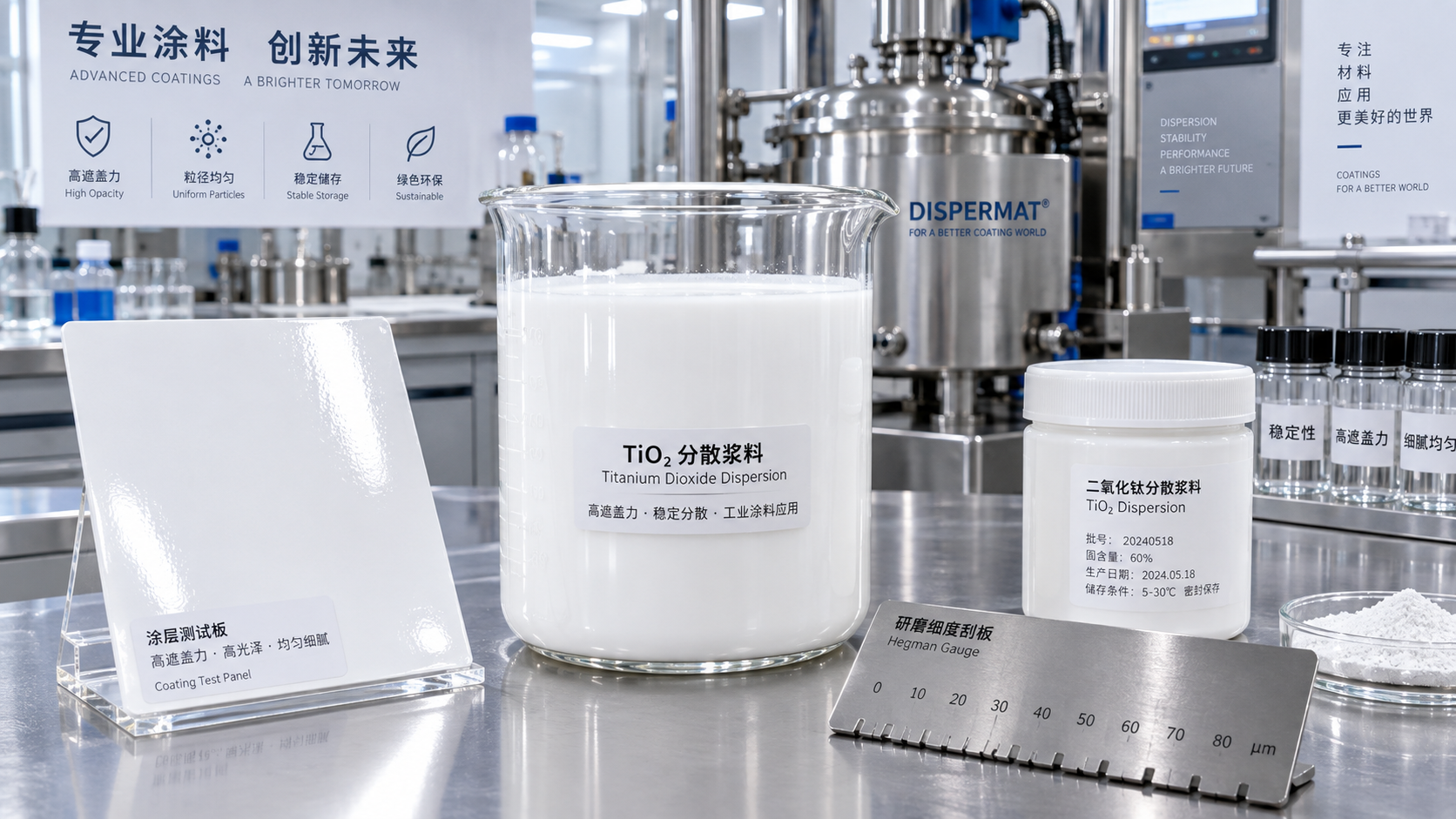
Titanium Dioxide Dispersion: Key Factors for Coating Opacity and Stability
Titanium dioxide dispersion is a critical determinant of coating opacity, tint strength, gloss, and long-term stability. For technical evaluators, dispersion quality matters as much as pigment grade selection.
The practical conclusion is straightforward: a high-performing TiO2 pigment cannot compensate for inadequate wetting, poor grinding, incompatible additives, or uncontrolled formulation changes during scale-up.
Technical teams should therefore evaluate titanium dioxide dispersion as a system property involving pigment treatment, resin chemistry, dispersant selection, processing energy, rheology, and storage conditions.
Why Titanium Dioxide Dispersion Determines Coating Performance
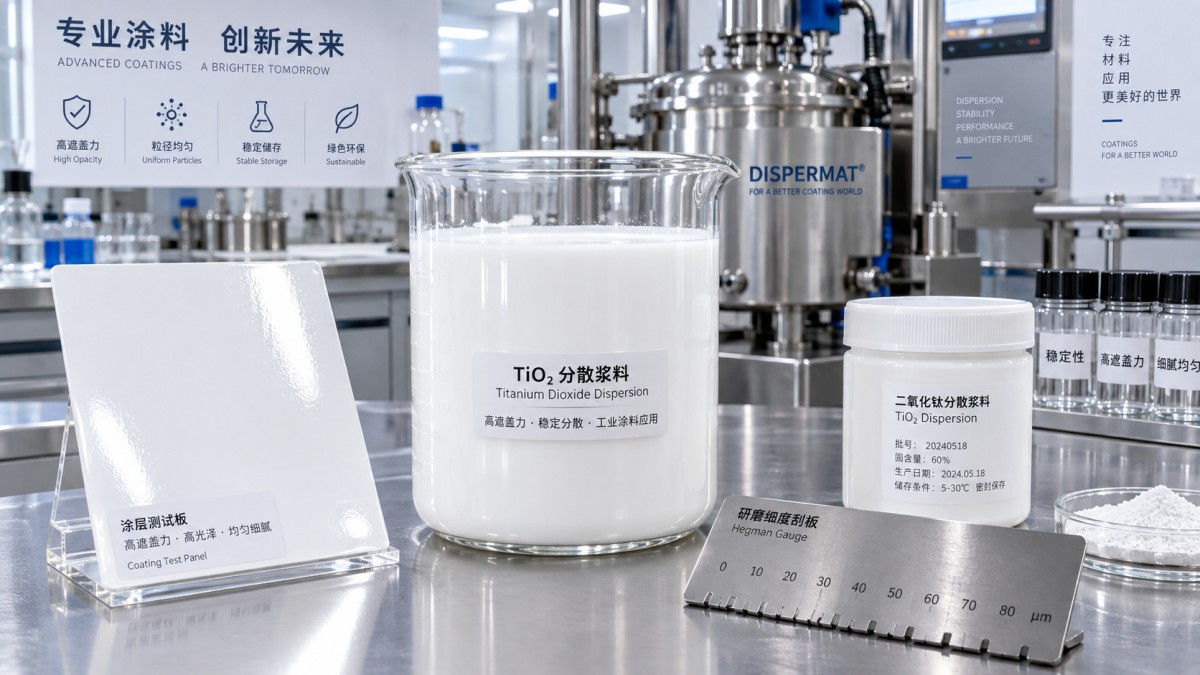
Titanium dioxide provides whiteness and hiding power because its refractive index is substantially higher than that of typical coating binders, solvents, and surrounding air.
However, this optical advantage is realized only when TiO2 primary particles are separated effectively and distributed uniformly throughout the cured coating film.
Poor dispersion leaves pigment particles clustered in agglomerates. These clusters scatter light inefficiently, reduce usable surface area, and create localized defects in appearance and film performance.
For evaluators, the central question is not simply whether a formulation contains enough titanium dioxide. It is whether the pigment is present at its effective optical state.
A well-designed titanium dioxide dispersion maximizes particle separation without damaging surface treatment, destabilizing the resin system, or introducing excessive viscosity and processing complexity.
When the dispersion is optimized, formulators generally obtain stronger opacity at a lower pigment loading, more consistent color development, improved gloss, and better production repeatability.
When it is not optimized, teams often respond by increasing TiO2 concentration. This may raise raw-material cost while worsening viscosity, crowding, settling risk, and application behavior.
Start with the Right Definition of Dispersion Quality
Dispersion quality should not be assessed using a single measurement. A technically useful evaluation combines particle-size evidence, optical performance, rheology, storage stability, and application results.
In pigment processing, the important distinction is between breaking soft agglomerates and damaging the pigment itself. The objective is controlled deagglomeration, not indiscriminate grinding.
TiO2 primary particles are commonly engineered for efficient visible-light scattering. Excessive mechanical energy can alter surface chemistry, accelerate contamination, or create unwanted temperature rise.
Particle-size measurements can indicate whether large agglomerates remain, but they should be interpreted alongside drawdown results, tint strength data, and microscopic inspection where practical.
A fine particle-size result alone does not prove that a coating will remain stable. The formulation must also prevent particles from re-flocculating after milling or during storage.
Technical evaluators should request test data that compares the completed dispersion or finished paint against a defined reference, rather than accepting broad claims about “excellent dispersion.”
Useful comparative data may include contrast ratio, opacity at specified dry-film thickness, 60-degree gloss, tint strength, fineness of grind, viscosity drift, and heat-storage stability.
Particle Size and Agglomeration Control Drive Opacity
Opacity depends on how efficiently titanium dioxide scatters light. This efficiency declines when particles form agglomerates that behave as larger, less optically effective structures.
Large agglomerates can also produce visible specks, lower gloss, reduced color uniformity, and uneven film appearance. These defects become especially important in high-gloss architectural and industrial coatings.
The ideal dispersion state depends on pigment grade and coating type. Aqueous systems, solventborne coatings, powder coatings, and high-solids formulations each impose different wetting and milling demands.
Rutile titanium dioxide is commonly selected for exterior durability and high opacity, while anatase grades may be used where brightness, specific optical behavior, or cost balance is prioritized.
Surface-treated rutile grades require careful handling because alumina, silica, zirconia, or organic treatments influence wetting behavior, dispersant adsorption, and compatibility with the final resin.
A dispersion process should provide enough shear and residence time to reduce agglomerates, while avoiding unnecessary energy consumption once the desired fineness and optical response are achieved.
Monitoring milling endpoints using a Hegman gauge can be useful operationally, but it should be supplemented with opacity and gloss testing because visual fineness does not capture all flocculation effects.
Resin Compatibility Is Often the Hidden Stability Variable
Many dispersion problems originate from a mismatch between the TiO2 surface, dispersant chemistry, and binder system. A stable millbase may fail after letdown if this interaction is overlooked.
The resin must wet the pigment surface effectively and maintain a protective environment around dispersed particles. Inadequate resin affinity can lead to reflocculation, viscosity rise, settling, or loss of gloss.
Waterborne acrylic, polyurethane, epoxy, alkyd, polyester, and fluoropolymer systems have different polarity profiles. A dispersant that performs well in one chemistry may be ineffective in another.
Technical evaluators should test titanium dioxide dispersion performance in the intended commercial binder rather than relying only on supplier data generated in generic laboratory systems.
Particular care is needed when switching resin suppliers, changing co-solvent packages, increasing solids, or incorporating new functional additives. Each change can alter pigment-resin interactions materially.
The pigment volume concentration also matters. As PVC increases, there is less binder available to separate and immobilize pigment particles, raising the risk of crowding and optical inefficiency.
Near or above critical pigment volume concentration, coating properties become more sensitive to dispersion quality, pore formation, water uptake, scrub resistance, and binder distribution around pigment particles.
How Dispersants Improve Wetting and Prevent Reflocculation
Dispersants reduce the energy required to wet titanium dioxide and help maintain particle separation after mechanical deagglomeration. Their role extends far beyond achieving a lower initial milling viscosity.
Effective dispersants anchor onto pigment surfaces and provide steric, electrostatic, or combined stabilization. The mechanism must remain effective throughout milling, letdown, application, curing, and storage.
Polymeric dispersants are often preferred in demanding systems because they can provide durable steric stabilization. Their molecular architecture should be matched to both pigment treatment and resin polarity.
Excess dispersant is not automatically beneficial. Overuse can create foam, water sensitivity, reduced intercoat adhesion, gloss changes, slower drying, migration concerns, or unfavorable cost structure.
Insufficient dispersant may result in incomplete wetting, excessive milling energy demand, broad particle-size distribution, viscosity instability, and poor tint strength despite using a high-quality pigment grade.
A structured dosage study is more reliable than choosing an additive level by convention. Technical teams should test several levels against optical performance, viscosity, gloss, and aged stability.
Because different suppliers express active content differently, dosage should be compared on a consistent active-matter basis, relative to titanium dioxide mass, rather than on addition volume alone.
Processing Conditions Can Preserve or Destroy a Good Formulation
Even an appropriate pigment, resin, and dispersant package can underperform when manufacturing conditions are inconsistent. Process control is essential for reproducible titanium dioxide dispersion at production scale.
Premixing must generate complete wetting before high-energy milling begins. Dry pockets and poorly incorporated powder can persist as hard agglomerates that are difficult to eliminate later.
Addition order matters because dispersants generally need access to the pigment surface. Adding high levels of resin or competing additives too early may reduce adsorption efficiency.
High-speed dispersers, bead mills, basket mills, and rotor-stator systems provide different shear profiles. Equipment selection should reflect batch volume, viscosity, target fineness, and contamination tolerance.
Bead selection affects milling efficiency. Smaller media may improve access to fine agglomerates, while larger media can provide stronger impacts for difficult initial breakdown under suitable operating conditions.
Temperature must be controlled throughout processing. Excessive heat can increase solvent loss, alter rheology, reduce dispersant effectiveness, accelerate side reactions, and change waterborne system behavior.
Scale-up should not assume that matching mixer speed produces equivalent results. Tip speed, power density, bead loading, recirculation rate, cooling capacity, and residence time all influence performance.
Rheology Must Support Both Milling and Coating Application
TiO2 dispersion affects rheology because pigment particles interact with each other, the dispersant, and the continuous phase. Viscosity is therefore both a process variable and a stability indicator.
Very high millbase viscosity can limit circulation and reduce milling efficiency. It may also increase entrained air, equipment wear, batch variation, and practical difficulties during transfer and filtration.
Very low viscosity is not necessarily desirable either. It can indicate inadequate structure, contribute to settling, reduce sag resistance, or create application defects in vertical coating operations.
Evaluators should consider viscosity across relevant shear rates. A formulation can appear acceptable under one laboratory measurement yet behave poorly during pumping, spraying, rolling, or storage.
Associative thickeners, clays, cellulosic materials, and other rheology modifiers can affect pigment stabilization. They should be introduced and evaluated at the stage most representative of commercial production.
A useful qualification protocol includes initial viscosity, post-letdown viscosity, viscosity after accelerated storage, and viscosity after freeze-thaw exposure where waterborne coatings may encounter cold logistics conditions.
Evaluate Opacity with Application-Relevant Test Methods
Opacity should be measured under film conditions that reflect intended use. Drawdowns on black-and-white charts remain useful, but results depend strongly on wet-film application and dry-film thickness control.
Contrast ratio compares reflectance over black and white substrates. It provides a practical indication of hiding performance, especially when samples are applied at a controlled and documented thickness.
Tint strength testing is also valuable because dispersed TiO2 influences how efficiently a white pigment modifies colored systems. Poor dispersion can reduce color development and increase color variability.
Gloss testing helps identify micro-level surface irregularities and flocculation. A formulation may show acceptable contrast ratio while still producing lower-than-required gloss or distinctness of image.
For automotive, coil, appliance, and protective coatings, evaluators should include substrate-specific panels, curing conditions, application equipment, and target film builds within the validation program.
Results should be reported with pigment loading, binder solids, PVC, dispersant level, milling equipment, and application thickness. Without this context, comparisons between titanium dioxide dispersions are weak.
Storage Stability Reveals Whether Dispersion Is Truly Robust
A titanium dioxide dispersion that looks satisfactory immediately after production may degrade over time. Storage testing is essential because real supply chains involve transport, temperature shifts, and holding periods.
Common failure signs include hard settling, soft settling, syneresis, viscosity increase, viscosity decrease, color drift, loss of gloss, reduced opacity, or poor redispersibility after storage.
Accelerated aging at elevated temperature can reveal instability faster, but it should not be treated as a complete substitute for ambient storage data and realistic packaging assessments.
Waterborne systems require additional attention to microbial control, pH drift, electrolyte sensitivity, and freeze-thaw resistance. These factors can alter electrostatic stabilization and cause rapid flocculation.
Technical teams should define acceptable redispersion criteria. A product that requires prolonged high-shear mixing after shipment may create avoidable inconsistency and productivity losses for downstream users.
Container geometry, headspace, filling level, and transport vibration can also influence observed settling. Qualification should therefore consider the actual packaging format used in commercial distribution.
Questions Technical Evaluators Should Ask Suppliers
Supplier discussions should move beyond nominal TiO2 content and basic whiteness values. The key issue is whether the proposed pigment or slurry performs reliably in the intended coating platform.
Ask which surface treatments are present, why they were selected, and whether the supplier has compatibility data for the relevant resin family, solvent system, and application method.
Request recommended dispersant classes, starting dosage ranges, milling guidance, target fineness, and known formulation limitations. Strong suppliers should explain the basis for these recommendations clearly.
Ask whether supplied data reflects dry pigment, predispersed slurry, or finished coating testing. These materials have different handling requirements, logistical implications, and risk profiles for production teams.
For critical applications, request lot-to-lot consistency information, change-control procedures, technical-service capability, and a defined process for investigating color, opacity, or stability deviations.
Commercial evaluation should also include total formulation economics. A lower-cost pigment may require higher loading, longer milling, extra additives, or greater quality-control effort, reducing its apparent savings.
Build a Practical Qualification Plan Before Commercial Adoption
A robust qualification plan begins with a benchmark formulation using the current approved pigment system. Candidate titanium dioxide dispersions should be compared under identical processing conditions whenever possible.
Screening should first confirm wetting behavior, achievable fineness, viscosity, foam control, and milling time. Candidates that fail these process fundamentals rarely justify extended downstream testing.
Promising formulations should then undergo drawdowns for opacity, tint strength, gloss, color, film appearance, and substrate adhesion. Test panels should represent expected commercial application conditions.
Next, assess stability through accelerated aging and relevant environmental cycling. Include viscosity, settling, redispersibility, application behavior, and optical performance after the storage challenge.
Production trials should validate scale-dependent variables, especially batch-to-batch repeatability, mill throughput, filtration performance, cleaning requirements, and operator sensitivity to addition sequence or mixing time.
Documenting these results creates a stronger sourcing decision than selecting by datasheet values alone. It also provides a technical baseline when future raw-material or process changes are proposed.
Conclusion: Evaluate the Complete Dispersion System
Titanium dioxide dispersion is not a minor formulation detail. It directly affects opacity, tint strength, gloss, rheology, stability, manufacturing efficiency, and the total cost of coating performance.
For technical evaluators, the best choice is rarely defined by pigment grade alone. It is defined by how effectively the pigment, dispersant, resin, process, and application conditions work together.
Focus qualification on measurable outcomes: optical efficiency at target film thickness, stable rheology, resistance to settling and reflocculation, repeatable processing, and compatibility with the finished coating system.
By treating titanium dioxide dispersion as an integrated technical and commercial decision, coating teams can reduce formulation risk while achieving more reliable appearance, durability, and material efficiency.