How to assess single-supplier risk in specialty chemicals sourcing in 2026
Key Takeaways
- US Steel Sheet Prices Rise as Buyers Report Tight Supply and Steady DemandLead Materials Scientist
- Can market entry planning software help prioritize new markets?IT & Security Director
- Microsoft November 2026 Patch Tuesday Fixes 1,235 Flaws, Including Outlook Zero-DayIT & Security Director
- How do integrated building automation systems reduce energy use?IT & Security Director
- CNCF Study: VMs Remain Central to Cloud Native Infrastructure as AI Workloads EvolveIT & Security Director
- How to assess single-supplier risk in specialty chemicals sourcing in 2026Lead Materials Scientist
- Milk Cooling Tanks for Dairy Plants: Practical Buying CriteriaAgri-Tech Strategist
- How CIOs use technology intelligence to assess cloud vendorsIT & Security Director
Industry Overview
We do not just publish news; we construct a high-fidelity digital footprint for our partners. By aligning with TNE, enterprises build the essential algorithmic "Trust Signals" required by modern search engines, ensuring they stand out to high-net-worth buyers in an increasingly crowded global digital landscape.
A single supplier may deliver consistent batches and favorable purchasing terms, but a plant disruption or quality failure can leave production with no immediately usable substitute. Assess the exposure by comparing the time your operation can continue without a delivery with the time needed to restore supply or qualify an alternative. Then test the supplier’s capacity, upstream dependencies, quality controls, logistics and financial resilience against that interruption window.
The decision is not automatically to add a second supplier. For some specialty chemicals, qualification costs or process sensitivity make a sole-source arrangement reasonable. The question for specialty chemicals sourcing risk in 2026 is whether the remaining exposure is understood, funded and supported by a workable recovery plan.
Start with the material’s operational consequence
Build the assessment at the material, grade and application level. A supplier may provide several products, but an interruption to a minor processing aid does not necessarily have the same effect as the loss of a catalyst or additive required for an approved formulation. Include materials purchased through distributors: a local distributor and an overseas distributor may both depend on the same producer and manufacturing site.
For each critical grade, establish normal consumption, usable inventory, confirmed deliveries and the minimum stock required to operate safely. Convert usable stock into days of production coverage using a realistic consumption rate. Exclude stock that is expired, quarantined, allocated elsewhere or unsuitable for the affected product line. Where demand varies, calculate coverage under both normal and credible high-demand conditions.
Compare that coverage with two separate timelines: the supplier’s credible recovery time after a disruption and the time to qualify and receive an alternative. A quoted lead time is not necessarily a recovery time; it may assume that raw materials, equipment and transport are already available. Where either timeline exceeds coverage, identify the production orders, customer commitments and contractual obligations exposed during the gap.
Map the supply chain behind the purchase order
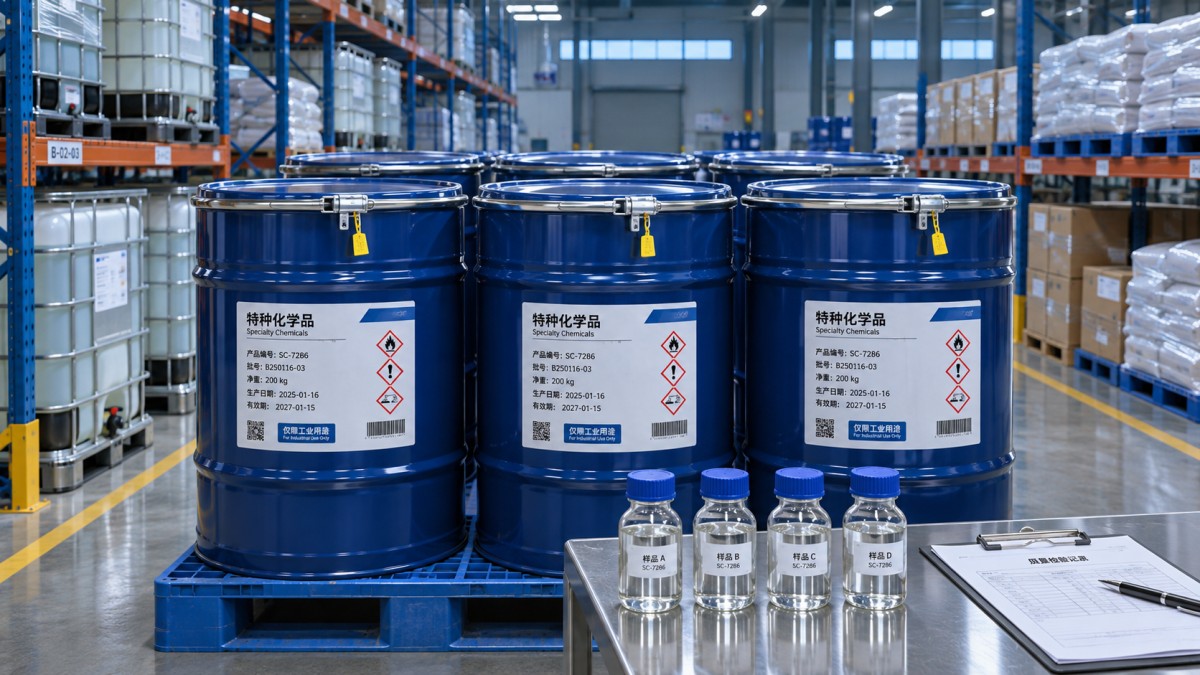
Ask the supplier to identify the actual manufacturing site, not just the sales office or contracting entity. Confirm where synthesis, blending, purification, packaging and quality release occur. A site capable of blending a material may still rely on one remote plant for its active ingredient. Similarly, a supplier with multiple facilities may have only one approved to make the required grade.
Request enough detail to identify shared dependencies without expecting disclosure of proprietary formulations. Useful questions include:
- Which critical feedstocks, intermediates or process utilities could stop production, and are they available from more than one qualified source?
- Is spare capacity available on the relevant production line, or is capacity shared with competing products and customers?
- Can another site produce the same specification, and would it require customer approval or new regulatory documentation?
- Where are finished goods stored, and which ports, carriers or temperature-controlled services does delivery depend on?
- What recovery arrangements exist for equipment failure, utility interruption or loss of a key raw material?
Distinguish documented arrangements from possibilities. A supplier’s statement that another plant “could make” a grade is weaker than evidence that the plant has made it, has capacity reserved and can release it against the required specification. Treat confidential information appropriately, but record any unanswered dependency as an assessment gap rather than assuming the exposure is low.
Test supplier resilience with evidence
Capacity and commercial health
Review delivery performance alongside the reasons for misses: late feedstocks, production scheduling, quality holds and transport delays call for different remedies. Ask for capacity utilization or an equivalent indication of available headroom, planned maintenance windows and the process for allocating product during shortages. A supplier operating near practical capacity may have little room to recover after an unplanned shutdown, even if its historical deliveries look reliable.
Financial health matters, but a credit assessment alone cannot establish continuity. Review available financial information, payment-term changes, ownership developments and signs of constrained investment alongside operational evidence. Where information is private, seek proportionate assurances, such as an independent credit assessment or a discussion of continuity funding. Avoid treating any single indicator as proof that failure is imminent.
Quality and change control
Review recent certificates of analysis, deviations, complaints and corrective actions against the characteristics that matter in the actual application. A chemical can meet its published specification yet behave differently because of an impurity profile, particle size distribution, residual solvent or other attribute not routinely controlled on the certificate. Ask engineering and quality teams which properties drive process performance and whether the supplier measures them.
Confirm how the supplier notifies customers about changes to manufacturing site, process, raw materials, analytical methods or packaging. Define which changes require advance notice, approval, testing or requalification. Notice alone is not protection if the buyer lacks enough time to assess stock and validate the change before implementation.
Documentation and regulatory fit
Check that the current safety data sheet, labeling, transport classification and applicable market-specific documentation support the intended use and destination. Responsibilities can differ by substance, jurisdiction, import role and application. Confirm who maintains required registrations or notifications and what happens if the manufacturing source changes. A replacement that performs well in a trial may still be unusable until its documentation and applicable approvals are in place.
Turn findings into a comparable risk rating
A simple scoring model helps compare materials, provided it does not conceal a critical weakness. Rate each material on likelihood of disruption and consequence, using defined bands rather than unsupported percentages. Consequence should reflect production stoppage, customer impact, safety or compliance exposure and cost. Assess detectability separately: a gradual financial decline may be visible, while contamination may only become apparent after a batch is used.
Use the ratings to prioritize action, not to calculate a precise probability without adequate data. A severe single point of failure should remain visible even if other categories score well. Record the assumptions, evidence date, owner and next review date; mark a rating as provisional when capacity, recovery time or upstream dependency is unknown.
Compare mitigation costs against the interruption gap
For each high-priority material, compare practical options over the same planning horizon. Include purchase price, freight, storage, insurance, financing, testing, qualification, potential expiry and the expected operational cost of disruption. Where reliable probabilities are unavailable, use scenarios: estimate the consequence of a defined interruption and compare mitigation costs with the exposure reduced. Do not present the result as a forecast.
- Additional inventory can bridge a short recovery period without changing the formulation. Check shelf life, storage conditions, working capital, demand variability and whether stock is physically separated from the supplier’s site.
- A second qualified source can reduce dependence, but only if it has distinct manufacturing and upstream dependencies. Maintaining approval may require periodic purchases, testing and document updates.
- Reserved capacity or supplier-held stock may improve access during disruption. Confirm ownership, location, replenishment rules, allocation priority and the circumstances in which the commitment applies.
- Reformulation or process changes may widen the available supply base, but require technical validation and potentially customer or regulatory review. They are usually longer-term measures rather than immediate contingency stock.
Two suppliers are not automatically safer than one. Both may purchase the same intermediate, operate in the same constrained transport corridor or rely on the same contract manufacturer. Conversely, splitting volume can reduce leverage or leave neither supplier with enough business to maintain capacity. Compare independent supply capacity with the true cost of maintaining it.
Make the alternative usable before it is needed
Agree on qualification criteria with quality, production and product stewardship teams before requesting samples. Start with specifications and documentation, then assess laboratory performance, process trials and finished-product effects as appropriate. Establish batch acceptance criteria and examine attributes that are important in use, not merely those printed on the supplier’s standard data sheet.
Map customer notification or approval requirements and the time needed to complete them. Confirm that the alternative supplier can provide the required quantity, packaging and delivery route after approval. A laboratory-approved sample is not an operational backup if commercial-scale batches, import documentation or plant trials remain outstanding.
Keep an alternative active at a level justified by its criticality. That may mean periodic purchases or scheduled revalidation rather than assuming an approval remains current indefinitely. Document who can authorize use, how inventory will be allocated and which production recipes or specifications must change.
Set triggers and assign ownership
Convert the assessment into a short action record for each priority material: exposure, evidence gap, chosen mitigation, responsible owner, deadline and decision required. Define triggers for escalation, such as a material change in lead time, repeated quality holds, a manufacturing-site change, a critical feedstock shortage or stock falling below the level needed to bridge recovery.
Review the record when those triggers occur and as part of the regular supplier review cycle. Ask the supplier to update recovery assumptions after material process or capacity changes, and test whether contact details, stock locations and allocation procedures still work. If the business elects to retain a single source, record who accepted the residual exposure and the maximum interruption the operation is prepared to absorb.
Deep Dive
Related Intelligence
 Specialty ChemicalsSodium Methoxide Selection: How Chemical Buyers Reduce Specification and Handling RiskAnalyst:Lead Materials Scientist
 Specialty ChemicalsHow Corporate Case Studies Reveal Real-World Challenges in Adopting Specialty Chemicals for Food SafetyAnalyst:Lead Materials Scientist
 Specialty ChemicalsCan Brand Elevation Tactics Reduce Customer Acquisition Cost for Specialty Chemicals in Organic Food Production?Analyst:Lead Materials Scientist