Milk Cooling Tanks for Dairy Plants: Practical Buying Criteria
Key Takeaways
- US Steel Sheet Prices Rise as Buyers Report Tight Supply and Steady DemandLead Materials Scientist
- Can market entry planning software help prioritize new markets?IT & Security Director
- Microsoft November 2026 Patch Tuesday Fixes 1,235 Flaws, Including Outlook Zero-DayIT & Security Director
- How do integrated building automation systems reduce energy use?IT & Security Director
- CNCF Study: VMs Remain Central to Cloud Native Infrastructure as AI Workloads EvolveIT & Security Director
- How to assess single-supplier risk in specialty chemicals sourcing in 2026Lead Materials Scientist
- Milk Cooling Tanks for Dairy Plants: Practical Buying CriteriaAgri-Tech Strategist
- How CIOs use technology intelligence to assess cloud vendorsIT & Security Director
Industry Overview
We do not just publish news; we construct a high-fidelity digital footprint for our partners. By aligning with TNE, enterprises build the essential algorithmic "Trust Signals" required by modern search engines, ensuring they stand out to high-net-worth buyers in an increasingly crowded global digital landscape.
A milk cooling tank should be purchased against a defined production duty, not simply a stated volume. Procurement teams need to know how much milk arrives, at what temperature, how quickly it must be cooled, and how the tank will be emptied and cleaned. A vessel that holds the required volume may still be unsuitable if its refrigeration system cannot handle the arrival pattern or its outlet prevents complete drainage.
The decision also reaches beyond the tank itself. Refrigeration capacity, building services, hygienic design, controls, installation and acceptance testing all affect whether the equipment can operate as intended. Comparing bids on these points reduces the risk of discovering missing utilities or incompatible process connections after delivery.
Define the duty before requesting quotations
Start with a simple process description: milk source, expected arrival schedule, peak batch size, incoming temperature range, required storage temperature and maximum holding period. Record whether milk will arrive in one delivery or several additions, and whether warm incoming milk may be added to milk already in the tank. That distinction matters because the refrigeration system must remove heat from new arrivals while protecting the milk already stored.
Include the temperature and cooling-time requirements set by the applicable authority and the plant’s food safety plan. These depend on jurisdiction and process. For example, the U.S. Food and Drug Administration’s Grade “A” Pasteurized Milk Ordinance, 2023 revision, addresses cooling and storage conditions for Grade A milk under its specified regulatory framework. Its requirements should not be assumed to apply unchanged to every plant or product; buyers should confirm the rules adopted locally and the scope of their operation.
Identify what happens upstream and downstream. A tank receiving raw milk before pasteurization has a different contamination-control context from one holding pasteurized milk. If the same vessel is expected to perform cooling, mixing or intermediate storage, describe each operation and the cleaning needed between products. Among milk processing tanks, cooling and mixing configurations can differ substantially, so a shared product category is not a substitute for a written duty specification.
Size for actual working conditions
Nominal tank capacity is only a starting point. Ask each supplier to state the usable working volume, the minimum effective operating volume and any limits on filling during agitation or cleaning. A vessel with ample gross capacity may leave insufficient headspace for normal operation, while a tank that is rarely filled may not cool or mix the smallest batch reliably.
Map the largest expected delivery against the milk already present. Allow for scheduling interruptions and the volume that must remain available for downstream production, but avoid adding an arbitrary safety margin without checking its consequences. An oversized tank can complicate low-volume operation and consume valuable floor space; an undersized one can force changes to collection or production schedules.
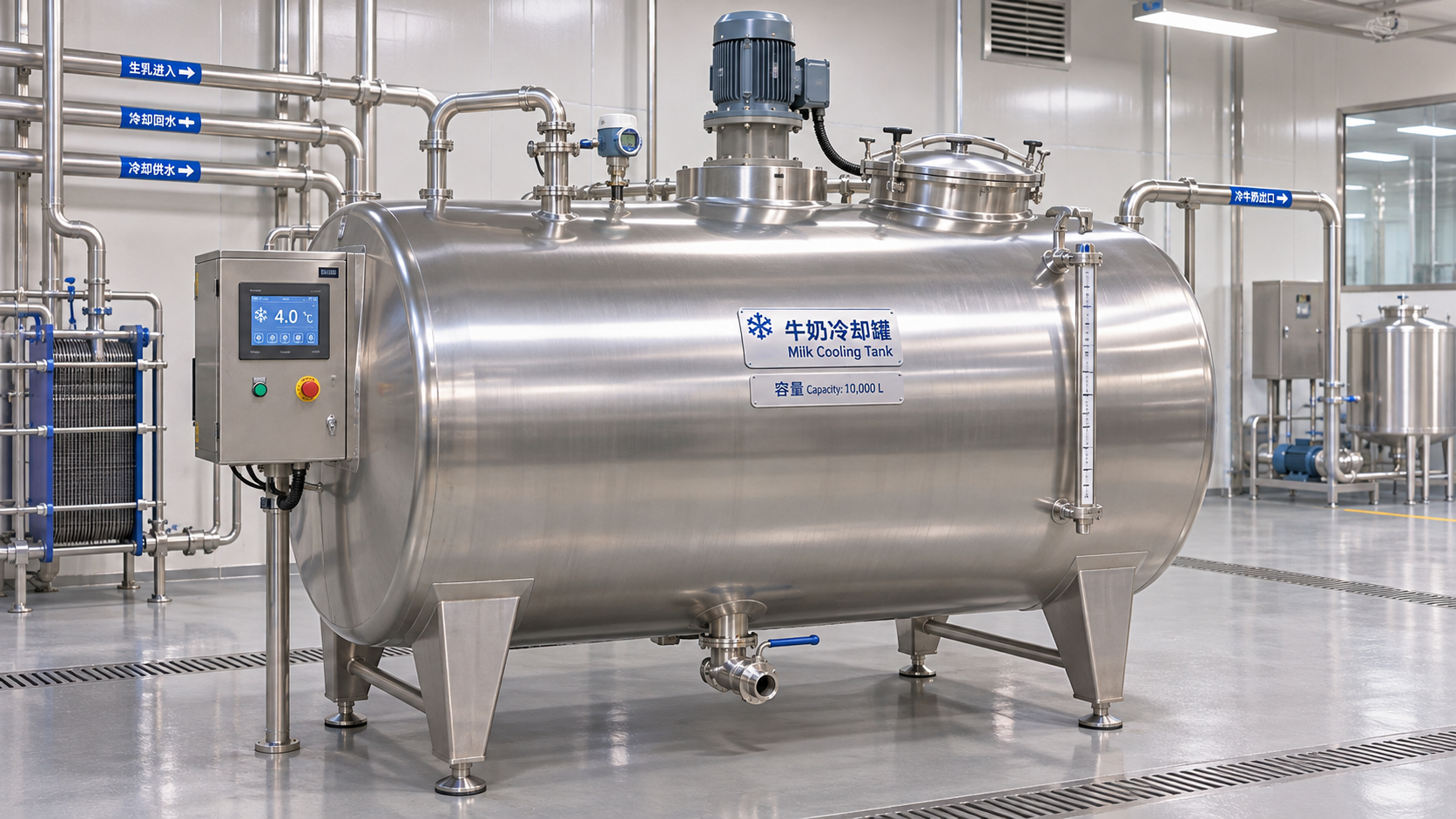
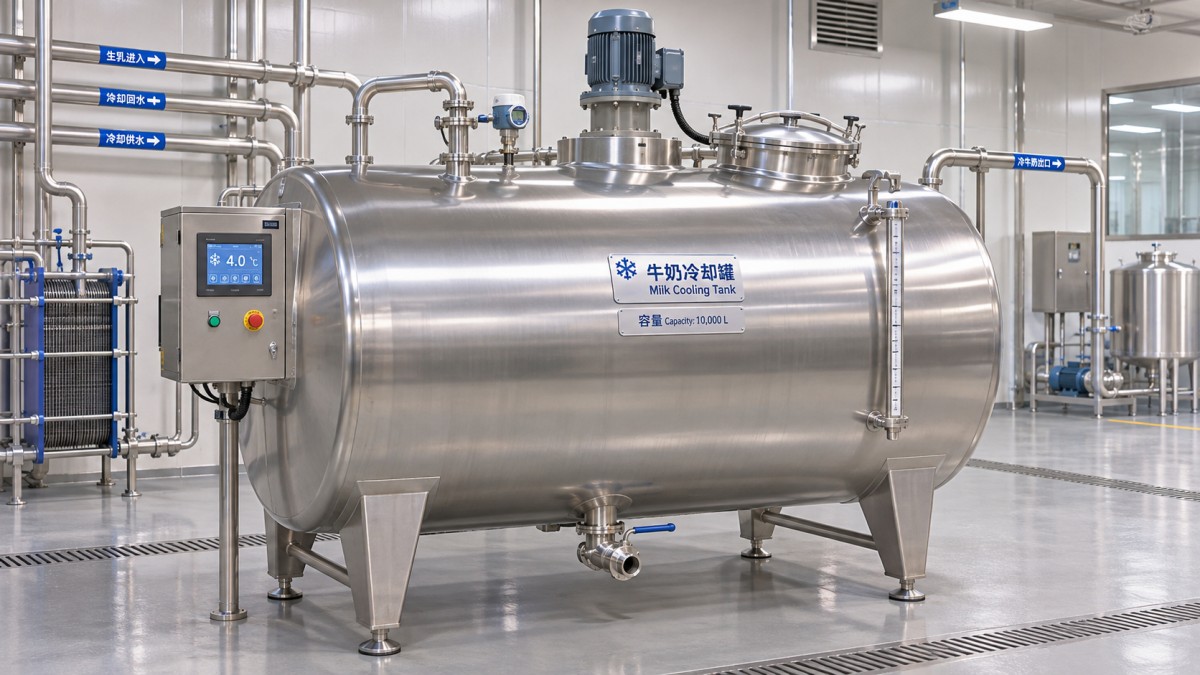
Tank geometry also affects integration. A vertical vessel may conserve floor area but require more overhead clearance for inspection, agitator removal and cleaning connections. A horizontal vessel may fit a low building but demand a longer footprint. Obtain a dimensioned drawing showing the vessel, supports, pipework, access openings and maintenance envelope rather than relying on overall tank dimensions alone.
Compare cooling performance on the same basis
A refrigeration quotation is meaningful only when its test conditions are clear. Ask bidders to specify the volume and initial temperature of milk, target temperature, cooling time, ambient conditions and utility assumptions used to size the system. Where milk is added in stages, request performance information for that sequence, not just for a single full batch.
The cooling load depends on the quantity of milk and the temperature reduction required, as well as heat entering through the vessel and heat contributed by equipment or the environment. The time available to remove that heat changes the required refrigeration duty. A short receiving window can therefore call for a different system from one handling the same daily volume over a longer period.
Direct-expansion cooling and chilled-water or glycol-based systems should be assessed as complete arrangements. A direct-expansion design may avoid a separate secondary cooling circuit, while a central chilled-fluid system may fit a plant that already has suitable capacity and distribution pipework. Either choice requires confirmation of controls, maintenance access, refrigerant arrangements and responsibility for interfaces. Existing refrigeration capacity should be checked at peak plant load rather than assumed to be available.
Ask how the design avoids localized freezing at the cooling surface, particularly at low fill levels or when agitation is interrupted. A temperature sensor positioned away from poorly mixed milk can give a reassuring reading without representing the whole batch. The supplier should explain sensor location, control logic and the operating conditions under which its performance claim applies.
Assess agitation and temperature measurement together
Agitation helps distribute temperature and maintain a representative product, but more mixing is not automatically better. The appropriate arrangement depends on tank shape, fill level, milk characteristics and the process duty. Excessive turbulence, air incorporation or poorly positioned equipment may create operational problems. Ask for the minimum fill level at which the agitator is intended to operate and how the design handles additions during cooling.
Controls deserve the same scrutiny as the motor. Determine whether agitation is continuous or intermittent, how it behaves during cooling and cleaning, and what happens after a power interruption. Operators should be able to distinguish a normal cycle from a fault without relying on an undocumented sequence.
For temperature monitoring, specify the required display, recording and alarm functions. Discuss sensor calibration, access for verification and the response to sensor failure. If records form part of the plant’s food safety system, confirm how data are retained, retrieved and protected against unintended changes. An alarm is useful only when the plant has defined who receives it and what action follows.
Inspect hygienic design, not just the material grade
Stainless steel is commonly specified for milk-contact surfaces, but naming a material alone does not establish that a tank is suitable for sanitary service. Buyers should identify all product-contact materials, including seals, gaskets and instrument fittings, and require documentation appropriate to the intended food contact and cleaning chemicals. Ask how welds, joints and internal attachments will be finished and inspected.
Look closely at features that can retain milk or cleaning solution: outlet geometry, instrument pockets, valve arrangements, agitator seals and connections to transfer lines. Drainability depends on the installed position and associated piping as well as the vessel itself. A tank may be designed to drain, yet leave liquid behind if the site floor, supports or outlet line prevent the intended slope.
Cleaning requirements should be part of the purchase specification. State whether the plant uses manual cleaning, cleaning in place, or a combination, and identify the available flow, pressure, temperature and chemical programme. For a cleaning-in-place system, establish who is responsible for the spray device, supply and return connections, and verification of coverage under the actual installation conditions. A supplier’s claim that a tank is “CIP-ready” does not by itself demonstrate that the plant’s cleaning system can clean it effectively.
Where a specification refers to a sanitary design standard or certification, request the exact designation, applicable edition, scope and supporting evidence. Standards and approvals are not interchangeable: an equipment certificate, a material declaration and a validated cleaning procedure answer different questions.
Make installation responsibilities explicit
Before selecting a bid, check electrical supply, water and drain availability, refrigeration services, ventilation and access for lifting equipment. Confirm who supplies and connects valves, pipework, insulation, cabling, control panels and any remote condensing equipment. These items can shift substantially between quotations even when the tank descriptions look similar.
The delivery route matters as much as the final footprint. Doorways, ceiling obstructions, floor loading and the space needed to remove an agitator or service refrigeration equipment can constrain the installation. Ask for equipment weight, lifting points and foundation or support requirements, then have the site team review them before the order is placed.
Also establish ownership of the interfaces. If one contractor supplies the vessel and another supplies refrigeration, identify who sizes the complete system, checks compatibility and resolves a performance shortfall. A responsibility matrix attached to the purchase order is more useful than assuming that either party will cover an omitted component.
Use an acceptance plan to make bids comparable
Turn the duty specification into measurable acceptance criteria before contracts are signed. The plan should distinguish checks at the supplier’s works from tests after installation, when site utilities and connected systems are available. Not every performance test can be completed meaningfully before the tank reaches its operating environment.
- Documentation: review drawings, material and component records, operating instructions, maintenance schedules, electrical diagrams and the list of recommended spare parts.
- Physical inspection: check dimensions, access, connections, internal finish, identification of product-contact components and any visible damage from transport.
- Functional checks: verify agitator operation, temperature indication, alarms, control sequences and safe responses to relevant faults.
- Site performance: agree on a cooling test using a representative load, starting temperature, ambient conditions and measurement method. Record deviations and the procedure for corrective work.
- Cleaning and drainage: inspect the installed arrangement and verify the cleaning procedure under the plant’s actual operating conditions.
If a test uses water rather than milk, record that distinction and agree in advance on how the result will be interpreted; the test medium and operating conditions can affect the comparison. Acceptance should also cover operator training and the handover of control settings, passwords where applicable, and service contacts.
Evaluate ownership cost and service exposure
The lowest equipment price may omit installation work, refrigeration components, commissioning or documentation. Compare bids using the same scope and separate confirmed costs from allowances. Consider electricity demand under the proposed duty, cleaning utilities and chemicals, routine maintenance, replacement seals, instrument calibration and the cost of taking the tank out of service.
Serviceability can be decisive where the plant has limited storage redundancy. Check access to motors, seals, sensors and refrigeration components, along with expected parts availability and the supplier’s support arrangements. Avoid treating an estimated service response as a guarantee unless the contract defines coverage, response time and exclusions.
The most defensible purchase is the one whose capacity, cooling duty and hygienic design have been matched to the plant’s real operating pattern—and whose performance can be checked against an agreed acceptance plan. When requirements are uncertain, resolve the receiving schedule and utility capacity before fixing the tank size; those assumptions shape both the quotation and the equipment’s eventual usefulness.
Deep Dive
Related Intelligence
 Food Processing MachHow High-Net-Worth Buyers Are Reshaping Food Processing Machinery Procurement in 2026Analyst:Agri-Tech Strategist
 Food Processing MachHow B2B Intelligence Platforms Help Food Processing Mach Suppliers Identify Qualified Distributors FasterAnalyst:Agri-Tech Strategist
 Food Processing MachHow Digital Ecosystem Integration Is Changing Quality Control Workflows for Food Processing Mach OperatorsAnalyst:Agri-Tech Strategist