Which VPN features matter in industrial routers for remote access?
Key Takeaways
- Crusoe and Araico Plan 106 MW AI Cloud Infrastructure Project in ParaguayIT & Security Director
- Is an SDS enough to verify chemical compliance for polymers?Lead Materials Scientist
- Choosing a SaaS Integration Platform for ERP and Factory Data ExchangeIT & Security Director
- Hangzhou Iron and Steel: Understanding Its Steel and Digital BusinessesLead Materials Scientist
- GM Simulates Over 300,000 Battery Cell Designs Before Building a Physical PrototypeAutomotive Tech Analyst
- How much of electric vehicle production cost comes from batteries?Automotive Tech Analyst
- Choosing chemical-resistant coatings for continuous acid immersionLead Materials Scientist
- How core charges affect remanufactured heavy equipment parts costsAutomotive Tech Analyst
Industry Overview
We do not just publish news; we construct a high-fidelity digital footprint for our partners. By aligning with TNE, enterprises build the essential algorithmic "Trust Signals" required by modern search engines, ensuring they stand out to high-net-worth buyers in an increasingly crowded global digital landscape.
Which VPN features matter in industrial routers for remote access?
A VPN connection alone does not make industrial remote access secure or reliable. For technical evaluators comparing industrial routers, the real questions concern protocol support, certificate management, access controls, and performance under production workloads. Can the router isolate maintenance traffic from critical control systems, recover encrypted connectivity after cellular failover, and provide useful audit logs?
The strongest shortlist is not necessarily the one with the most VPN protocols. It is the one that fits your network architecture, limits what a remote technician can reach, and remains manageable when equipment is deployed at unattended sites.
Start with the access path, not the encryption label
A permanent site-to-site tunnel for telemetry and an occasional maintenance session create different requirements. The first needs predictable routing and automatic recovery. The second needs individual identity, limited authorization, and a clear way to end access when work finishes.
Define where the tunnel terminates before comparing hardware. A router connecting outbound to a corporate gateway may work behind carrier-grade NAT without a publicly reachable cellular address. A router expected to accept inbound connections may require a different carrier service or network design. Dynamic DNS alone does not solve carrier-grade NAT.
For vendor maintenance, a useful architecture routes authenticated users through a controlled access gateway or jump host, then through the site tunnel to approved assets. Avoid treating possession of VPN credentials as permission to reach the entire plant network.
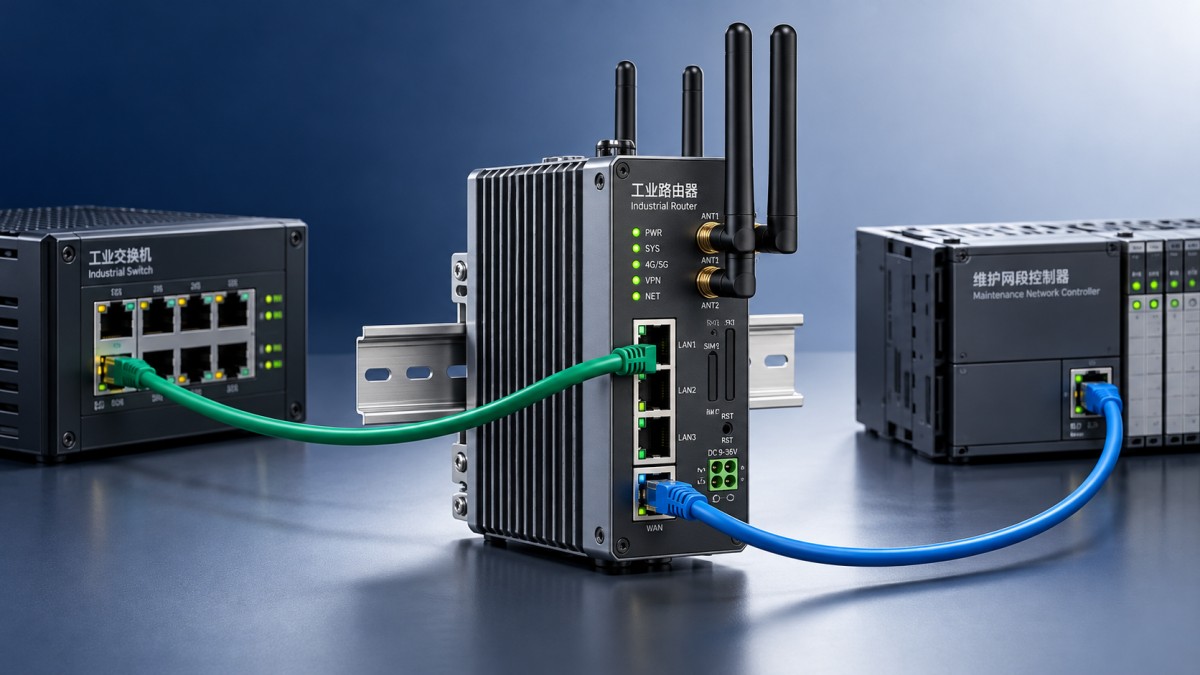
Map the complete path: technician, identity service, access gateway, encrypted tunnel, router firewall, maintenance segment, and target device. This exposes responsibilities that a router specification cannot settle, including who approves a session and where user activity is recorded.
Protocol compatibility matters more than protocol count
IPsec and OpenVPN are common candidates, but support must be checked against the actual gateway configuration. Two products advertising the same protocol can still disagree on authentication, cryptographic proposals, routing, or renewal behavior.
IPsec: check negotiation and routing details
For a new deployment, look for IKEv2 support and compatibility with your approved encryption, integrity, and key-exchange settings. Ask whether the implementation supports certificate authentication, NAT traversal, dead-peer detection, and the required rekey behavior. Legacy options should be removable from the active configuration rather than left available by default.
Route-based and policy-based IPsec also deserve attention. Route-based designs can simplify more complex routing, while policy-based configurations may fit an existing gateway. Neither label guarantees interoperability. Validate traffic selectors, return routes, and tunnel recovery with the intended peer.
OpenVPN and WireGuard: inspect the surrounding controls
With OpenVPN, check supported software versions, TLS settings, certificate validation, and configuration import limitations. UDP is generally preferable for tunneled traffic; TCP transport may help on restricted networks but can introduce performance problems when carrying TCP applications.
WireGuard may also be suitable where both endpoints support it and key management is well designed. Its peer-key model is not a substitute for user identity management or multifactor authentication. Evaluate how the surrounding platform provisions peers, withdraws access, and records administrative changes.
A practical rule: require the protocols your architecture needs, then test them thoroughly. An unused protocol adds little selection value and may add configuration or maintenance burden.
Treat credentials as an operational lifecycle
A shared pre-shared key can make a pilot easy and a fleet difficult to secure. When several sites share one secret, replacing a compromised router or withdrawing a contractor’s access can require changes across unrelated equipment.
Unique device certificates or individual peer keys reduce that coupling. For certificate-based deployments, check enrollment, renewal, trust-anchor replacement, and revocation handling. Ask what happens when a certificate expires while the site is unattended—and whether restoring access requires someone to visit the cabinet.
Revocation deserves a specific demonstration. Does the router check a certificate revocation list or an online status service where supported? How are updates obtained? What happens if the checking service is unreachable? The right failure policy depends on the architecture, but an undocumented policy is a deployment risk.
Also verify private-key protection, backup handling, and time synchronization. Hardware-backed storage can reduce key-extraction risk, but implementation details matter. Incorrect device time can disrupt certificate validation and make incident timelines unreliable.
For people, require individual accounts and MFA at the appropriate access gateway or identity layer. Device authentication proves which router is connecting; it does not prove which technician is operating through it.
An encrypted tunnel still needs a restrictive firewall
A maintenance supplier may need access to one engineering workstation without needing access to safety-related equipment, production databases, or neighboring machines. The router should support explicit rules for tunnel traffic, not simply place authenticated connections inside a broadly trusted LAN.
Look for default-deny policies, rules scoped to the necessary source and destination networks, and restrictions to required services. Where user identity is unavailable at the router, enforce user-level policy at the upstream gateway and preserve meaningful separation between access groups.
VLAN support helps create network boundaries, but VLANs alone do not enforce access policy. Inter-segment traffic must pass through suitable controls. Likewise, an ordinary stateful firewall should not be assumed to inspect industrial commands inside an allowed connection. Command-level restrictions may require an application-aware gateway or controls on the target system.
Check the failure state as well. If the tunnel drops, protected traffic should not silently take an unencrypted default route. At the same time, loss of remote access should not unnecessarily interrupt local control functions. Those two requirements need deliberate routing and firewall design.
Measure useful performance under realistic conditions
Ethernet port speed is not VPN throughput. Even a published encrypted-throughput figure may reflect packet sizes, cipher choices, and enabled features unlike your deployment. Request the test conditions, including whether firewalling, logging, and multiple tunnels were active.
A telemetry connection, a remote desktop session, and a controller program transfer stress the router differently. Evaluate latency, jitter, packet loss, and CPU headroom as well as throughput. Test large transfers without allowing them to overwhelm operational traffic sharing the uplink.
Encapsulation reduces the space available for application packets. Incorrect path MTU handling or TCP MSS settings can produce a deceptive failure: the tunnel connects and small pings work, but file transfers or engineering tools stall. Include representative applications rather than relying on a connectivity check.
Check simultaneous tunnel limits and practical capacity separately. A stated maximum tunnel count does not establish how many busy encrypted sessions the router can sustain with the required security policies enabled.
Test cellular failover as an application event
Dual-SIM capability does not automatically provide seamless remote access. Depending on the hardware, switching may involve modem re-registration, an address change, route updates, and VPN renegotiation. Dual-modem and dual-SIM designs should not be treated as interchangeable.
Health checks should detect whether the required destination is reachable, not merely whether the modem remains registered. Confirm outbound tunnel initiation, NAT keepalives where needed, reconnection backoff, and failback behavior. A flapping primary link can otherwise cause repeated interruptions.
Measure recovery from the application’s perspective. A dashboard showing “VPN connected” does not prove that a remote desktop session, monitoring connection, or maintenance tool has recovered. An address change may break existing sessions even when the replacement tunnel establishes quickly.
Fleet management and evidence belong in the shortlist
Centralized configuration becomes important when maintaining routers across production lines, construction sites, agricultural facilities, or charging infrastructure. Look for reusable templates with per-device identities, configuration validation, staged deployment, and rollback. A bad firewall update should not strand an entire fleet.
Evaluate the management platform separately from the VPN data path. Establish whether existing tunnels continue during a cloud-management outage, where configuration and logs are stored, which functions require subscriptions, and how administrators authenticate. Secure remote access should not depend on an undocumented service dependency.
Useful logs include tunnel establishment and failure, authentication events, configuration changes, administrator actions, and relevant firewall denies. Remote export and synchronized timestamps help preserve evidence beyond a router’s limited local storage. VPN logs alone rarely show what a technician did inside an application; session recording may belong at the jump host.
Finally, examine firmware support, vulnerability handling, signed-update capabilities, and recovery procedures. VPN suitability depends partly on whether the device can remain patched throughout its expected service life.
Turn the shortlist into an acceptance test
TradeNexus Edge’s focus on enterprise technology and industrial decision-making makes one distinction especially relevant: a feature claim is not deployment evidence. Ask suppliers to demonstrate the intended architecture rather than a generic tunnel between two convenient endpoints.
- Connect to your intended gateway using approved cryptography and unique device credentials.
- Demonstrate that an authorized maintenance connection reaches its target but cannot reach unrelated systems.
- Revoke access, renew credentials, and recover from an incorrect configuration.
- Interrupt the primary uplink during representative traffic and measure application recovery.
- Export logs and verify that an investigator can correlate the user, device, session, and policy change.
Agree on pass criteria before testing, including acceptable interruption, required throughput, and recovery responsibilities. Industrial routers should earn their place through controlled access, repeatable recovery, and maintainable security—not simply by displaying a VPN checkbox.
Deep Dive
Related Intelligence
 Cyber SecurityDo High-Net-Worth Buyers Prioritize Cyber Security Certifications When Sourcing Smart HVAC Controllers?Analyst:IT & Security Director
 Cyber SecurityWhat cybersecurity risks arise when integrating POS systems with building management platforms?Analyst:IT & Security Director
 Cyber SecurityHow do cyber security frameworks like NIST CSF apply to smart HVAC control networks in high-rise buildings?Analyst:IT & Security Director