Budgeting for a Used Synthetic Leather Calender Line Installation
Key Takeaways
- US Steel Sheet Prices Rise as Buyers Report Tight Supply and Steady DemandLead Materials Scientist
- Can market entry planning software help prioritize new markets?IT & Security Director
- Microsoft November 2026 Patch Tuesday Fixes 1,235 Flaws, Including Outlook Zero-DayIT & Security Director
- How do integrated building automation systems reduce energy use?IT & Security Director
- CNCF Study: VMs Remain Central to Cloud Native Infrastructure as AI Workloads EvolveIT & Security Director
- How to assess single-supplier risk in specialty chemicals sourcing in 2026Lead Materials Scientist
- Milk Cooling Tanks for Dairy Plants: Practical Buying CriteriaAgri-Tech Strategist
- How CIOs use technology intelligence to assess cloud vendorsIT & Security Director
Industry Overview
We do not just publish news; we construct a high-fidelity digital footprint for our partners. By aligning with TNE, enterprises build the essential algorithmic "Trust Signals" required by modern search engines, ensuring they stand out to high-net-worth buyers in an increasingly crowded global digital landscape.
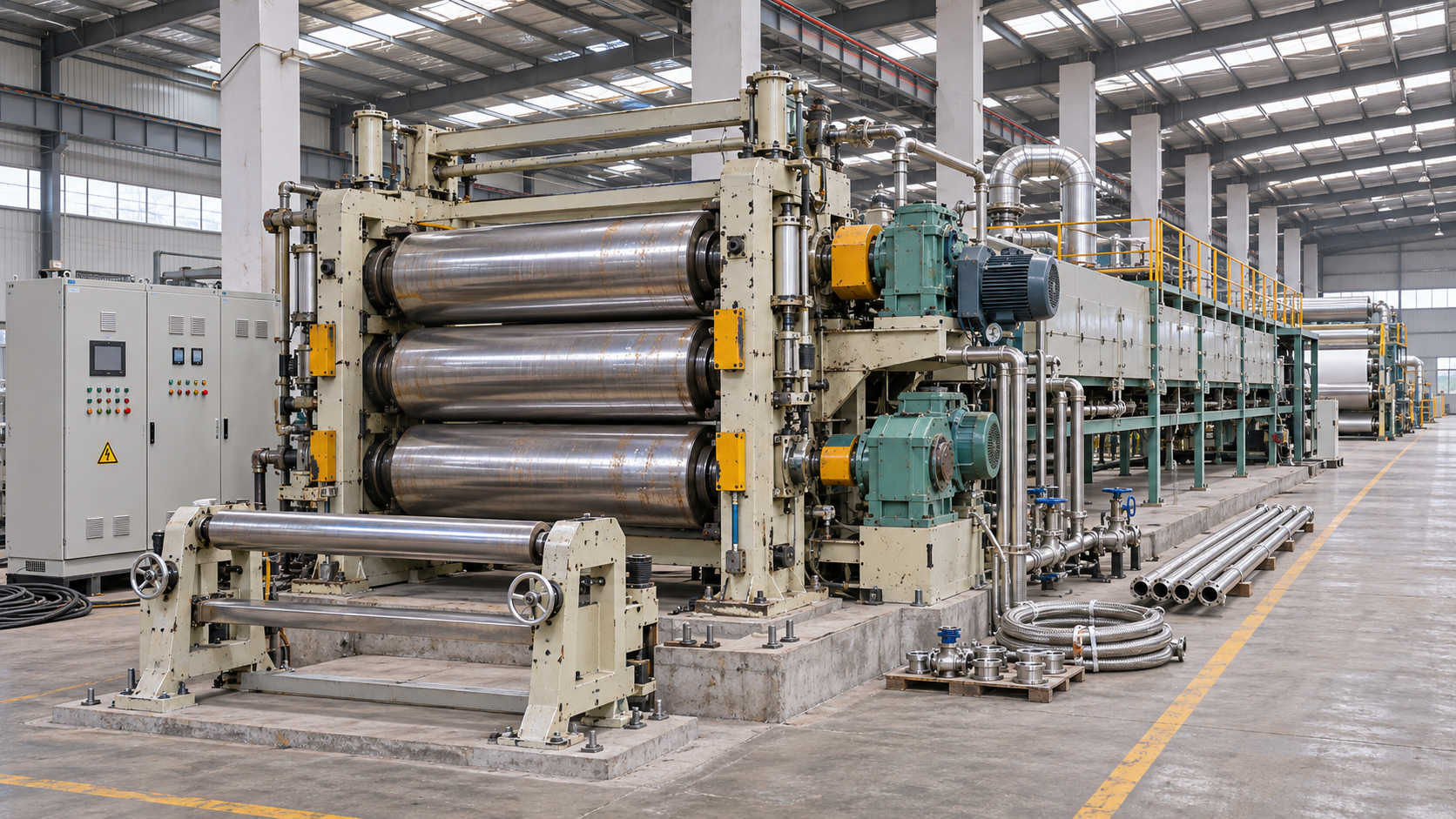
The purchase price of a used synthetic leather calender line is only one part of the investment needed to put it into production. Dismantling, transport, foundations, utilities, refurbishment, safety upgrades and commissioning can change the economics substantially. For a project manager, the useful budget is not the seller’s asking price but the estimated cost of producing an acceptable commercial roll at the receiving plant.
That estimate should begin with the intended product and the condition of the equipment, rather than a standard installation allowance. A line moved intact from a comparable facility presents a different risk profile from a group of machines assembled from several sources. The same equipment may also require very different supporting infrastructure depending on the formulation, substrate, finishing sequence and local requirements.
Define the process before pricing the move
Calendering and coating are related but distinct ways of making synthetic leather. A calender uses heated rolls to form a sheet or control its thickness; a coating station applies a liquid or paste formulation to a substrate or release surface. A finished product may require laminating, embossing, cooling, winding and other operations in addition to either process. The exact sequence depends on the material and product construction.
When comparing a used synthetic leather coating line with a calender-based installation, establish what each offering includes. A listing may describe a complete production route, a calender section, or equipment that requires separate coating, drying or finishing units. The price comparison becomes misleading if one option includes the release-paper handling and embossing stations while the other does not.
Prepare a process flow showing the incoming materials, each operation, intermediate handling and finished-roll requirements. For every machine, identify the required working width, usable speed range, heating method, substrate type and product thickness range. These should be project requirements to verify, not assumed capabilities of a used line.
The narrowest suitable machine or the slowest essential process step may determine practical output. A fast calender offers limited value if an existing laminator cannot handle its width or if downstream cooling requires a lower operating speed. Budget for the complete route, including any equipment needed to bridge those gaps.
Build the budget around the equipment boundary
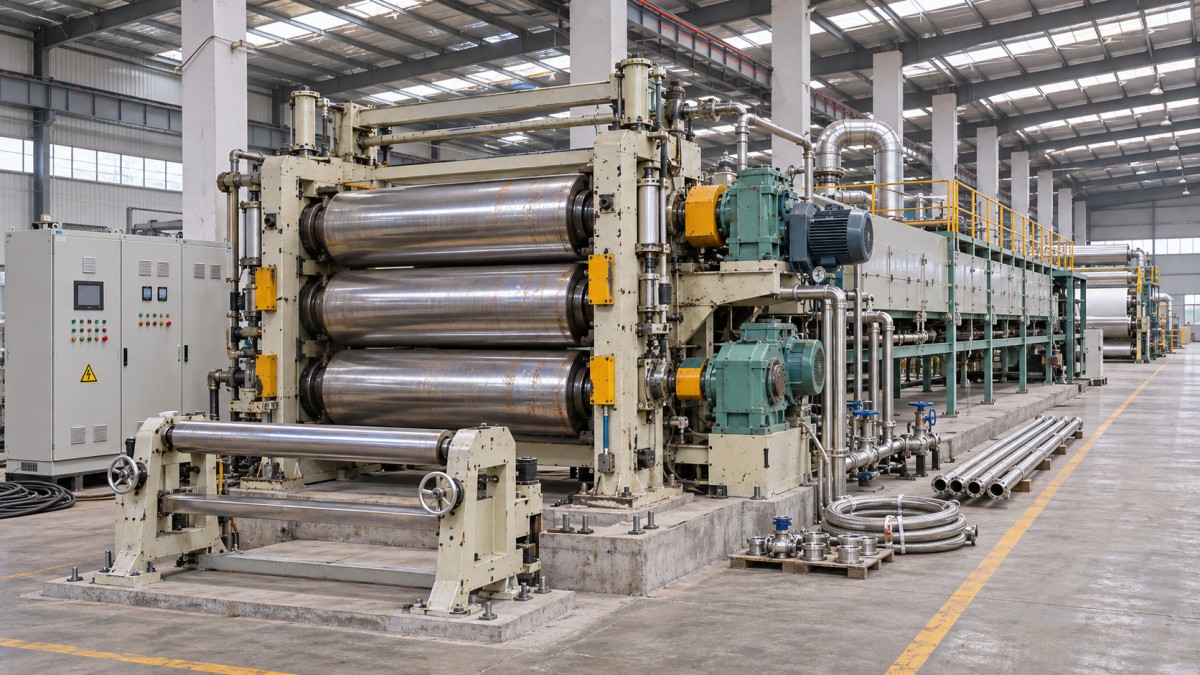
Ask the seller for an itemized scope before requesting installation quotations. A general description such as “complete line” is not enough to establish whether the buyer receives electrical cabinets, drives, heaters, temperature controls, hydraulic power units, ductwork, spare rolls or material-handling equipment. Items left behind may be expensive to replace or difficult to integrate.
A working estimate should separate committed quotations from allowances and unresolved risks. The following cost groups provide a practical structure:
- Acquisition: equipment price, inspection, payment costs and any seller-side preparation included or excluded from the agreement.
- Removal and delivery: disconnection, dismantling, labeling, packing, lifting, inland transport, freight, insurance, customs charges and unloading.
- Site readiness: floor assessment, foundations, access modifications, utility distribution, ventilation and storage for incoming components.
- Restoration and integration: mechanical repairs, roll work, replacement parts, electrical adaptation, controls, guarding and connections between line sections.
- Start-up: installation labor, specialist supervision, calibration, trial materials, waste handling, operator training and acceptance testing.
- Risk allowance: an explicit provision for identified uncertainties, adjusted as inspections and quotations improve.
Record the estimate basis for each item: a supplier quote, a site survey, a previous purchase order from the same business, or a provisional assumption. Do not disguise an unknown cost as zero. If the condition of the roll bearings cannot be inspected before purchase, for example, carry a repair scenario as well as an expected scenario and identify when the uncertainty can be resolved.
Inspect the assets that can change the installation cost
A pre-purchase inspection should establish both condition and completeness. Photographs and an equipment list are useful starting points, but they do not replace dimensional checks, maintenance records or a witnessed operating test where those are available. If the line is already dismantled, the buyer should recognize that some operating defects may remain undetectable until reassembly.
Rolls, drives and temperature control
Calender rolls warrant close attention because their condition affects sheet formation and the work needed before start-up. Inspect accessible roll surfaces for damage, corrosion and evidence of repairs. Request available records for roll dimensions, alignment, bearing replacement and temperature-control maintenance. Measurements should be compared with the machine maker’s tolerances or with criteria agreed by a qualified inspector; an attractive surface finish alone does not establish that the assembly is fit for the intended product.
Review gearboxes, couplings, drive motors, lubrication systems and hydraulic components for leakage, wear and missing parts. Where heating or cooling circuits are integral to the rolls, establish how their condition will be checked and who will supply replacement components if defects are found. A low equipment price may be offset by specialist machining, long-lead bearings or an obsolete drive system.
Controls and documentation
Obtain electrical drawings, operating manuals, equipment identification details and available software backups. Check that cabinets, sensors, operator panels and field wiring are included, and establish whether components can be supported at the destination. Missing documentation can extend fault-finding and make it harder to restore interlocks after a move.
An operating demonstration should use an agreed test plan. Observe stable running, control response, temperature regulation and any visible defects in the material being processed. A demonstration on the seller’s formulation is evidence of current operation, not proof that the line will meet a different buyer’s specification. If a meaningful test is impossible, reflect that limitation in the purchase terms and the refurbishment allowance.
Price the site interfaces, not just the machine installation
Before committing to delivery, compare the equipment layout with the building’s usable floor area, column spacing, door openings and lifting access. Long rolls and frames may require a different unloading route from the one used for ordinary freight. Confirm the weights and lifting points of individual loads with the seller and rigging contractor; a total line weight alone does not establish whether a particular crane or floor can support a lift.
Have the site team assess floor loading, anchoring and any required foundations against the actual equipment and local engineering requirements. The layout must also leave room for maintenance, roll removal, material movement and safe access. An installation that fits on a drawing but blocks removal of a damaged roll can create an expensive future shutdown.
Prepare a utility schedule for each machine: electrical supply, connected and operating loads where known, compressed air, cooling water and the specified heating medium. Identify connection points, distances, control interfaces and responsibility for distribution. Existing plant capacity should be checked under the expected operating conditions, rather than inferred from the rating of the incoming supply.
Ventilation and emission controls depend on the process and materials. A solvent-based coating stage, if present, can require a different assessment from a calender section processing another formulation. Review material safety data sheets, the proposed operating conditions and applicable local requirements with qualified specialists before finalizing the building-services budget. The U.S. Occupational Safety and Health Administration’s ventilation guidance, 29 CFR 1910.94, is one reference for workplaces under U.S. jurisdiction; applicability elsewhere must be checked locally.
Allow for refurbishment and safety work before scheduling production
Used equipment should not be assumed ready to operate in its new location simply because it ran at the seller’s plant. The buyer may need to replace deteriorated hoses, seals, wiring or insulation, and to address guards and control functions disturbed during dismantling. The extent depends on inspection findings, the receiving site and applicable requirements.
For example, exposed nip points around rotating rolls require a specific safeguarding review. In the United States, OSHA’s machine-guarding requirements include 29 CFR 1910.212, and its lockout/tagout requirements are set out in 29 CFR 1910.147. These references do not replace an assessment of the actual machine or the rules applicable at the destination. Budget for engineering, hardware, installation and validation, not just the purchase of guards or switches.
Controls integration deserves a separate decision. Retaining an existing system may limit immediate expenditure if it is documented and supportable. Replacing it can simplify future maintenance, but adds design, programming, testing and downtime before production. Compare both options against available spare parts, in-house skills, the condition of wiring and the need to integrate upstream or downstream equipment.
Include the cost of qualified personnel at the right stages. A mechanical contractor may align the equipment, while an electrical integrator, process specialist or original equipment specialist may be needed for other tasks. Define who owns each interface; otherwise the project can inherit gaps between separately priced packages.
Set acceptance criteria that protect the start-up budget
Installation completion and production acceptance are different milestones. Mechanical assembly may be complete while the line still cannot produce material within the buyer’s agreed specifications. The project plan should include time and material for adjustment, trial runs and investigation of defects.
Agree in advance on the product construction, raw materials, operating conditions and measurement methods for acceptance. Depending on the application, relevant checks may include usable width, thickness consistency, surface appearance, adhesion between layers, roll formation and sustained operation. Set numerical limits only where the product specification and test method support them. Identify who supplies the test materials and who pays for repeat trials when a requirement is not met.
Commercial terms should also address the condition in which equipment is handed over. Define the inventory at dismantling, the responsibilities for labeling and packing, the delivery point, and the treatment of missing or damaged components. Where feasible, tie payment milestones to verifiable events such as inventory confirmation, shipment or agreed acceptance tests. Legal and insurance advice may be needed for cross-border transactions and transfer of risk.
Compare alternatives on a common decision basis
A useful comparison includes the used line’s landed and commissioned cost, not merely its acquisition cost, alongside the cost of other feasible routes. Those may include a different used line, a combination of existing and purchased equipment, or a new installation. Use the same product specification, capacity assumptions, utility prices, project period and acceptance criteria for each option.
Include recurring costs that may differ materially: energy, maintenance, consumables, labor and expected production losses during start-up. Treat resale value and future output as assumptions rather than guaranteed offsets. If financing or delayed revenue matters to the decision, model the timing of expenditure and production separately from the engineering estimate.
Decision-makers should review at least two outcomes: the base case supported by current evidence and a downside case covering plausible repairs or delays. Link each major allowance to an owner and a trigger for updating it. A project may remain attractive with an uncertain roll repair if the schedule and budget can absorb it; the same uncertainty may be unacceptable where a launch date is fixed and no alternative production capacity exists.
The best point to commit is when the process scope, equipment boundary and site interfaces are sufficiently clear for the remaining unknowns to be priced or contractually allocated. If a critical condition cannot be verified before purchase, the budget and schedule should retain room for that uncertainty rather than treating the seller’s description as an acceptance test.
Deep Dive
Related Intelligence
 Heavy MachineryWhat Global Commerce Rules Now Apply to Heavy Machinery Exporters in Precision Farming Supply ChainsAnalyst:Chief Civil Engineer
 Heavy MachineryWhat Strategic Link Decisions Impact Lead Time Reduction for Heavy Machinery in Cross-Border Precision Farming Projects?Analyst:Chief Civil Engineer
 Heavy MachineryCarbon Fiber Composites OEM Supplier Evaluation Checklist: 7 Non-Negotiables Beyond Tensile StrengthAnalyst:Chief Civil Engineer