Which paint emissions test reports are accepted under LEED v4.1?
Key Takeaways
- How Do You Fix Missing Material Specs in a BIM Handover Model?Chief Civil Engineer
- SpaceX Completes $40 Billion Debt Financing for GPU PurchasesIT & Security Director
- How to identify supplier risks with supply chain cybersecurity analysisIT & Security Director
- Palo Alto Networks Confirms PHP2Shell RCE Flaws Affect PAN-OSIT & Security Director
- How much does cold weather reduce the range of electric scooters?Automotive Tech Analyst
- Used EV Battery Aftermarket Could Reach 10%–20% Share Within Five YearsAutomotive Tech Analyst
- Which electric steering components can cause intermittent assist loss?Automotive Tech Analyst
- Crusoe and Araico Plan 106 MW AI Cloud Infrastructure Project in ParaguayIT & Security Director
Industry Overview
We do not just publish news; we construct a high-fidelity digital footprint for our partners. By aligning with TNE, enterprises build the essential algorithmic "Trust Signals" required by modern search engines, ensuring they stand out to high-net-worth buyers in an increasingly crowded global digital landscape.
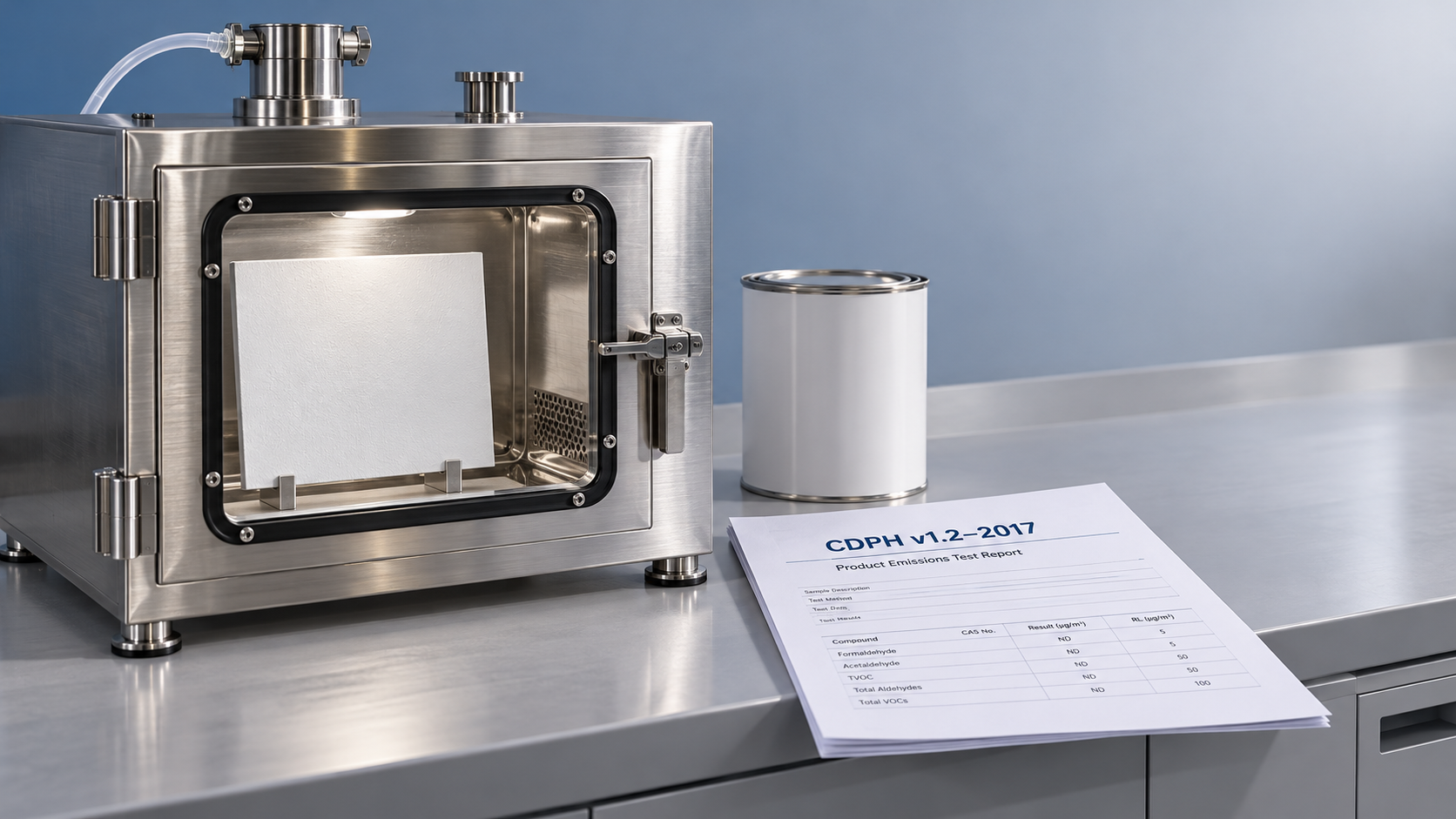
For LEED v4.1, the main evidence for interior paint emissions is a product-specific report demonstrating compliance with the California Department of Public Health (CDPH) Standard Method v1.2–2017, or qualifying third-party certification documenting that same compliance. An alternative testing pathway may be available for projects outside the United States, but it must match the applicable credit language. A report that merely measures emissions, without showing compliance with the required limits and evaluation conditions, is not enough.
The practical problem often appears during submittal review: a paint arrives with a “low-VOC” label, a safety data sheet, and a certificate, yet none clearly establishes emissions compliance. Approving that package prematurely can leave installed coatings without usable credit documentation. Reviewing LEED v4.1 emissions paint evidence therefore requires two separate decisions: whether the product satisfies emissions criteria, and whether its VOC content meets the applicable requirements.
Establish the applicable credit requirements before accepting a report
Start with the project’s registered rating system, version, and applicable requirements for the Low-Emitting Materials credit. Do not assume that a document prepared for another LEED version, another rating system, or a different regional pathway transfers automatically. Addenda, approved interpretations, and project-specific circumstances can affect the documentation route.
For a typical LEED v4.1 interior paint submission using the CDPH pathway, the evidence needs to establish compliance with CDPH Standard Method v1.2–2017, using the applicable exposure scenario. The credit also requires disclosure of the range of total volatile organic compound emissions after 14 days. That disclosure is distinct from demonstrating compliance with individual chemical limits.
A laboratory report does not award a LEED credit. It supports a product-level determination, which then feeds into the project’s category calculations and overall submission. Keep those decisions separate: “acceptable evidence for this coating” does not mean “the project has achieved the credit.”
Which documents can support acceptance?
A certificate can be more convenient than a lengthy laboratory report, but its logo is not the acceptance criterion. Check the certification level, referenced standard, product listing, and validity. Some programs have several certification tiers or cover multiple environmental attributes; only the relevant emissions qualification supports this part of the credit.
Where a certificate is too brief to establish the necessary details, request its technical supplement, directory listing, or underlying report. A generic brochure describing the certification program cannot replace evidence that the actual paint is covered.
Read the emissions report as a technical record
Product identity must match the submitted coating
Compare the manufacturer, product name, product code, base, finish, and formulation identifiers against the material submittal. Similar names are not enough. A report for a flat wall paint does not automatically cover an eggshell finish, a primer, or a specialty coating from the same product line.
Tinting creates a particularly important boundary. Testing a white base does not, by itself, establish coverage of every tinted product. A certification program may use a documented product-family or representative-sample approach, but that scope needs to be explicit. Request confirmation that the supplied base and tint system fall within the evaluated family rather than demanding a separate test for every color without first checking the program rules.
The method citation needs a compliance result
Look for the complete standard reference and an explicit conclusion against its applicable limits. “Tested according to CDPH” can describe a test procedure without confirming that the product passed. Likewise, a table of measured concentrations is not self-explanatory if the evaluation limits, modeled exposure conditions, or compliance determination are absent.
Older references, including CDPH v1.1 or informal “Section 01350” descriptions, should trigger clarification rather than automatic acceptance. Ask whether the documentation establishes compliance with the version required by the project, or whether an expressly permitted alternative applies. Similar terminology does not establish equivalence.
Application and exposure assumptions must be relevant
Paint emissions testing involves preparing an applied specimen and evaluating emissions under controlled conditions. Review the documented substrate, application amount or coverage, preparation sequence, and conditioning. For a multicomponent coating, check that the tested material represents the mixed product rather than an individual component.
The applicable office or classroom exposure scenario also matters. Do not substitute a residential scenario merely because it appears more familiar, or assume that any scenario listed in a report satisfies the project. The report or supporting certificate should make the applicable evaluation clear.
Finally, locate the required 14-day TVOC range disclosure. A CDPH compliance statement and a TVOC disclosure answer different questions. A package can establish individual-compound compliance yet still need additional documentation for the credit’s reporting requirements.
Check laboratory competence without confusing it with product approval
Verify the testing laboratory’s identity and qualifications. ISO/IEC 17025 accreditation is useful evidence of testing competence, but the accreditation scope matters: general accreditation for chemical testing does not necessarily cover building-product emissions testing. Review the applicable scope and any laboratory requirements in the governing credit or certification program.
Also distinguish the testing laboratory from the certification body. A laboratory produces test results; a certification body evaluates products under a defined program, potentially including surveillance and rules for product families. Neither role should be inferred from a manufacturer’s marketing language.
When documentation is unclear, request the report identifier, laboratory details, applicable accreditation information, and the basis for the compliance conclusion. Confidential formulation information need not be publicly disclosed, but confidentiality should not prevent verification of the submitted product’s identity, test method, and qualification.
VOC content is a separate approval gate
VOC content measures what is in the wet coating; emissions testing evaluates what the applied material releases under defined conditions. A low content value does not establish low emissions, and a successful emissions test does not establish compliance with the applicable content limit.
For paints and coatings, review the VOC-content requirements identified by the project’s applicable credit language, including the relevant coating category and referenced regulation or standard. Use the correct basis of calculation. Values expressed with different treatment of water or exempt compounds cannot be compared casually.
A safety data sheet is helpful for identifying products and hazards, but it is not automatically a complete VOC-content compliance record. Depending on the documentation route, a technical data sheet, manufacturer compliance statement, or suitable content test report may be needed. Check tinted and mixed products where relevant; the supplied formulation must remain within the claimed coverage.
Keep separate fields for emissions status and VOC-content status in the materials register. This prevents a reviewer from marking a coating “LEED compliant” after confirming only one requirement. It also exposes precisely what is missing when a substitution is proposed shortly before application.
Handling reports based on other emissions standards
For projects outside the United States, the applicable LEED v4.1 requirements may permit an international evaluation route, including specified use of EN 16516 or the ISO 16000 series. These references must be read together with the required evaluation criteria; a test method alone does not define an acceptable pass threshold.
Do not treat every report referencing these standards as interchangeable with CDPH compliance. An ISO 16000 report may cover only selected analytical procedures. An EN 16516 report may provide measured results without evaluating them against the criteria required by the LEED pathway.
Ask the supplier to identify the precise permitted route and provide evidence against each required criterion. Where the report uses a national classification or certification, establish how that classification satisfies the project’s accepted pathway. Avoid constructing an informal equivalence from separate documents unless that approach is expressly supported.
A submittal review sequence that prevents late gaps
- Define the product’s use. Record whether the paint is within the interior scope of the credit and identify its coating category. Do not include or exclude products solely from marketing descriptions.
- Match the supplied product to the evidence. Reconcile product codes, finish, base, tinting coverage, and any component mixing requirements before reviewing test results.
- Confirm the emissions pathway. Identify CDPH v1.2–2017 or the expressly permitted alternative, the applicable exposure scenario, the compliance conclusion, and required TVOC disclosure.
- Review evidence credibility and currency. Verify the laboratory or certification details and establish whether the evidence still applies to the current formulation.
- Complete the independent VOC-content check. Record the applicable limit, the documented value, and the source supporting that value.
- Enter the product into the project calculation. Use the quantities and calculation rules required by the applicable credit. Retain traceable records connecting approved products with installed materials.
An older report is not necessarily unusable simply because of its date. The important questions are whether the applicable requirements allow it, whether the product has changed, and whether any certification remains valid. Conversely, a recently issued certificate may still be unsuitable if it covers the wrong formulation or standard.
After approval, substitutions need the same review. A replacement described as “equivalent low-VOC paint” may have different emissions evidence, different tint coverage, or a different VOC-content category. Installation records and delivery documentation help prevent the approved product from being replaced without an updated determination.
When to hold a paint submittal
Place the submission on hold when the test method is missing, the report does not state compliance, the product identity cannot be reconciled, or the claimed alternative pathway is not established. The same applies when a certificate has expired and no valid supporting route is available, or when formulation changes leave earlier evidence unsupported.
Make the request specific: ask for the missing scenario, product-family scope, current certification, TVOC disclosure, or separate VOC-content evidence. If a genuinely ambiguous pathway remains, seek clarification through the project’s LEED review process before installation. A documented technical question is easier to resolve than an installed coating whose compliance rests only on a label.
Deep Dive
Related Intelligence
 Sustainable BuildingBuilding insulation rated R-30 — does real-world performance match lab-tested values?Analyst:Chief Civil Engineer
 Sustainable BuildingPrefabricated houses with structural insulated panels — how fire-rated are the joints?Analyst:Chief Civil Engineer
 Sustainable BuildingStrategic Link Partnerships in Precision Farming Rarely Include Shared Firmware UpdatesAnalyst:Chief Civil Engineer