Does tinting affect paint VOC content compliance under LEED v4.1?
Key Takeaways
- Palo Alto Networks Confirms PHP2Shell RCE Flaws Affect PAN-OSIT & Security Director
- How much does cold weather reduce the range of electric scooters?Automotive Tech Analyst
- Used EV Battery Aftermarket Could Reach 10%–20% Share Within Five YearsAutomotive Tech Analyst
- Which electric steering components can cause intermittent assist loss?Automotive Tech Analyst
- Crusoe and Araico Plan 106 MW AI Cloud Infrastructure Project in ParaguayIT & Security Director
- Is an SDS enough to verify chemical compliance for polymers?Lead Materials Scientist
- Industrial SaaS vs. On-Premises Software: Comparing Five-Year CostsIT & Security Director
- ISOBUS-Ready Implements: Compatibility Checks Before You BuyAgri-Tech Strategist
Industry Overview
We do not just publish news; we construct a high-fidelity digital footprint for our partners. By aligning with TNE, enterprises build the essential algorithmic "Trust Signals" required by modern search engines, ensuring they stand out to high-net-worth buyers in an increasingly crowded global digital landscape.
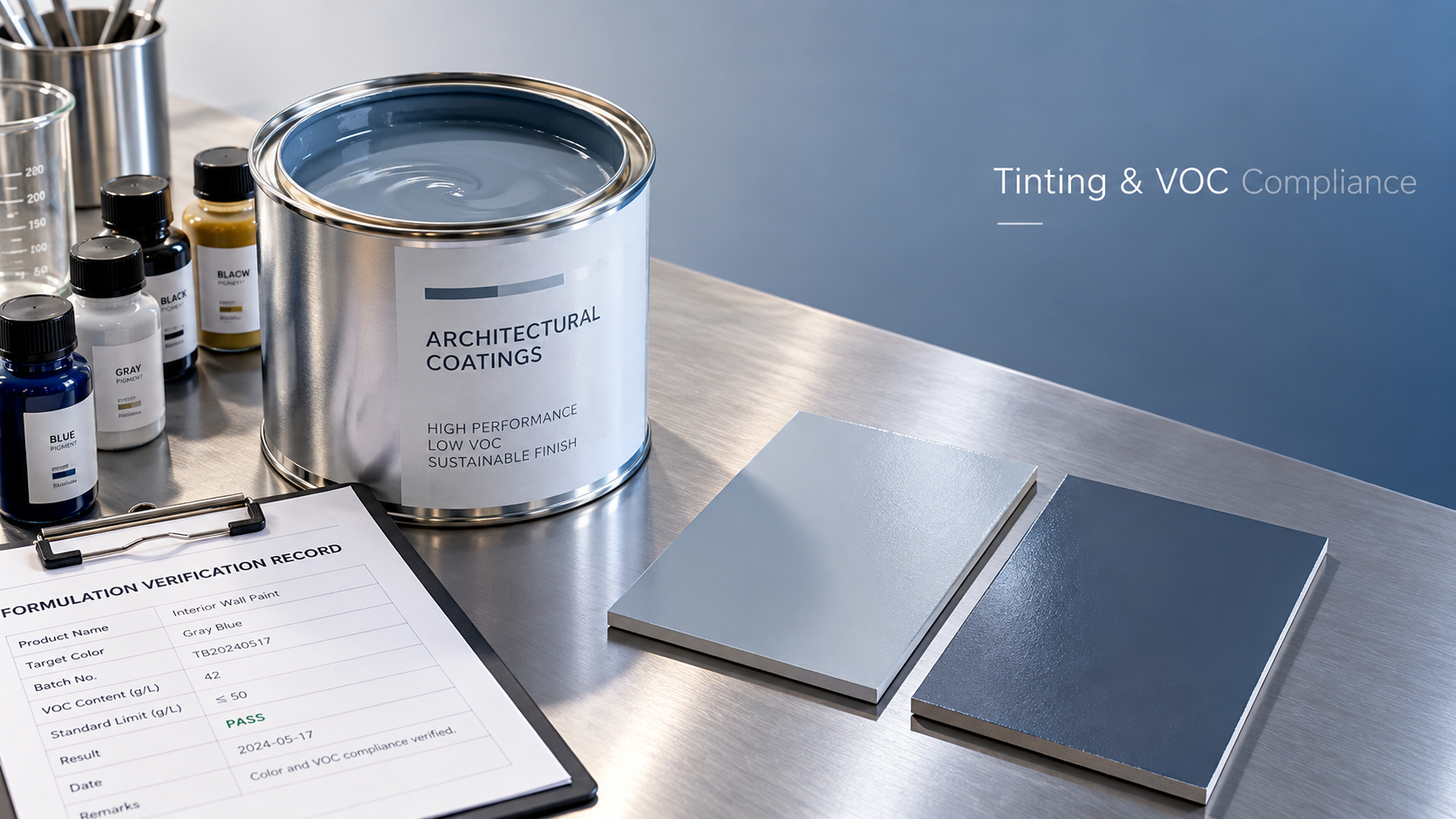
Yes. Tinting can change a paint’s VOC content and can affect its compliance with the VOC content requirements used under LEED v4.1. A compliant base paint does not, by itself, establish that every color made from that base is compliant. The assessment must account for the specified colorant system, the permitted tint loading, and the treatment of colorants under the applicable standard.
However, adding tint does not automatically make a paint noncompliant. A manufacturer may already have documented compliance across an approved range of bases and colors. The decisive question is whether that documentation covers the formulation supplied to the project—not simply whether the untinted base carries a “low-VOC” or “zero-VOC” claim.
What LEED v4.1 requires—and what a base-paint claim leaves unanswered
Under the LEED v4.1 Low-Emitting Materials credit, applicable interior paints and coatings are evaluated against VOC content requirements as well as VOC emissions requirements. These are separate assessments. Compliance with one does not establish compliance with the other.
The VOC content requirement refers to recognized coating standards, including applicable provisions of California Air Resources Board architectural coating guidance and South Coast Air Quality Management District Rule 1113. The accepted reference and compliance pathway depend on the project’s rating system, location, and applicable credit language. Referenced editions and LEED addenda matter: a later regulatory rule is not automatically interchangeable with the edition named in the project’s requirements.
For a tinted coating, the approval question therefore has several connected parts:
- Which coating category and VOC limit apply?
- What VOC reporting basis does that category require?
- How does the referenced standard address tinting and colorants?
- Does the supplier’s evidence cover the selected base, colorant system, and tint quantity?
A technical data sheet that states only “VOC: less than 50 g/L” may leave these questions unanswered. That value could describe an untinted white base, a particular test formulation, or a product range subject to qualifications elsewhere in the document. Any statement such as “before tinting” is material to the approval decision.
Why adding colorant can change the result
Tinting colorants contain more than pigment. Their formulations can include carriers, dispersants, glycols, and other ingredients needed for storage stability, dispensing, and compatibility with the coating. Depending on the formulation and the governing VOC definition, some of those ingredients contribute to regulated VOC content.
The effect is determined by both composition and dose. A small addition of a higher-VOC colorant and a larger addition of a lower-VOC colorant cannot be compared from the colorant labels alone. Their contributions must be evaluated within the complete coating formulation and the applicable calculation method.
Color depth also affects the evidence needed. A pastel formulation made from a white base and a saturated formulation made from a deep or clear base may use different base compositions and substantially different tint quantities. Compliance documentation for one combination does not necessarily cover the other.
Nevertheless, dark colors should not be rejected categorically. A deep shade made with a properly documented low-VOC tinting system can comply. Conversely, a light shade is not automatically acceptable if its colorants, base, or compliance basis are undocumented.
Check the rule’s treatment of tinting before calculating
Architectural coating standards can contain specific provisions for colorants, tinting, and the condition in which a coating is evaluated. Those provisions must be read together with the coating-category limit. A generic instruction to “add the tint VOC to the base VOC” is not a substitute for applying the referenced rule.
The location of tinting is relevant to traceability, but it is not a blanket compliance exemption. Factory-tinted and point-of-sale-tinted coatings may have different documentation arrangements. Neither should be assumed compliant solely because of where mixing occurs.
If a supplier relies on a colorant exclusion, a separate colorant limit, or another special provision, request the specific clause and confirmation that it is applicable to the project’s LEED compliance pathway. A provision used for local regulatory reporting should not be transferred to a LEED submission without checking that connection.
This distinction is particularly important when documentation says the product “meets Rule 1113” without identifying the coating category, rule edition, or tinting conditions. The statement may be valid, but it needs enough detail to demonstrate that it addresses the actual product being approved.
Why simple averaging can produce the wrong VOC value
VOC content is not always the mass of VOC divided by the total volume in the container. Many architectural coating limits are expressed in grams per liter, less water and exempt compounds. Other categories or provisions can use a different basis.
For a coating evaluated on a less-water-and-exempt-compounds basis, the underlying relationship is:
VOC content = mass of regulated VOC ÷ coating volume excluding water and exempt-compound volumes.
Tinting can change both the regulated VOC mass and the relevant denominator. Consequently, combining a base-paint value and a colorant value using their gross container volumes can produce an incorrect result when those values are not expressed on a compatible basis.
For illustration, assume a coating category has a 50 g/L limit and an untinted base is reported at 45 g/L. Neither value establishes how much tint can safely be added. The answer also requires the colorant composition, the addition rate, the reporting basis, and any applicable tinting provisions. These figures are illustrative, not a universal LEED limit or tint allowance.
A defensible assessment uses formulation data and the prescribed calculation method, or an appropriate determination accepted under the governing standard. Where confidential formulation information prevents an independent calculation, a manufacturer’s signed declaration covering the specified tinted system is more useful than an estimate assembled from incomplete safety data sheets.
VOC content and VOC emissions answer different questions
VOC content measures the quantity of regulated volatile organic compounds in a coating under a specified definition and method. VOC emissions evaluation examines chemicals released into indoor air under controlled test conditions.
For LEED v4.1, emissions documentation commonly references the California Department of Public Health Standard Method v1.2–2017, or another pathway accepted by the applicable credit requirements. This evidence is not interchangeable with a coating’s VOC content declaration.
Tinting therefore creates two documentation questions: whether the VOC content evidence covers the supplied formulation, and whether the emissions evidence covers the relevant product configuration. An emissions certificate may cover a defined product family rather than every color being individually tested. Its scope and the certification program’s grouping rules determine whether the selected tinted product is included.
A change in tinting does not automatically require a new emissions test. It does require confirmation that the existing evidence remains applicable. The same principle applies to content compliance: use established coverage where it exists, rather than demanding unnecessary testing or assuming coverage without support.
What adequate supplier documentation looks like
The strongest documentation connects a recognizable product to a clear compliance basis. For a custom-tinted coating, that connection should extend beyond the product family name.
A useful submission identifies:
- The coating name, product code, base designation, and applicable coating category.
- The referenced VOC standard and edition, including the reporting basis.
- The VOC content of the supplied tinted coating, or a documented maximum covering the approved tint range.
- The approved colorant system and any maximum tint-loading restrictions.
- Whether the declaration covers factory tinting, point-of-sale tinting, or both.
- The separate emissions documentation and its product coverage.
A manufacturer does not necessarily need to issue a separate certificate for every color. A declaration covering all approved colors can be sufficient when its scope is explicit and supported by an appropriate assessment. A maximum-value declaration is particularly useful when it clearly encompasses the selected base and permitted tint loadings.
By contrast, “all colors are available” is a sales statement, not a compliance statement. Likewise, a certificate naming a coating family without explaining whether its bases and tinting systems are included may require clarification before approval.
Safety data sheets remain important for handling and hazard communication, but they are not complete formulation disclosures. Ingredient reporting thresholds, concentration ranges, and proprietary information can prevent a reliable VOC calculation. The absence of a listed solvent is not proof that the finished coating contains no regulated VOC.
Keep the delivered paint within the approved scope
A correct submittal can lose its relevance if the delivered formulation changes. The practical control point is the connection between the approved coating system and the material actually mixed and applied.
For point-of-sale tinting, retain the base product identification, selected color or formula reference, tinting-system identification, and dispensing record where available. Delivery labels and batch information help establish that the supplied paint matches the documented system.
Substitutions deserve particular attention. Replacing an approved colorant with another brand, changing from a pastel base to a deep base, or adding extra tint to correct a color mismatch can move the product outside the manufacturer’s documented coverage. Such a change is not proof of noncompliance, but it is a reason to reassess the approval.
The same applies to field-added reducers, solvents, or other additives. Approval of a tinted coating should not be interpreted as permission to modify it without checking the manufacturer’s instructions and the applicable compliance conditions.
Where documentation covers only the untinted base, the appropriate response is to hold approval of the tinted configuration until its coverage is established. Where a manufacturer explicitly covers the selected base, authorized colorants, and permitted tint loading, there is no technical reason to reject the coating merely because colorant has been added.
The defensible LEED v4.1 VOC paint decision rests on a traceable formulation and the correct standard—not on the base-paint label alone. Tinting matters when it changes the regulated content, invokes a specific rule provision, or takes the supplied product outside the scope of existing evidence.
Reference documents: the applicable USGBC LEED credit requirements and addenda, the referenced architectural coating provisions in SCAQMD Rule 1113, applicable CARB architectural coating guidance, and the emissions evaluation standard identified in the project’s credit requirements.
Deep Dive
Related Intelligence
 Sustainable BuildingBuilding insulation rated R-30 — does real-world performance match lab-tested values?Analyst:Chief Civil Engineer
 Sustainable BuildingPrefabricated houses with structural insulated panels — how fire-rated are the joints?Analyst:Chief Civil Engineer
 Sustainable BuildingStrategic Link Partnerships in Precision Farming Rarely Include Shared Firmware UpdatesAnalyst:Chief Civil Engineer