How LEED v4.1 emissions paint is assessed for low-emitting materials
Key Takeaways
- When does modular construction reduce a project's total cost?Chief Civil Engineer
- What cloud infrastructure analysis reveals about Singapore latency risksIT & Security Director
- How to verify recycled green building materials meet project standardsChief Civil Engineer
- What to evaluate when comparing cybersecurity analysis providersIT & Security Director
- When does agricultural automation equipment pay off for mid-size farms?Agri-Tech Strategist
- How Tank Design Helps Reduce Oxidation Risks in Edible Oil StorageAgri-Tech Strategist
- How to match heavy duty earthmoving equipment to site conditionsChief Civil Engineer
- When chemical supply solutions reduce the risk of production downtimeLead Materials Scientist
Industry Overview
We do not just publish news; we construct a high-fidelity digital footprint for our partners. By aligning with TNE, enterprises build the essential algorithmic "Trust Signals" required by modern search engines, ensuring they stand out to high-net-worth buyers in an increasingly crowded global digital landscape.
A LEED v4.1 emissions paint assessment starts with the finished coating system and the evidence attached to the exact product being installed. A “low-VOC” claim on a label or a safety data sheet is insufficient on its own. LEED low-emitting materials requirements address two related but distinct issues: the volatile organic compound (VOC) content of wet-applied paint and the chemical emissions released from the dried product into indoor air.
For interior paints and coatings, both conditions commonly need to be addressed. VOC-content limits control chemicals added to the coating formulation before application. Emissions testing evaluates compounds that may off-gas after the coating has been applied and cured. A paint can meet a VOC-content limit yet lack acceptable chamber-test evidence, while another product may have emissions documentation but fail the applicable VOC-content rule for its product category. The leed v4.1 emissions paint review therefore needs a product-specific, installation-specific record rather than a generic sustainability declaration.
Classify the coating before reviewing its documents
Paint is generally considered an interior wet-applied product when it is applied inside the building envelope to walls, ceilings, trim, doors, built-in millwork, exposed structural elements, or other interior substrates. The classification must reflect the actual specification and field use. A coating described broadly as “architectural paint” may function as a primer, sealer, stain, specialty coating, floor coating, or anti-corrosive finish, each of which can have a different VOC category and limit.
The complete installed system matters. If a gypsum-board wall receives joint compound, a stain-blocking primer, two finish coats, and a clear protective coat, each material should be logged separately when it is within the relevant scope. Substituting a primer after the finish paint has been reviewed can create a documentation gap even if the finish paint itself remains unchanged. Tinted bases also require attention because colorant addition can alter reported VOC content or make a base-product document inapplicable to the delivered color.
VOC content and emissions are assessed separately
LEED v4.1 low-emitting materials criteria for interior paints and coatings generally reference VOC-content requirements based on recognized architectural-coating regulations, including limits associated with the California Air Resources Board Suggested Control Measure for Architectural Coatings or South Coast Air Quality Management District Rule 1113, depending on the applicable project path and product type. The governing LEED reference should be confirmed against the rating-system version and addenda used for the project.
VOC content is normally expressed in grams per liter. The reported value must be compared with the limit for the proper category, such as flat coating, nonflat coating, primer, sealer, undercoat, floor coating, rust-preventive coating, or another defined specialty category. A value expressed “less water and exempt compounds” cannot automatically be compared with a limit stated under a different convention. The declaration should identify the testing or calculation basis, the category used, and whether the value applies after tinting.
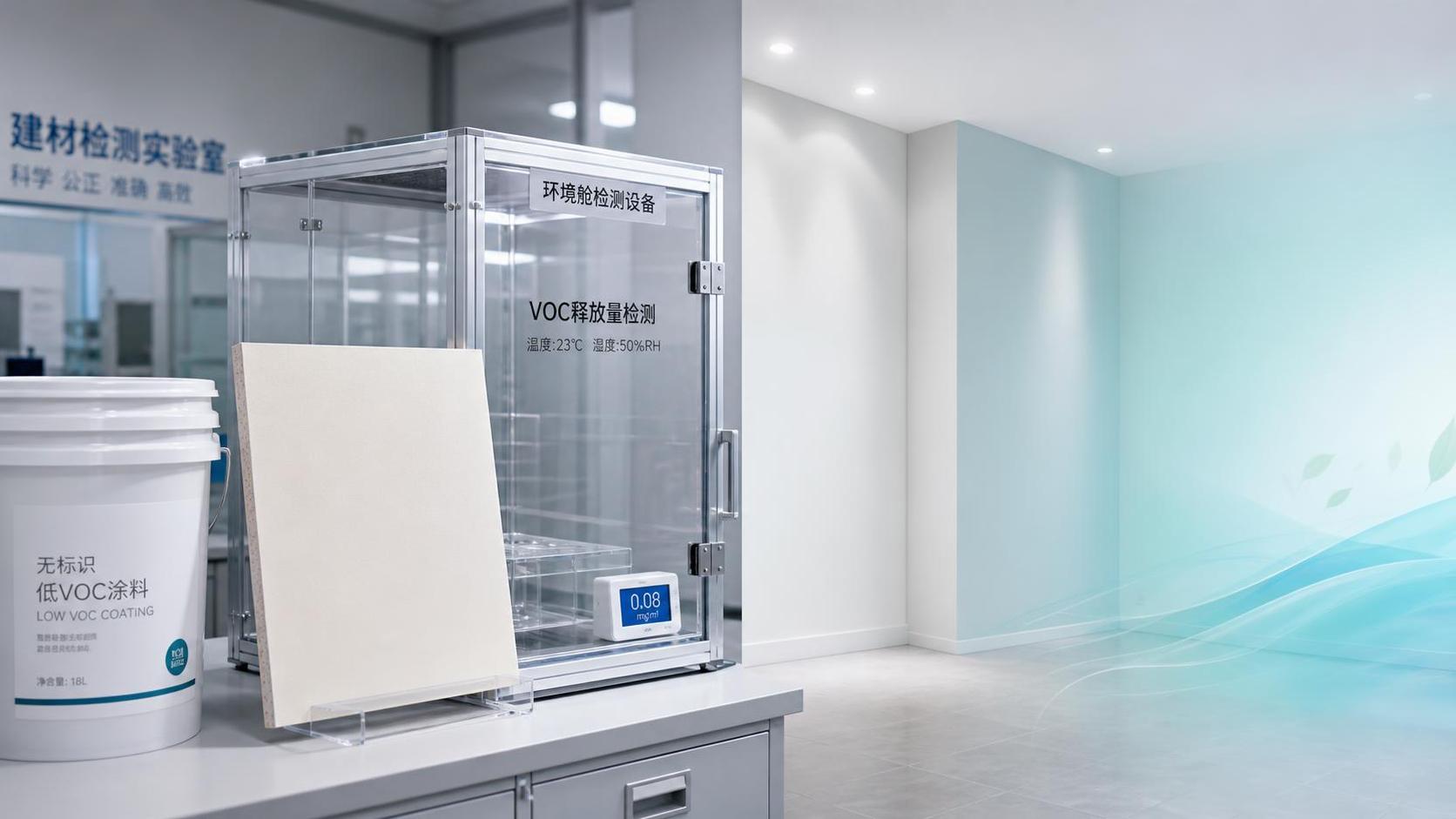
Emissions compliance is commonly demonstrated through testing to the California Department of Public Health Standard Method for testing and evaluating volatile organic chemical emissions from indoor sources using environmental chambers. LEED v4.1 references a specified version of this method for the relevant credit requirements. An accepted certificate should state the standard used, identify the product covered, show the applicable indoor-air emissions conclusion, and remain valid for the material installed. A laboratory report may be useful supporting evidence, but it needs enough detail to establish that the tested formulation, test conditions, and evaluation criteria correspond to the LEED requirement.
Chamber testing measures airborne concentrations under defined conditions after a sample has cured or been conditioned. The result is not simply a measure of total VOC content. It can include evaluation of individual compounds, total volatile organic compounds, and other substances addressed by the method. Because formulation changes can affect emissions behavior, an old report should not be assumed to cover a current product merely because the trade name is unchanged.
Build an auditable material record
Documentation is strongest when it follows the path from submittal to installed material. Start with the finish schedule and paint specification, then create a material register using one row for every interior coating, primer, sealer, and related wet-applied product within scope. Record the specification section, location or finish code, substrate, manufacturer, product name, color or base, application method, quantity, unit cost, VOC-content source, emissions source, and compliance status.
Cost information should be retained because LEED low-emitting materials calculations are typically based on product cost for the applicable product group. The calculation should follow the project’s selected LEED v4.1 pathway and should use a consistent cost basis. Materials that lack acceptable evidence should not be counted as compliant merely because they are a small portion of a coating package. A small quantity of stain-blocking primer can be consequential if it is required across many rooms, while an omitted document can reduce the compliant value available to the calculation.
- Keep the technical data sheet that was current when the product was released for construction, rather than relying only on a later web download.
- Link third-party emissions certificates to the exact product and formulation. A certificate covering only selected sheens, bases, or manufacturing locations may have limits on its applicability.
- Retain the purchase record, approved submittal, and field delivery information together where possible. These records establish whether the documented material reached the site.
- Flag “or approved equal” substitutions before purchase. Their environmental documents need the same review as the originally specified coating.
Safety data sheets remain useful for handling, storage, and hazard communication, but they are not normally sufficient proof of either LEED VOC-content compliance or low-emitting chamber-test compliance. They may disclose VOC information in a form intended for occupational safety rather than the regulatory category comparison required for the credit.
Interpret certificates without overstating their scope
Third-party certifications can simplify review when their scope, testing basis, and validity are clear. The certificate should be read as a controlled document, not as a marketing badge. Confirm the certificate number or listing, issue and expiry dates, product nomenclature, covered finishes, and stated emissions standard. When a certificate references a product line, obtain the schedule or appendix that shows the specific product, rather than assuming all related coatings are included.
Some declarations use terms such as “zero VOC,” “low odor,” “low emissions,” or “indoor air quality approved.” Those phrases may have commercial meaning but do not identify the applicable LEED criterion. “Zero VOC” can refer to the untinted base, a particular method of calculating content, or a threshold different from the LEED requirement. Low odor is a sensory claim and does not establish that chemical emissions satisfy chamber-test criteria. The review should rely on the cited standard, the test or certification scope, and the product identifier.
Environmental product declarations, ingredient disclosures, recycled-content statements, and bio-based content claims can support other material-credit discussions, but they do not replace emissions evidence. These documents answer different questions. Combining them into one submittal package is efficient; treating one document as proof of every environmental attribute is not.
Application conditions can affect the practical result
LEED compliance evidence concerns the specified material, while indoor-air performance is also influenced by installation conditions. Painting over damp substrates, applying excessive film thickness, using incompatible additives, or reducing cure time through aggressive occupancy scheduling can change odor and off-gassing conditions in the completed space. Product data sheets should be followed for substrate preparation, temperature, relative humidity, ventilation, recoating interval, and cure period.
Field-added materials deserve particular scrutiny. Water used for thinning, site-added colorants, extenders, cleaners, solvents, and touch-up materials can affect both the VOC-content review and construction indoor-air management. A compliant factory coating can be compromised by an unreviewed solvent-borne reducer or a maintenance paint selected late in the project. Where touch-up is anticipated, the approved product list should identify a compliant equivalent for that purpose.
Storage and logistics records also have value when products originate from multiple regional plants or are delivered through distributors. Packaging labels, batch codes, and delivery tickets can resolve questions about whether the site received the product covered by the certificate. This is especially relevant when a product family has regional variants or when a distributor substitutes an apparently similar item because of supply availability.
Resolve gaps before the coating is applied
The least disruptive time to resolve a missing emissions certificate is during submittal review. Once a coating has been applied, replacing it can affect schedule, substrate condition, warranties, color consistency, and indoor-air planning. A status such as “VOC content verified; emissions evidence pending” should remain incomplete rather than being converted to compliant based on an expectation that documentation will arrive later.
When a document is unclear, request a focused manufacturer clarification that identifies the exact coating, intended LEED v4.1 use, applicable VOC category, reported VOC content, emissions-testing or certification basis, and coverage of tint bases or sheen levels. Broad letters stating that a product “meets LEED” are weak evidence unless they state the underlying criteria and product scope. Clarification should be dated and attributable to a responsible technical source.
Coordination between specification authors, interior finish selections, submittal reviewers, contractors, and commissioning or certification documentation leads should occur while alternatives remain available. Finish schedules often change for color, lead time, sheen, cleanability, fire performance, corrosion resistance, or substrate compatibility. Each change can alter the low-emitting materials record. Maintaining a controlled register avoids an end-of-project effort to reconstruct which paint was actually used.
A defensible leed v4.1 emissions paint assessment connects the installed coating to the relevant VOC-content limit, accepted emissions evidence, and project cost calculation. The documentation should be specific enough that an independent reviewer can trace each claim without inferring missing details. That level of control supports the credit record and reduces the chance that a late substitution, ambiguous label, or expired certificate undermines an otherwise compliant interior finish package.
Deep Dive
Related Intelligence
 Sustainable BuildingBuilding insulation rated R-30 — does real-world performance match lab-tested values?Analyst:Chief Civil Engineer
 Sustainable BuildingPrefabricated houses with structural insulated panels — how fire-rated are the joints?Analyst:Chief Civil Engineer
 Sustainable BuildingStrategic Link Partnerships in Precision Farming Rarely Include Shared Firmware UpdatesAnalyst:Chief Civil Engineer