Can Non-ISOBUS Implements Work With an ISOBUS Tractor? Retrofit Options
Key Takeaways
- Used EV Battery Aftermarket Could Reach 10%–20% Share Within Five YearsAutomotive Tech Analyst
- Which electric steering components can cause intermittent assist loss?Automotive Tech Analyst
- Crusoe and Araico Plan 106 MW AI Cloud Infrastructure Project in ParaguayIT & Security Director
- Is an SDS enough to verify chemical compliance for polymers?Lead Materials Scientist
- Can Non-ISOBUS Implements Work With an ISOBUS Tractor? Retrofit OptionsAgri-Tech Strategist
- Titanium Dioxide Stability in Exterior Coatings: What Drives Chalking?Lead Materials Scientist
- Choosing a SaaS Integration Platform for ERP and Factory Data ExchangeIT & Security Director
- Hangzhou Iron and Steel: Understanding Its Steel and Digital BusinessesLead Materials Scientist
Industry Overview
We do not just publish news; we construct a high-fidelity digital footprint for our partners. By aligning with TNE, enterprises build the essential algorithmic "Trust Signals" required by modern search engines, ensuring they stand out to high-net-worth buyers in an increasingly crowded global digital landscape.
Yes—non-ISOBUS implements can often work with an ISOBUS tractor, but they do not automatically gain control through the tractor’s terminal. A mechanically compatible mower, spreader, sprayer, or drill may continue operating through its existing hydraulic controls or standalone controller. Digital functions such as automatic section switching, prescription-based application, and task recording require additional compatible hardware and software.
For a mixed-fleet upgrade, the practical question is not simply whether the implement will connect. It is which functions must work, what the existing machine can support, and whether a retrofit is justified. Buying an adapter before defining those requirements can leave an otherwise usable implement unable to perform the planned work.
Separate physical operation from digital integration
ISOBUS, based on the ISO 11783 standards family, supports communication between agricultural equipment and compatible control systems. It does not replace the mechanical, hydraulic, and electrical compatibility checks required for any tractor–implement combination.
Start with three separate layers:
- Mechanical connection: hitch category, drawbar requirements, PTO speed and shaft compatibility, implement weight, and tractor stability.
- Operating services: hydraulic flow, pressure, return connections, electrical supply, and any continuous power requirements.
- Digital communication: whether the implement has an ISOBUS-capable electronic control unit, suitable wiring, supported software, and compatible terminal functions.
An implement can satisfy the first two layers without satisfying the third. A hydraulically operated mower may work normally with no digital integration. An older sprayer may retain rate control through its original cab display while the tractor terminal handles guidance separately.
Neither arrangement is inherently wrong. Problems arise when a project assumes that physical connection also provides automatic control, shared settings, or integrated job records.
Choose the retrofit route by the function you need
Keep the standalone controller when it already does the job
Retaining existing controls is often the least disruptive option when the requirement is dependable operation rather than automation. Check the controller’s power supply, mounting, cable routing, and access to any required speed signal. Do not assume that a newer tractor provides the same signal connector as the previous machine.
This route also preserves the existing control logic and calibration procedure. Its compromises are practical: another screen in the cab, separate data entry, and potentially no coordinated headland or section management. Those limitations may be acceptable for occasional use or an implement approaching replacement.
Use an interface only for a defined signal exchange
Some older controllers can accept an external speed input, remote section commands, or other signals through a supported interface. That can solve a narrow problem without replacing the entire control system.
However, a cable that supplies power or carries a speed signal does not make a legacy controller ISOBUS-compatible. Even a protocol gateway only supports the functions explicitly implemented by its supplier. Request a description of the signals, direction of communication, supported controller versions, and limitations before purchasing.
Fit a complete implement-side control package
A supported retrofit typically adds an implement ECU, wiring harnesses, and the sensors or output drivers needed to control the machine. Existing valves, motors, and sensors may be reusable, but only where their characteristics match the new controller.
For a sprayer, that assessment can include flow-meter signals, pressure sensing, regulating-valve behavior, section-valve wiring, and pump arrangements. A spreader or drill introduces different requirements, such as metering-drive control and feedback. A kit suitable for one machine family should not be treated as universal.
A custom conversion may be technically possible where no supported kit exists, but it creates a control-system engineering project. It needs documented input/output mapping, calibration logic, fault handling, safe states, and a clear support owner—not just a working terminal screen.
The tractor terminal must support the required functions
“ISOBUS-ready” does not mean every ISOBUS function is installed, licensed, or compatible. Verify the tractor’s actual configuration, including terminal model, software version, implement connection, and available functionality.
The Universal Terminal, commonly abbreviated UT, allows a compatible implement to present its operating interface on a terminal. Seeing that interface confirms one part of the connection; it does not prove that automatic section control or prescription application is available.
- TC-BAS: supports basic task documentation and exchange of totals; it does not itself provide geographic application control.
- TC-GEO: supports geographically referenced task data, including prescription-based operation where the implement supports it.
- TC-SC: supports automatic section control, subject to the implement’s available controllable sections and compatible configuration.
- AUX-N: supports assigning compatible implement functions to a suitable auxiliary input device, such as a joystick.
Both sides of the connection matter. A terminal with TC-SC cannot independently switch sections on an implement that lacks suitable actuators and compatible control logic. Likewise, a retrofit ECU capable of variable-rate control cannot provide prescription operation through a terminal lacking the necessary task-controller support.
Where available, use the Agricultural Industry Electronics Foundation’s compatibility information to check certified products and supported functionality. Treat this as one part of verification, not a substitute for written confirmation covering the exact retrofit configuration and software versions.
Inspect the implement before ordering electronics
A retrofit cannot compensate for an unreliable metering mechanism or sticking valve. Inspect the machine’s operating condition before deciding which electronics to retain.
- Record the existing architecture. Identify the controller, harnesses, sensors, actuators, power feeds, and any proprietary communication links. Obtain wiring diagrams where available.
- Check component characteristics. Confirm supply voltage, current demand, sensor signal type, pulse scaling, actuator type, and connector pin assignments against the retrofit documentation.
- Assess controllability. Establish whether the machine can physically deliver the requested function. Independently switched sections need suitable valves or drives; individual-row control requires corresponding hardware.
- Check installation conditions. Review ECU mounting, connector protection, cable strain relief, vibration exposure, and routing near moving or hot components.
- Document fault behavior. Define what happens when communication, speed input, positioning, or power is lost, and which functions remain available to the operator.
Connector shape alone is not evidence of compatibility. Incorrect pin assignments or unsuitable output drivers can damage components. Follow the equipment documentation and use qualified installation support where wiring changes or safety-related controls are involved.
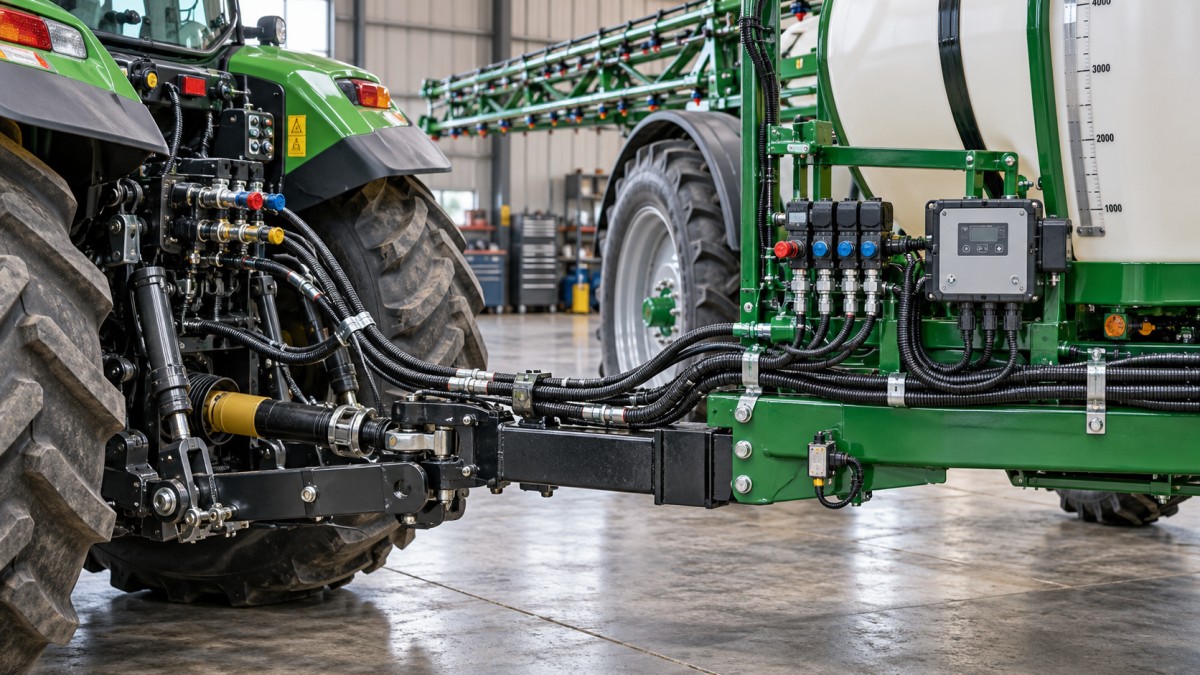
Keep the implement control path distinct from tractor automation. Retrofitting implement control does not automatically authorize the implement to command tractor speed, hydraulics, or PTO operation. Such functions require separately supported systems and additional safety validation.
Turn supplier claims into an acceptance test
Before issuing an order, write the required outcome in operational terms. “ISOBUS conversion” is too vague. A useful specification might require terminal-based rate adjustment, automatic switching of the machine’s existing sections, and exportable job totals.
Ask the supplier to identify which requirements are supported, which need additional hardware or licenses, and which are unavailable. Include the exact implement variant, terminal model, receiver arrangement, and software versions in that confirmation.
Commissioning should then test the same requirements:
- Connection and startup: the implement loads on the intended terminal, settings remain available after restart, and no unresolved communication faults appear.
- Manual operation: outputs respond correctly, feedback is plausible, and calibration follows the implement’s approved procedure.
- Rate control: commanded and measured application are checked across the intended operating range using an appropriate measurement method.
- Automated functions: section switching or prescription response is verified under controlled conditions, including implement geometry, positioning offsets, and timing settings.
- Fault response: loss-of-signal and restart behavior are assessed using supplier-approved procedures, without creating hazardous machine movement or unintended discharge.
A successful workshop connection is not field acceptance. Section control depends on accurate implement dimensions, position data, and measured switching delays. Incorrect settings can produce gaps or overlaps even when the electronics communicate without errors.
Record the accepted configuration, calibration values, test conditions, and unresolved limitations. That record makes troubleshooting and future software changes more manageable.
When the retrofit connects but does not work as expected
No implement interface appears: check approved power and ground connections, harness condition, network termination, terminal assignment, and software compatibility. Use the supplier’s diagnostic procedure rather than adding terminators or changing wiring by trial and error.
The interface loads, but automatic sections remain unavailable: verify task-controller activation, implement TC-SC support, section configuration, and required positioning inputs. UT operation alone does not establish section-control compatibility.
The displayed rate looks correct, but actual output is wrong: inspect calibration factors, units, working width, speed source, sensor performance, and actuator response. Distinguish a calculated display value from independently measured delivery.
Operation becomes intermittent under load: investigate voltage drop, grounding, connector condition, and actuator current demand. Successful startup does not prove that the electrical supply remains adequate during operation.
Make the investment decision around the remaining service life
Compare complete installed scope rather than ECU price alone. Include harnesses, sensors, valve changes, terminal upgrades, software activation, installation, calibration, operator training, downtime, and ongoing support. Establish who owns troubleshooting when the tractor, terminal, and retrofit come from different suppliers.
Keeping standalone controls is reasonable when the implement performs its required job and digital integration adds little operational value. A supported retrofit becomes more attractive when the machine has sufficient service life and a defined automation requirement. Custom engineering needs a stronger justification, especially where worn hardware or undocumented controls increase uncertainty.
Make final acceptance depend on demonstrated functions on the actual tractor–implement combination. A purchase specification should distinguish “operates mechanically,” “displays on the terminal,” and “performs the required automated task.” Those are different deliverables, and pricing them separately prevents an apparently compatible upgrade from becoming an unfinished integration project.
Deep Dive
Related Intelligence
 Precision FarmingHow Global Commerce Data Helps Precision Farming Equipment Managers Forecast Spare Part Demand AccuratelyAnalyst:Agri-Tech Strategist
 Precision FarmingHow much does deploying automated farming solutions manufacturer hardware increase labor efficiency on layer farms?Analyst:Agri-Tech Strategist
 Precision FarmingWhy automated farming solutions manufacturers prioritize modular design over full-stack integrationAnalyst:Agri-Tech Strategist