Nipple Drinker Line Layout for a 1,000-Chicken Flock
Key Takeaways
- OpenRouter Removes Three AI Inference Providers After Prompt TheftIT & Security Director
- How to verify supplier credentials in global chemical sourcingLead Materials Scientist
- National Cybersecurity Standards Committee Seeks Feedback on Three GuidelinesIT & Security Director
- How to verify specialty chemical exporters in IndiaLead Materials Scientist
- Trump Fires National Cyber Director, Names Kirsten Davies Acting DirectorIT & Security Director
- Can mobile POS systems accept payments without internet access?IT & Security Director
- Malaysia and US Deepen Sovereign AI Cloud Cooperation, With $50 Million in US SupportIT & Security Director
- How chemical recycling is reshaping plastics technology in EuropeLead Materials Scientist
Industry Overview
We do not just publish news; we construct a high-fidelity digital footprint for our partners. By aligning with TNE, enterprises build the essential algorithmic "Trust Signals" required by modern search engines, ensuring they stand out to high-net-worth buyers in an increasingly crowded global digital landscape.
A flock of 1,000 chickens does not have one universally correct nipple-drinker count. The answer depends on the birds’ age and type, the drinker manufacturer’s rated capacity, line placement, water pressure and the applicable welfare requirements. For an early layout exercise, a project manager can divide 1,000 by the supplier’s stated birds-per-nipple capacity, round up, and then check whether the resulting outlets can be distributed where the birds can reach them. That calculation is a starting point, not an acceptance test.
A line can have enough nipples on paper and still leave birds short of water if pressure falls at the far end, outlets are difficult to reach, or the system is poorly positioned within the usable floor area. The design decision therefore combines outlet count with hydraulic performance, access, maintenance and verification under operating conditions.
Calculate outlet count before fixing the line arrangement
When assessing how many nipple drinker for 1000 chickens, begin with the capacity stated for the exact nipple model and intended flock. The calculation is straightforward: required nipples = planned number of birds ÷ permitted birds per nipple, rounded up to a whole outlet. If the project’s welfare specification sets a stricter limit than the supplier’s recommendation, use the stricter requirement. Confirm that both figures apply to the same bird category and management system.
For illustration only, if a project specification allows 10 birds per nipple, the arithmetic gives 100 nipples for 1,000 birds. If it allows 12 birds per nipple, the result is 84 after rounding up. These figures demonstrate the method; they are not universal stocking recommendations or evidence that either arrangement is suitable for a particular flock.
The calculated minimum also needs to fit the available pipe modules. A layout may contain more outlets than the arithmetic minimum because the selected pipe spacing and usable line length do not produce an exact match. Extra nipples can improve distribution, but they do not compensate for an inadequate water supply or an unsuitable pressure setting.
Document the assumptions alongside the count: maximum birds present, species and production purpose, ages covered, nipple model, supplier’s rating and any applicable welfare limit. If a house will be divided into pens, repeat the calculation for each pen. An adequate house-wide total is of little use if one partition contains too few accessible outlets.
Translate the count into a workable floor plan
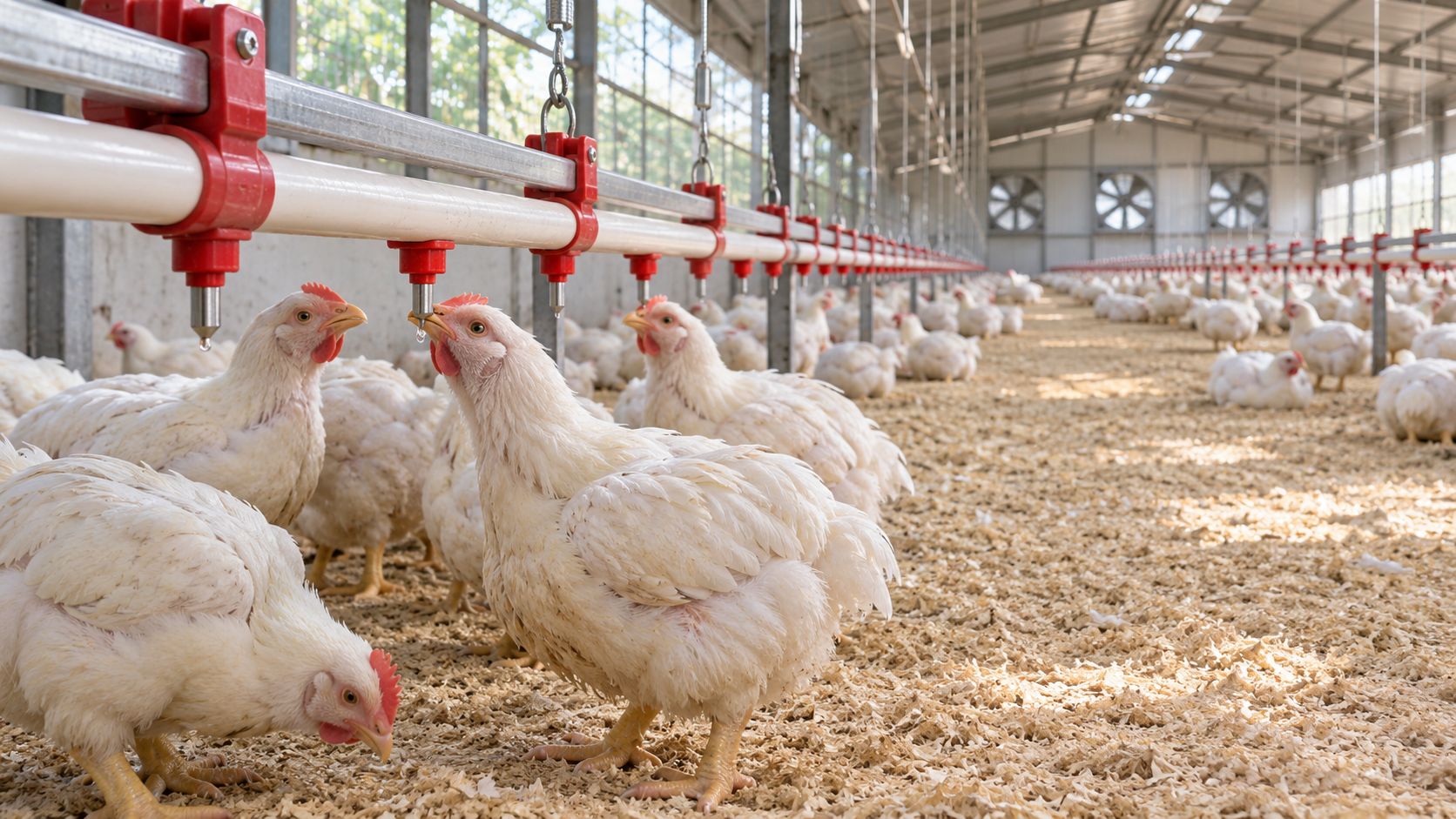
Mark the usable bird area, partitions, doors, feeders, columns and service access on a scaled drawing. Then place drinker lines so that birds can approach outlets without having to cross persistent obstructions or compete in a narrow space. Avoid treating the longest available wall as the automatic route: a line along one edge may satisfy the outlet count while concentrating traffic and moisture in a limited area.
For a broad floor area, parallel lines may distribute access more evenly than one long line. They also introduce additional pipework, suspension points, connections and potentially separate control components. A single line may be easier to install and inspect in a narrow enclosure, provided that birds can reach it throughout the occupied area and the manufacturer confirms that its hydraulic performance is adequate.
Line length follows from the selected nipple spacing and the number of outlets assigned to that line. Include end connections and maintenance clearance in the drawing rather than assuming the pipe’s nominal length is entirely available for drinkers. Check that partitions do not interrupt access and that raised equipment, feed hoppers or structural supports do not block the suspension system.
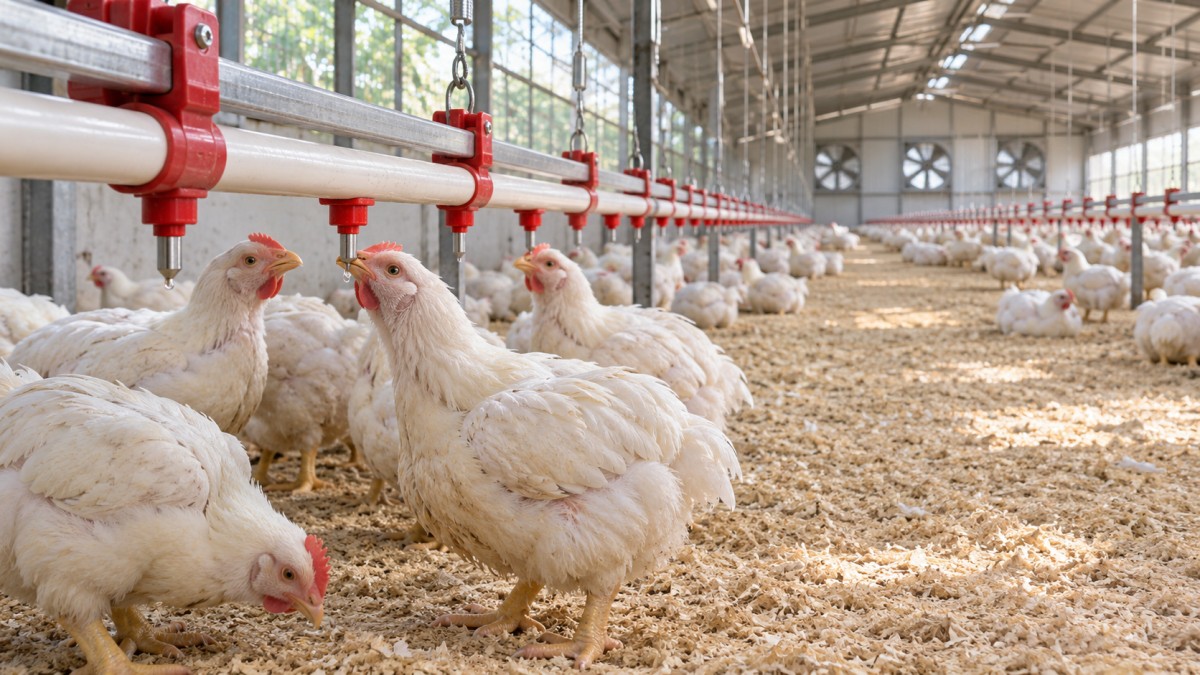
Consider how the layout changes during the flock’s life. Young chicks need outlets they can reach; larger birds require a different line height. Adjustable suspension makes it possible to reset the line as birds grow, but the adjustment mechanism must remain accessible and hold the pipe level. Any temporary brooding arrangement should be shown separately, including how birds will reach water before they have access to the full house.
Check the water supply, not just the number of nipples
The upstream supply must deliver adequate water at the pressure and flow conditions specified for the system. Ask the supplier for the operating range, the expected flow from an outlet at the proposed setting, and the maximum line arrangement supported by its design guidance. Project documents should distinguish static supply pressure from the pressure available while birds are drinking: a satisfactory reading with no flow does not establish that the line can meet demand.
Demand is not constant. Bird size, feed intake, house temperature and management conditions can change consumption, while birds may drink at the same time after a disturbance or a period of reduced access. Size the supply and control equipment for the intended operating conditions using documented supplier guidance and flock requirements, rather than multiplying the nipple count by an assumed continuous flow from every outlet.
Pressure regulators, filters, shutoff valves and flushing arrangements need positions that staff can reach without disturbing birds unnecessarily. Pressure that is too low can restrict delivery; pressure that is too high for the equipment may increase leakage or make operation unsuitable for the birds. Use the nipple supplier’s instructions for the specified model instead of transferring settings from another installation.
Where the floor or building slopes, show the elevation difference on the drawing. Changes in elevation can alter pressure along a line, making the upstream and downstream outlets behave differently. Long runs, fittings and undersized supply components can add pressure loss. If the supplier cannot demonstrate satisfactory performance at the far end, divide the system into shorter controlled sections or revise the pipework.
Water quality and contamination control
Water suitable for a flock must be assessed at its source and at the point of delivery. The project team should identify the intended water source, any treatment or filtration, and the tests required by the producer’s veterinary adviser and local authorities. Sediment can obstruct components; deposits or biofilm can affect internal cleanliness and flow. The appropriate test list and treatment depend on the water source and the products used in the system.
Provide a way to isolate and flush each section without disassembling the entire house. If medication or water-treatment products will pass through the lines, confirm material compatibility, dosing arrangements and the supplier’s cleaning instructions. Backflow protection and disposal of flushing water should follow the requirements applicable at the site; do not assume the same arrangement is acceptable in every jurisdiction.
Compare layouts by access, isolation and maintenance
More sections are not automatically better. Each valve and connection adds a potential leak point and an item to inspect. Conversely, a single unisolated line can make a small repair disruptive. Compare the alternatives against the house footprint, staff routines and consequences of taking equipment out of service.
Plan access to replacement nipples, regulators and seals as part of procurement. Components should be identifiable and replaceable without improvised fittings. Ask for spare-parts lead times, installation instructions and the process for obtaining compatible replacements after the initial delivery.
Write acceptance criteria into the purchase and installation scope
A useful purchase specification connects the drawing to measurable checks. It should identify the approved nipple and pipe components, number of outlets per section, intended bird category, adjustment method, water source, operating pressure range and any required filtration. Attach the layout and state who is responsible for supply-side pipework, electrical equipment if applicable, testing and handover.
Request the manufacturer’s documentation for the chosen equipment, including the bird capacity used in the design, allowable operating conditions, cleaning procedure and recommended maintenance. Ask the installer to flag any conflict between the drawing and site conditions before substituting components. A different nipple model or pipe spacing can change both the count and the hydraulic assumptions.
At commissioning, inspect supports and connections, flush the system as instructed, and check for leaks. Measure pressure at the locations specified in the test plan under both static and flowing conditions. Confirm representative outlets operate along each line, including at the far end, using the supplier’s test method. Record the settings and any corrective work rather than accepting a visual inspection alone.
Commissioning cannot fully reproduce flock behavior. After placement, staff should observe whether birds find and use the drinkers, whether the height remains appropriate, and whether litter beneath the lines becomes persistently wet. Investigate wet areas for leaks, unsuitable pressure, damaged outlets or poor adjustment; dry-looking litter alone does not prove that all birds have adequate access. Establish an escalation plan for low water use, blocked lines or supply interruption, including how an alternative water source will be provided.
The final design should be approved only when the outlet calculation, physical layout and water-delivery checks agree. Keep the assumptions and commissioning records with the house operating documents so that a change in flock type, pen arrangement or equipment can trigger a fresh capacity review.
Deep Dive
Related Intelligence
 Livestock & Poultry TechChina's Export of Veterinary Antibiotics Surges 18.7% YoY in Q1 2026: Key Industry Impacts and ResponsesAnalyst:Agri-Tech Strategist
 Livestock & Poultry TechChina Feed Industry Association Initiates Revision of Microbial Fermented Feed Additives Group StandardAnalyst:Agri-Tech Strategist
 Livestock & Poultry TechNational Feed Quality Inspection Center Releases Q1 2026 Feed Safety Report: Key Impacts and Industry ResponsesAnalyst:Agri-Tech Strategist