Can Existing Edible Oil Tanks Be Retrofitted for Nitrogen Blanketing?
Key Takeaways
- US Agencies Issue Joint Cybersecurity Warning for Industrial RefrigerationIT & Security Director
- How to use B2B competitive intelligence to track rival pricingIT & Security Director
- The Kyiv Independent Hit by Suspected Russian CyberattackIT & Security Director
- What is editorial exposure and how does it differ from paid advertising?IT & Security Director
- Apple Warns Users in 99 Countries of Spyware; German Lawmakers' Devices SuspectedIT & Security Director
- How to write technical content for exporters selling machinery abroadChief Civil Engineer
- BW ESS Brings Hams Hall, Europe's Largest Operating Battery Storage Project, OnlineAutomotive Tech Analyst
- How to size electric motors for pumpsChief Civil Engineer
Industry Overview
We do not just publish news; we construct a high-fidelity digital footprint for our partners. By aligning with TNE, enterprises build the essential algorithmic "Trust Signals" required by modern search engines, ensuring they stand out to high-net-worth buyers in an increasingly crowded global digital landscape.
Yes—many existing edible oil tanks can be retrofitted for nitrogen blanketing, provided their pressure and vacuum limits, condition, venting arrangements, and hygienic design support the change. The deciding factor is rarely whether a nitrogen connection can be added. It is whether the tank can maintain a controlled atmosphere during filling, withdrawal, cooling, cleaning, and equipment failure without exceeding its structural limits.
For project managers, this is a tank-integrity and process-integration project, not simply a gas-supply purchase. A sound assessment separates three questions: will reduced oxygen exposure address the actual quality problem, can the existing vessel operate safely, and does retrofitting offer better lifecycle value than replacement?
Define the quality objective before specifying equipment
Nitrogen blanketing maintains a nitrogen-rich atmosphere above the oil, limiting contact with atmospheric oxygen. The Codex code for bulk edible oils identifies oxygen exposure, temperature, and contamination as important storage and transport considerations, and discusses inert-gas protection as a means of limiting oxidation. It does not establish one operating recipe for every oil or installation.[1]
Blanketing should not be confused with nitrogen sparging. Blanketing protects the headspace; sparging introduces gas into the liquid. Adding a blanket does not automatically remove oxygen already dissolved in incoming oil, reverse oxidation, or correct excessive storage temperatures. If deterioration begins upstream, the retrofit may address only part of the problem.
The project brief should identify the oil grades, incoming quality, storage duration, temperature profile, transfer frequency, and existing quality complaints. A frequently emptied buffer tank presents a different operating pattern from a seasonal storage vessel. Evaluation should connect the proposed investment to measurable quality outcomes rather than assume that installing nitrogen guarantees longer shelf life.
Establish whether the existing tank is a suitable candidate
Begin with drawings, fabrication records, inspection reports, repair history, and documented pressure and vacuum limits. “Atmospheric tank” is not a usable pressure rating. Where records are incomplete, a qualified tank engineer should establish an assessment and inspection scope before anyone selects a regulator setpoint.
The review should cover the shell, roof, roof-to-shell connection, nozzles, supports, corrosion, and previous modifications. Roof geometry and construction matter because a vessel designed for very small pressure differences may not tolerate operating conditions that appear modest on a gas-system specification.
When comparing modification with a replacement edible oil storage tank, assess the complete vessel arrangement: usable capacity, cleanability, access, nozzle layout, structural limits, and compatibility with the proposed blanketing system. Nominal volume and construction material alone do not establish retrofit suitability.
Nozzle reuse also needs review. A convenient spare connection may be poorly positioned, subject to liquid carryover, or unsuitable for hygienic maintenance. New welding introduces additional scope for engineering approval, fabrication control, inspection, cleaning, and production downtime.
Design pressure control and venting as one system
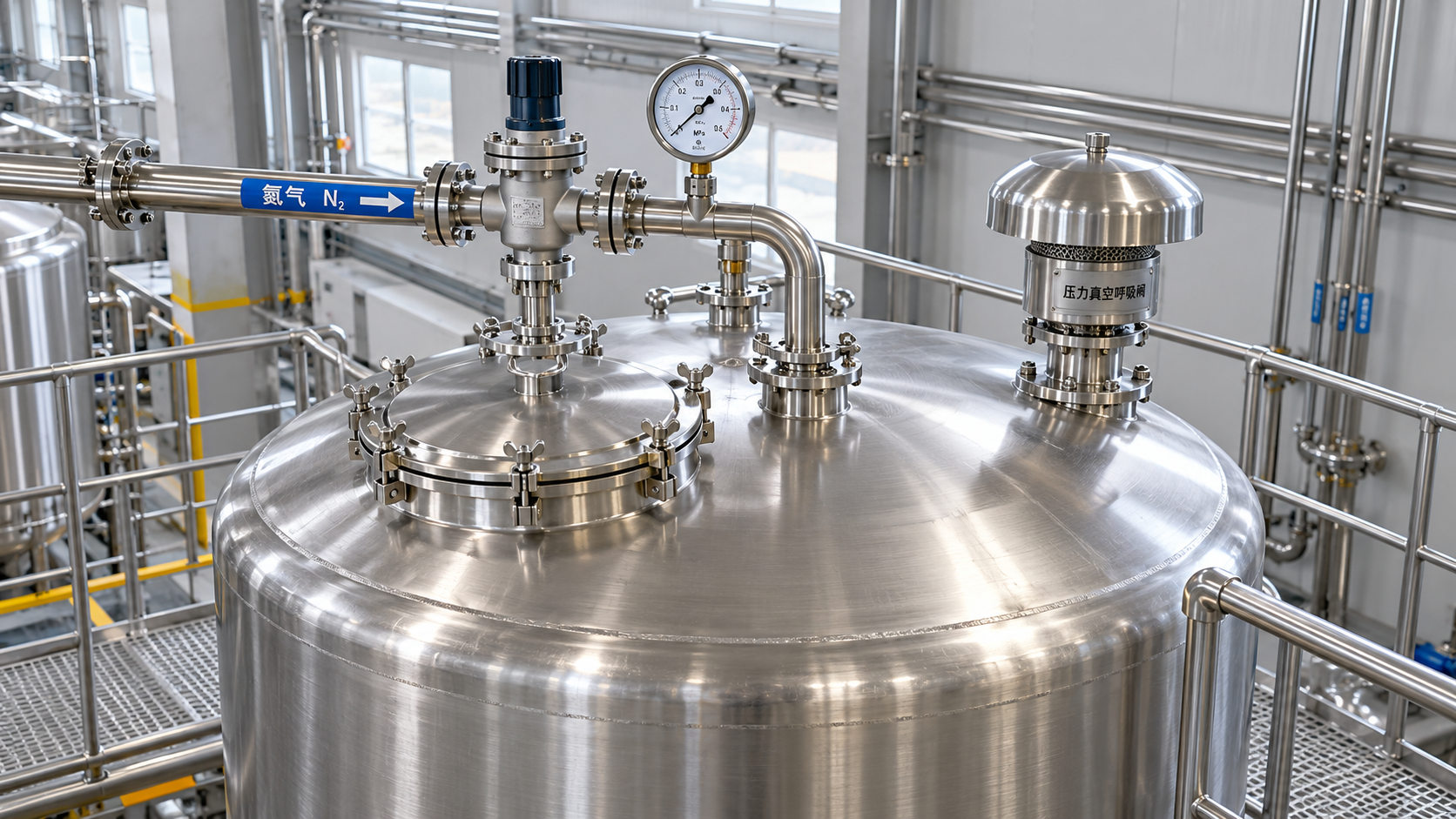
A typical arrangement includes nitrogen pressure reduction, a blanketing regulator, pressure indication, and pressure/vacuum protection. Depending on the risk assessment, it may also require alarms, independent protective functions, supply monitoring, and oxygen measurement. These components perform different duties; the regulator is not a substitute for tank protection.
During oil withdrawal, nitrogen must replace the departing liquid volume while maintaining the intended operating pressure. Cooling can create additional inbreathing demand. During filling or warming, the tank must discharge displaced or expanding gas. The design basis should identify the credible combinations of transfer and thermal conditions, not just average throughput.
API Standard 2000 addresses normal and emergency venting of atmospheric and low-pressure tanks within its stated petroleum-service scope. An engineer may consider its methods where appropriate, but an edible-oil project should explicitly confirm applicability, governing local requirements, and any alternative design basis. Referencing the standard is not, by itself, proof that a particular tank or vent arrangement is adequate.[2]
Pressure settings need a documented hierarchy. Normal control should operate without repeatedly opening the conservation vent, while protective devices must act before the tank exceeds its established limits. Allowances should account for instrument tolerance, regulator behavior, and pressure losses in connected piping. Copying settings from another vessel can be unsafe even when capacities appear similar.
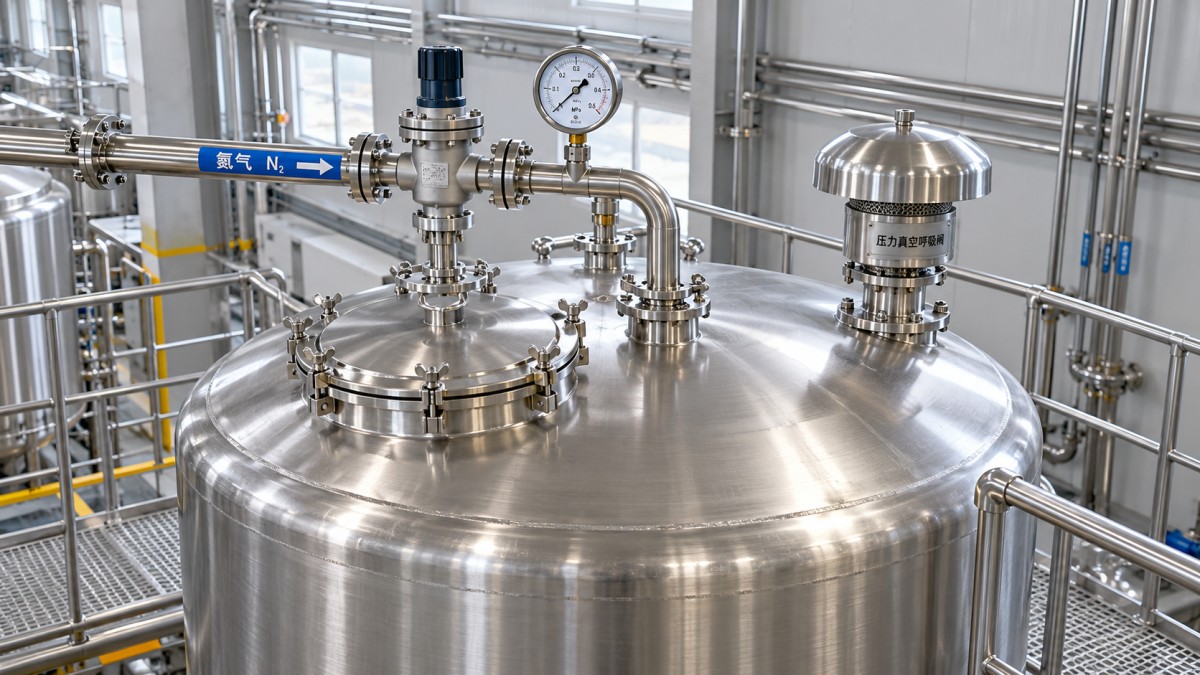
Failure scenarios deserve separate attention. These can include nitrogen supply loss, regulator failure open, a blocked sensing connection, restricted venting, and pump withdrawal continuing after gas supply disappears. Vacuum relief may admit air to protect the tank during an upset; product protection should not be achieved by defeating structural protection.
Cleaning and cooling require their own review. If hot washing or steam is used, the engineer should assess condensation, changing vent paths, and the operating sequence. A normal production calculation should not be assumed to cover every cleaning condition.
Specify nitrogen quality and supply capacity separately
A purchase specification that says only “food-grade nitrogen” leaves important questions unanswered. Define the required gas composition, impurity limits, moisture requirements, evidence of conformity, and verification point. In the United States, nitrogen is addressed under 21 CFR 184.1540 for food use subject to current good manufacturing practice; this does not remove the need to qualify the supply and distribution system for the intended application.[3]
Cylinders, bulk liquid supply, and on-site generation have different operating implications. Cylinders may suit limited consumption but require changeover planning. Bulk supply depends on delivery arrangements and vaporization capacity. Generation requires evaluation of compressed-air quality, output purity, available flow, and maintenance support. Selection should follow the site's demand profile and service constraints.
Peak capacity and total consumption are separate calculations. The system may need to support simultaneous withdrawal from several tanks, while total usage depends on operating cycles, leakage, purge procedures, and vent losses. Supply-header pressure losses can prevent adequate delivery even when the nominal source capacity appears sufficient.
Gas purity is also different from actual headspace oxygen concentration. Initial air, access openings, leakage, gas mixing, and operating practice affect the atmosphere above the oil. If a headspace oxygen target is specified, procurement documents should explain the measurement location, sampling method, operating conditions, and acceptance criteria. A gas-source certificate cannot verify tank performance by itself.
Include hygiene and personnel protection in the scope
Food-contact suitability extends beyond the tank shell. Gaskets, valve seats, lubricants, gas piping, and any filtration should be reviewed for their intended exposure and cleaning conditions. New branches should not create avoidable liquid traps or inaccessible residues. U.S. food facilities subject to 21 CFR Part 117 should assess the modification against applicable equipment and sanitary-operation requirements, including section 117.40.[4]
Nitrogen also creates an oxygen-deficiency hazard. Vent discharge locations, enclosed spaces, access platforms, and maintenance activities require a site-specific assessment. A vessel that previously contained air may present a different entry hazard after blanketing. OSHA's permit-required confined-space standard provides the relevant U.S. framework where applicable; other jurisdictions require assessment under their own rules.[5]
The retrofit scope should address isolation, lockout, controlled depressurization, atmospheric testing, and entry procedures. Oxygen monitoring and ventilation should be selected through the workplace hazard assessment, not treated as optional accessories to a product-quality project. Nitrogen's food-use status does not make an oxygen-deficient atmosphere safe to enter.
Request a complete retrofit package, not a regulator quotation
A useful inquiry package gives bidders a common operating basis. Without it, a low quotation may simply omit vent replacement, structural assessment, instrumentation, commissioning, or plant shutdown work that another bidder has included.
- Tank information: drawings, capacity, operating levels, materials, established pressure/vacuum limits, inspection findings, and existing nozzle details.
- Operating cases: maximum filling and withdrawal rates, simultaneous transfers, temperature changes, cleaning sequences, and planned future throughput.
- Gas requirements: supply conditions, composition specification, peak demand, consumption assumptions, backup arrangements, and supply-loss response.
- Engineering deliverables: process and instrumentation diagram, sizing calculations, setpoint schedule, cause-and-effect description, and installation drawings.
- Execution boundaries: responsibility for welding, electrical work, hygienic restoration, inspection, commissioning, training, and handover records.
Compare lifecycle costs on the same basis. Relevant items include engineering, shutdown duration, access equipment, gas consumption, maintenance, calibration, and recurring inspection. A repairable vessel may still be an unattractive retrofit if leakage or unsuitable geometry requires extensive work. Replacement deserves serious consideration when the project also requires capacity expansion or major hygienic improvements.
Make acceptance operational, not merely mechanical
Commissioning should follow an engineer-approved procedure and stay within the vessel's established limits. A general-purpose pressure test must not be improvised for a lightly constructed atmospheric tank. Verification should cover installation quality, instrument calibration, valve identification, protective-device documentation, and the agreed functional tests.
Demonstrate behavior during representative filling and withdrawal, including the approved response to loss of nitrogen. Where oxygen performance is contractual, test it under defined conditions rather than immediately after a favorable purge. Establish baseline consumption and distinguish startup purging from ongoing usage so future leakage or control problems can be investigated.
Product-quality assessment needs a separate baseline, using the site's agreed oil-specific methods and comparable storage conditions. Mechanical completion and acceptable headspace readings do not alone prove a shelf-life benefit.
The strongest retrofit candidates have verifiable structural limits, manageable leakage, suitable hygienic arrangements, and a clear quality objective. Where those conditions are missing, the next purchase should be an assessment—not nitrogen hardware. Approval should follow evidence that the vessel, gas supply, protective systems, and operating procedures will function together.
Sources
- Codex Alimentarius, CXC 36-1987, Code of Practice for the Storage and Transport of Edible Fats and Oils in Bulk.
- American Petroleum Institute, API Standard 2000, Venting Atmospheric and Low-pressure Storage Tanks. Confirm the applicable edition and project-specific suitability.
- U.S. Food and Drug Administration, 21 CFR 184.1540, Nitrogen.
- U.S. Food and Drug Administration, 21 CFR 117.40, Equipment and utensils.
- U.S. Occupational Safety and Health Administration, 29 CFR 1910.146, Permit-required confined spaces.
Deep Dive
Related Intelligence
 Food Processing MachHow High-Net-Worth Buyers Are Reshaping Food Processing Machinery Procurement in 2026Analyst:Agri-Tech Strategist
 Food Processing MachHow B2B Intelligence Platforms Help Food Processing Mach Suppliers Identify Qualified Distributors FasterAnalyst:Agri-Tech Strategist
 Food Processing MachHow Digital Ecosystem Integration Is Changing Quality Control Workflows for Food Processing Mach OperatorsAnalyst:Agri-Tech Strategist