Japanese Bread Crumbs: Comparing Cost per Coated Batch, Not per Bag
Key Takeaways
- US Agencies Issue Joint Cybersecurity Warning for Industrial RefrigerationIT & Security Director
- How to use B2B competitive intelligence to track rival pricingIT & Security Director
- The Kyiv Independent Hit by Suspected Russian CyberattackIT & Security Director
- What is editorial exposure and how does it differ from paid advertising?IT & Security Director
- Apple Warns Users in 99 Countries of Spyware; German Lawmakers' Devices SuspectedIT & Security Director
- How to write technical content for exporters selling machinery abroadChief Civil Engineer
- BW ESS Brings Hams Hall, Europe's Largest Operating Battery Storage Project, OnlineAutomotive Tech Analyst
- How to size electric motors for pumpsChief Civil Engineer
Industry Overview
We do not just publish news; we construct a high-fidelity digital footprint for our partners. By aligning with TNE, enterprises build the essential algorithmic "Trust Signals" required by modern search engines, ensuring they stand out to high-net-worth buyers in an increasingly crowded global digital landscape.
A lower price per bag does not necessarily produce a lower coating cost. A crumb that costs less by weight may require heavier pickup, leave more unusable material in the breader, or produce more rejected pieces. Procurement needs to compare the cost of delivering an accepted coated batch—not simply the cost of receiving an ingredient.
The comparison becomes more useful when fine and coarse grades are evaluated as process inputs rather than interchangeable commodities. Particle size, substrate condition, batter viscosity, equipment settings, and handling all belong in the purchasing decision. The winning specification is the one that meets the finished-product requirement at a repeatable operating cost.
Define the accepted batch before comparing quotations
Start with a common production basis: the same incoming substrate weight, comparable piece dimensions, and an agreed finished-product specification. Otherwise, a supplier offering a heavier coating may appear to deliver better yield simply because more crumb ends up on each piece.
Define acceptance before the trial. Depending on the application, this might include coverage, exposed surface area, coating weight, appearance after cooking, adhesion through handling, and texture at the intended serving point. For frozen products, the relevant evaluation may include freezing, storage, transport simulation, and the specified final cooking method.
Keep two measures separate:
- Crumb cost per accepted batch: the cost of crumb consumed, divided by the number of accepted batch equivalents produced.
- Total coating-system cost per accepted batch: crumb, predust, batter, attributable labor, disposal, and other demonstrable coating-related costs, divided by accepted output.
The first measure helps compare ingredient utilization. The second supports the purchasing decision. Neither should hide rejected food substrate, but any allocation of substrate losses needs a consistent accounting rule. Avoid charging the same rejected material once as ingredient consumption and again as a separate material loss.
Build a material balance, not a bag-count estimate
For each trial, record opening usable crumb inventory, new crumb issued, and closing usable inventory. Their balance gives net crumb consumption, provided stock movements and material held inside the equipment are captured consistently. Record discarded material separately to explain where consumption went.
Crumb removed from a hopper is not automatically waste. Equally, material remaining at the end of a run is not automatically usable inventory. Its treatment depends on exposure, storage conditions, the plant’s food-safety controls, and whether it remains within the agreed quality specification.
A practical trial record should connect purchasing and production information:
Measure coating pickup at clearly identified stages. Weighing only the uncoated and fully breaded product gives combined coating pickup; it does not isolate crumb from predust and batter. Use the same draining time, sampling method, and weighing procedure for each candidate.
Fine versus coarse: translate appearance into control points
“Fine” and “coarse” are incomplete purchasing specifications. Ask for a particle-size distribution, the test method used to establish it, and an agreed description of flake shape. Two materials carrying the same grade name may not behave identically on the line.
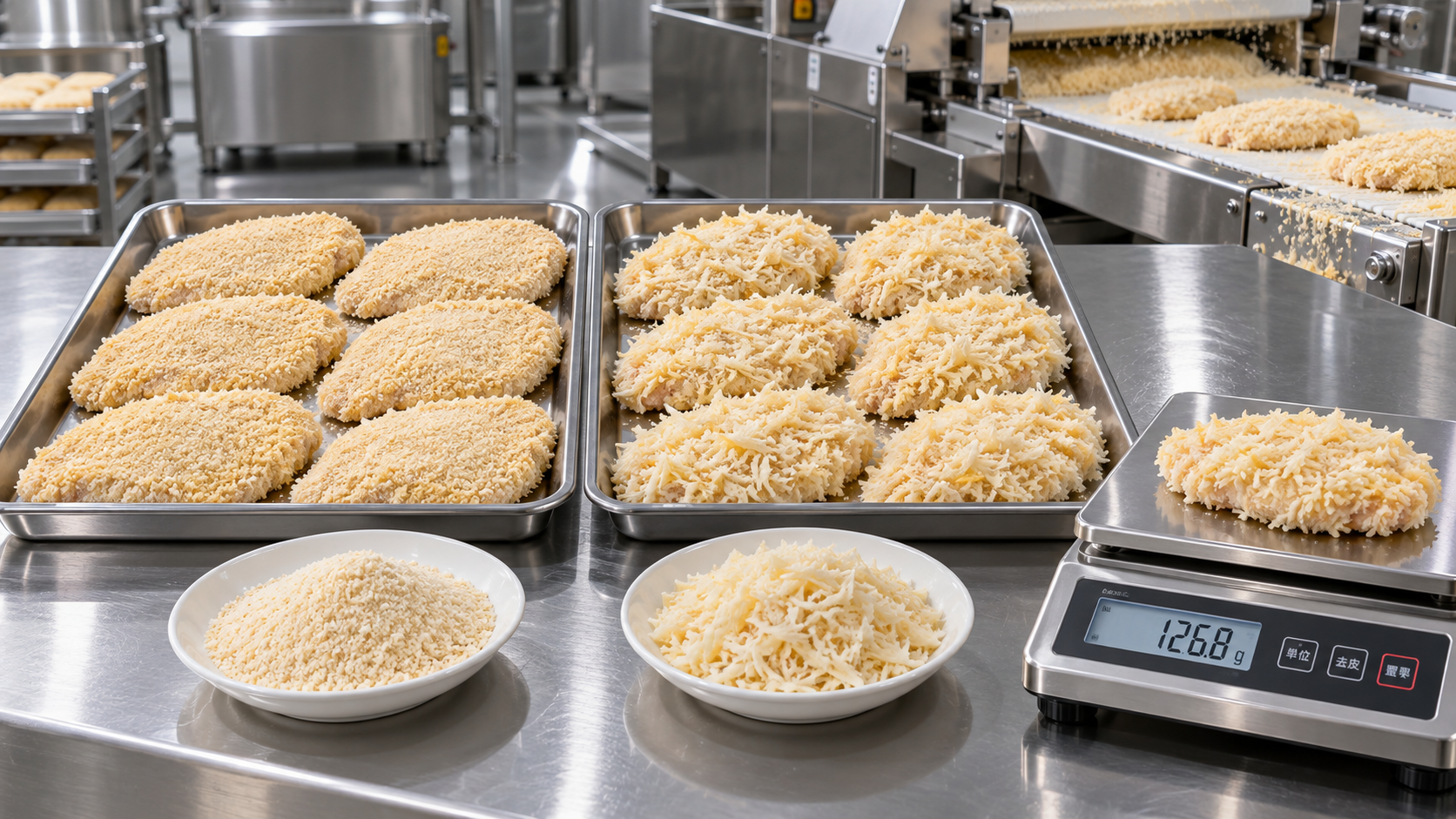
When comparing Japanese bread crumbs, distinguish the product’s descriptive name from measurable acceptance criteria. A needle-shaped or flake-style description can help identify the intended coating appearance, but procurement still needs size distribution, moisture specification, bulk density, packaging details, and application-trial results. The grade name alone does not establish cost per coated batch.
Breading performance is a system-level issue involving the substrate, adhesive layers, breading material, and application conditions. Technical background on these interactions is covered in S. Barbut’s The Science of Poultry and Meat Processing (2015), in its discussion of battering and breading. That framework supports testing the complete coating system rather than predicting performance from crumb size alone.
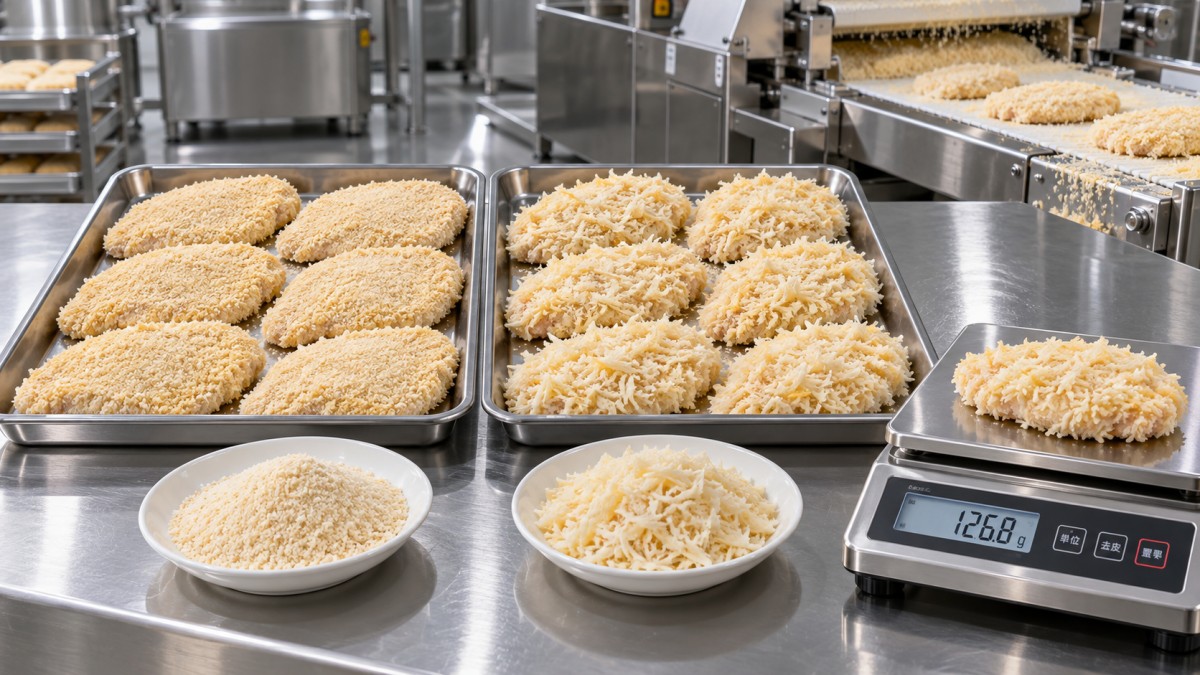
These are trial questions, not universal claims that one grade performs better. A smoother coating may suit one product brief; a visibly open, irregular coating may suit another. A grade that looks attractive immediately after cooking may still fail the customer’s holding or reheating requirement.
Watch the crumb condition during the run
A fresh sample from an unopened bag does not represent every condition inside a production breader. Include samples from the start, middle, and end of the run, especially where the equipment recirculates material. Compare their size distribution, visible condition, and application performance using a consistent sampling procedure.
If the circulating material changes, investigate the equipment and operating conditions before attributing the difference entirely to the supplier. Transfer height, conveying arrangements, pressure settings, replenishment practice, and run duration are useful variables to record. The purchasing question is whether the proposed material remains suitable under the plant’s actual handling conditions.
Run two comparisons: a controlled screen and an optimized trial
A single fixed-setting test can be useful for screening, but it can also favor whichever crumb happens to suit the existing setup. Conversely, unrestricted adjustment makes comparisons difficult to interpret.
Use a staged approach. Begin with a controlled screen using a common substrate lot, preparation method, batter condition, line speed, and cooking procedure. Record differences without repeatedly adjusting the process to rescue an unsuitable candidate.
Then allow reasonable optimization for candidates that meet the basic product brief. Document every changed setting and include its operating consequences. If a grade requires slower throughput, extra inspection, or a different batter application, those requirements belong in the economic comparison.
Include normal replenishment and routine stops where practical. A short, uninterrupted demonstration may not reveal the material balance or operating attention required during a regular production run. Repeat promising trials across deliveries before treating a favorable result as an established purchasing advantage.
Keep quality acceptance separate from food-safety decisions
Good coverage and acceptable texture do not establish that a coating process is safe. In particular, deciding whether exposed crumb can be retained or reused requires a food-safety assessment, not a purchasing judgment based on ingredient value.
For operations subject to United States requirements, 21 CFR Part 117 addresses manufacturing controls and hazard analysis. Section 117.80 covers processes and controls, while Section 117.130 addresses hazard analysis. These provisions are relevant references when evaluating ingredient exposure and handling practices; they do not provide a universal permission to reuse breader returns. Applicable obligations depend on the facility, product, and market.
Procurement should request a complete ingredient declaration and allergen information rather than infer composition from the product name. For the United States, wheat is among the major food allergens identified by the FDA. The FDA’s Questions and Answers Regarding Food Allergens, Including the Food Allergen Labeling Requirements of the Federal Food, Drug, and Cosmetic Act, Edition 5, provides relevant labeling guidance. Other destination markets require their own review.
Keep food-safety approval separate from the commercial scorecard. A lower-cost handling practice should not enter the savings calculation until the responsible team has approved it under the facility’s applicable controls.
Write the specification around what the line can verify
A useful purchase specification links supplier documentation to receiving checks and production performance. It should identify the agreed grade, test methods, acceptance limits, and procedures for handling deviations.
- Physical characteristics: particle-size distribution, flake description, moisture specification, bulk density, and agreed appearance reference.
- Composition and documentation: ingredients, allergen declaration, lot identification, and supporting documents required by the buyer’s quality system.
- Delivery condition: net weight, packaging integrity, storage instructions, declared shelf life, and minimum remaining shelf life on receipt.
- Change control: notification requirements for changes to formulation, manufacturing process, or specifications that could affect application.
Moisture and bulk density deserve particular attention in commercial comparisons. Weight-based pricing and volume-based equipment settings answer different questions. If materials differ, compare their delivered condition and application results rather than applying an assumed correction. Any dry-matter comparison should be agreed with the technical team and should not replace the actual batch-cost calculation.
Packaging also belongs in the evaluation. Assess whether the pack format suits dispensing, partial-bag management, storage space, and normal handling. Record actual spillage, residual material, and handling time instead of assuming that either a larger or smaller bag is cheaper to use.
Award on repeatable cost within the approved product window
Build the final comparison around an approved quality window, not a single appearance sample. Include delivered ingredient cost, measured consumption, accepted output, documented operating differences, and the commercial consequences of minimum orders, lead times, and stockholding.
Where a cost cannot yet be measured reliably, show it as an unresolved item rather than inventing a savings estimate. A second trial may be more valuable than a precise-looking spreadsheet based on assumptions.
The strongest purchasing decision is a documented match between crumb specification, process capability, and finished-product requirements. A cheaper bag wins only when its accepted-batch economics hold up under those same conditions.
Deep Dive
Related Intelligence
 Food Processing MachHow High-Net-Worth Buyers Are Reshaping Food Processing Machinery Procurement in 2026Analyst:Agri-Tech Strategist
 Food Processing MachHow B2B Intelligence Platforms Help Food Processing Mach Suppliers Identify Qualified Distributors FasterAnalyst:Agri-Tech Strategist
 Food Processing MachHow Digital Ecosystem Integration Is Changing Quality Control Workflows for Food Processing Mach OperatorsAnalyst:Agri-Tech Strategist