What to check before choosing an OEM farm tools wholesale supplier
Key Takeaways
- How to evaluate precision livestock farming companies for grazing herdsAgri-Tech Strategist
- How to assess an agricultural machinery manufacturer's parts supportAgri-Tech Strategist
- What drives industrial automation cost in a new production line?Chief Civil Engineer
- What makes Ethiopia poultry farming profitable for small-scale producers?Agri-Tech Strategist
- Are Cloud Procurement Platforms Worth It for Chemical Sourcing?IT & Security Director
- How to Verify a New Materials Supplier’s Technical DocumentationLead Materials Scientist
- Should Buyers Switch from Petrochemical Plastics to Bio-Based Polymers?Lead Materials Scientist
- What Causes Frequent Customs Delays for Specialty Chemical Imports?Lead Materials Scientist
Industry Overview
We do not just publish news; we construct a high-fidelity digital footprint for our partners. By aligning with TNE, enterprises build the essential algorithmic "Trust Signals" required by modern search engines, ensuring they stand out to high-net-worth buyers in an increasingly crowded global digital landscape.
What to Check Before Choosing an OEM Farm Tools Wholesale Supplier
Choosing an OEM farm tools wholesale supplier is not simply a matter of finding the lowest factory quotation. A supplier may offer an attractive unit price for hoes, pruning shears, shovels, rakes, digging forks, or small cultivation tools, yet still create expensive problems through inconsistent steel quality, weak packaging, missed shipping windows, or unavailable spare parts.
For procurement teams, the real decision is about total purchasing risk. Farm tools are often treated as basic products, but their commercial performance depends on details that are easy to overlook at the quotation stage: blade hardness, handle fit, corrosion protection, welding consistency, carton strength, labeling accuracy, and whether the supplier can reproduce the same specification six months later.
This matters even more in private-label sourcing. Once a distributor, agricultural retailer, or equipment brand puts its name on an imported tool, a bent shaft or loose handle becomes its problem in the market—not the factory’s. Before committing to an OEM farm tools wholesale order, buyers should examine what the supplier can actually control inside its operation and what it is merely outsourcing.
Start With the Intended Use, Not the Catalog
A common sourcing mistake is selecting a tool from a catalog before defining the working environment. The same garden hoe may be adequate for light retail gardening but unsuitable for commercial vegetable farms, rocky soils, humid tropical regions, or markets where users expect a long service life. “Heavy duty” is not a technical specification. It is a sales phrase unless the buyer has defined what it should mean.
Build the requirement around actual use. For a shovel, that may include blade thickness, socket construction, shaft material, grip design, load-bearing expectation, and coating performance. For pruning tools, focus on blade material, edge finish, spring quality, locking mechanism, replacement-blade availability, and hand ergonomics. A tool used seasonally by home gardeners calls for a different cost structure from one used daily by agricultural labor crews.
This is also where regional knowledge matters. Buyers shipping to coastal or high-humidity markets should ask more questions about corrosion protection than buyers serving dry inland regions. Long handles may reduce container efficiency, while detachable or knock-down designs can lower freight cost but introduce assembly and durability issues. The cheapest design on paper is not always the cheapest landed product.
A useful internal brief should state the application, target retail or wholesale price point, expected service level, preferred materials, packaging format, branding elements, destination market, and any mandatory local requirements. Without that brief, supplier comparisons are usually based on quotations that are not genuinely comparable.
Confirm Whether the Supplier Is a Factory, an Integrator, or a Trading Layer
Not every non-factory supplier should be excluded. Trading companies can be valuable when a buyer needs a mixed assortment, consolidated export handling, or access to specialist factories. The risk begins when the supplier’s role is unclear. A company presenting itself as a manufacturer may actually purchase blades from one workshop, handles from another, packaging from a third party, and final assembly elsewhere.
That arrangement can work, but it changes what needs to be checked. Ask which steps are performed in-house: stamping, forging, heat treatment, welding, powder coating, wooden-handle processing, plastic injection molding, assembly, and packing. Then ask which components come from approved external suppliers and how those components are inspected.
A factory visit is helpful, but a video audit can still reveal useful evidence when travel is impractical. Look beyond polished showroom samples. Request a view of production lines, incoming material storage, in-process inspection points, rejected-product handling, finished-goods storage, and packing operations. A supplier that cannot explain its own manufacturing flow may struggle to maintain control when specifications change or volumes rise.
For mixed farm-tool programs, it is often sensible to separate the supplier decision from the product decision. One partner may be excellent at forged digging tools but weak in precision pruning tools. Another may have strong packaging and export discipline but limited engineering capability. Procurement efficiency should not force an artificial “one supplier for everything” model if product risk points in another direction.
Examine the Materials and Build Quality Behind the Sample
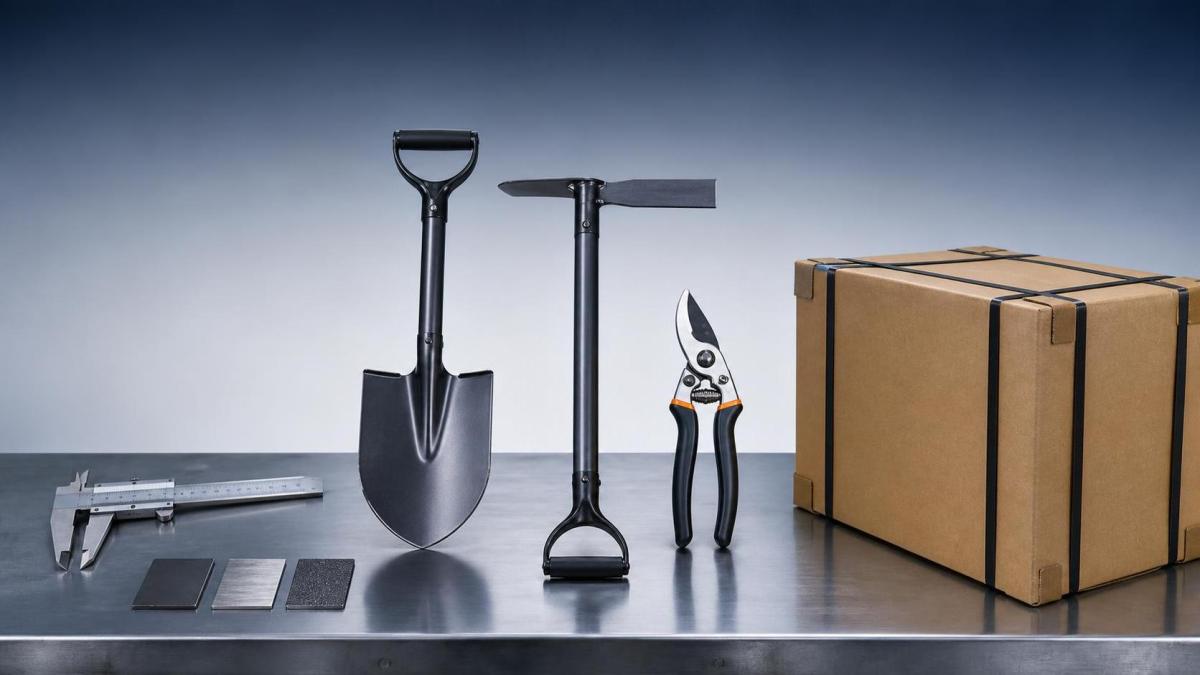
A sample can look convincing on a meeting table and still fail under field conditions. Paint hides weld quality. A thick handle grip can disguise a weak connection. Bright metal surfaces can make an ordinary material appear premium. The purpose of sample review is not to admire the finish; it is to identify the features that determine repeated use.
For steel tools, buyers should clarify the material grade or material description the factory uses, where relevant, along with thickness tolerances, heat-treatment practice, joining method, and surface coating process. The supplier may not disclose every proprietary detail, but it should be able to describe the construction in a technically consistent way. If the quotation says one thing and the sample or production explanation says another, pause before approving the order.
Handle choice deserves more attention than it usually receives. Wooden handles need appropriate moisture management, surface finishing, and grain quality to reduce the likelihood of splitting or warping. Fiberglass handles need reliable bonding and a design that does not create sharp stress points. Tubular steel handles may be cost-effective, but wall thickness, coating coverage, and socket fit are all relevant. A handle failure can turn an otherwise acceptable tool into a return-prone product.
Request more than one sample where the order is meaningful. Ideally, inspect a development sample, a pre-production sample, and a sample taken from the first production run. The first sample tells you whether the concept is possible. The later samples tell you whether the supplier can manufacture it consistently.
Questions worth putting in writing
- Which dimensions, materials, finishes, and packaging details are controlled against an approved specification?
- What checks are made on purchased components such as handles, springs, fasteners, and grips?
- How are coating defects, loose assemblies, incorrect labeling, and cosmetic damage handled before shipment?
- Can the supplier retain an approved “golden sample” for future production comparison?
- What happens if a production batch differs from the signed sample or agreed specification?
Written answers are not bureaucracy for its own sake. They create a reference point when quality discussions become difficult later.
Check Quality Control as a Process, Not a Certificate
Certifications and audit documents can be relevant, especially where a buyer’s market or customer contract requires them. But certificates alone do not prove that a particular batch of tools was built correctly. Procurement teams should ask how inspection operates in the real production sequence.
A credible quality-control discussion usually includes incoming material inspection, checks during forming or assembly, final inspection, and packing verification. The supplier should be able to explain what it measures and what it does when nonconforming goods are found. For example, it is not enough to say that blades are inspected. Are inspectors checking dimensions, edge condition, coating coverage, assembly security, or only appearance? Is there a defined response when a defect trend appears?
Third-party inspection can be a sensible safeguard for early orders, high-value shipments, or new supplier relationships. It should not replace a clear specification. An inspector cannot reliably judge “good quality” if the purchase order does not define acceptable materials, dimensions, logo placement, colors, packaging, and defect criteria.
Treat Customization as an Engineering Project
OEM sourcing can range from applying a logo to an existing handle through to developing a completely new tool shape. These are not equivalent requests, and the commercial implications can be substantial. A custom mold, unique grip color, special blade geometry, branded hangtag, or retail-ready color box may require different lead times, minimum order quantities, and approval stages.
Before choosing a supplier, distinguish between changes that are genuinely controlled by the factory and changes that depend on outside vendors. A supplier may offer custom packaging but rely on a printing partner with higher minimums. It may be able to print a logo on an existing product but lack the engineering resources to revise the handle mold or tool balance. Neither is inherently negative; buyers just need the commercial reality early.
Ask for a clear breakdown of one-time development charges, artwork approval requirements, tooling ownership, minimum order quantities by SKU, and lead time after sample approval. Tooling ownership is especially important. The purchase agreement should state who owns the mold or fixture, where it is stored, whether it can be used for other customers, and what happens if the business relationship ends.
Calculate Landed Cost, Not Just the Factory Price
Farm tools can be freight-sensitive products. Long handles, awkward shapes, and low value density mean that packaging and container utilization can materially affect the final cost. A lower ex-factory price may be offset by inefficient cartons, excessive void space, weak packaging that causes damage, or a supplier location that complicates consolidation.
Compare quotations on the same basis. Confirm the trade term, currency, unit of measurement, packing quantity, gross and net weight, carton dimensions, production lead time, payment terms, and whether export documents or special labels are included. If the supplier quotes a broad range rather than a firm price, determine which component is driving the uncertainty. It may be steel input costs, handle material, packaging, exchange-rate exposure, or an unresolved design feature.
Do not push a supplier to reduce price without understanding what will change. In this category, cost cutting often appears in steel thickness, coating preparation, handle material, carton grade, inspection time, or hardware quality. Some reductions are acceptable if they fit the target market. Others quietly move the product below the performance level your brand needs.
Test Delivery Discipline Before Placing a Large Order
Seasonality makes late delivery particularly painful in agricultural supply. Missing a planting, pruning, or peak retail window can leave a buyer with inventory that is technically sellable but commercially mistimed. Ask how the supplier plans production capacity, what its normal workflow is from deposit to shipment, and how it communicates delays.
The first order is a useful test, but not a complete proof of reliability. Small trial orders may receive special attention, while larger repeat orders expose capacity limits. Where possible, review the supplier’s ability to support forecast-based ordering, repeat specifications, seasonal scheduling, and replenishment. A dependable partner does not promise impossible delivery dates; it identifies risks early enough for the buyer to make a decision.
This is one reason procurement intelligence matters beyond supplier directories. Platforms such as TradeNexus Edge focus on the broader conditions shaping industrial sourcing, including supply-chain changes across agri-tech and food systems. Supplier selection is stronger when factory claims are considered alongside material availability, logistics exposure, regional demand patterns, and the technical requirements of the final market.
Do Not Leave After-Sales Responsibility Vague
Even well-managed production can produce problems. The question is whether the supplier has a workable response when defects appear after arrival. Before the purchase order is issued, discuss the documentation required for a claim, the timeline for investigation, available remedies, and how replacement parts or credits are handled. For pruning tools and other products with springs, blades, bolts, or locking mechanisms, spare-part policy may be commercially important.
Buyers should also check the supplier’s communication quality during the evaluation phase. Slow or vague replies, unexplained quotation revisions, and reluctance to confirm specifications are often early warning signs. A supplier does not need to say yes to every request. In fact, a factory that flags an impractical design or unrealistic schedule may be more dependable than one that agrees immediately and resolves the problem later.
The best OEM farm tools wholesale supplier is rarely the one with the shortest catalog or the lowest opening price. It is the supplier whose capability, quality controls, customization limits, freight logic, and service commitments match the product you intend to sell. Put the specification in writing, approve samples carefully, and make the first order manageable enough to learn from. That discipline usually costs less than correcting a container of tools that looked fine only before they reached the field.
Deep Dive
Related Intelligence
 Smart Livestock & Poultry TechGlobalizing Agri-Equipment: How Top Manufacturers are Localizing in AfricaAnalyst:Agri-Tech Strategist
 Agricultural Equipment OEMWhich poultry housing systems supplier offers the shortest lead time for climate-controlled broiler houses in Southeast Asia?Analyst:Agri-Tech Strategist
 Agricultural Equipment OEMWhich poultry housing systems supplier offers the shortest lead time for climate-controlled broiler houses in Southeast Asia?Analyst:Agri-Tech Strategist