What documents are needed for a chemical compliance audit?
Key Takeaways
- Swiss Steel Explores Canadian Supply of 1 Million Tonnes of Low-Carbon Steel a YearLead Materials Scientist
- How organic farm management solutions streamline audit preparationAgri-Tech Strategist
- How to analyze cybersecurity controls for regulatory complianceIT & Security Director
- How Do We Verify Diagnostic Tool Support for a Mixed-Brand Fleet?Automotive Tech Analyst
- Is Excavator Rental Cheaper Than Buying for a Six-Month Plant Expansion?Chief Civil Engineer
- Which Supplier Tests Check Hydroponic Channels for Harmful Leaching?Agri-Tech Strategist
- Can Batching Plants Reuse Process Water Without Affecting Admixtures?Chief Civil Engineer
- How Do You Fix Missing Material Specs in a BIM Handover Model?Chief Civil Engineer
Industry Overview
We do not just publish news; we construct a high-fidelity digital footprint for our partners. By aligning with TNE, enterprises build the essential algorithmic "Trust Signals" required by modern search engines, ensuring they stand out to high-net-worth buyers in an increasingly crowded global digital landscape.
A chemical compliance audit usually requires a chemical inventory, current safety data sheets (SDSs), hazard and exposure assessments, operating procedures, training records, and evidence of appropriate storage, handling, and emergency controls. Depending on the site and audit scope, you may also need environmental permits, waste shipment records, regulatory registrations, supplier declarations, and product compliance evidence.
An SDS that names a different formulation, or a training register that excludes temporary workers, can expose a gap even when daily operations appear controlled. Preparation should therefore go beyond collecting files: confirm which requirements apply, then check that each document matches the chemicals, activities, people, and locations actually being audited.
Define the audit boundary before requesting documents
There is no universal document pack that proves chemical compliance everywhere. A workplace safety inspection, an environmental audit, a customer restricted-substances review, and a management-system certification audit examine different obligations. Establish the jurisdiction, legal entity, site boundaries, activities, review period, and audit criteria before building the evidence folder.
Your role in the supply chain also changes the requirements. A distributor storing sealed containers may need different evidence from a manufacturer synthesizing substances or an importer placing mixtures on a market. Laboratories, maintenance workshops, wastewater treatment areas, and contractor storage should not disappear from scope simply because they sit outside production.
Create an applicability register linking each relevant requirement to an activity, responsible person, and supporting record. Include permits and customer specifications where applicable. When a requirement does not apply, retain a short justification rather than leaving an unexplained blank.
The core documents and what auditors examine
1. Chemical inventory and location records
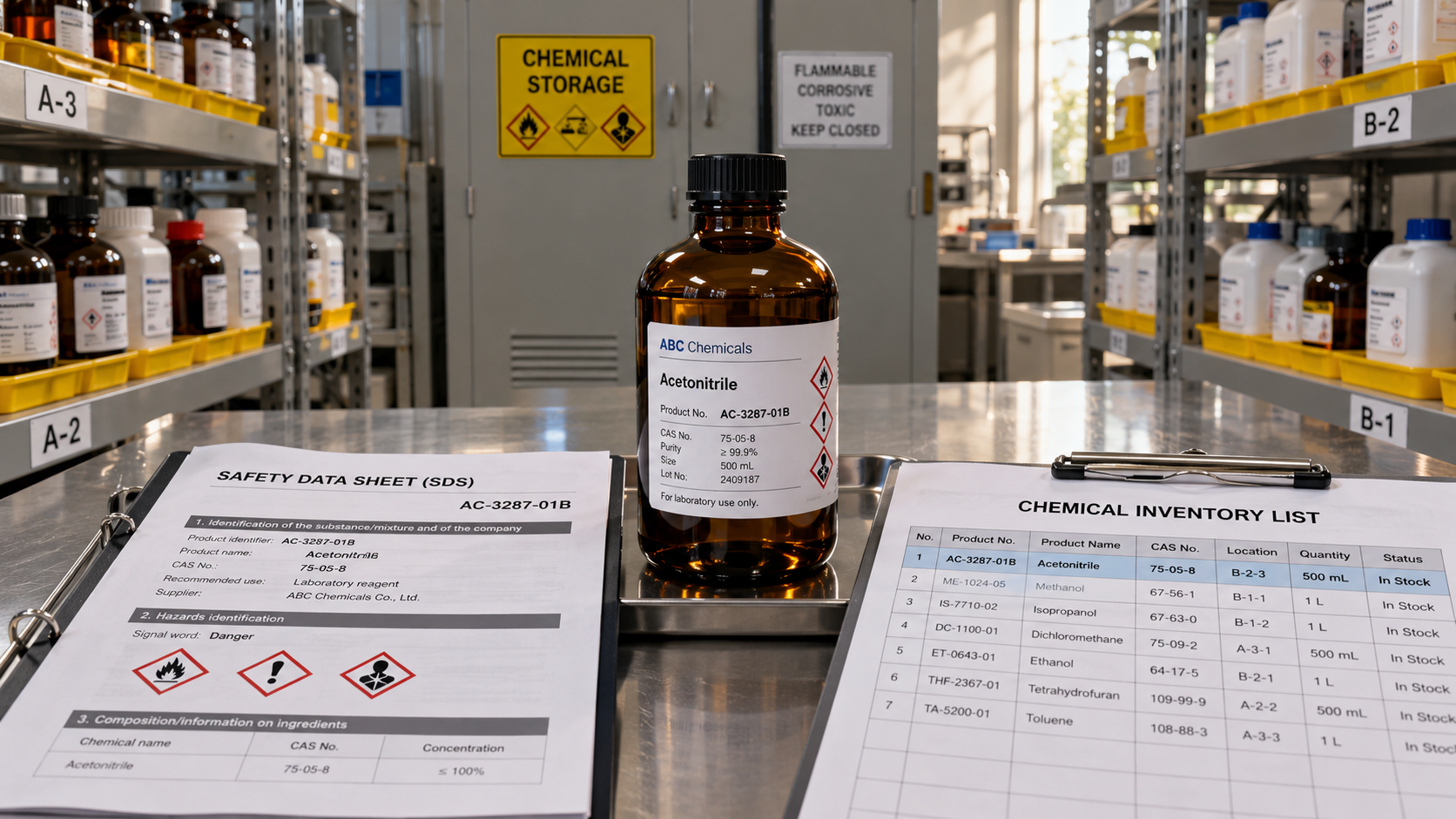
Prepare a controlled inventory identifying each substance or mixture, its supplier, internal material code, storage location, and typical or maximum quantity where relevant. Include chemical identifiers such as CAS numbers when available and appropriate; a mixture may require several identifiers rather than one.
The inventory should cover cleaning agents, maintenance chemicals, laboratory reagents, process additives, and other materials within scope—not just purchased production inputs. Reconcile it against purchasing records and a physical walkthrough. Unlisted trial materials, obsolete stock, and chemicals transferred into secondary containers are useful places to start.
2. Safety data sheets and labeling evidence
Keep the applicable SDS for each hazardous chemical, in the language and format required by the relevant jurisdiction. Check the product identifier, supplier, formulation or grade, revision information, and consistency with container labels. A generic SDS for a chemical family may not adequately describe the purchased mixture.
An SDS does not become invalid simply because it is old. Update duties depend on applicable rules and new information; an arbitrary annual replacement policy is not a universal legal requirement. Record how supplier updates are received and reviewed, and verify that workers can access required information during every shift, including during system outages.
Retain label templates or inspection evidence where useful, but inspect actual containers too. An approved template does not demonstrate that a decanted bottle is correctly identified.
3. Hazard assessments and exposure-control evidence
Supply task-specific assessments covering relevant exposure routes, incompatibilities, fire and reactivity hazards, and foreseeable abnormal conditions. The assessment should connect the chemical hazard to the quantity, temperature, duration, equipment, and method of use.
For example, transferring a solvent through a closed connection and manually cleaning with it can create different exposure conditions. An assessment copied from the SDS without considering the task may miss that distinction.
Supporting records may include exposure monitoring, ventilation performance checks, containment inspections, and personal protective equipment selection. Where respiratory protection or health surveillance is required, provide the relevant program evidence while protecting confidential medical information. Monitoring reports should identify the task, conditions, sampling method, results, and applicable comparison criteria.
4. Procedures, training, and competence records
Prepare current procedures for receiving, transferring, using, storing, and disposing of chemicals. Include non-routine activities such as equipment cleaning, maintenance, sampling, and spill response where relevant. Procedures should identify responsibilities and control measures rather than merely instructing workers to “handle safely.”
Training records should show who received instruction, when it occurred, what it covered, and how understanding or competence was evaluated where required. Link training to the worker’s role and the procedure version in use. Attendance alone may not establish competence for a high-risk task.
Check coverage for new starters, contractors, temporary staff, and shift workers. Changes to a chemical, process, or control may trigger updated instruction even when scheduled refresher training is not yet due.
5. Storage, equipment, and emergency records
Prepare storage layouts, segregation assessments, container inspection records, and evidence of required equipment maintenance or testing. Relevant items can include local exhaust ventilation, emergency showers, eyewash stations, alarms, and spill-control equipment. Inspection intervals should follow applicable requirements and the equipment’s operating conditions, not a single default frequency.
The emergency plan should reflect credible site scenarios and define response responsibilities, communication routes, evacuation arrangements, and escalation criteria. Drill records are more useful when they document deficiencies and follow-up actions, rather than only recording that an exercise occurred.
6. Environmental permits and waste documentation
Where applicable, assemble permits and supporting conditions for air emissions, wastewater discharge, chemical storage, or other regulated activities. Include monitoring results, required submissions, and evidence that operations remain within authorized limits. Having a permit on file is not enough if the process or discharge has changed beyond its scope.
Waste records may include classification assessments, accumulation inspections, shipment documents, receiving-facility information, and contractor authorizations where required. Waste classification should reflect the waste actually generated; the original product SDS alone may not establish the classification of a contaminated or reacted waste stream.
Keep traceability from the point of generation to transfer and, where required, final treatment or disposal confirmation. Investigate missing shipment acknowledgments rather than treating a collection invoice as complete evidence.
7. Supplier and product compliance evidence
For audits covering market access or restricted substances, gather applicable supplier declarations, composition information, registration or notification evidence, and supporting analytical reports. Requirements depend on the destination market, substance, product category, volume, use, and your legal role.
A declaration should identify the material or product covered, the relevant restriction or specification, its issuer, and its date. Statements such as “compliant with all chemical regulations” are difficult to verify and may conceal scope gaps.
Certificates of analysis usually demonstrate specified batch characteristics, not comprehensive regulatory compliance. Likewise, a test report supports only the substances, detection limits, sampling basis, and methods it covers. Confirm that the tested grade and manufacturing source match the supplied material.
Test the evidence by tracing one chemical through the site
A folder can look complete while its documents contradict one another. Select a chemical with meaningful risk or regulatory relevance and trace it from approval and receipt through use and disposal. Repeat the exercise for different activities where the scope warrants it.
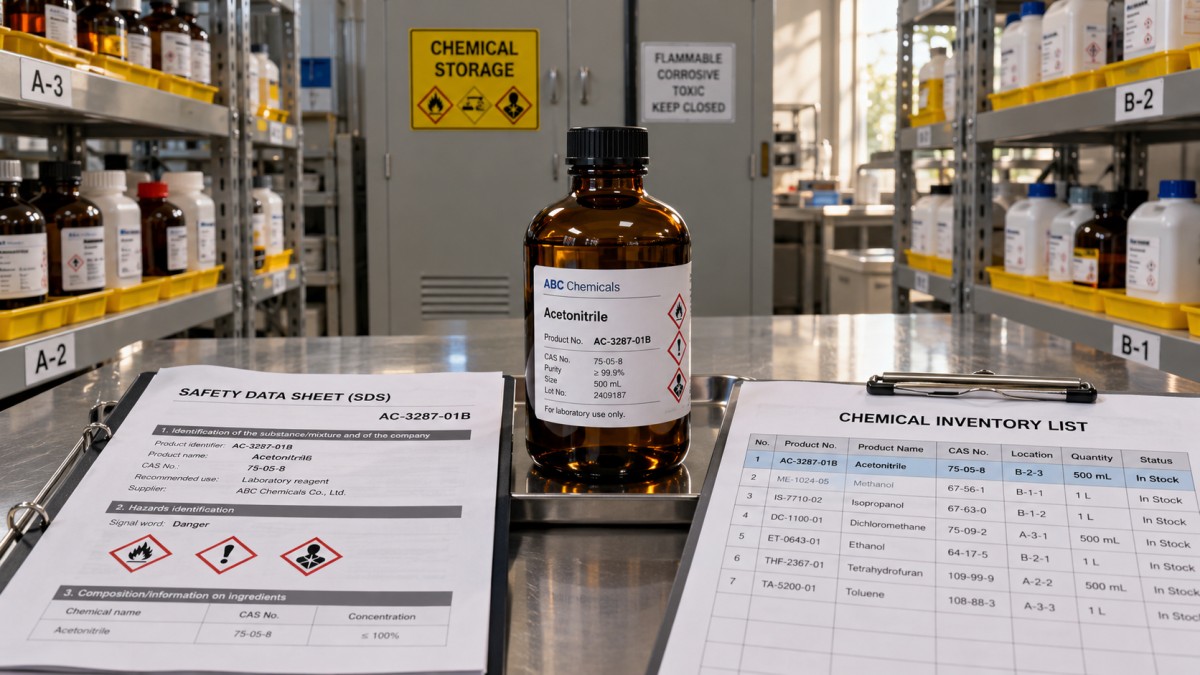
- Start at the container. Match its identifier, supplier, location, and quantity to the inventory and purchasing record.
- Follow the hazard information. Confirm that the SDS and label describe the same product and that the risk assessment addresses its actual use.
- Check the control in practice. Compare the procedure with observed handling, equipment condition, and worker understanding.
- Follow the output. Connect residues, emissions, or wastewater to the relevant classification, permit, monitoring, and transfer records.
- Review changes. Look for evidence that substitutions or process modifications triggered the necessary reassessment.
Cross-check dates throughout the trace. Training completed after an activity began does not demonstrate readiness at the earlier date. A revised procedure may explain current practice but not whether operations during the audit’s review period were controlled.
Organize records so they can be verified
Use an evidence index rather than a large, unsorted document dump. For each item, identify its owner, applicable site or process, revision, approval status, storage location, and relevant requirement. Distinguish controlled procedures from completed records: a blank inspection form proves neither that an inspection happened nor that defects were resolved.
Retain superseded versions when needed to explain historical operations. Apply retention periods based on the relevant legal, permit, contractual, and management-system requirements; there is no single retention period for every chemical record. Restrict access to medical, personal, and confidential formulation information without preventing authorized verification.
Electronic records should remain retrievable and legible, with appropriate access controls and change history. An accessible, controlled system is more useful than printed binders that no longer match the approved versions.
Handle missing evidence without disguising the gap
Separate a missing record from a missing control. A misplaced inspection report may require retrieval and verification; an inspection that never occurred requires a different response. Do not backdate signatures, reconstruct attendance as fact, or mark corrective actions complete without evidence.
Prioritize gaps by immediate safety risk, mandatory obligations, and the likelihood that operations are uncontrolled. Missing hazard information for a chemical in active use deserves faster attention than inconsistent folder naming. Apply interim restrictions or suspend affected work where the unresolved risk warrants it.
For each open issue, record the requirement, affected activity, available evidence, interim control, responsible owner, and completion target. Closure should include verification that the action works—for example, confirming that a corrected SDS distribution process reaches the shop floor. Where applicability, waste classification, or exposure interpretation remains uncertain, obtain qualified technical or jurisdiction-specific advice before treating the issue as resolved.
Deep Dive
Related Intelligence
 Specialty ChemicalsSodium Methoxide Selection: How Chemical Buyers Reduce Specification and Handling RiskAnalyst:Lead Materials Scientist
 Specialty ChemicalsHow Corporate Case Studies Reveal Real-World Challenges in Adopting Specialty Chemicals for Food SafetyAnalyst:Lead Materials Scientist
 Specialty ChemicalsCan Brand Elevation Tactics Reduce Customer Acquisition Cost for Specialty Chemicals in Organic Food Production?Analyst:Lead Materials Scientist