Which Supplier Tests Check Hydroponic Channels for Harmful Leaching?
Key Takeaways
- Swiss Steel Explores Canadian Supply of 1 Million Tonnes of Low-Carbon Steel a YearLead Materials Scientist
- How organic farm management solutions streamline audit preparationAgri-Tech Strategist
- How to analyze cybersecurity controls for regulatory complianceIT & Security Director
- How Do We Verify Diagnostic Tool Support for a Mixed-Brand Fleet?Automotive Tech Analyst
- Is Excavator Rental Cheaper Than Buying for a Six-Month Plant Expansion?Chief Civil Engineer
- Which Supplier Tests Check Hydroponic Channels for Harmful Leaching?Agri-Tech Strategist
- Can Batching Plants Reuse Process Water Without Affecting Admixtures?Chief Civil Engineer
- How Do You Fix Missing Material Specs in a BIM Handover Model?Chief Civil Engineer
Industry Overview
We do not just publish news; we construct a high-fidelity digital footprint for our partners. By aligning with TNE, enterprises build the essential algorithmic "Trust Signals" required by modern search engines, ensuring they stand out to high-net-worth buyers in an increasingly crowded global digital landscape.
A supplier offers “food-grade” hydroponic channels, but the proposed installation will circulate mildly acidic nutrient solution through them for months. Before ordering, you need evidence that the finished channels will not release substances at levels that could compromise crop safety. A resin datasheet or a clean-looking water sample cannot establish that.
The strongest supplier evidence combines independent migration testing on finished channels, targeted analysis for formulation-related contaminants, and extractables screening where composition is uncertain. Test conditions must represent nutrient chemistry, temperature, exposure duration, and repeated use. No report proves zero leaching under every condition; a credible report identifies what was measured, how sensitively, under which conditions, and against which acceptance criteria.
Start with the finished channel, not the “food-grade” claim
Hydroponic channels may contain more than their base polymer. Stabilizers, pigments, processing aids, fillers, recycled content, and fabrication residues can affect what enters the circulating solution. End caps, seals, adhesives, and repaired joints may introduce additional substances. Evidence covering virgin resin alone does not automatically cover the manufactured assembly.
Ask the supplier to identify the exact product code, material grade, color, production site, and formulation revision associated with each report. A report for an unpigmented sample does not necessarily represent a colored channel. A test on an injection-molded accessory may not represent an extruded profile, even when both use the same polymer family.
The practical question is not simply, “Which supplier tests show that hydroponic channels will not leach harmful substances?” It is whether the evidence covers this channel, its wetted components, and the intended growing conditions.
The tests that provide useful leaching evidence
Targeted migration should follow the material chemistry
A useful testing program starts with formulation information, not a generic laboratory package. For PVC channels, ask about the stabilizer system and whether plasticizers are present; rigid PVC should not automatically be treated as plasticized PVC. For polyethylene or polypropylene, relevant questions may concern antioxidants, processing aids, and their degradation products. Pigments and recycled inputs can add separate uncertainties.
Metals such as lead and cadmium may warrant analysis where formulation, pigment, or supply-chain history creates a credible concern. Other metals should be selected on the same basis. ICP-MS or ICP-OES can measure metals in leachates, but the instrument name alone says nothing about whether sample preparation, sensitivity, and quality controls were adequate.
Organic targets may require GC-MS, LC-MS, or other validated methods. Request the actual analyte list. “Tested for harmful chemicals” is not meaningful unless the supplier identifies the chemicals, reporting limits, and results.
Use broad screening to investigate unknowns
Extractables testing can help when a supplier cannot fully disclose the formulation or when recycled material, unusual additives, or processing changes introduce uncertainty. More aggressive solvents or elevated temperatures may reveal substances that a routine aqueous test misses. These findings identify candidates for follow-up; they do not automatically describe what roots encounter during normal operation.
Distinguish extractables, released under deliberately challenging conditions, from leachables, released under intended or representative use. A screening peak may need confirmation with a reference standard, reliable quantification, and toxicological review before it supports an acceptance decision.
Match the exposure conditions to the nutrient loop
A short room-temperature soak in clean water may miss release that occurs in a warm, recirculating nutrient system. Conversely, an aggressive solvent extraction may be useful for hazard discovery without accurately estimating operating exposure. Ask the laboratory to explain what each test represents.
- Record the operating envelope. Include nutrient pH, maximum expected solution temperature, crop-cycle duration, reservoir volume, wetted channel area, and replacement schedule.
- Identify additional exposures. Document cleaning agents, sanitizer concentrations, contact times, rinsing procedures, and sunlight exposure where relevant.
- Choose defensible contact media. A recognized migration method may use specified simulants. Supplementary testing with representative nutrient solution can address application-specific chemistry, provided the method controls matrix interference.
- Set contact duration and repeated exposures. The plan should distinguish initial release from continued release and explain any accelerated conditions used to represent longer service.
Surface-area-to-liquid-volume ratio deserves close attention. A small sample immersed in a large volume can produce a low measured concentration simply through dilution. Ask for both the exposed area and liquid volume, plus any normalized migration result. Translating results to your system requires care because replenishment, adsorption, precipitation, and chemical equilibria can affect concentrations.
Test specimens also need realistic exposure geometry. Cutting a channel into pieces may expose internal edges that nutrient solution would not normally contact. That can be useful as a conservative investigation, but the report should state whether cut edges were included, sealed, or excluded from the calculated area.
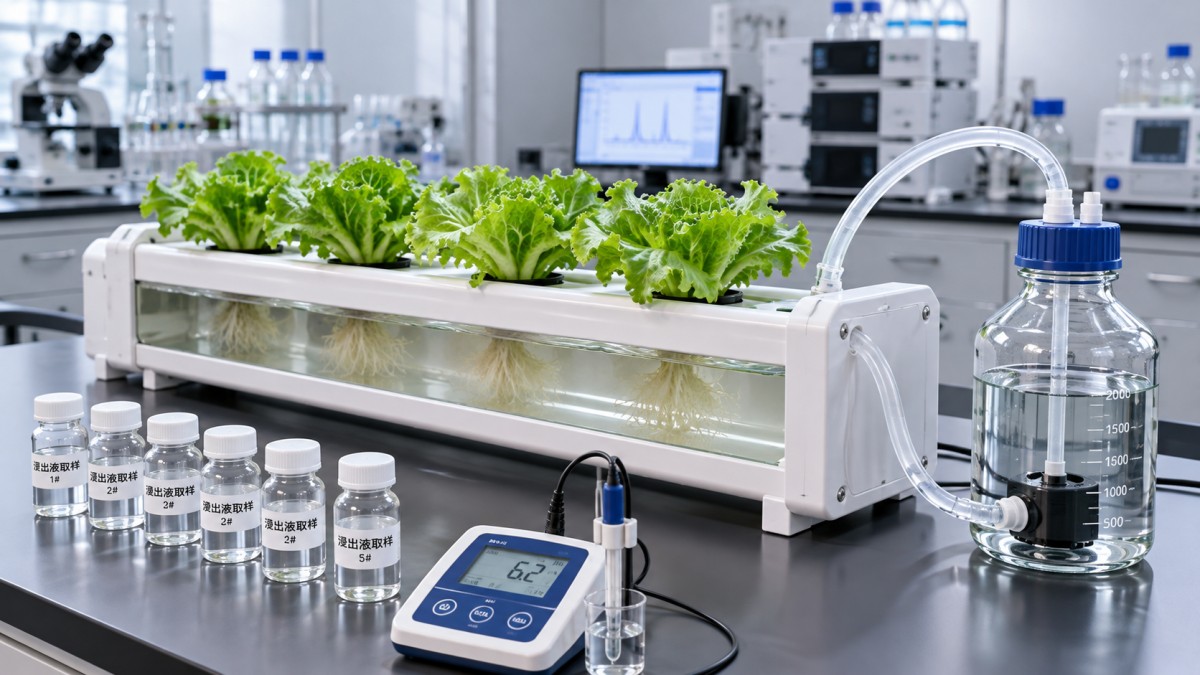
For recirculating systems, test design should account for accumulation between solution changes. Repeated fresh-medium extractions can show whether release declines, but they do not directly reproduce a reservoir that retains released substances. A laboratory can select a complementary approach rather than treating either setup as universally representative.
Read the report beyond the pass statement
Request the complete laboratory report, not a cropped certificate or supplier-created summary. Independent testing is stronger when the laboratory is accredited to ISO/IEC 17025 for the relevant methods or activities. Accreditation does not mean every service offered by that laboratory is within its accredited scope.
Check these details before accepting the evidence:
- Sample identity and custody: product description, batch or lot reference, photographs where available, receipt date, and who selected and submitted the specimen.
- Preparation and exposure: prewashing, conditioning, contact medium, temperature, duration, wetted area, liquid volume, and extraction sequence.
- Analytical performance: reporting limits, blanks, recoveries or other relevant quality controls, and treatment of nutrient-solution interference.
- Results and decision basis: numerical findings, units, applicable limits, and the precise rule used to declare compliance.
“Not detected” does not mean absent. It means the substance was not detected above the method’s stated threshold under those conditions. If the reporting limit exceeds the concentration relevant to the assessment, a nondetect cannot resolve the concern. Results expressed per unit area also cannot be compared directly with concentration limits expressed per liter without an appropriate conversion.
Look for unexplained background contamination. Nutrient salts, laboratory vessels, source water, and sampling equipment can contribute metals or organics. A representative nutrient-solution blank helps distinguish channel-related release from material already present in the test medium. Without suitable blanks, small measured concentrations may be difficult to interpret.
Understand what certificates do—and do not—cover
Food-contact documentation can provide useful evidence about composition and migration under specified conditions. It is not automatically an approval for every hydroponic application. Ask which requirements the supplier claims to meet, which product and formulation are covered, and whether the stated contact conditions resemble your installation.
Likewise, drinking-water-contact certification may support an assessment only within its listed scope. Confirm the exact product listing, permitted use, temperature restrictions, and other limitations with the certification body’s records where available. A logo printed on a brochure is insufficient.
A restriction-of-hazardous-substances declaration, safety data sheet, or statement that a material is “BPA-free” answers a narrower question. None replaces finished-product migration testing. Absence of one named substance does not address other additives, contaminants, or breakdown products.
Even a strong channel leaching report does not by itself prove that harvested produce meets food-safety requirements. Uptake depends on the substance, crop, nutrient chemistry, and exposure. Where migration raises a credible crop-contamination concern, further exposure assessment or appropriately designed crop testing may be necessary.
Turn gaps in the evidence into a purchase decision
Use the documentation to separate a missing explanation from a missing test. A report with complete results but unclear sample identification may need traceability records. A report covering a different formulation, however, usually requires evidence connecting the products or new testing.
Acceptance criteria should be agreed before testing. Use applicable requirements for the intended market and contact category, supplemented by a qualified toxicological assessment where those requirements do not resolve the hydroponic exposure question. Do not choose an unrelated drinking-water or food-contact limit simply because it is available.
For a long-term supply agreement, specify change notification for formulation, raw-material sourcing, colorants, production site, and wetted accessories. Retain approved sample references and link delivered lots to the agreed specification. An older report is not automatically invalid, but it needs evidence that the tested construction still represents current production.
A concise supplier request can read: “Please provide complete independent migration and relevant extractables reports for the finished channel and wetted accessories, including sample traceability, exposure conditions, analyte lists, reporting limits, numerical results, and the basis for compliance. Please identify any differences between the tested samples and the products offered.” That request makes missing evidence visible before the channels become part of a growing system.
Deep Dive
Related Intelligence
 Precision FarmingHow Global Commerce Data Helps Precision Farming Equipment Managers Forecast Spare Part Demand AccuratelyAnalyst:Agri-Tech Strategist
 Precision FarmingHow much does deploying automated farming solutions manufacturer hardware increase labor efficiency on layer farms?Analyst:Agri-Tech Strategist
 Precision FarmingWhy automated farming solutions manufacturers prioritize modular design over full-stack integrationAnalyst:Agri-Tech Strategist