What Data Helps Vet Alternative Chemical Suppliers in Emerging Markets?
Key Takeaways
- How to analyze cybersecurity controls for regulatory complianceIT & Security Director
- How Do You Fix Missing Material Specs in a BIM Handover Model?Chief Civil Engineer
- SpaceX Completes $40 Billion Debt Financing for GPU PurchasesIT & Security Director
- How to identify supplier risks with supply chain cybersecurity analysisIT & Security Director
- Palo Alto Networks Confirms PHP2Shell RCE Flaws Affect PAN-OSIT & Security Director
- How much does cold weather reduce the range of electric scooters?Automotive Tech Analyst
- Used EV Battery Aftermarket Could Reach 10%–20% Share Within Five YearsAutomotive Tech Analyst
- Which electric steering components can cause intermittent assist loss?Automotive Tech Analyst
Industry Overview
We do not just publish news; we construct a high-fidelity digital footprint for our partners. By aligning with TNE, enterprises build the essential algorithmic "Trust Signals" required by modern search engines, ensuring they stand out to high-net-worth buyers in an increasingly crowded global digital landscape.
The most useful data for vetting alternative chemical suppliers connects three things: the material you will receive, the conditions in which you will use it, and the supplier’s ability to repeat that result. A competitive quotation and a polished technical brochure cannot establish all three.
Start with product specifications, batch records, application test results, destination-specific compliance documents, and delivery history. For coatings, industrial coatings application fit analysis should connect those records to the actual substrate, exposure conditions, and production process. A formulation can meet its published specification yet still cause poor adhesion, slow curing, or unacceptable appearance on your line.
Emerging markets should not be treated as a single risk category. Assess the individual manufacturing site, its upstream dependencies, and the route your shipments will take. The questions below help turn scattered supplier information into a sourcing decision with clear acceptance conditions.
What information should you request before shortlisting a supplier?
Request evidence for the exact product grade and manufacturing site being proposed. Documents covering a related product, another factory, or an unspecified “equivalent” grade leave important gaps.
Use this evidence to identify issues that would prevent approval before spending heavily on trials. An unavailable composition declaration, an unsuitable cure requirement, or an untraceable manufacturing source can make further evaluation unnecessary.
How does industrial coatings application fit analysis change the decision?
It makes the comparison specific to the job the coating must perform. Labels such as “epoxy,” “polyurethane,” or “corrosion resistant” describe broad categories. They do not establish compatibility with a particular surface, pretreatment, production speed, or service environment.
Define an application brief before comparing formulations. Record the substrate, surface preparation, existing primer or topcoat, application equipment, target film thickness, curing conditions, and expected exposure. Include appearance requirements when color, gloss, or texture affects acceptance.
For a coating applied to fabricated steel, adhesion and corrosion protection depend partly on surface preparation and the complete coating system. For a plastic component, substrate compatibility and cure temperature may be more restrictive. A coating intended for chemical splash exposure needs evidence relevant to the chemicals, concentrations, temperatures, and contact duration involved.
If you are sourcing a resin, pigment, additive, or solvent rather than a finished coating, assess it inside the formulation. A replacement resin may have similar headline properties while changing viscosity, cure response, or solvent compatibility. A pigment can affect dispersion, color development, and storage stability. The relevant question is whether the replacement performs at the intended dosage under the existing process conditions.
Compare candidates against the same application brief and test protocol. Record differences in mixing, thinning, pot life, recoat windows, drying, and curing. A material that performs well only after substantial process changes may still be useful, but those changes belong in the cost and qualification decision.
Which batch data shows whether quality is repeatable?
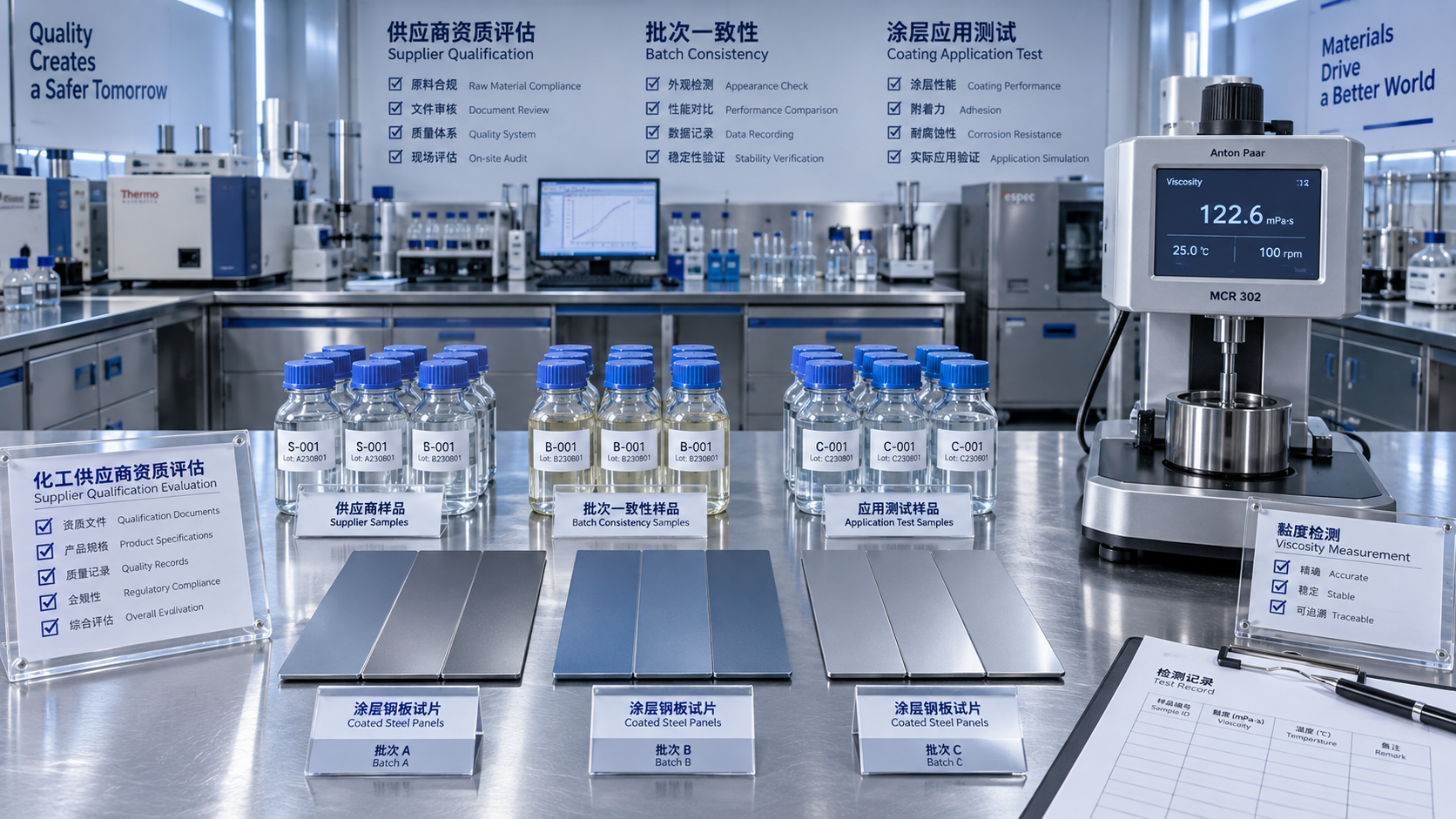
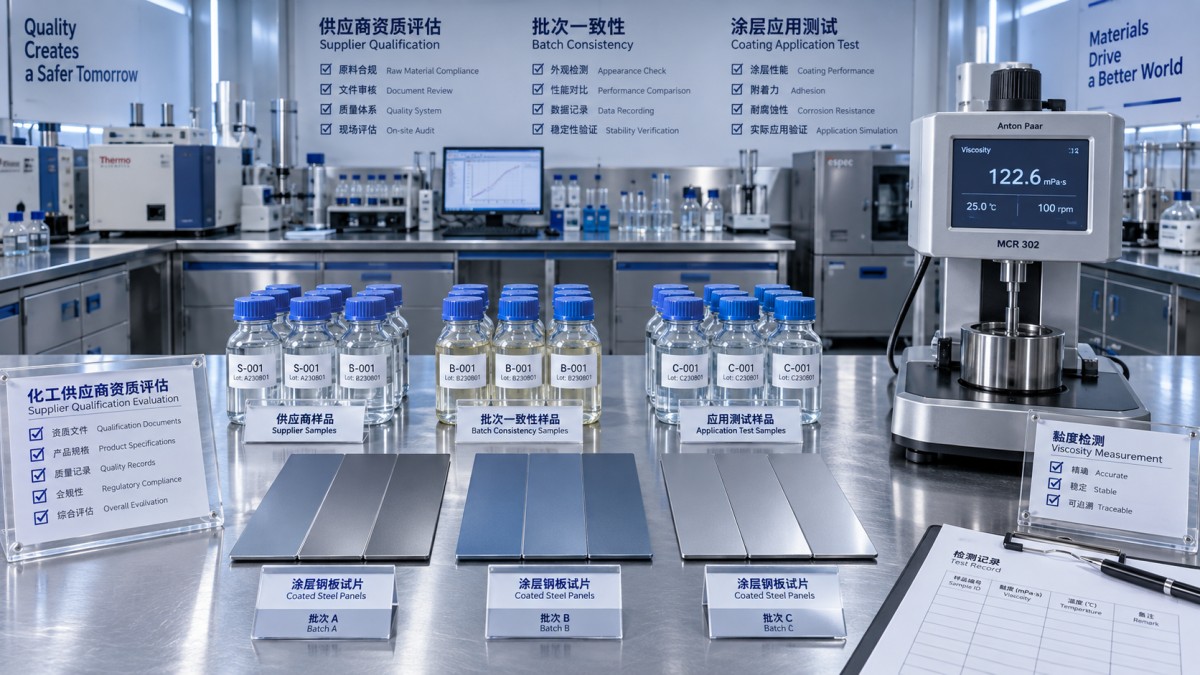
A single approved sample demonstrates that the supplier can produce acceptable material once. Batch consistency requires evidence from separate production runs, preferably spanning different production dates and raw material lots.
Request certificates of analysis showing actual measurements for properties that influence your process. Depending on the material, these might include solids content, viscosity, moisture, purity, particle size, density, or color. A certificate containing only “pass” entries provides less insight into variation.
Compare test methods and measurement conditions before comparing values. Viscosity results, for example, can change with temperature, instrument, and measurement procedure. Similar numbers measured differently may not indicate equivalent behavior.
Watch for results that repeatedly approach a specification limit or gradually move toward one. Every batch may technically pass while the available processing margin narrows. If your production line is sensitive to viscosity or moisture, that trend can matter more than the supplier’s overall pass rate.
Also ask how raw material changes, process adjustments, and manufacturing transfers are controlled. Agree on which changes require notification and which require renewed qualification. Traceability should connect an incoming container to its batch, manufacturing site, release results, and retained sample.
Which compliance documents matter, and what do they actually prove?
Separate product compliance, site management, and transport requirements. Each addresses a different question, and none substitutes for application testing.
A safety data sheet explains hazards and handling precautions. It does not establish coating durability or automatically demonstrate that every intended use is permitted. A quality management certificate describes a management system within its stated scope; it does not certify that your particular batch meets your specification.
For the destination and application, establish which substance restrictions, chemical inventory obligations, labeling rules, and sector-specific requirements apply. Then obtain declarations tied to the exact product identity and responsible legal entity. Some uses also require composition information beyond what appears in the safety data sheet.
Check that product names and identifiers agree across the quotation, specification, safety documentation, and shipment paperwork. If confidential formulation details are necessary for assessment, use a confidentiality arrangement or an appropriate third-party review process.
Where certificates are relevant, examine the issuing organization, validity, covered site, and scope. A document for a group headquarters or another factory offers limited evidence about the facility making your material.
How can you assess capacity and delivery reliability?
Ask about available capacity for the proposed grade, including constraints shared with other products. A factory’s total output says little about access to a particular reactor, blending line, packaging format, or quality release process.
Map the order cycle from purchase acceptance through raw material procurement, production, testing, packing, export clearance, and transport. Request historical shipment dates or anonymized order records that show both typical lead times and variation. A quoted lead time may exclude stages that matter to your production schedule.
Identify dependencies on imported feedstocks, utilities, port access, and specialist packaging. These dependencies can create delays even when the factory itself operates reliably. Ask how the supplier handles shortages and whether substitute inputs trigger a controlled change process.
Storage and transport conditions deserve separate attention. Heat, moisture exposure, or prolonged transit can affect some chemical products. Assess packaging compatibility, closure integrity, shelf life remaining on arrival, and any temperature controls required along the route.
An alternative supplier may offer limited resilience if it relies on the same upstream producer or transport corridor as the existing source. Compare those dependencies before treating the new supply route as independent.
How do you tell whether supplier evidence is credible?
Look for evidence that is current, traceable, and consistent across independent records. A detailed report is more useful when its sample identity, test method, conditions, and issuing laboratory are clear.
Match batch numbers on certificates to container labels and shipment records. Match manufacturing addresses to site documents. Confirm whether the business supplying the quotation operates the factory or purchases from another manufacturer.
A distributor can be a suitable partner when responsibilities are clear. Establish who controls quality release, provides technical support, manages complaints, and authorizes changes. Access to the original manufacturer’s evidence becomes especially valuable when resolving a defect.
Warning signs include unexplained document inconsistencies, unsupported equivalence claims, and reluctance to define acceptance limits. Identical reported measurements across many batches also deserve examination: they may reflect rounding or a reporting convention, but they provide little visibility into actual variation.
Market intelligence from sources such as TradeNexus Edge can provide context on supply chain exposure and alternative sourcing options. Supplier approval still depends on evidence tied to the specific material, site, and application.
What should a qualification trial include?
Use the trial to answer unresolved questions rather than merely reproduce the supplier’s demonstration. Agree on acceptance criteria before testing, including which failures would prevent approval.
- Screen representative material. Check incoming properties and formulation compatibility using agreed methods.
- Test under relevant application conditions. Use the intended substrate, preparation, equipment, film thickness, and cure schedule.
- Assess service performance. Select tests that reflect expected exposure, such as adhesion, chemical resistance, flexibility, or corrosion protection.
- Run a controlled production trial. Record application behavior, defects, throughput, cleaning requirements, and rework.
- Check repeatability. Evaluate material from another production batch before expanding approval.
Use the existing approved material as a reference where practical. Apply both candidates under comparable conditions so that preparation or curing differences do not obscure the comparison.
Accelerated testing can reveal weaknesses and support comparison, but its relevance depends on the failure mechanism and intended environment. A strong result in one test does not establish performance under every service condition.
How should price and risk be weighed together?
Compare the cost of achieving an acceptable result, not just the price per kilogram. Include freight, duties, packaging, usable yield, application consumption, cure energy, inventory, waste, and qualification work.
For coatings, lower solids content may require more supplied material to reach the required dry film thickness. A different cure schedule may increase energy use or reduce throughput. For raw materials, a cheaper replacement may require additional additives or processing. These effects can outweigh a lower purchase price.
Keep mandatory conditions separate from preferences. Legal supply requirements, essential performance, traceability, and critical delivery needs should act as approval gates. Price, payment terms, flexibility, and support can then distinguish candidates that pass those gates.
This prevents a weighted score from allowing a low price to compensate for an unacceptable technical or compliance gap.
Can a supplier be approved for only part of the requirement?
Yes. Approval can be limited to a defined grade, site, application, or operating range. A coating that performs adequately indoors may lack sufficient evidence for exterior exposure. A source may also be suitable for routine demand while having insufficient capacity for emergency replenishment.
Record those limits in the purchasing specification and approval record. Include permitted manufacturing sites, packaging, delivery conditions, change notification obligations, and the evidence required to expand approval.
For the first commercial orders, connect incoming inspection results with production observations and any complaints. That feedback shows whether the qualified performance carries through to regular supply. Expansion should follow demonstrated consistency within the agreed conditions, with a clear route for investigating and containing any batch that falls outside them.
Deep Dive
Related Intelligence
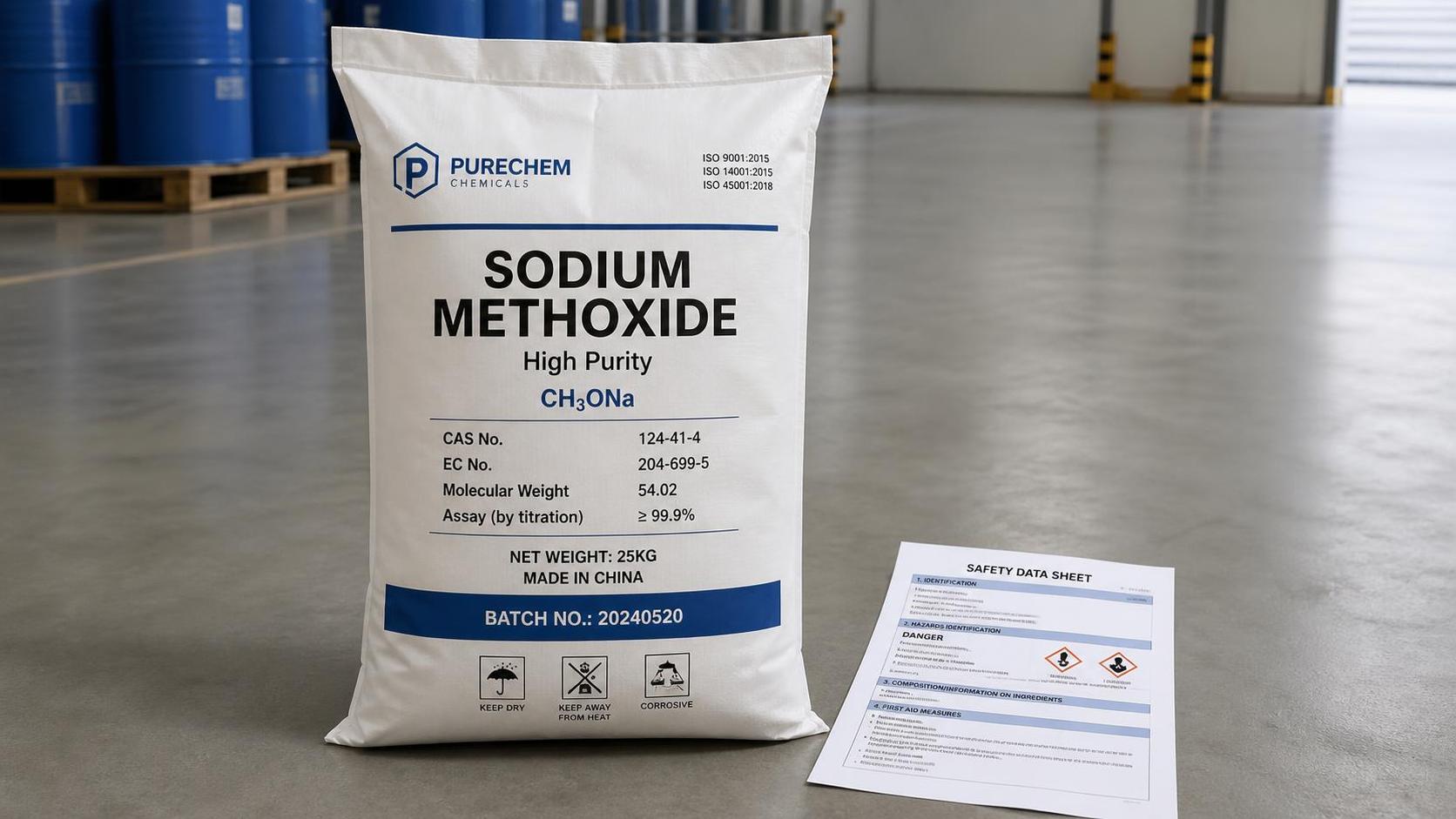
 Specialty ChemicalsSodium Methoxide Selection: How Chemical Buyers Reduce Specification and Handling RiskAnalyst:Lead Materials Scientist
 Specialty ChemicalsHow Corporate Case Studies Reveal Real-World Challenges in Adopting Specialty Chemicals for Food SafetyAnalyst:Lead Materials Scientist
 Specialty ChemicalsCan Brand Elevation Tactics Reduce Customer Acquisition Cost for Specialty Chemicals in Organic Food Production?Analyst:Lead Materials Scientist