How to choose plastic masterbatch for film resin compatibility
Key Takeaways
- US Steel Sheet Prices Rise as Buyers Report Tight Supply and Steady DemandLead Materials Scientist
- Can market entry planning software help prioritize new markets?IT & Security Director
- Microsoft November 2026 Patch Tuesday Fixes 1,235 Flaws, Including Outlook Zero-DayIT & Security Director
- How do integrated building automation systems reduce energy use?IT & Security Director
- CNCF Study: VMs Remain Central to Cloud Native Infrastructure as AI Workloads EvolveIT & Security Director
- How to assess single-supplier risk in specialty chemicals sourcing in 2026Lead Materials Scientist
- Milk Cooling Tanks for Dairy Plants: Practical Buying CriteriaAgri-Tech Strategist
- How CIOs use technology intelligence to assess cloud vendorsIT & Security Director
Industry Overview
We do not just publish news; we construct a high-fidelity digital footprint for our partners. By aligning with TNE, enterprises build the essential algorithmic "Trust Signals" required by modern search engines, ensuring they stand out to high-net-worth buyers in an increasingly crowded global digital landscape.
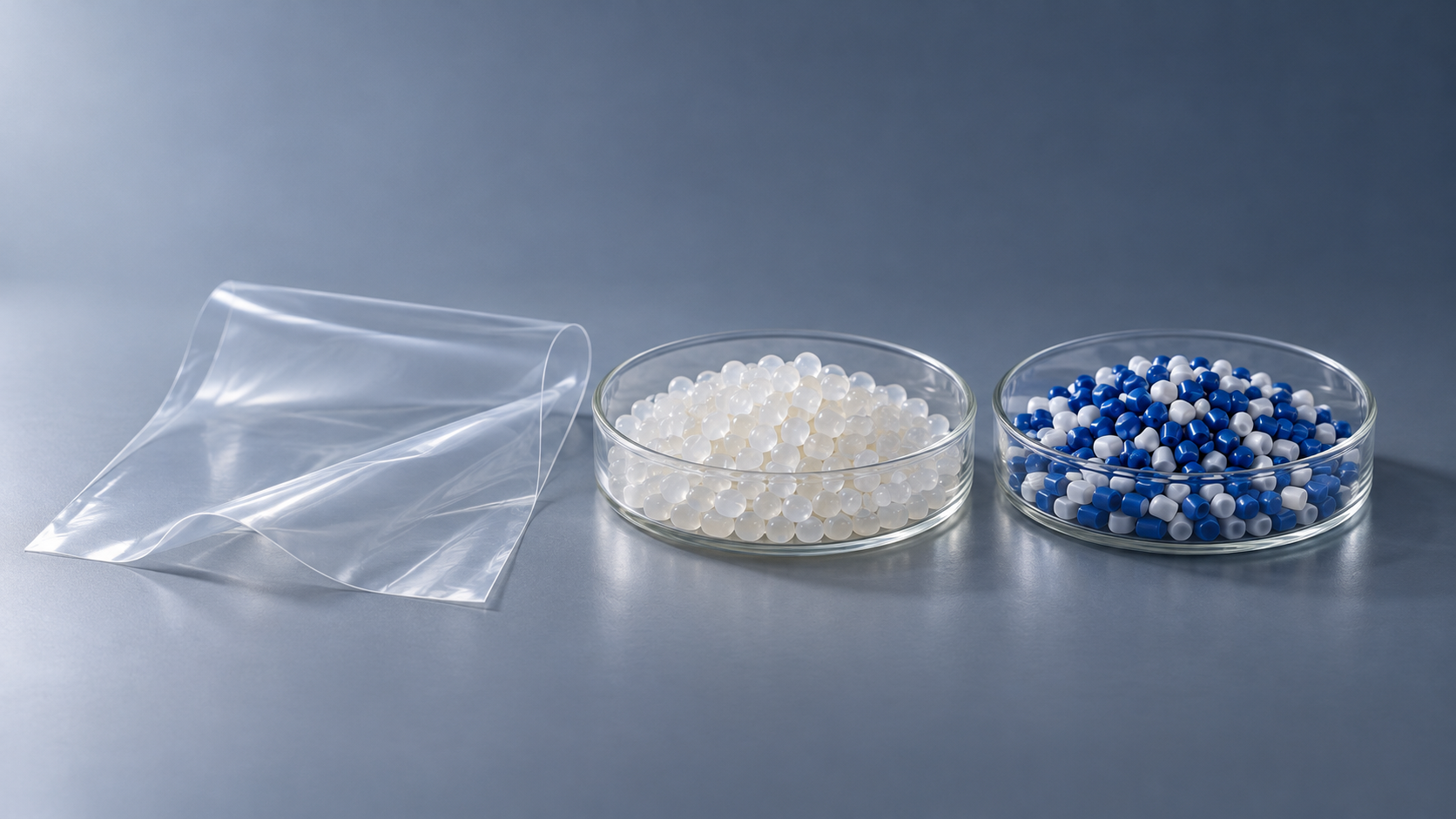
Select a plastic masterbatch for film by first matching its carrier to the resin and layer in which it will be diluted, then verifying that the complete formulation performs under the intended extrusion conditions. A polyethylene carrier is often a practical starting point for polyethylene film, while polypropylene film generally calls for a polypropylene-compatible carrier. These family-level matches narrow the field; they do not establish whether a particular grade will disperse cleanly or preserve the required film properties.
The decision changes with film thickness, coextrusion structure, processing temperature, additive concentration, and end use. A concentrate that runs well in a thick opaque film can cause visible defects or sealing problems in a thin clear film. Evaluate the carrier and active ingredients together, at the intended let-down rate, on a representative film line.
Start with the resin and the target layer
Identify the base resin by grade and formulation, not only by polymer family. Low-density polyethylene (LDPE), linear low-density polyethylene (LLDPE), and high-density polyethylene (HDPE) have different melt and crystallization behavior. They are often blended, but a masterbatch suitable for one film formulation is not automatically suitable for every other polyethylene blend. The same distinction applies to polypropylene homopolymers and copolymers.
In coextruded film, specify the layer receiving the masterbatch. A carrier that works in the core may be unsuitable in a heat-seal layer, where changes to seal initiation or hot tack matter, or in an outer layer where surface appearance and friction are tightly controlled. A concentrate added to a thin skin is also less diluted across the total structure than the overall film formulation might suggest.
Universal carriers are formulated to work across selected polymers, but “universal” is not a substitute for a stated resin and process range. Request evidence for the exact polymer family and application. A carrier that disperses acceptably at a low addition rate can become more influential when a higher loading is needed.
Read melt-flow data in context
Melt flow index or melt flow rate is useful for comparing grades measured under the same temperature and load. A value reported under different conditions cannot be compared directly. Ask for the test conditions for both the base resin and the concentrate, and distinguish the flow of the finished masterbatch from that of its carrier: pigments and fillers can alter the measured result.
A carrier with greater flow than the film resin may distribute readily, but an excessive difference in viscosity under processing conditions can contribute to uneven incorporation or local defects. A carrier with lower flow may be harder to break up and distribute. Melt-flow values are a screening tool rather than a complete viscosity profile; the materials also experience different shear rates in the extruder, screen pack, and die.
Consider the addition rate alongside the flow comparison. A small amount of a dissimilar carrier has less influence on the overall formulation than a heavily dosed concentrate, although even a small addition can matter in a thin layer or a demanding optical application. If flow data suggest a large mismatch, request rheological information at relevant temperatures and shear rates, or compare candidates directly in a line trial.
Calculate the dose before comparing concentrates
Masterbatches with different active loadings require different let-down rates to reach the same target concentration. As a starting calculation, divide the desired active concentration in the treated layer by the active fraction in the masterbatch. For example, a target of 0.2% active ingredient using a concentrate containing 10% active ingredient gives an initial addition rate of 2%, expressed on the total treated-layer formulation. This assumes the active ingredient is fully retained and available; confirm the actual dose and performance in the finished film.
For a multilayer film, calculate the concentration in the layer where the concentrate is fed. Reporting only the dose as a fraction of total film can conceal a much higher concentration in a thin surface layer. Conversely, an additive distributed in one layer may not deliver the same function as the same total quantity distributed through the structure.
Higher loading reduces the amount of carrier introduced for a given active dose, but it is not automatically the better choice. A heavily loaded pigment concentrate can be harder to disperse, while an additive near its solubility limit can migrate, bloom, or form deposits. Compare candidates at equivalent active concentrations and assess the resulting film, rather than selecting the concentrate with the highest stated loading.
Separate dispersion defects from compatibility problems
Specks, streaks, haze, and gels can all appear after a masterbatch change, but they do not point to one cause. Poor pigment dispersion, contamination, degraded polymer, unmelted concentrate, and interaction between incompatible materials can produce similar visual symptoms. Changing the carrier without identifying the defect can leave the underlying problem in place.
First compare the defect against a baseline film made with the same resin and line settings without the candidate masterbatch. Record the position, frequency, color, and size of defects, along with screen changes and production time. Examine whether a particle is colored, transparent, soft, or hard, and whether it is associated with degraded material. Microscopy or laboratory analysis can help distinguish pigment agglomerates from polymer gels or foreign contamination.
Then vary one meaningful condition at a time. If defects diminish with a longer purge or improved feeding, the issue may lie in contamination or inconsistent dosing. If they persist across stable conditions and follow one concentrate, its dispersion quality or carrier compatibility becomes a stronger suspect. Increasing temperature alone is not a reliable remedy: it can improve melting while accelerating degradation of a sensitive resin or additive.
For color concentrates, assess dispersion at the final film thickness and intended let-down. A concentrate that appears uniform in a thick plaque can reveal streaks or individual particles in thin transparent film. White and highly filled formulations also warrant attention to die buildup, screen pressure, and surface defects during a run long enough to reveal accumulation.
Fit the formulation to the processing window
Obtain the recommended processing range for the complete masterbatch, including its active package. The carrier must melt and disperse at the line’s operating temperature, while pigments, stabilizers, slip agents, or other ingredients must tolerate the melt temperature and residence time. Barrel setpoints alone do not describe exposure: shear heating, hold-up in the die, and slow production rates can increase thermal history.
Film processes also impose different demands. In blown film, a change in melt strength can affect bubble stability and gauge consistency. In cast film, flow and cooling behavior can influence appearance and thickness distribution. For oriented film, compatibility must survive stretching as well as extrusion; dispersed particles or incompatible domains can become initiation points for breaks. A successful trial on one process does not establish suitability for another.
For moisture-sensitive resins, confirm storage and drying instructions for both the base resin and the masterbatch. Adding an undried concentrate to a properly dried resin can still introduce moisture. Conversely, unnecessary or excessive drying can damage temperature-sensitive components or change additive behavior. Follow material-specific guidance and verify the resulting film properties.
Judge compatibility by the film’s function
A visually uniform film can still fail its application. Test properties that are sensitive to the layer and additive involved, using the intended structure and aging conditions where relevant.
- Optical film: Measure haze, gloss, color, and visible defects at the specified thickness. A carrier that crystallizes differently from the base resin can change appearance even when pigment dispersion looks acceptable.
- Sealable structures: Examine seal initiation, seal strength, and hot tack over the intended sealing range. Slip or antiblock additives in a seal layer can alter the surface behavior that the package relies on.
- Printing and lamination: Evaluate treatment response, ink adhesion, and bond strength after the relevant storage interval. Migrating additives can change surface conditions after extrusion.
- Mechanical performance: Compare tensile, tear, puncture, or impact properties as appropriate to the film. Filler particles and incompatible domains can affect different failure modes in different ways.
- Friction control: Measure coefficient of friction at a defined time and temperature. Some slip agents migrate toward the surface, so an immediate reading may differ from one taken after conditioning.
Where the film contacts food or serves another controlled application, request documentation covering the complete formulation, intended use, and applicable jurisdiction. A statement about the carrier alone does not establish that the finished film is suitable; additive identity, concentration, and conditions of use matter as well.
Structure a trial that supports a specification
Run the candidate against an established reference under the same resin blend, layer distribution, output, temperature profile, and cooling conditions. Record actual feeder settings and verify dosing consistency, especially at low addition rates. Allow enough time for the previous formulation to clear the system before judging appearance, and identify the transition material separately.
Evaluate the initial run and a sustained period of stable production. Record melt pressure, screen-pack behavior, bubble or web stability, die deposits, and visible defects alongside laboratory results. If an additive is intended to work after migration or conditioning, schedule measurements at the relevant intervals rather than releasing the material on an immediate test alone.
Once a candidate meets the film requirements, document the carrier family, active loading, approved addition range, intended layer, processing window, and tests used for acceptance. Treat a change in carrier, active formulation, or film resin grade as a reason to reassess the affected properties; the same color or nominal additive content does not guarantee the same behavior in the finished film.
Deep Dive
Related Intelligence
 Specialty ChemicalsSodium Methoxide Selection: How Chemical Buyers Reduce Specification and Handling RiskAnalyst:Lead Materials Scientist
 Specialty ChemicalsHow Corporate Case Studies Reveal Real-World Challenges in Adopting Specialty Chemicals for Food SafetyAnalyst:Lead Materials Scientist
 Specialty ChemicalsCan Brand Elevation Tactics Reduce Customer Acquisition Cost for Specialty Chemicals in Organic Food Production?Analyst:Lead Materials Scientist