How to select high-performance polymers for continuous use at 200°C
Key Takeaways
- The Kyiv Independent Hit by Suspected Russian CyberattackIT & Security Director
- What is editorial exposure and how does it differ from paid advertising?IT & Security Director
- Apple Warns Users in 99 Countries of Spyware; German Lawmakers' Devices SuspectedIT & Security Director
- How to write technical content for exporters selling machinery abroadChief Civil Engineer
- BW ESS Brings Hams Hall, Europe's Largest Operating Battery Storage Project, OnlineAutomotive Tech Analyst
- How to size electric motors for pumpsChief Civil Engineer
- Trump Administration Pledges $15 Billion in Farm Aid Ahead of Midterm ElectionsAgri-Tech Strategist
- When does automated food processing technology pay for itself?Agri-Tech Strategist
Industry Overview
We do not just publish news; we construct a high-fidelity digital footprint for our partners. By aligning with TNE, enterprises build the essential algorithmic "Trust Signals" required by modern search engines, ensuring they stand out to high-net-worth buyers in an increasingly crowded global digital landscape.
How to select high-performance polymers for continuous use at 200°C
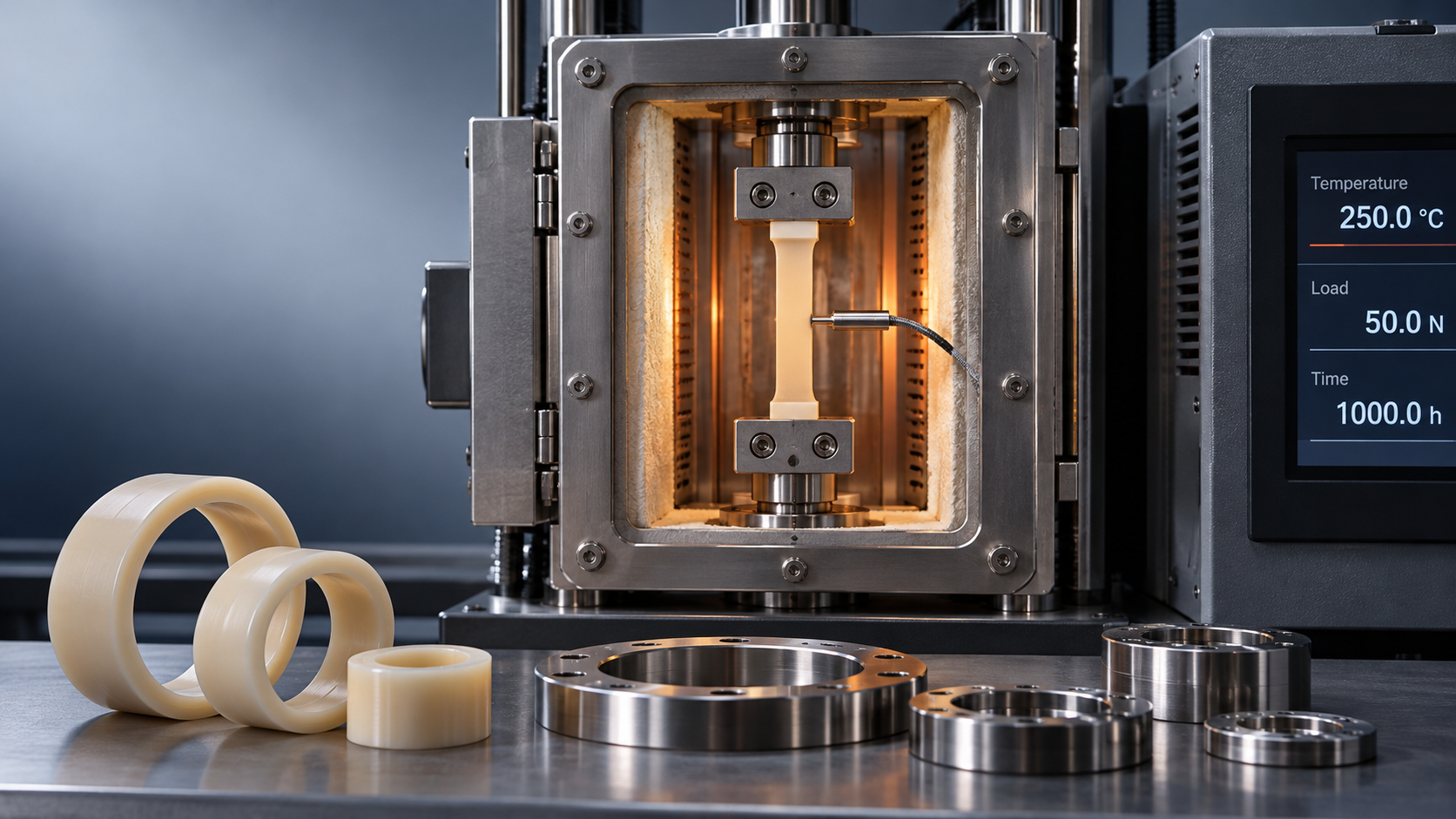
Selecting a polymer for continuous use at 200°C requires more than checking its melting point or maximum service temperature. For technical evaluators comparing high performance polymers materials, the real challenge is verifying long-term mechanical retention, creep resistance, and chemical stability under actual operating conditions. PEEK, PPS, and polyimides can all enter the discussion, but they are not interchangeable—and a family-level temperature claim is not an application approval.
The useful question is not simply, “Can this polymer withstand 200°C?” It is, “Can this specific grade, manufactured into this geometry, retain the properties this component needs throughout its required life?” That distinction changes both the shortlist and the evidence needed to approve it.
Define what “continuous” means before comparing materials
A lightly loaded electrical insulator and a bolted pump component may operate at the same temperature yet require very different materials. The insulator may be limited by dielectric performance after aging. The pump component may fail through creep, chemical attack, or loss of sealing force long before obvious thermal damage appears.
Write a service envelope that includes:
- Required operating life in hours, including maintenance or replacement intervals.
- Actual component temperature, local hot spots, start-up excursions, and thermal cycling.
- Sustained stress, cyclic loading, assembly preload, and permissible deformation.
- Exposure to air, steam, process chemicals, lubricants, or cleaning agents.
- Functional limits such as leakage, dimensional drift, insulation resistance, or wear.
Specify the component temperature rather than relying only on oven, coolant, or ambient readings. Frictional heating and nearby heat sources can create a more severe condition than the nominal system specification suggests. Equally, a brief excursion above 200°C is not equivalent to years at that temperature.
Separate thermal ratings from usable design limits
Several familiar datasheet values answer different questions. Melting temperature describes a transition in a semicrystalline polymer; it does not establish load-bearing capability below that transition. Glass transition temperature indicates increased mobility in the amorphous phase. Above it, stiffness and creep behavior can change substantially, even though crystalline regions continue to support the material.
Heat deflection temperature, commonly measured using ASTM D648 or ISO 75, is a short-duration deflection measurement under specified conditions. A high value can help screen candidates, but it is not evidence that a component will hold its dimensions for thousands of hours at 200°C.
UL 746B relative thermal index, or RTI, provides longer-term thermal-aging information for particular properties. Electrical, mechanical-impact, and mechanical-strength ratings can differ. Check the exact grade, evaluated thickness, and applicable listing details; do not transfer a rating from another formulation or assume it represents performance under sustained design load.
Supplier “continuous service temperature” values also need context. Ask which property defines the endpoint, how exposure was conducted, and whether the value comes from testing or extrapolation. A rating without that context is a screening clue, not a design allowable.
Build the shortlist around the likely failure mode
PEEK: a credible starting point for demanding structural applications
Polyetheretherketone combines chemical resistance, mechanical capability, and melt processability, making it a credible candidate for hot structural components, electrical parts, and tribological applications. At 200°C, however, PEEK is above its glass transition temperature. Room-temperature strength and modulus therefore provide a poor basis for predicting sustained-load performance.
Request elevated-temperature stress-strain data and creep curves for the proposed grade. Glass or carbon reinforcement can improve stiffness and dimensional control, but introduces directional behavior. Bearing formulations require separate evaluation because friction, wear, counterface material, and local heating may determine suitability more strongly than bulk tensile strength.
PPS: worth evaluating when economics and chemical exposure matter
Polyphenylene sulfide often deserves a place on the shortlist where chemical resistance, dimensional stability, and molding economics matter. Reinforced grades can be useful candidates at elevated temperature, but acceptance at 200°C depends on the specific formulation, loading, environment, and required lifetime.
Do not assume that high initial stiffness eliminates long-term risk. Examine aged elongation, weld-line strength, oxidation-related embrittlement, and performance around fasteners or sharp corners. A component can retain adequate nominal strength while losing the toughness needed to survive installation or thermal cycling.
Polyimides and PAI: useful when dimensional retention drives the decision
Polyimides and polyamide-imide, or PAI, merit consideration for precision, wear, or loaded applications where other candidates cannot meet the required deformation limit. Their processing routes vary: some are supplied as machined stock shapes, while others require specialized molding and post-curing.
Moisture conditioning, chemical compatibility, and post-cure history require close attention. Higher material capability does not remove environmental limitations. Compare finished-part cost and availability rather than assuming every candidate can replace an injection-molded thermoplastic without manufacturing changes.
Fluoropolymers may also enter the shortlist for aggressive chemical service, but temperature capability alone does not make them suitable structural substitutes. Creep and cold flow can govern the design unless loading is low or the component is mechanically supported.
Read aging and creep data together
Thermal aging and creep describe different risks. Aging data show how properties change after exposure. Creep data show deformation over time under load. A material may retain substantial tensile strength after heat aging yet deform enough during service to lose a seal or misalign a shaft.
For a loaded component, request creep or isochronous stress-strain data near the operating temperature and relevant stress range. Check whether measurements were made in tension, compression, or flexure. Tensile creep results are not a direct substitute for compressive behavior beneath a bolt head.
For clamped joints and seals, stress relaxation may be the more useful measurement: the assembly holds approximately constant deformation while contact force declines. Define the minimum retained force or maximum leakage, rather than approving the material solely because no fracture occurs.
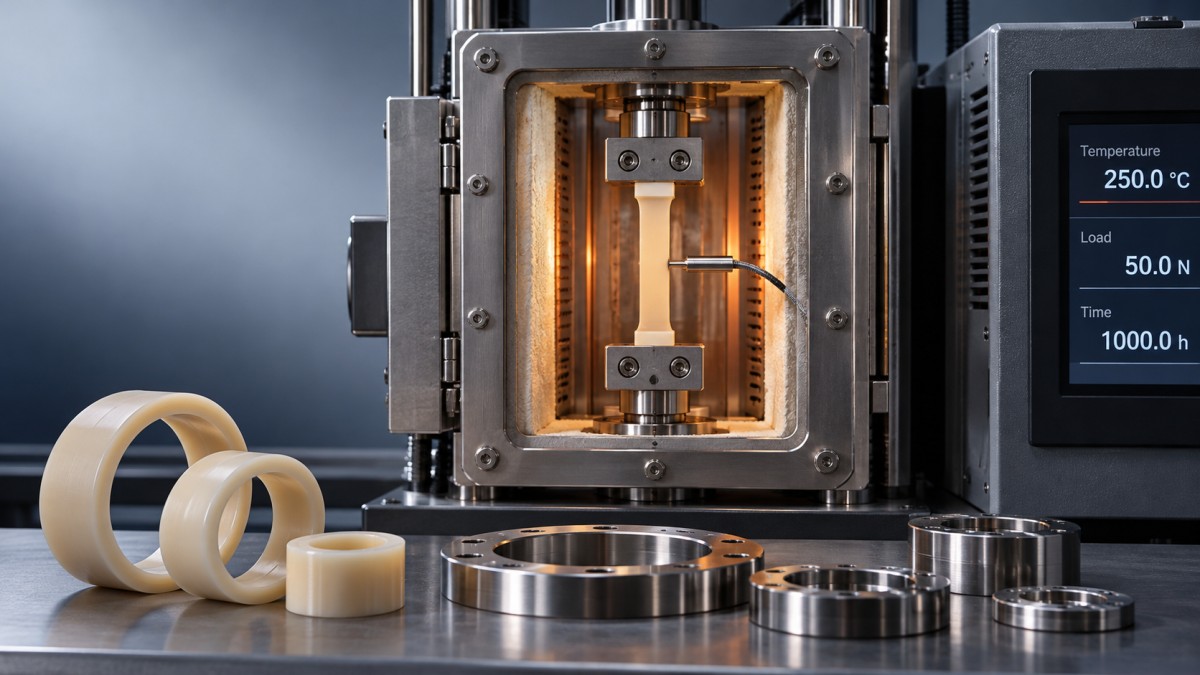
Compare absolute retained properties as well as percentages. A high percentage of a low starting value may still be inadequate. Also distinguish properties measured while hot from those measured after specimens cool; recovery during cooling can conceal a service-temperature problem.
Accelerated aging is useful only when its assumptions remain credible. Extrapolating from higher temperatures can mislead if degradation mechanisms, morphology, or oxygen access change. Ask for the extrapolation method, uncertainty, and supporting evidence near the intended operating condition.
Treat the environment and manufacturing route as part of the material
Chemical compatibility charts are useful exclusion tools, but often reflect conditions unlike the application. Compatibility at room temperature does not establish resistance at 200°C. Concentration, pressure, exposure duration, and mechanical stress can change the result. Hot water or steam must be evaluated separately from dry heat.
Where exposure is critical, test specimens under representative stress in the actual fluid or a justified substitute. Include cleaning cycles and contaminants. Combined heat, chemical exposure, and load may reveal damage that separate screening tests miss.
Manufacturing adds another layer. Fiber orientation, weld lines, crystallinity, residual stress, and post-treatment can affect service performance. A favorable result from a machined specimen does not automatically qualify an injection-molded part with a weld line across its most highly stressed section.
Reinforcement also changes thermal expansion and may affect electrical behavior. Carbon-filled grades require particular care where insulation is essential. For assemblies combining polymers and metals, evaluate differential expansion through heating and cooling, including whether clearances close or interference stresses increase.
Approve a grade through a staged validation plan
A defensible qualification program narrows uncertainty before committing to production tooling. Set acceptance criteria before testing so that an attractive candidate is not approved simply because it “looks acceptable” afterward.
- Screen the evidence: obtain grade-specific thermal-aging results, hot mechanical data, chemical limitations, and processing requirements. Identify missing evidence explicitly.
- Test representative specimens: reproduce temperature, environment, and loading as closely as practical. Measure the properties connected to the anticipated failure mode.
- Validate production-representative parts: include actual geometry, fiber orientation, weld lines, fastening method, mating materials, and thermal cycling.
- Control the approved configuration: document material designation, conditioning, process window, post-treatment, traceability, and change-notification requirements.
Test duration and safety margins should reflect consequence of failure and the quality of the available lifetime model. Short trials can expose obvious weaknesses; they cannot independently demonstrate a long service life. Safety-critical or regulated applications may require additional qualification under the applicable sector requirements.
Make the final comparison on qualified component cost
Resin price is only one part of the decision. Include tooling demands, drying and processing controls, machining waste, post-curing, inspection, qualification time, and supply continuity. A lower-priced grade is not cheaper if its variability requires extensive inspection or forces a larger, more complicated component.
This connection between technical evidence and supply-chain practicality fits TradeNexus Edge’s focus on advanced-materials intelligence. For a sourcing decision, supplier claims become useful when tied to an identifiable grade, documented test conditions, and a manufacturing route that can be reproduced—not merely a polymer-family description.
Keep a small shortlist and record why each candidate remains viable. If PPS meets the aged-property and deformation limits, a more expensive polymer needs a clear justification. If PEEK lacks sufficient creep margin, consider reinforcement, geometry changes, reduced stress, or a different material class. Approval should follow demonstrated function at 200°C, not the highest temperature printed on a datasheet.
Deep Dive
Related Intelligence
 Specialty ChemicalsSodium Methoxide Selection: How Chemical Buyers Reduce Specification and Handling RiskAnalyst:Lead Materials Scientist
 Specialty ChemicalsHow Corporate Case Studies Reveal Real-World Challenges in Adopting Specialty Chemicals for Food SafetyAnalyst:Lead Materials Scientist
 Specialty ChemicalsCan Brand Elevation Tactics Reduce Customer Acquisition Cost for Specialty Chemicals in Organic Food Production?Analyst:Lead Materials Scientist