How Do Buyers Assess Industrial Coatings for Application Fit?
Key Takeaways
- Swiss Steel Explores Canadian Supply of 1 Million Tonnes of Low-Carbon Steel a YearLead Materials Scientist
- How organic farm management solutions streamline audit preparationAgri-Tech Strategist
- How to analyze cybersecurity controls for regulatory complianceIT & Security Director
- How Do We Verify Diagnostic Tool Support for a Mixed-Brand Fleet?Automotive Tech Analyst
- Is Excavator Rental Cheaper Than Buying for a Six-Month Plant Expansion?Chief Civil Engineer
- Which Supplier Tests Check Hydroponic Channels for Harmful Leaching?Agri-Tech Strategist
- Can Batching Plants Reuse Process Water Without Affecting Admixtures?Chief Civil Engineer
- How Do You Fix Missing Material Specs in a BIM Handover Model?Chief Civil Engineer
Industry Overview
We do not just publish news; we construct a high-fidelity digital footprint for our partners. By aligning with TNE, enterprises build the essential algorithmic "Trust Signals" required by modern search engines, ensuring they stand out to high-net-worth buyers in an increasingly crowded global digital landscape.
How Do Buyers Assess Industrial Coatings for Application Fit?
Choosing industrial coatings requires more than comparing price and technical data sheets. Buyers need to match coating chemistry to substrate, service conditions, surface preparation, and application equipment while checking the regulatory requirements relevant to their markets. Knowing how to verify a chemical supplier meets REACH and TSCA standards is part of that assessment, alongside evaluating adhesion, corrosion resistance, curing conditions, and supplier traceability.
The central question is not whether a coating is “high performance.” It is whether the complete coating system can be applied consistently to the actual component and withstand its expected exposure. A strong laboratory result offers little protection when the production line cannot reproduce the preparation, film thickness, or cure conditions behind it.
Define the exposure before choosing the chemistry
A useful specification starts with the asset, not the supplier catalogue. Record the substrate, operating environment, required service life, maintenance access, and consequences of failure. Exterior structural steel, a food-processing floor, and an electric vehicle battery enclosure may all need protective coatings, but their acceptance criteria will differ substantially.
Exposure descriptions should be specific. “Chemical resistant” is incomplete without the chemical identity, concentration, temperature, contact duration, and cleaning regime. Intermittent splashes are not equivalent to continuous immersion. Likewise, continuous operating temperature and short temperature excursions should be stated separately.
For atmospheric corrosion protection of steel structures, the ISO 12944 series provides a framework for discussing environments, protective paint systems, and durability. Its durability categories concern expected time to first major maintenance; they are not warranty periods. Other applications may require sector-specific specifications rather than this framework.
Build the requirement around likely failure modes: corrosion at edges, loss of adhesion, ultraviolet degradation, abrasion, chemical softening, or cracking under thermal cycling. This prevents a supplier from answering the wrong question with an impressive but irrelevant test report.
Compare coating systems, not isolated resin labels
Epoxy, polyurethane, acrylic, and powder coatings describe broad families, not guaranteed performance levels. Formulation, pigments, crosslinking, film thickness, and substrate preparation can change the outcome considerably. The buyer should assess the proposed primer, intermediate coat, and topcoat together, including their compatibility and recoating limits.
Epoxies are often considered for adhesion and chemical resistance, but many conventional epoxy finishes chalk under ultraviolet exposure. Where outdoor appearance matters, an appropriate topcoat may be needed. Polyurethane topcoats can offer weathering performance, although not every formulation provides the same resistance, and isocyanate-containing systems require suitable exposure controls.
Powder coatings can suit factory production when components tolerate the required cure cycle. They are not automatically suitable for heat-sensitive assemblies or geometries that complicate coverage. Waterborne coatings may reduce solvent use, but their drying behaviour still depends on temperature, humidity, airflow, and formulation.
Avoid choosing by chemistry alone. Ask suppliers to explain why their proposed system fits the exposure and manufacturing constraints, and where it should not be used. A technically useful proposal states limitations rather than treating every application as interchangeable.
Surface preparation and curing decide whether the system is practical
Substrate condition is often the gap between a successful qualification test and disappointing field performance. Steel may carry soluble salts, oil, mill scale, or weld residues. Aluminium and galvanized surfaces introduce different adhesion challenges. Plastics may contain mould-release agents or have low surface energy. Each requires a preparation method validated for the selected coating.
Specify both cleanliness and surface profile where relevant. For steel, standards such as ISO 8501-1 help describe visual preparation grades, but visual cleanliness alone does not establish acceptable salt contamination or profile. Those requirements need separate methods and acceptance limits.
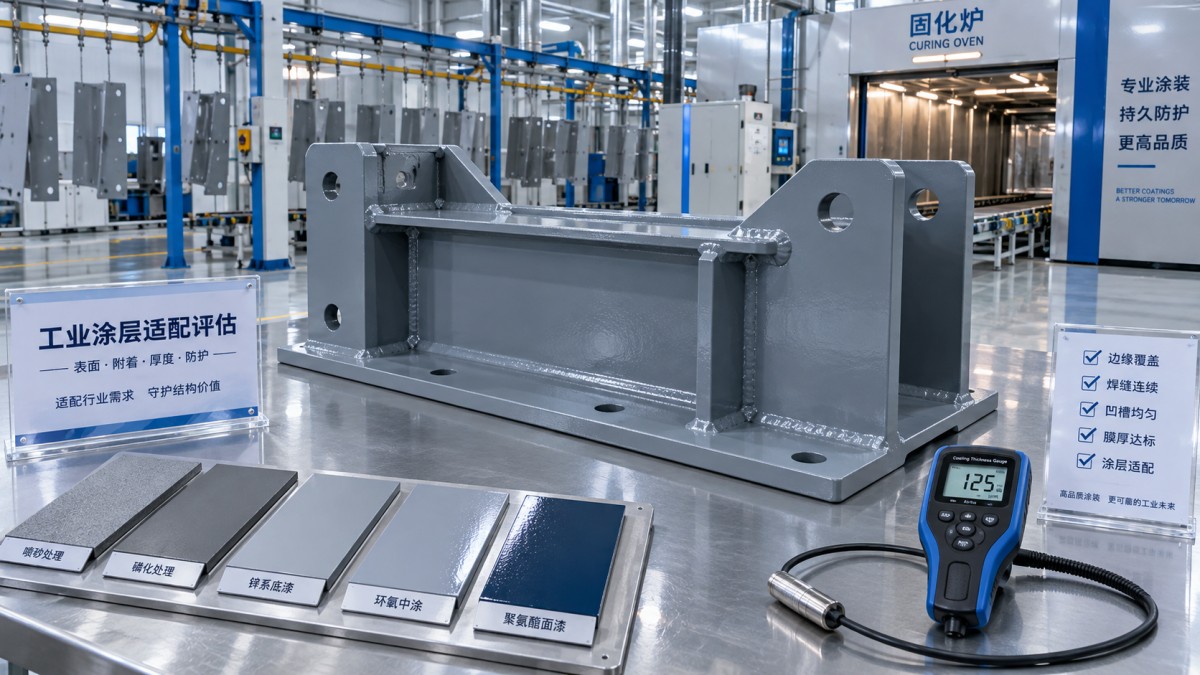
The application trial should follow the actual production sequence: cleaning, preparation, coating, flash-off where required, curing, handling, and inspection. Include difficult features such as sharp edges, recessed areas, welds, and mixed substrates. Flat test panels cannot reveal every coverage problem on a fabricated part.
Check whether the plant can maintain mixing ratios, induction time, pot life, spray conditions, and recoating windows. A coating with a short workable life may create waste or inconsistent results on a slow line. A narrow recoating window can become a scheduling problem when parts wait between process stages.
Cure instructions deserve particular scrutiny. Oven air temperature does not prove that a component reached the required metal temperature for the specified duration. For ambient-cure systems, distinguish handling readiness from full chemical cure. Packing or exposing parts too early can compromise an otherwise suitable system.
Read performance evidence with its test conditions attached
A test result is meaningful only when the method, substrate, preparation, coating system, film thickness, cure, exposure conditions, and acceptance criteria are known. Ask for the full report where the decision warrants it, not merely a summary saying “passed.” Check that the tested formulation matches the product being supplied.
Salt-spray results under ISO 9227 or ASTM B117 can support comparisons under defined conditions, but test hours should not be converted directly into years of field life. Depending on the environment, cyclic corrosion testing, weathering exposure, immersion testing, or documented service experience may provide more relevant evidence.
Adhesion results also need context. Pull-off testing and cross-cut testing assess different aspects of coating behaviour and are not interchangeable. For pull-off results, the failure location matters: separation at the substrate interface, failure within a coating layer, or failure in the test adhesive lead to different interpretations.
Set acceptance criteria before starting trials. Depending on the application, these may include dry-film thickness, appearance, adhesion, cure confirmation, and corrosion or chemical resistance. Use holiday testing only where appropriate for the coating and substrate, with a procedure that avoids damaging the film.
How to verify a chemical supplier meets REACH and TSCA standards
REACH and TSCA are regulatory frameworks, not universal coating certifications. A generic “REACH and TSCA compliant” statement does not establish that a specific formulation can be supplied and used lawfully in every market. Verification must connect the product, relevant substances, supply-chain roles, and intended use.
For the EU market, establish the relevant REACH obligations
Request a current safety data sheet appropriate to the destination market and a product-specific regulatory declaration. Under REACH, registration generally concerns substances rather than the finished coating mixture. Whether registration is required depends on factors including tonnage, supply-chain role, and applicable exemptions.
For non-EU supply, clarify who holds the relevant obligations: the EU importer or, where applicable, an appointed Only Representative. Where registration applies, request confirmation that the relevant substances and supply arrangements are covered. Check that intended uses and operating conditions are addressed where exposure scenarios are required.
Ask separately about applicable Annex XVII restrictions, Annex XIV authorisation requirements, and Candidate List substances. These are different regulatory questions. Candidate List inclusion is not automatically a blanket prohibition, while restrictions may specify concentration limits or prohibited uses. An SDS alone may not disclose everything needed to resolve these questions.
For the United States, check more than Inventory presence
Request confirmation that relevant substances are listed on the TSCA Inventory or covered by an applicable exemption, and that the proposed manufacture, import, and use comply with relevant requirements. Inventory listing does not mean a chemical is approved for unrestricted use or declared safe for every application.
Supplier verification should consider applicable significant new use rules, restrictions, and other substance-specific obligations. Clarify who is responsible for import certification where required. If confidentiality limits ingredient disclosure, consider a confidential review by qualified regulatory personnel rather than accepting an unsupported assurance.
Use current European Chemicals Agency and US Environmental Protection Agency information to cross-check relevant claims. Document the review date and require notification of formulation or regulatory-status changes. REACH and TSCA checks do not replace separate assessment of workplace safety, VOC requirements, food-contact suitability, or sector-specific rules.
Qualify the supplier’s ability to repeat the result
A successful sample is only the beginning. Ask how the supplier controls batch consistency, identifies retained samples, handles nonconforming material, and traces production lots. Confirm which properties appear on the certificate of analysis and whether they are batch-tested results or specification statements.
Change control is especially important. A raw-material substitution can affect application behaviour, cure, colour, or regulatory status without changing the commercial product name. Agree which changes require notification and whether requalification is necessary before altered material enters production.
Compare cost per accepted coated component rather than price per litre or kilogram. Include preparation, material consumption, transfer efficiency, curing energy, labour, rejects, and repair. Shelf life and storage conditions also matter when purchasing volume discounts or shipping across long distances.
TradeNexus Edge’s focus on advanced materials and supply-chain intelligence supports this broader approach: understanding supplier capabilities and market context alongside technical claims. Such intelligence helps identify questions and risks, but it does not replace product-specific testing or regulatory verification.
Make the approval conditional on a controlled trial
Before purchase approval, assemble a qualification file containing the agreed coating system, application procedure, performance evidence, regulatory review, trial results, and change-notification requirements. Record unresolved issues and assign responsibility for closing them.
Run the trial on representative parts using normal equipment and realistic operating conditions. If success requires exceptional preparation or tightly controlled conditions that the plant cannot maintain, the coating is not yet qualified for that process. Approve the combination of coating, substrate, preparation, and application conditions—not simply the product name.
Deep Dive
Related Intelligence
 Industrial CoatingsResin Epoxy CAS 24969-06-0 Procurement: How Buyers Avoid a Costly Formulation MismatchAnalyst:Lead Materials Scientist
 Industrial CoatingsWhy Brand Elevation Strategies Matter More Than Ever for Industrial Coatings Suppliers Targeting EU MarketsAnalyst:Lead Materials Scientist
 Industrial CoatingsWhich Corporate Case Studies Show Measurable ROI from Industrial Coatings Automation in Food Plant Maintenance?Analyst:Lead Materials Scientist