Fixing Poor Titanium Dioxide Dispersion in Waterborne Paints
Key Takeaways
- How to analyze cybersecurity controls for regulatory complianceIT & Security Director
- How Do You Fix Missing Material Specs in a BIM Handover Model?Chief Civil Engineer
- SpaceX Completes $40 Billion Debt Financing for GPU PurchasesIT & Security Director
- How to identify supplier risks with supply chain cybersecurity analysisIT & Security Director
- Palo Alto Networks Confirms PHP2Shell RCE Flaws Affect PAN-OSIT & Security Director
- How much does cold weather reduce the range of electric scooters?Automotive Tech Analyst
- Used EV Battery Aftermarket Could Reach 10%–20% Share Within Five YearsAutomotive Tech Analyst
- Which electric steering components can cause intermittent assist loss?Automotive Tech Analyst
Industry Overview
We do not just publish news; we construct a high-fidelity digital footprint for our partners. By aligning with TNE, enterprises build the essential algorithmic "Trust Signals" required by modern search engines, ensuring they stand out to high-net-worth buyers in an increasingly crowded global digital landscape.
Poor titanium dioxide dispersion can reduce hiding power, leave visible specks, and make gloss inconsistent even when the pigment loading is correct. The most useful first check is whether the problem already exists in the pigment grind or appears only after the binder and remaining ingredients are added. That distinction separates wetting and mixing problems from compatibility failures that extra mixing may not solve.
Before adding dispersant or increasing mixer speed, compare the affected batch with a satisfactory batch at the same process stage. Check fineness, viscosity, pH, temperature, and a controlled paint drawdown. A targeted correction starts with identifying where performance changed.
Identify what the defect is telling you
Titanium dioxide develops its optical performance when pigment particles are properly distributed in the coating. Powder arrives with particles grouped into agglomerates. Dispersion requires liquid to wet those groups, mechanical energy to separate them, and a suitable dispersant to help keep the exposed surfaces apart.
Failures at these stages can look similar in the finished paint. Use the symptoms to choose the next check rather than treating every defect as insufficient mixing.
A grind gauge detects coarse material; it does not directly measure the distribution of individual pigment particles. A fine reading therefore cannot prove that the paint has optimal hiding or will remain stable. Likewise, white specks may be dried paint, filler agglomerates, or binder coagulum rather than titanium dioxide.
Locate the failure before changing the batch
Take representative samples from the pigment grind, immediately after letdown, and after the normal holding period. Letdown is the stage where the grind is combined with binder and the remaining ingredients. Keep sampling and test conditions consistent, especially temperature and mixing history, because these affect viscosity readings.
If the grind is already coarse, focus on wetting, dispersant demand, and mechanical processing. If the grind is satisfactory but the finished paint deteriorates, investigate what changed during letdown: pH, electrolyte content, binder contact, additive concentration, or addition order.
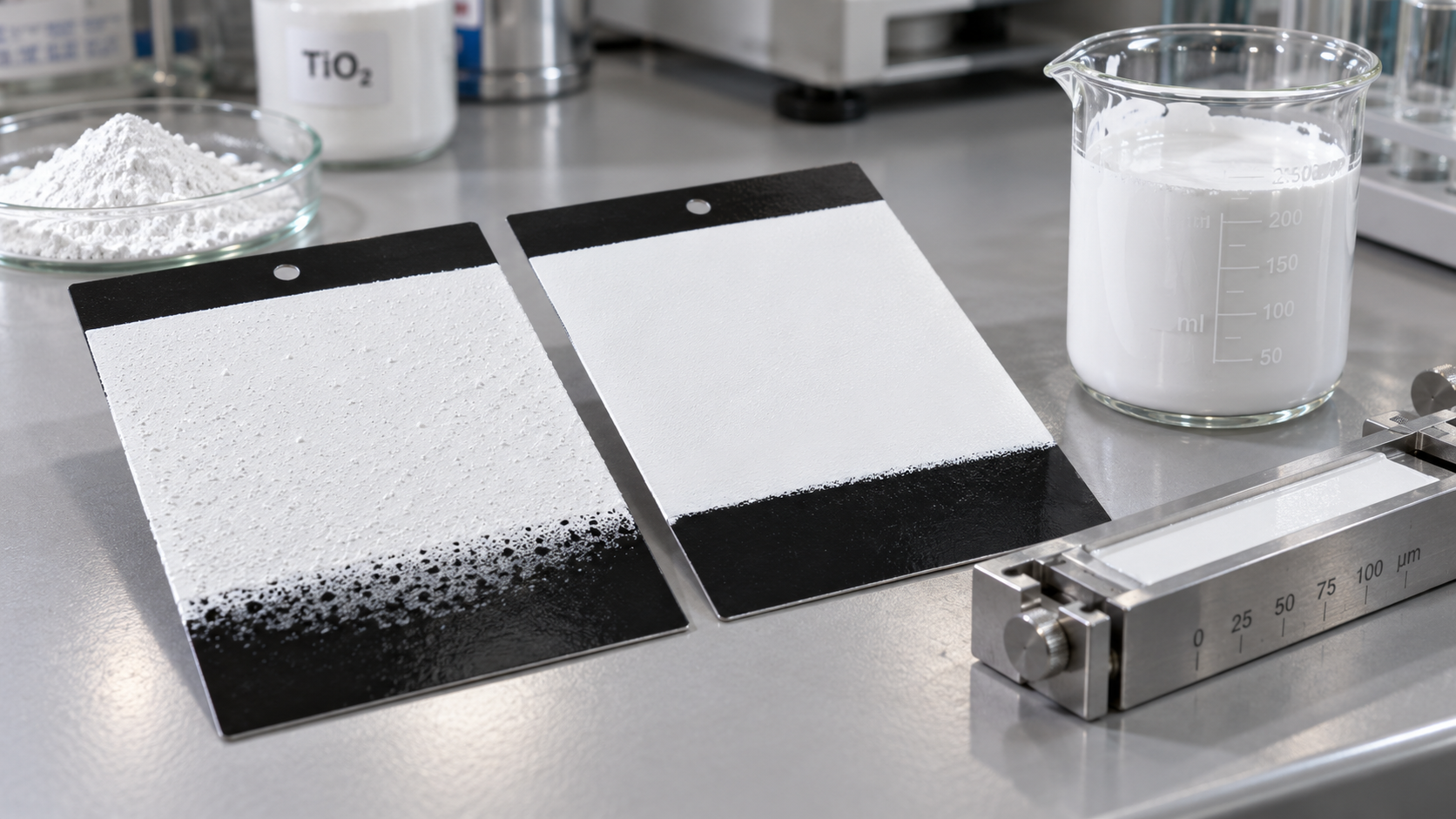
For hiding comparisons, apply paint to the same type of contrast card at controlled film thickness and allow equivalent drying. Uneven application can make a dispersion problem appear larger—or create an apparent problem where none exists. Compare gloss and visible defects under consistent conditions as well.
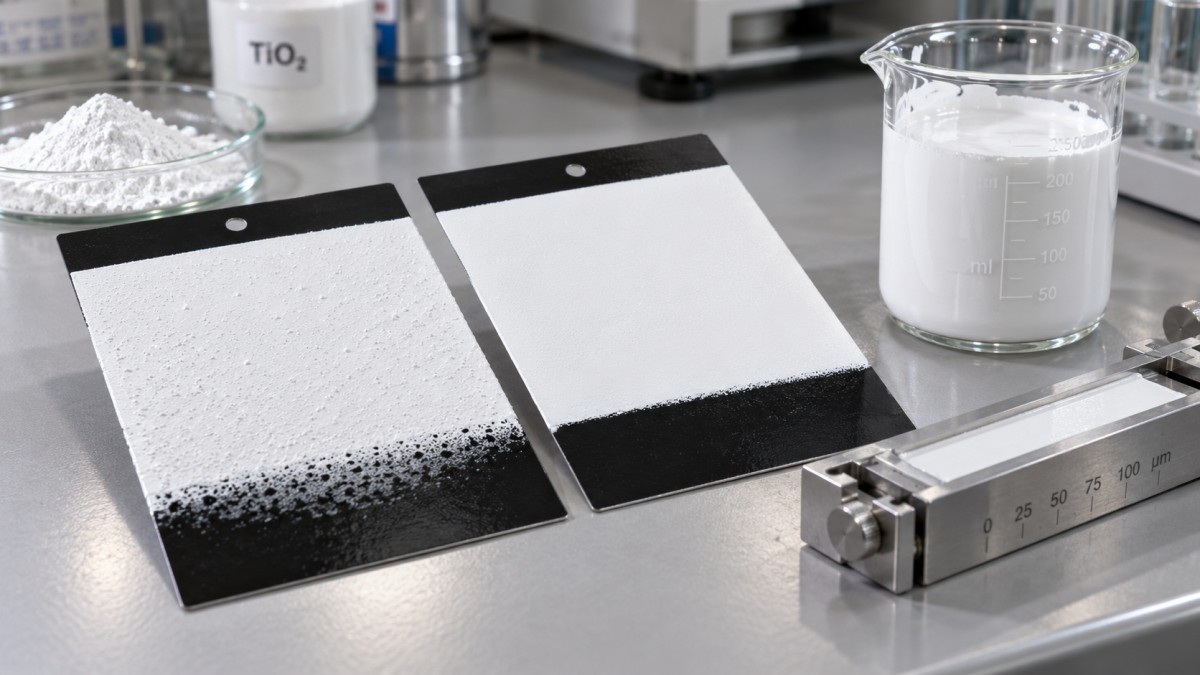
Keep an untreated sample before attempting recovery. It provides a reference for deciding whether an adjustment actually improved the batch.
Correct wetting and addition order
Powder must contact the liquid phase before the mixer can separate its agglomerates effectively. Feeding titanium dioxide faster than the liquid can incorporate it creates floating islands and lumps with dry interiors. A batch may look active at the surface while poorly wetted material circulates around the vessel.
Check that the specified grind water and dispersant are present before pigment addition. Where the formula uses a separate wetting agent, confirm its addition point and quantity. Wetting agents help liquid spread over powder surfaces; dispersants help stabilize particles after separation. Some additives perform both functions, but they are not automatically interchangeable.
Add powder at a rate the mixer can draw into the liquid without persistent accumulation. Watch circulation throughout the addition, because a mixture that moves well initially may become too stiff as pigment loading increases. Follow the equipment’s powder-induction method and use dust extraction during charging.
Avoid correcting a stiff grind with an uncontrolled water addition. Extra water can improve circulation, but it also changes pigment concentration, dispersant concentration, and the mechanical conditions needed for dispersion. Record any adjustment and assess it against the complete formula.
Match the dispersant to the pigment and the full formulation
Different titanium dioxide grades can have different surface treatments and dispersant requirements. A grade that works in one waterborne paint may behave differently with another binder, water source, or additive package. A pigment substitution therefore deserves a formulation check even when the nominal pigment content stays the same.
Too little effective dispersant leaves insufficient stabilization after agglomerates are broken apart. Adding more can help when that is the cause, but excess dispersant can affect water resistance, foam, rheology, and compatibility. The lowest grind viscosity alone does not establish the best dosage for the finished coating.
When dosage is uncertain, prepare a small series of comparable grinds with different dispersant levels. Keep pigment, water, temperature, and mixing conditions consistent, accounting for the water carried by the additive. Compare fineness and viscosity, then let each sample down into the same paint formulation and assess hiding, gloss, and storage behavior.
Check how dosage is expressed. Product supplied, active dispersant content, and dosage relative to pigment mass are different bases. Copying a percentage from another formulation without checking its basis can create a substantial dosing error.
Also consider the other solids in the grind. Extenders and additional pigments may adsorb dispersant, changing the amount available to stabilize titanium dioxide. A dosage developed for a simple pigment slurry may need adjustment in a multi-pigment paint.
Check pH and water quality together
Some dispersants depend on suitable neutralization and pH to function effectively. Changes in pH can alter pigment interactions, binder stability, and thickener response. Measure pH at the process stage where the failure begins and compare it with the established working range for that formulation.
There is no universal pH correction for all waterborne paints. Make controlled additions of the specified neutralizer, allow it to distribute, and remeasure before adding more. Avoid localized exposure to concentrated neutralizer.
Water hardness and dissolved salts can also affect stability, particularly in systems that rely strongly on electrical repulsion between particles. If a previously reliable formulation starts failing, compare production water with the normal reference supply. Include cleaning-water carryover and changed raw-material sources in the investigation.
Make the mixing energy effective
A high speed reading does not guarantee effective dispersion. Blade design, diameter, position, vessel geometry, batch volume, and grind viscosity determine how material passes through the high-shear region. A deep vortex may indicate air entrainment while material elsewhere in the vessel remains poorly processed.
Inspect circulation using the equipment’s approved operating procedure. Look for stagnant zones, material collecting on the wall, and a blade position that no longer suits the batch volume. A partially filled production vessel can behave very differently from a laboratory container.
Grind consistency matters in both directions. A very thin mixture may circulate readily but provide inadequate conditions for breaking agglomerates in a high-speed disperser. An excessively thick mixture may stop circulating effectively and overheat locally. The useful operating window depends on the formulation and equipment.
Track fineness and temperature during processing. If fineness stops improving, extending the mixing time may simply add heat and air. Investigate wetting, dispersant coverage, and circulation before assuming that a longer cycle will solve the problem. Persistent coarse material may require a different dispersion process, but equipment changes should follow a diagnosis.
During scale-up, compare blade tip speed and circulation conditions rather than copying revolutions per minute alone. Equal rotational speeds with different blade diameters do not produce equivalent processing.
When a good grind fails during letdown
A satisfactory grind followed by poor finished-paint performance points toward an interaction introduced later. The binder, thickener, surfactant package, neutralizer, and dissolved salts all change the environment around the pigment. Flocculation can reduce optical efficiency even when the resulting particle groups do not produce an obvious coarse grind-gauge reading.
Reproduce the letdown in a small sample using the production sequence. Observe changes after each addition, allowing adequate mixing before judging the result. Check whether the issue follows binder addition, thickener incorporation, or final pH adjustment. This is more informative than adding several corrective ingredients together.
A sudden viscosity increase does not by itself establish pigment flocculation. Associative thickeners, for example, interact with binder and surfactants and can change viscosity without a corresponding loss of pigment dispersion. Pair viscosity observations with drawdowns, fineness checks, and storage assessment.
Where incompatibility is suspected, trial a revised addition rate, predilution, or sequence within the formulation’s processing limits. Adding water to restore application viscosity may leave the underlying instability unresolved.
Recover the batch through controlled trials
Before treating the full vessel, test the proposed correction on a representative portion. The trial should answer one question at a time: does improved wetting help, does a dispersant adjustment restore stability, or does controlled reprocessing remove the coarse fraction?
- Establish the baseline. Record fineness, pH, viscosity, temperature, and drawdown appearance before treatment.
- Apply one measured correction. Record the additive amount, dilution, addition sequence, and mixing conditions.
- Check the finished paint. Evaluate hiding, gloss, foam, application behavior, and viscosity after the normal equilibration period.
- Assess stability before scaling up. Check whether the improvement persists during the relevant holding or storage assessment.
Reprocessing a finished paint requires more caution than reworking a pigment grind. The binder and rheology package may tolerate different shear and temperature conditions. Use the established rework procedure and account for any added water or chemicals in the final composition.
Filtering may remove contamination or occasional coarse material, but it cannot restore the optical efficiency of broadly flocculated pigment. Similarly, adding more titanium dioxide can increase cost and viscosity without correcting the original dispersion failure.
Keep the next batch within a proven process window
Once a correction works, document more than the final recipe. Record raw-material grades, water source, addition order, powder feed rate, batch size, blade position, mixing conditions, temperature, and pH at useful checkpoints. These details explain why identical ingredient quantities can produce different results.
Use separate checks for the grind and finished paint. Grind fineness helps control coarse material; controlled drawdowns reveal hiding and appearance; storage checks show whether the dispersion remains useful over time. Together, they provide a stronger release decision than any single reading.
For the next affected batch, start by finding the earliest stage where it differs from a satisfactory one. That gives each adjustment a clear purpose and reduces the chance of turning one dispersion problem into several formulation problems.
Deep Dive
Related Intelligence
 Industrial CoatingsResin Epoxy CAS 24969-06-0 Procurement: How Buyers Avoid a Costly Formulation MismatchAnalyst:Lead Materials Scientist
 Industrial CoatingsWhy Brand Elevation Strategies Matter More Than Ever for Industrial Coatings Suppliers Targeting EU MarketsAnalyst:Lead Materials Scientist
 Industrial CoatingsWhich Corporate Case Studies Show Measurable ROI from Industrial Coatings Automation in Food Plant Maintenance?Analyst:Lead Materials Scientist