How to match heavy duty earthmoving equipment to site conditions
Key Takeaways
- When does modular construction reduce a project's total cost?Chief Civil Engineer
- What cloud infrastructure analysis reveals about Singapore latency risksIT & Security Director
- How to verify recycled green building materials meet project standardsChief Civil Engineer
- What to evaluate when comparing cybersecurity analysis providersIT & Security Director
- When does agricultural automation equipment pay off for mid-size farms?Agri-Tech Strategist
- How Tank Design Helps Reduce Oxidation Risks in Edible Oil StorageAgri-Tech Strategist
- How to match heavy duty earthmoving equipment to site conditionsChief Civil Engineer
- When chemical supply solutions reduce the risk of production downtimeLead Materials Scientist
Industry Overview
We do not just publish news; we construct a high-fidelity digital footprint for our partners. By aligning with TNE, enterprises build the essential algorithmic "Trust Signals" required by modern search engines, ensuring they stand out to high-net-worth buyers in an increasingly crowded global digital landscape.
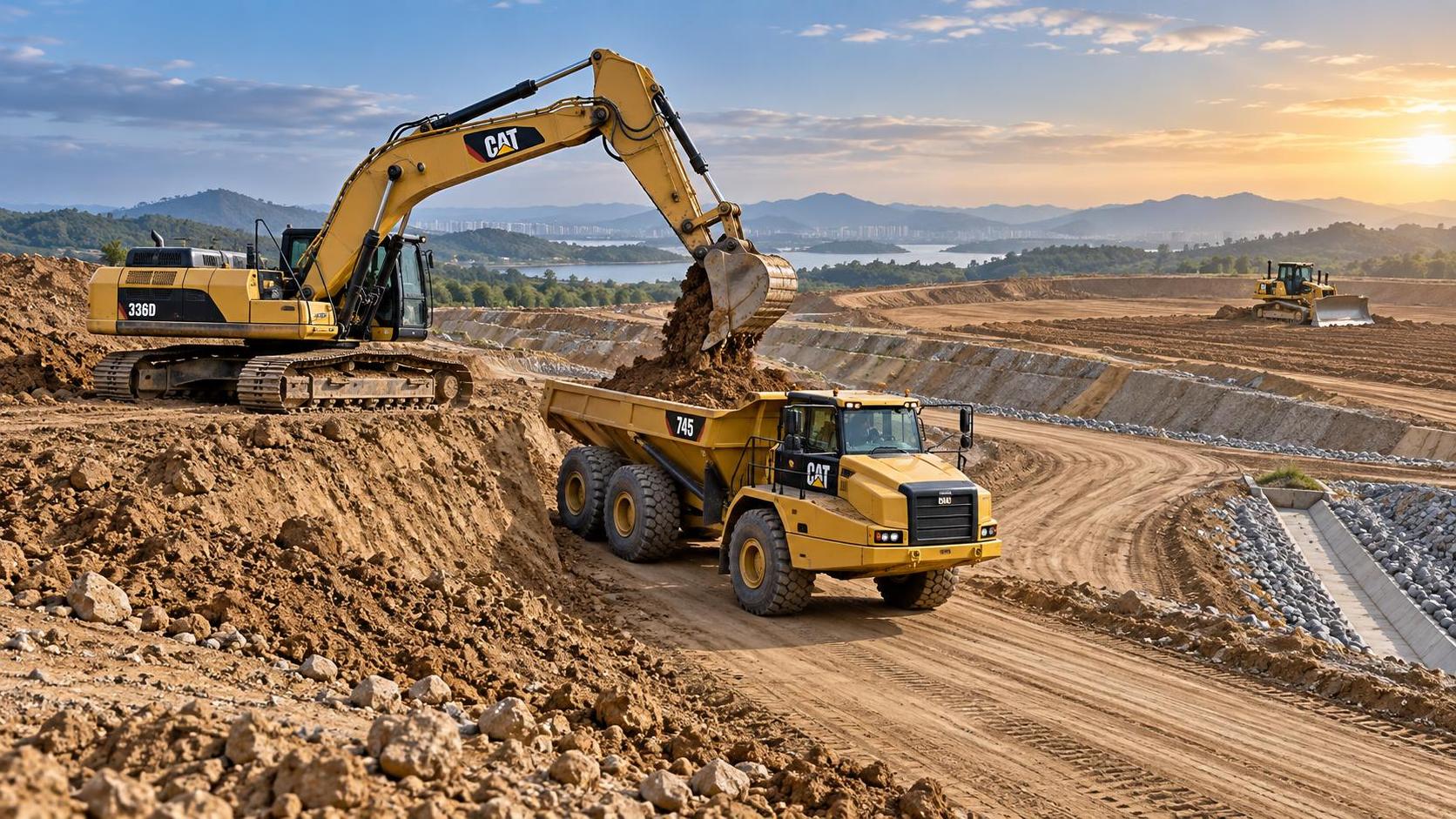
Selecting heavy duty earthmoving equipment starts with a simple discipline: specify the work and the ground before specifying the machine. A larger excavator, dozer, scraper, or articulated hauler may offer more capacity on paper, yet become the wrong choice when access is constrained, the formation is soft, haul roads are poorly maintained, or daily production is too variable to keep it loaded.
For project managers, the practical objective is to create a workable system: equipment that can enter the site, remain stable, move the expected material at a predictable rate, and avoid turning maintenance, fuel use, traffic management, or weather delays into the project’s controlling constraint. Machine selection should therefore follow site conditions and production logic, not fleet availability alone.
Start with the ground, not the machine class
Site investigation reports are useful, but equipment decisions often require a more operational reading of the ground. The question is not only whether soil is classified as clay, sand, rock, fill, or mixed material. It is whether the material can be cut, loaded, carried, compacted, or placed under the expected moisture condition and traffic level.
Soft cohesive soils can limit ground-bearing capacity and rapidly damage haul routes. Loose granular ground may support a machine when dry but lose stability after heavy rain. Rock excavation changes the decision completely: ripping, hammer work, drilling and blasting, or crushing may determine production far more than nominal excavator bucket size. Mixed demolition fill introduces another problem, because buried concrete, steel, and oversized fragments can create shock loads and increase wear on buckets, undercarriages, tires, and conveyors.
A useful early-screening exercise is to map the site into operational zones rather than treating it as one uniform area:
- Cut zones, including expected material hardness, boulder content, and digging depth.
- Travel zones, including gradient, width, drainage, turning space, and bearing capacity.
- Loading and dumping zones, where machine stability, edge protection, and queue management matter most.
- Restricted zones around utilities, existing structures, traffic interfaces, or environmentally sensitive areas.
This approach often reveals that one machine specification will not suit every task. A high-production machine may work well in the main cut while a smaller, lower-ground-pressure unit is needed near services or on weak formation. Trying to make one oversized unit perform every function can reduce flexibility and create avoidable safety exposure.
Match the equipment type to the material flow
Heavy duty earthmoving equipment is usually assessed machine by machine. That is understandable during procurement, but the project succeeds or fails through the movement of material from excavation to final placement. A loading machine that outpaces the haul fleet creates queues. Haulers that arrive faster than material can be loaded sit idle. A dozer that pushes material only a short distance may be efficient, while using it for long-distance transport can consume time, fuel, and undercarriage life without delivering comparable output.
The table is a starting point, not a substitute for production modelling. Cycle time should be estimated from actual travel distance, expected speed under load, loading duration, maneuvering, dumping, and likely delays at intersections or work fronts. A fleet can look balanced based on rated capacities and still perform poorly because the longest part of the cycle was ignored.
Material density also needs a practical interpretation. Loose, bank, and compacted volumes are not interchangeable. Managers should establish the volume basis used for excavation, hauling, and placement before comparing equipment capacity. Otherwise, apparent differences in quoted productivity may come from different assumptions rather than better machine performance.
Access, slopes, and weather can override rated capacity
Manufacturers publish operating weights, payloads, gradeability, reach, and breakout forces for good reason. These figures matter, but site geometry determines whether those capabilities are usable. A machine may physically fit through a site entrance yet have insufficient room to turn, position safely, pass other traffic, or be serviced. Transport into the site can be another limiting factor, especially where road permits, bridge limits, or staging space constrain delivery.
Slope conditions deserve separate attention. A route that seems manageable when empty can become unsuitable when a truck is loaded, wet, or required to stop and restart. Cross-slopes affect rollover risk and can make loading areas unstable. On steep or confined sites, the selection discussion should include braking performance, retarding systems, traction, visibility, and emergency access, rather than treating slope only as a number in a specification sheet.
Weather exposure should be built into the plan before mobilization. Rain is not merely a productivity inconvenience on earthworks sites. It can alter ground strength, reduce tire and track traction, create rutting, impair haul-road drainage, and change the safe working envelope near edges and embankments. In locations with recurring wet periods, a lower-ground-pressure configuration, better route construction, additional drainage, or a smaller but more mobile fleet may deliver more usable production than a larger fleet that frequently loses access.
Evaluate the machine as a maintainable operating unit
Purchase price or rental rate is only one part of the decision. The more important comparison is the cost and reliability of obtaining a required volume of completed work. That includes fuel or energy consumption, wear components, planned maintenance, access to technicians, spare-parts lead times, transport between phases, and the consequences of a machine being unavailable at a critical point in the programme.
Undercarriage and tire decisions are particularly site-dependent. Abrasive rock can shorten component life quickly. Soft, muddy terrain may favor track systems for flotation, but track wear and cleaning requirements still need to be considered. Wheeled equipment can be highly productive on properly maintained haul roads and firmer surfaces, while becoming less effective where roads break down or grades become severe.
Attachment strategy should be confirmed early. A base excavator can support buckets, rippers, hydraulic hammers, grapples, compactors, or other tools, but attachment weight, hydraulic requirements, changeover time, transport arrangements, and operator familiarity all affect its usable value. An attachment that is technically compatible but rarely available, difficult to mobilize, or too slow to change may not solve a programme risk.
Avoid the “largest machine” and “one fleet” assumptions
Two common assumptions lead to poor matches. The first is that the largest available machine will finish the work fastest. It may instead overload site access, require stronger working platforms, create greater exclusion zones, or spend too much time waiting for support equipment. The second is that standardizing on one equipment type simplifies management. It can simplify contracting, but it may force the site team to use a poor tool for specialized parts of the work.
A more defensible selection often uses a primary production fleet and a limited number of support units. The primary fleet handles repeated bulk movement; support equipment protects the flow by maintaining haul roads, trimming working platforms, dealing with localized difficult ground, managing stockpiles, and recovering quickly from disruptions. The support units may have lower hourly utilization, but their contribution can be substantial when they prevent a larger fleet from standing idle.
There is also a point at which adding more machines reduces output. Congested loading areas, narrow haul routes, constrained dump points, and limited supervision can turn extra capacity into queues and interaction risk. Production planning should set a workable fleet size for the available road width, loading face, traffic controls, and dumping sequence.
Turn site information into a selection decision
Before committing equipment, project teams should develop a short decision sheet for each major earthwork phase. It should state the material condition, target quantity and programme window, hauling distance, working gradients, expected weather limitations, available access, required attachments, and support infrastructure such as fueling, maintenance, drainage, and haul-road construction.
Then test each proposed machine or fleet against three questions:
- Can it operate safely and repeatedly in the weakest expected site condition, not only on the best day?
- Can the full loading-hauling-dumping chain sustain the required output without one stage becoming a persistent bottleneck?
- Can the contractor maintain and recover the equipment within the project’s programme tolerance?
Where the answer is uncertain, a controlled trial section, revised haul-road plan, or alternative fleet mix is usually more valuable than relying on a rated productivity figure. Earthmoving output is shaped by ground, traffic, and coordination as much as by engine power or bucket volume. The strongest selection is the one that keeps material moving safely when site conditions become less favorable than the original plan.
Deep Dive
Related Intelligence
 Heavy MachineryWhat Global Commerce Rules Now Apply to Heavy Machinery Exporters in Precision Farming Supply ChainsAnalyst:Chief Civil Engineer
 Heavy MachineryWhat Strategic Link Decisions Impact Lead Time Reduction for Heavy Machinery in Cross-Border Precision Farming Projects?Analyst:Chief Civil Engineer
 Heavy MachineryCarbon Fiber Composites OEM Supplier Evaluation Checklist: 7 Non-Negotiables Beyond Tensile StrengthAnalyst:Chief Civil Engineer