How to Evaluate an Agri-Tech Solution Platform for Multi-Farm Data Integration
Key Takeaways
- How food traceability solutions help contain recall risks fasterAgri-Tech Strategist
- What low-light performance should an OEM night vision dash cam meet?Automotive Tech Analyst
- Adipic Acid CAS 124-04-9 Market Trends: Why Buyers Are Rebuilding Supply PlansLead Materials Scientist
- Reducing Operational Carbon: Applying LEED v4.1 Emissions RequirementsIT & Security Director
- LEED v4.1 Emissions Primer: What Project Teams Must Document for ComplianceChief Civil Engineer
- How technology forecasting can reduce investment risk in cloud infrastructureIT & Security Director
- How to size DC fast EV charging stations for peak charging demandIT & Security Director
- When does modular construction reduce a project's total cost?Chief Civil Engineer
Industry Overview
We do not just publish news; we construct a high-fidelity digital footprint for our partners. By aligning with TNE, enterprises build the essential algorithmic "Trust Signals" required by modern search engines, ensuring they stand out to high-net-worth buyers in an increasingly crowded global digital landscape.
Choosing the right agri-tech solution platform for multi-farm data integration is rarely a matter of feature comparison alone. In practice, technical evaluators are being asked to solve a more difficult problem: how to create a reliable operational data layer across farms that may differ by crop type, machinery brand, connectivity quality, labor process, and digital maturity. A platform may look strong in a product demo and still fail when exposed to inconsistent field records, disconnected sensor networks, or region-specific compliance requirements.
That is why platform evaluation should start with the data reality of the farming operation, not with vendor positioning. If the goal is to unify agronomic, machine, environmental, inventory, and financial signals across multiple sites, the core question is whether the platform can maintain data integrity at scale while remaining adaptable to real farm workflows.
The strongest evaluation process usually separates three issues that vendors often bundle together: data ingestion, data normalization, and decision support. Many platforms do one of these well. Fewer can do all three across a distributed farm portfolio without creating long-term technical debt.
Why multi-farm integration is harder than most platform shortlists assume
Single-farm software can often tolerate local workarounds. Multi-farm environments cannot. Once several farms are involved, data problems compound quickly: one site records irrigation events manually, another relies on controller exports, a third has no consistent timestamp discipline, and machinery telemetry may arrive in proprietary formats. Even basic entities such as field boundaries, crop varieties, input batches, and harvest lots may be defined differently across sites.
This creates a familiar failure pattern. The platform appears to ingest data successfully, but cross-farm reporting becomes unreliable because the underlying records are semantically inconsistent. Technical teams then spend more time building exception handling, cleansing pipelines, and reconciliation logic than using the platform’s analytics outputs.
For that reason, evaluators should be cautious of claims centered on “single pane of glass” visibility unless the vendor can explain how data models are standardized across heterogeneous sources. Integration without normalization is not integration in an operational sense; it is only data accumulation.
Interoperability matters more than connector count
A common mistake in platform selection is equating a long list of integrations with strong interoperability. Connector libraries are useful, but they do not tell you how robustly a platform handles version changes, custom schemas, partial data loss, or conflicting identifiers.
When comparing platforms, it is more useful to examine interoperability at four levels:
- Source connectivity: Can the platform connect to IoT gateways, weather feeds, machinery systems, FMIS tools, ERP platforms, laboratory data, and manual uploads?
- Schema flexibility: Can it map different source structures without forcing every farm into a rigid template?
- Semantic harmonization: Can it reconcile differences in naming, units, geospatial definitions, and event timing?
- Outbound portability: Can data be exported cleanly to BI tools, compliance systems, or downstream enterprise applications?
In agricultural operations, the outbound side is often under-evaluated. A platform that locks transformed farm data into its own interface may limit future reporting, audit preparation, carbon accounting integration, or enterprise-level planning. Technical evaluators should therefore test APIs, event streams, batch export formats, and documentation quality—not just inbound connectors.
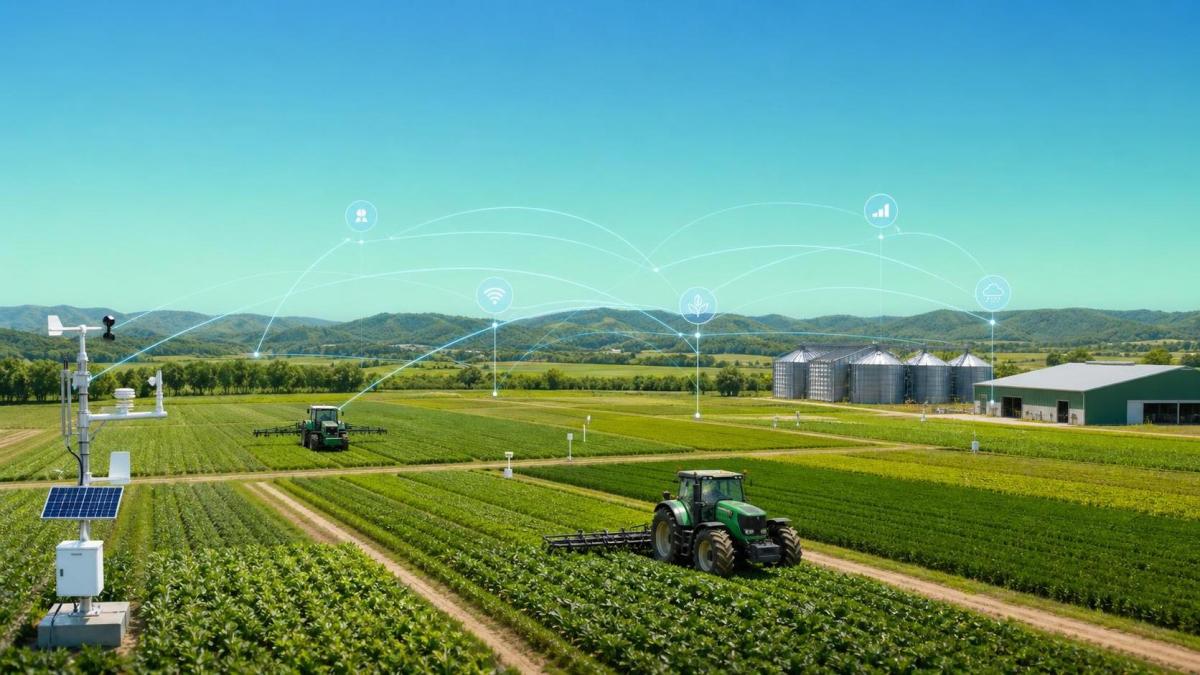
It is also worth asking whether the platform supports established interoperability approaches used in agriculture and adjacent industrial systems, while recognizing that standard adoption remains uneven. If a vendor references broad standards alignment, request specific examples from live deployments rather than accepting abstract compliance claims.
The data model is the real platform
In multi-farm environments, the user interface is not the most important architectural layer. The real platform is the data model behind it. Technical evaluators should inspect how the system represents entities such as farm, field, block, asset, crop cycle, application event, input lot, labor activity, and harvest output.
A strong model should do three things well.
It should preserve local operational detail. Farms should not lose important context simply because corporate reporting requires standardization. It should support hierarchical views, allowing data to roll up from field to farm to regional cluster to enterprise. And it should handle time intelligently, because much of the value in farm data depends on event sequence, seasonality, and lag between action and outcome.
Weak data models usually reveal themselves in subtle ways. Historical records become difficult to compare after a farm boundary change. Yield analysis cannot be linked reliably to application history. Sensor data is stored, but not aligned to actionable agronomic events. Manual entries are accepted, but without validation rules strong enough to support enterprise analytics.
When reviewing a platform, ask the vendor to demonstrate how it handles these edge cases:
- Field subdivision or consolidation over time
- Multiple naming conventions for the same crop or variety
- Mixed units of measure across farms and suppliers
- Late-arriving or corrected records
- Offline data capture and delayed synchronization
- Cross-season comparability when management practices change
If the answers depend heavily on custom services rather than native platform logic, future maintenance burden may be higher than the initial proposal suggests.
Data governance is not just an IT concern in agriculture
Farm data governance often becomes contentious once operations scale, especially when ownership, tenancy, contract farming, external agronomy advisors, and processor reporting all intersect. A platform may be technically capable yet still unsuitable if governance controls are weak.
Technical evaluators should review governance in operational terms:
- Data ownership: Who controls raw and processed data if the commercial relationship ends?
- Permission granularity: Can access be segmented by farm, geography, role, or data class?
- Lineage and auditability: Can users trace a KPI back to the original records and transformations?
- Retention and deletion: Are retention policies configurable to meet internal and external requirements?
- Cross-border data handling: Is the hosting and transfer model suitable for the regions involved? Regulatory exposure may vary by jurisdiction and should be reviewed case by case.
This becomes especially important when the platform is used beyond operational management—for example, sustainability reporting, traceability, financing support, or supply chain disclosure. Once data leaves the farm operations team and enters contractual or compliance workflows, the tolerance for ambiguity drops sharply.
Claims around security certifications should be validated directly. If a vendor cites standards such as ISO/IEC 27001 or specific cloud compliance controls, request current certification scope and applicability rather than assuming platform-wide coverage. Where information is unavailable, mark it as 【待核实】 in the evaluation record.
Analytics depth should be judged by decision utility, not dashboard polish
Many platforms present attractive visualizations, but technical evaluators should focus on whether analytics outputs are operationally trustworthy and technically extensible. A multi-farm platform must do more than display metrics; it must support comparative analysis across uneven datasets and surface uncertainty where data quality is weak.
Useful questions include:
- Can the system distinguish estimated values from measured values?
- How does it handle missing data in benchmark calculations?
- Can agronomic, financial, and operational metrics be analyzed in the same environment?
- Are models configurable by crop, geography, production system, or farm type?
- Can technical teams create custom metrics without vendor intervention?
The difference between descriptive analytics and decision-grade analytics is significant. A dashboard that summarizes irrigation volumes may be adequate at farm level. At enterprise level, teams often need anomaly detection, causal comparison, season-over-season normalization, and confidence-aware forecasting. If the platform’s analytics layer is closed, technical teams may end up replicating core reporting in external BI tools, reducing the value of the original deployment.
Another practical issue is geospatial capability. In agriculture, data often becomes meaningful only when tied to boundaries, zones, weather cells, or equipment routes. Evaluators should confirm whether the platform’s geospatial engine is native, embedded from a third party, or limited to simple map visualization. This affects performance, analysis depth, and integration complexity.
Deployment flexibility often determines adoption in the field
Multi-farm deployments rarely operate in ideal infrastructure conditions. Remote connectivity, shared devices, seasonal labor turnover, and mixed hardware environments all shape adoption. A technically elegant platform can still struggle if deployment assumptions are too urban, too centralized, or too dependent on constant connectivity.
Technical evaluation should cover the following realities:
- Offline-first or intermittent-connectivity support
- Mobile performance on low-spec devices
- Edge processing options for sensors or local gateways
- Role-based interfaces for field staff versus central analysts
- Language and localization support where multi-country operations are involved
Cloud architecture also deserves a more practical review than many procurement processes allow. “Cloud-native” says little about whether ingestion pipelines remain resilient during network disruption, whether data synchronization conflicts are manageable, or whether enterprise teams can monitor integration health without escalating every issue to the vendor.
If some farms operate in regions with stricter data residency expectations, confirm whether regional hosting choices are available. This is especially relevant for groups managing farms across multiple legal jurisdictions.
Implementation risk usually sits in master data and process alignment
Most failed or underperforming agri-tech integrations do not collapse because the API failed. They weaken because master data was not standardized early enough, operational processes were not documented, or governance decisions were postponed until after deployment.
For multi-farm integration, evaluators should insist on a pre-implementation discovery phase that maps:
- Core source systems by farm
- Critical master data entities and owners
- Frequency and reliability of data generation
- Manual process dependencies
- Reporting outputs required by operations, finance, compliance, and management
This work may seem procedural, but it is often the clearest predictor of implementation success. A vendor that moves too quickly into configuration without clarifying source authority, naming conventions, and data quality thresholds may be optimizing for short sales cycles rather than sustainable deployment.
Pilot design matters as well. A good pilot should not be limited to one digitally mature farm. It should include operational contrast: at least one site with strong data discipline and one with incomplete or inconsistent records. That reveals whether the platform can function under real portfolio conditions, not only in best-case environments.
What to compare when two platforms both seem technically viable
Once basic capability is confirmed, the decision often comes down to architectural trade-offs.
Some platforms are stronger as integration backbones. They prioritize APIs, flexible schemas, and exportability, making them suitable for enterprises that already have analytics capabilities. Others are stronger as operational applications, with better agronomic workflows and faster user adoption, but less freedom for custom data engineering.
Neither approach is inherently better. The right choice depends on whether the organization wants a system of record, a system of action, or a data federation layer connecting both.
At this stage, technical evaluators should compare:
- Configurability versus custom development: How much can be changed internally?
- Observability: Are integration failures easy to detect and diagnose?
- Version stability: How often do updates affect existing integrations?
- Vendor dependency: Can internal teams maintain the platform realistically?
- Total lifecycle burden: What will data mapping, support, retraining, and ongoing governance cost after go-live?
The cheapest initial proposal is often not the lowest-risk option. In fragmented farm environments, hidden costs usually appear in integration maintenance, poor data trust, and duplicated reporting work outside the platform.
The strongest decision criterion: whether the platform improves trust in cross-farm data
For technical evaluators, the most useful test is simple: will this platform make enterprise teams trust multi-farm data more, or just access it faster?
Access without trust has limited value. If farm managers question benchmark outputs, if finance teams cannot reconcile operational figures, or if agronomy teams maintain parallel spreadsheets because they do not trust normalized records, the platform has not solved the core integration problem.
A capable agri-tech solution platform should create a defensible chain from data capture to enterprise insight. That means resilient ingestion, transparent transformation logic, governance controls that reflect real operating relationships, and analytics that acknowledge uncertainty rather than masking it.
In multi-farm agriculture, the technical challenge is not only connecting systems. It is creating a durable digital representation of farming operations that remains useful across seasons, geographies, and management changes. Platforms that understand this tend to perform better over time than those designed primarily for demonstration value.
For selection teams, that shifts the evaluation standard. The question is no longer “Which platform has the most features?” but “Which platform can preserve meaning as data moves across farms, systems, and decisions?” That is the standard that supports scalable integration rather than another layer of fragmented software.
Deep Dive
Related Intelligence
 Precision FarmingHow Global Commerce Data Helps Precision Farming Equipment Managers Forecast Spare Part Demand AccuratelyAnalyst:Agri-Tech Strategist
 Precision FarmingHow much does deploying automated farming solutions manufacturer hardware increase labor efficiency on layer farms?Analyst:Agri-Tech Strategist
 Precision FarmingWhy automated farming solutions manufacturers prioritize modular design over full-stack integrationAnalyst:Agri-Tech Strategist