How Specialty Chemical Research Reduces Scale-Up Risk
Specialty chemical research is the first line of defense against costly scale-up failures. For technical evaluators, early validation turns laboratory observations into evidence for sound manufacturing decisions.
Laboratory success alone does not demonstrate commercial readiness. A formulation can meet target specifications in small batches while becoming unstable, inefficient, inconsistent, or uneconomic at production scale.
The central question is therefore not whether a chemistry works in principle. It is whether the chemistry will perform consistently across equipment, operators, suppliers, process conditions, and regulatory markets.
A disciplined research program reduces uncertainty before capital, production capacity, and customer commitments are exposed. It identifies critical variables, quantifies their impact, and establishes a practical operating window.
For technical evaluators, the value of specialty chemical research lies in decision quality. Strong research provides evidence to advance, redesign, qualify alternatives, or stop a project before failure becomes expensive.
This article explains the scale-up risks that matter most, the research activities that address them, and the questions evaluators should ask before approving pilot or commercial production.
Why Laboratory Results Can Mislead Scale-Up Decisions
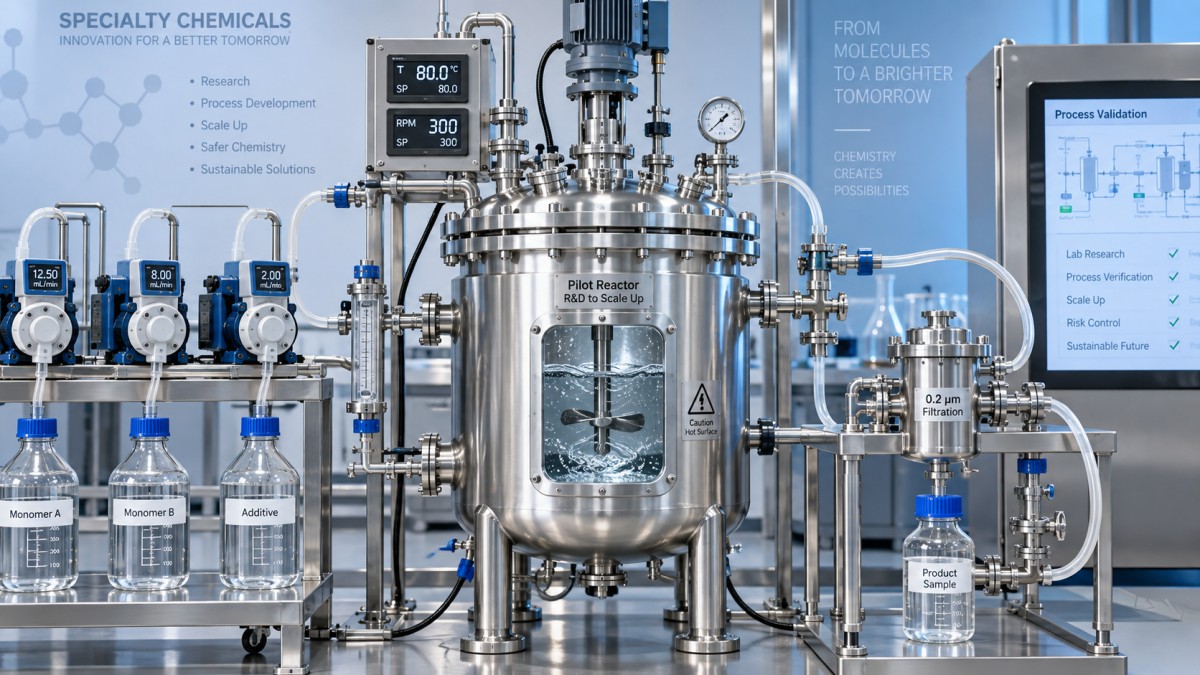
Small-scale experiments are useful for discovering chemistry, but they simplify the conditions that determine real manufacturing performance. Heat transfer, mixing energy, residence time, and contamination pathways all change.
A one-liter reactor may remove heat rapidly and mix uniformly. A multi-ton vessel may develop temperature gradients, dead zones, vortexing, foam formation, or delayed reagent dispersion.
These differences can alter reaction selectivity, molecular-weight distribution, particle size, viscosity, color, yield, or impurity profiles. For high-value specialty products, even modest variation can affect qualification.
Specialty chemical research addresses this gap by treating scale-up as a knowledge problem rather than an equipment-sizing exercise. The objective is to understand what truly controls product quality.
Technical teams should distinguish between nominal process conditions and critical process parameters. A stated temperature, mixing speed, or feed rate may be inadequate without defining acceptable variation limits.
Research also reveals whether a process is robust or merely repeatable under one carefully controlled laboratory setup. Robust processes tolerate realistic variation without generating unacceptable product or safety outcomes.
This distinction matters during technology transfer. A process dependent on one operator, one vessel geometry, or one narrowly specified raw material creates risk even when laboratory data appears convincing.
Evaluators should ask whether the development package explains cause and effect. Data tables are insufficient when they do not connect process inputs to measurable quality attributes.
Start With the Product Attributes That Must Not Drift
Effective specialty chemical research begins with a clear definition of commercial product performance. Teams need to identify which physical, chemical, functional, and regulatory attributes customers will actually evaluate.
For a coating additive, critical attributes may include viscosity, color, dispersion stability, compatibility, gloss retention, and volatile content. For an electronic chemical, trace metals may dominate risk.
For polymeric materials, molecular weight, polydispersity, residual monomers, thermal behavior, and mechanical properties may all determine whether downstream converters can process the material successfully.
Each critical quality attribute should have a measurement method, acceptance range, sampling plan, and commercial relevance. This prevents teams from optimizing convenient laboratory metrics instead of customer-critical outcomes.
Technical evaluators should look for explicit links between product attributes and use conditions. A material can pass release testing yet fail when exposed to humidity, shear, light, heat, or storage.
Research programs become more efficient when they prioritize attributes with the greatest commercial consequence. Not every test deserves equal resources, particularly when timelines and development budgets are constrained.
A useful review question is simple: if this attribute moves outside range, what fails first? The answer may be production efficiency, customer application performance, compliance, shelf life, or safety.
That question also clarifies the required level of process control. High-impact attributes may need tighter raw-material specifications, in-process monitoring, additional purification, or more rigorous batch-release testing.
Raw-Material Variability Is Often the Hidden Commercial Risk
Many scale-up programs underestimate raw-material variability because early work relies on a small number of high-purity laboratory lots. Commercial sourcing introduces broader composition and handling differences.
Supplier-grade materials can vary in moisture, particle size, inhibitor concentration, trace metals, isomer content, acidity, color, and stabilizer package. These differences may affect reactions or product stability.
Specialty chemical research should therefore include representative raw-material studies before scale-up approval. The purpose is not simply to qualify a supplier but to understand material sensitivity.
Teams should test expected specification extremes, not only typical values. A process that works with average material may fail when a legitimate incoming lot reaches one boundary.
Where multiple suppliers are planned, research should compare material fingerprints against product behavior. Analytical equivalence alone may not establish functional equivalence in a complex formulation or reaction.
Storage and transport conditions also deserve attention. Hygroscopic powders, reactive intermediates, temperature-sensitive additives, and solvents with changing water content can introduce variability before manufacturing begins.
A strong raw-material control strategy defines critical incoming tests, sampling frequency, handling requirements, and supplier change-notification expectations. It should also explain which deviations require revalidation.
For evaluators, supplier resilience and process robustness should be reviewed together. A commercially attractive formulation is not truly scalable if it depends on one narrowly controlled source.
Process Compatibility Must Be Proven, Not Assumed
Equipment compatibility is a frequent source of avoidable scale-up trouble. Materials interact with vessel surfaces, seals, pumps, filters, hoses, packaging, and cleaning agents throughout production.
Corrosion, extractables, adsorption, abrasion, static charge, and elastomer swelling can each alter quality or reliability. These issues may remain invisible in glassware-based laboratory development.
Research should assess whether the chemistry is compatible with intended construction materials. Stainless steel, lined reactors, fluoropolymers, carbon steel, and specialized alloys produce different operating constraints.
Filtration deserves particular scrutiny for dispersions, high-viscosity materials, reactive mixtures, and low-level impurity specifications. Filter media can remove desired components or introduce extractable contaminants.
Transfer behavior is equally important. A formulation may be stable in a beaker but difficult to pump, prone to phase separation, or vulnerable to aeration during recirculation.
Scale-relevant trials should examine charging order, agitation profile, addition rate, hold time, and cleaning sequence. These operational details often determine whether a process is reproducible.
Technical evaluators should request evidence from representative equipment whenever possible. Modeling and laboratory simulations are valuable, but they should be paired with pilot confirmation for high-risk operations.
Compatibility research also informs capital planning. Identifying a need for specialized seals, inert handling, controlled feeding, or dedicated equipment early is far cheaper than retrofitting a commissioned line.
Thermal, Mixing, and Reaction Risks Need Quantitative Boundaries
Reaction scale-up is especially vulnerable when heat generation and heat removal do not remain balanced. A safe laboratory reaction can become difficult to control in larger equipment.
Specialty chemical research should characterize reaction kinetics, heat release, induction periods, gas evolution, and sensitivity to addition rate. These factors define safe and productive operating boundaries.
Calorimetry, reaction monitoring, and designed experiments help teams determine how temperature, concentration, catalyst level, and feed profile affect conversion, selectivity, and runaway potential.
Mixing studies are essential where local concentration spikes can cause side reactions, gel formation, precipitation, discoloration, or hazardous exotherms. Average bulk conditions may conceal local events.
Rather than selecting a single target condition, developers should establish an operating window. This includes preferred conditions, acceptable limits, warning signals, and recovery actions for foreseeable deviations.
For technical evaluators, an operating window is stronger evidence than a successful demonstration batch. It shows whether the process can withstand normal manufacturing variation without losing control.
Research should also consider production interruptions. A delayed feed, power loss, extended hold time, or temporary cooling failure can reveal vulnerabilities absent from uninterrupted laboratory protocols.
When hazards are material, independent process safety review should accompany development decisions. Product performance data cannot compensate for an insufficient understanding of thermal or pressure-related process risk.
Pilot Trials Should Answer Specific Commercial Questions
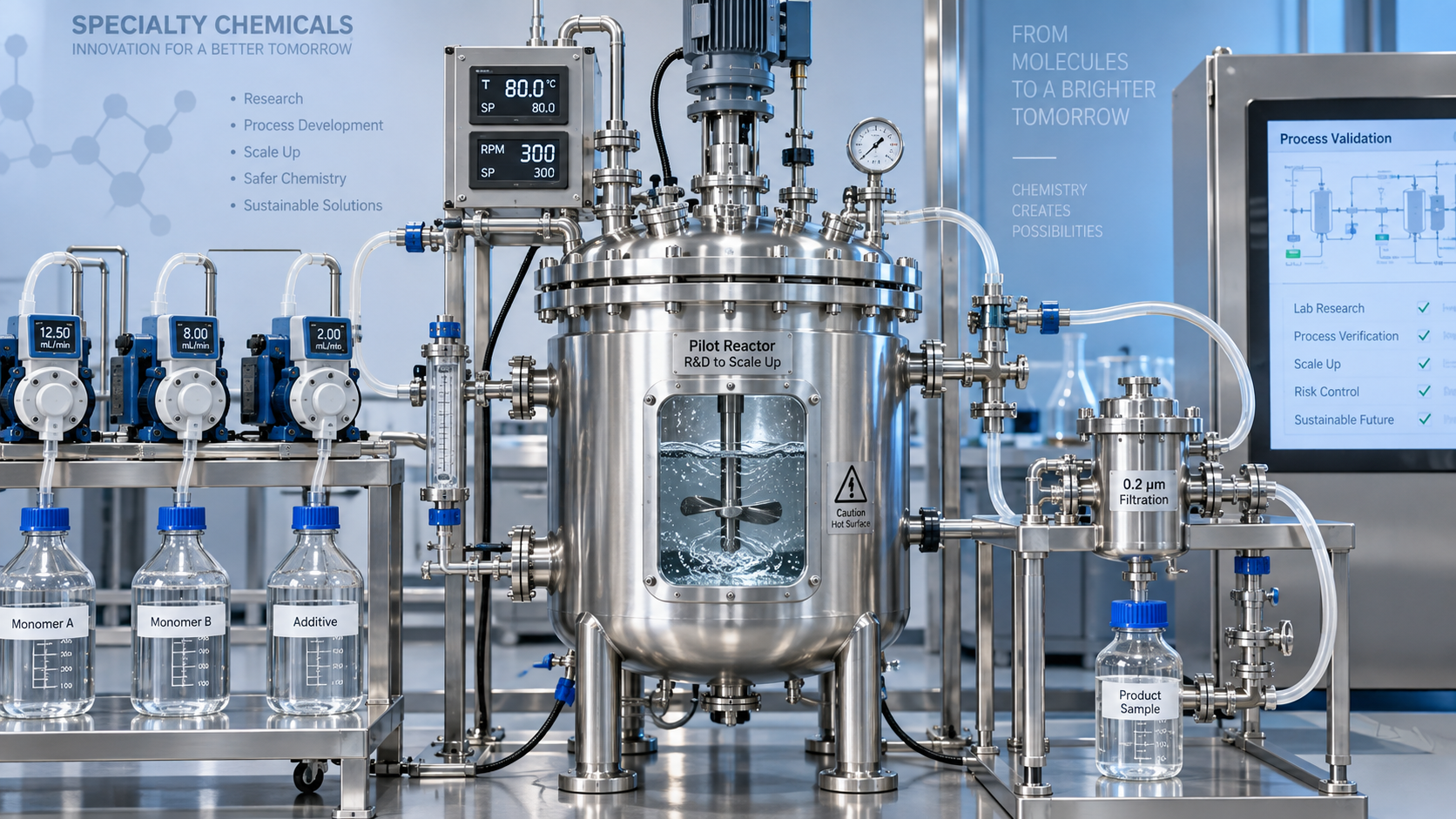
A pilot campaign is not merely a larger laboratory batch. It is a controlled learning stage that should resolve the uncertainties preventing confident commercial design and customer qualification.
Before running a pilot, teams should define the questions it must answer. Examples include mixing adequacy, filtration rate, impurity control, packaging stability, batch cycle time, and yield variability.
Each trial should have acceptance criteria tied to commercial decisions. Without predefined criteria, teams can mistake partial success for sufficient evidence and carry unresolved risk forward.
Pilot batches should use representative raw materials, intended equipment features, realistic work instructions, and commercial analytical methods. Artificially favorable conditions reduce the value of the trial.
Sampling must be designed to detect variation within the batch, not simply confirm final release values. In-process samples can reveal gradients, incomplete reaction, settling, or late-stage instability.
Commercially relevant losses also need measurement. Small handling losses, filter hold-up, cleaning losses, and off-spec rework can materially affect margin in specialty chemical production.
Technical evaluators should assess pilot outcomes as a package. A batch that meets specification but requires excessive operator intervention or produces poor yield may not be commercially acceptable.
The best pilot reports document surprises, deviations, root causes, and changes made afterward. A record containing only successful results provides limited confidence in process understanding.
Analytical Methods Must Be Fit for Manufacturing Decisions
Scale-up decisions depend on analytical methods that are reliable, sufficiently sensitive, and practical in the production environment. Research-grade methods are not always suitable for routine release or process control.
Methods should be evaluated for precision, accuracy, specificity, detection limits, sample preparation burden, turnaround time, and transferability across laboratories or manufacturing sites.
A slow analytical method can create operational bottlenecks when manufacturing must wait for release results. Conversely, a rapid method may be inadequate for trace contaminants with regulatory significance.
Specialty chemical research should identify which measurements need real-time or near-real-time control. Moisture, acidity, viscosity, particle size, and residual reactants often benefit from timely feedback.
Sampling itself may be a source of error. Heterogeneous dispersions, volatile mixtures, reactive systems, and high-solids formulations require procedures that preserve representative composition during collection and preparation.
Technical evaluators should verify that reported values come from methods capable of detecting meaningful drift. A stable-looking trend may reflect inadequate method sensitivity rather than true process consistency.
Reference standards, retention samples, and stability-indicating methods also support future investigations. They enable teams to distinguish manufacturing variation from storage-related degradation or measurement uncertainty.
Method readiness is particularly important before customer sampling begins. Inadequate analytical control can delay root-cause analysis when an application issue emerges after shipment.
Stability and Application Testing Protect Customer Qualification
A specialty chemical product must remain fit for use beyond the day it leaves the reactor. Stability research examines how time, temperature, moisture, oxygen, light, and packaging affect performance.
Accelerated aging is useful, but it should be interpreted carefully. Elevated-temperature behavior may identify degradation pathways without perfectly predicting long-term performance under normal storage conditions.
Testing should reflect the actual supply chain. Marine transit, warehouse exposure, seasonal temperature extremes, repeated freeze-thaw cycles, and partially used containers may all affect customer experience.
Packaging compatibility is part of the stability question. Containers can permit moisture ingress, leach additives, absorb active components, deform under pressure, or fail to protect light-sensitive materials.
Application testing is equally important because many specialty chemicals create value only inside a downstream system. A coating additive, adhesive modifier, or catalyst needs realistic formulation validation.
Technical evaluators should seek data from representative customer conditions, not only internal bench tests. End-use processing can introduce shear, curing profiles, contaminants, or interactions absent from development work.
Where final application testing is impractical, teams should identify meaningful surrogate tests and explain their correlation. A surrogate is credible when it predicts a customer-relevant performance outcome.
Strong stability and application data reduce the risk of qualification delays, field complaints, returns, and emergency reformulation after commercial launch.
Regulatory and Sustainability Requirements Should Enter Early
Regulatory constraints can change a viable chemistry into an unusable commercial product. Research should evaluate market requirements before scale-up locks in raw materials, impurity profiles, or production routes.
Relevant requirements may include chemical inventory status, restricted substances, transport classification, worker exposure controls, food-contact obligations, emissions limits, and customer-specific banned-material lists.
For global supply chains, the same product may require different documentation and disclosure across regions. Early research identifies where a formulation needs market-specific controls or alternatives.
Sustainability claims also require evidence. Bio-based content, recyclability, lower-carbon positioning, biodegradability, and safer-chemistry assertions should be supported by appropriate methods and clear boundaries.
Technical evaluators should consider whether compliance testing can be maintained as suppliers change. A compliant initial batch is insufficient if future procurement flexibility creates disclosure or impurity risks.
Regulatory planning should connect directly to research priorities. For example, a trace impurity may be commercially irrelevant in one market but critical where stricter thresholds or reporting rules apply.
Early integration prevents late-stage redesign, which can trigger renewed stability work, customer qualification, safety assessment, and process validation. These delays are especially costly after launch commitments.
How Technical Evaluators Can Assess Research Readiness
Technical evaluators need a structured way to decide whether specialty chemical research has sufficiently reduced scale-up risk. The review should focus on evidence quality, not presentation quality.
First, confirm that critical quality attributes are defined and linked to customer performance. Undefined quality priorities make it difficult to judge whether process data addresses meaningful commercial risk.
Second, examine whether raw-material ranges, supplier differences, and storage effects were tested. A development program based on idealized inputs has limited predictive value for routine production.
Third, review process sensitivity. The team should know which parameters matter, how much they can vary, how they will be monitored, and what action follows a deviation.
Fourth, assess the relevance of equipment and pilot evidence. Representative trials are especially important when the product involves exothermic reactions, difficult mixing, filtration challenges, or sensitive impurity limits.
Fifth, verify analytical readiness. Commercial decisions need methods that can be transferred, executed reliably, and completed within operational timelines without compromising meaningful detection capability.
Finally, look for a residual-risk register. Mature teams acknowledge what remains uncertain, assign owners, define mitigation activities, and specify the evidence required before each next-stage decision.
This approach avoids a false binary between ready and not ready. It allows organizations to advance projects responsibly while concentrating resources on the risks with the highest consequence.
Conclusion: Research Converts Scale-Up Risk Into Manageable Decisions
Specialty chemical research reduces scale-up risk by exposing the conditions that laboratory work cannot fully reveal. It creates a factual basis for process design, supplier qualification, customer testing, and investment decisions.
The most valuable programs do not simply generate more data. They identify critical product attributes, test realistic sources of variation, and establish the limits within which reliable manufacturing is possible.
For technical evaluators, the key standard is practical evidence. A scalable specialty chemical should demonstrate controlled raw materials, compatible equipment, defined process windows, credible analytics, and relevant stability performance.
When these elements are addressed before commercial commitment, teams can move from pilot trials to full production with better predictability, stronger customer confidence, and fewer costly corrective actions.