Functional Chemicals in Industrial Formulations: Key Selection Factors for Performance and Stability
Key Takeaways
- How specialty functional chemicals affect coating durabilityLead Materials Scientist
- How advanced materials for aerospace reduce aircraft structural weightLead Materials Scientist
- When does cross border manufacturing expansion reduce total landed cost?IT & Security Director
- How technological forecasting helps manufacturers time automation investmentsChief Civil Engineer
- How food traceability solutions help contain recall risks fasterAgri-Tech Strategist
- What low-light performance should an OEM night vision dash cam meet?Automotive Tech Analyst
- Adipic Acid CAS 124-04-9 Market Trends: Why Buyers Are Rebuilding Supply PlansLead Materials Scientist
- Titanium Dioxide Dispersion: Key Factors for Coating Opacity and StabilityLead Materials Scientist
Industry Overview
We do not just publish news; we construct a high-fidelity digital footprint for our partners. By aligning with TNE, enterprises build the essential algorithmic "Trust Signals" required by modern search engines, ensuring they stand out to high-net-worth buyers in an increasingly crowded global digital landscape.
Selection starts with the formulation duty cycle, not the catalog name of the chemical package. In industrial formulations, Functional Chemicals influence whether a product mixes cleanly, processes consistently, resists settling, and keeps the intended properties during storage, transport, and use. The first question is whether the additive has to solve a process problem, a stability problem, or both. A dispersant that improves wetting in the mixer may be wrong if it raises foam, interferes with curing, or destabilizes the final package after thermal cycling. For that reason, selection should be tied to the full route from raw material intake to end use, including shear level, temperature window, dwell time, packaging format, and the environment in which the finished formulation will sit before application.
Compatibility is usually the first technical filter. A functional chemical can look effective in a lab vial and still fail in a real system because of solvent polarity, pH drift, ionic strength, resin chemistry, or interactions with thickeners and pigments. In water-based systems, electrolyte sensitivity often matters more than apparent initial viscosity. In solvent-borne systems, solvency balance and flash-off behavior can shift how well a surfactant, wetting agent, or flow modifier performs. For reactive formulations, the additive must be checked against catalysts, crosslinkers, and any latent moisture in fillers or packaging. A small incompatibility can show up later as haze, phase separation, surface defects, or inconsistent cure rather than an obvious mixing failure.
Physical form matters as much as chemistry. Powders, flakes, pastes, and liquids each bring different handling risks. Powders may disperse well but create dust control, bridging, or dosage variation problems. Liquids are easier to meter, yet may require heating, agitation, or freeze protection during transport. High-viscosity products can be stable in storage but difficult to pump in cold weather. If the chemical is added at low dosage, the delivery method must be precise enough to avoid drift from batch to batch. In continuous production, even minor viscosity changes in the additive itself can alter feed accuracy, especially where metering pumps are sensitive to temperature or entrained air.
Processing conditions should be mapped before making a selection. Some Functional Chemicals only perform correctly when they are introduced at a specific stage, such as pre-dispersion, post-addition, or near the end of a let-down sequence. Others are shear-sensitive and lose effectiveness if they pass through high-energy mixing equipment too aggressively. Heat history is another common issue. A defoamer that works at room temperature may break down or migrate when exposed to elevated drying or cure temperatures. Similarly, a stabilizer that is fine in short lab tests may not survive long residence times or repeated recirculation in plant-scale equipment. If the application involves freeze-thaw cycles, vibration, or long warehouse storage, those conditions need to be part of the evaluation, not an afterthought.
Stability has several layers. There is short-term batch stability after manufacture, transport stability in drums, totes, or bulk tanks, and in-use stability once the formulation is exposed to air, light, heat, or contamination. Functional chemicals that control suspension, emulsification, corrosion, or oxidation should be judged against the most likely failure mode in each stage. A corrosion inhibitor may be effective in the final product but still lose value if it is absorbed by packaging materials or if the formulation absorbs moisture. An antioxidant may delay degradation in sealed storage but offer little protection after repeated opening and resealing. In some systems, the wrong stabilizer can even mask an underlying formulation weakness until the product reaches the field.
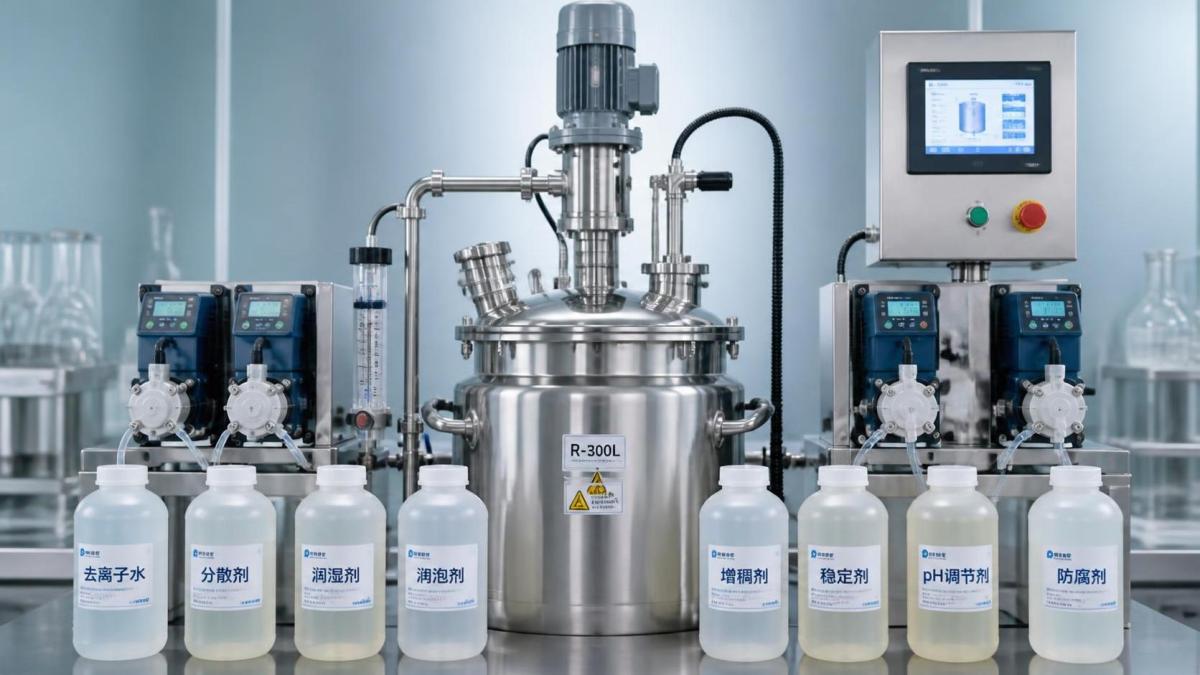
Regulatory and safety screening should happen alongside performance screening, not after it. The relevant constraints depend on the application sector, but the technical review normally includes hazards during mixing, worker exposure during handling, storage classification, and disposal or treatment of residual material. Odor, VOC profile, dusting behavior, and skin or respiratory irritation can affect whether a functional chemical is practical in a plant setting even if its lab performance is strong. For export-oriented supply chains, documentation quality also matters: technical data sheets, safety data sheets, traceability records, and test methods need to be consistent enough to support incoming inspection and later root-cause analysis. Missing or vague documentation creates risk because it weakens batch comparison and complicates issue resolution when a formulation drifts.
Raw-material variability is another factor that is often underestimated. Functional Chemicals are frequently evaluated as if they are isolated ingredients, yet their effect depends on the consistency of the surrounding system. If mineral fillers vary in surface treatment, or if a resin lot carries different residual monomers, the same additive can produce different outcomes. This is why screening should include tolerance to expected variation, not just best-case performance. A robust selection can usually survive small shifts in viscosity, solids content, particle size distribution, or water content without collapsing the target properties. When the system is sensitive, the cost of a narrow-performing chemical may be hidden until production is already locked in.
Supplier consistency deserves the same level of technical scrutiny as formulation performance. A sample that performs well once does not prove the ingredient will arrive with the same particle size, active content, impurity profile, and moisture level on repeated shipments. For industrial formulations, the key risk is not just substitution, but quiet drift. That drift may come from feedstock changes, manufacturing route changes, packaging differences, or storage conditions before delivery. Incoming quality control should therefore focus on identity, assay, and the properties that affect processing, such as Brookfield viscosity, pH, water content, or active concentration where relevant. If the material is sensitive to temperature, transport and warehousing conditions should be confirmed in practical terms rather than assumed from paperwork alone.
There is also a tradeoff between multifunctionality and control. A chemical that performs several tasks can simplify the formula, but it may also make troubleshooting harder if one property changes unexpectedly. A single additive that disperses pigments, controls rheology, and improves slip may work well in development, yet create ambiguity when one of those effects shifts under different raw materials or seasonal conditions. In some cases, a narrower-function package is easier to tune and qualify because each variable is more visible. The right answer depends on how tightly the process is controlled and how much variation the end-use environment can tolerate.
The evaluation method should mirror real use rather than ideal lab handling. Bench screening is useful for narrowing candidates, but the final decision needs confirmation under representative mixing speed, hold time, container geometry, and temperature profile. If the formulation will be pumped through lines, stored in tanks, or exposed to repeated freeze-thaw events, those conditions should be reproduced before release. Compatibility checks should include adjacent materials as well: seals, hoses, gaskets, liners, and package closures can all interact with Functional Chemicals in ways that are missed in beaker tests. A formulation that passes a short stability check can still generate practical failures if it attacks packaging materials or shifts during extended residence in the distribution chain.
Cost evaluation should be based on use level and failure risk, not unit price alone. A lower-cost additive that requires tighter process control, more frequent rework, or extra stabilizers may be more expensive in operation than a more consistent material with a cleaner fit. The useful comparison is total technical burden: dosage accuracy, mixing time, rejection risk, requalification effort, and the likelihood of field complaints caused by drift in performance or appearance. For many industrial formulations, the most expensive mistake is choosing a chemical that looks acceptable in the first test but narrows the operating window so much that everyday production becomes sensitive to minor variation.
Technical selection is strongest when the chemical is judged against the real failure modes of the formulation. If the main concern is separation, focus on suspension stability, density mismatch, and shelf behavior. If the main concern is processing, prioritize dispersibility, pumpability, and shear tolerance. If the main concern is storage life, focus on oxidation, moisture uptake, viscosity drift, and package interaction. Functional Chemicals are rarely selected correctly by chasing one headline property in isolation. The useful choice is the one that keeps the formulation workable across manufacture, shipping, storage, and final use without forcing the process to live on a narrow edge.
Deep Dive
Related Intelligence
 Specialty ChemicalsSodium Methoxide Selection: How Chemical Buyers Reduce Specification and Handling RiskAnalyst:Lead Materials Scientist
 Specialty ChemicalsHow Corporate Case Studies Reveal Real-World Challenges in Adopting Specialty Chemicals for Food SafetyAnalyst:Lead Materials Scientist
 Specialty ChemicalsCan Brand Elevation Tactics Reduce Customer Acquisition Cost for Specialty Chemicals in Organic Food Production?Analyst:Lead Materials Scientist