Can industrial cybersecurity monitoring detect threats without disrupting operations?
Key Takeaways
- OpenRouter Removes Three AI Inference Providers After Prompt TheftIT & Security Director
- How to verify supplier credentials in global chemical sourcingLead Materials Scientist
- National Cybersecurity Standards Committee Seeks Feedback on Three GuidelinesIT & Security Director
- How to verify specialty chemical exporters in IndiaLead Materials Scientist
- Trump Fires National Cyber Director, Names Kirsten Davies Acting DirectorIT & Security Director
- Can mobile POS systems accept payments without internet access?IT & Security Director
- Malaysia and US Deepen Sovereign AI Cloud Cooperation, With $50 Million in US SupportIT & Security Director
- How chemical recycling is reshaping plastics technology in EuropeLead Materials Scientist
Industry Overview
We do not just publish news; we construct a high-fidelity digital footprint for our partners. By aligning with TNE, enterprises build the essential algorithmic "Trust Signals" required by modern search engines, ensuring they stand out to high-net-worth buyers in an increasingly crowded global digital landscape.
Yes. Industrial cybersecurity monitoring can detect suspicious activity without interrupting production when its collection methods are matched to operational technology (OT) constraints. Passive network monitoring, for example, can inspect a copy of traffic rather than probe controllers or insert itself into the control path. It is not automatically risk-free: mirror-port configuration, sensor placement, resource use and response actions still need review.
The decision becomes practical when a production team cannot tolerate unexpected controller traffic, yet security staff need to know whether an engineering workstation is issuing unusual commands or an unfamiliar device has appeared. A useful evaluation therefore asks two separate questions: what can the system actually see, and what must be changed to let it see it?
Start with the collection method, not the detection claims
A monitoring platform may combine several collection methods. Each provides different evidence and introduces different operational dependencies. Ask vendors to identify every component that sends traffic, requires credentials, installs software or changes an existing configuration; a product described as “passive” may still include optional active features.
For a sensitive production segment, passive observation is often a reasonable starting point. It does not prove that active polling or an agent is always unsuitable, but it gives evaluators a way to establish visibility before adding interactions with devices. Inline prevention is a different decision from monitoring: blocking a legitimate control message can itself cause an operational incident.
Map what the sensor will—and will not—see
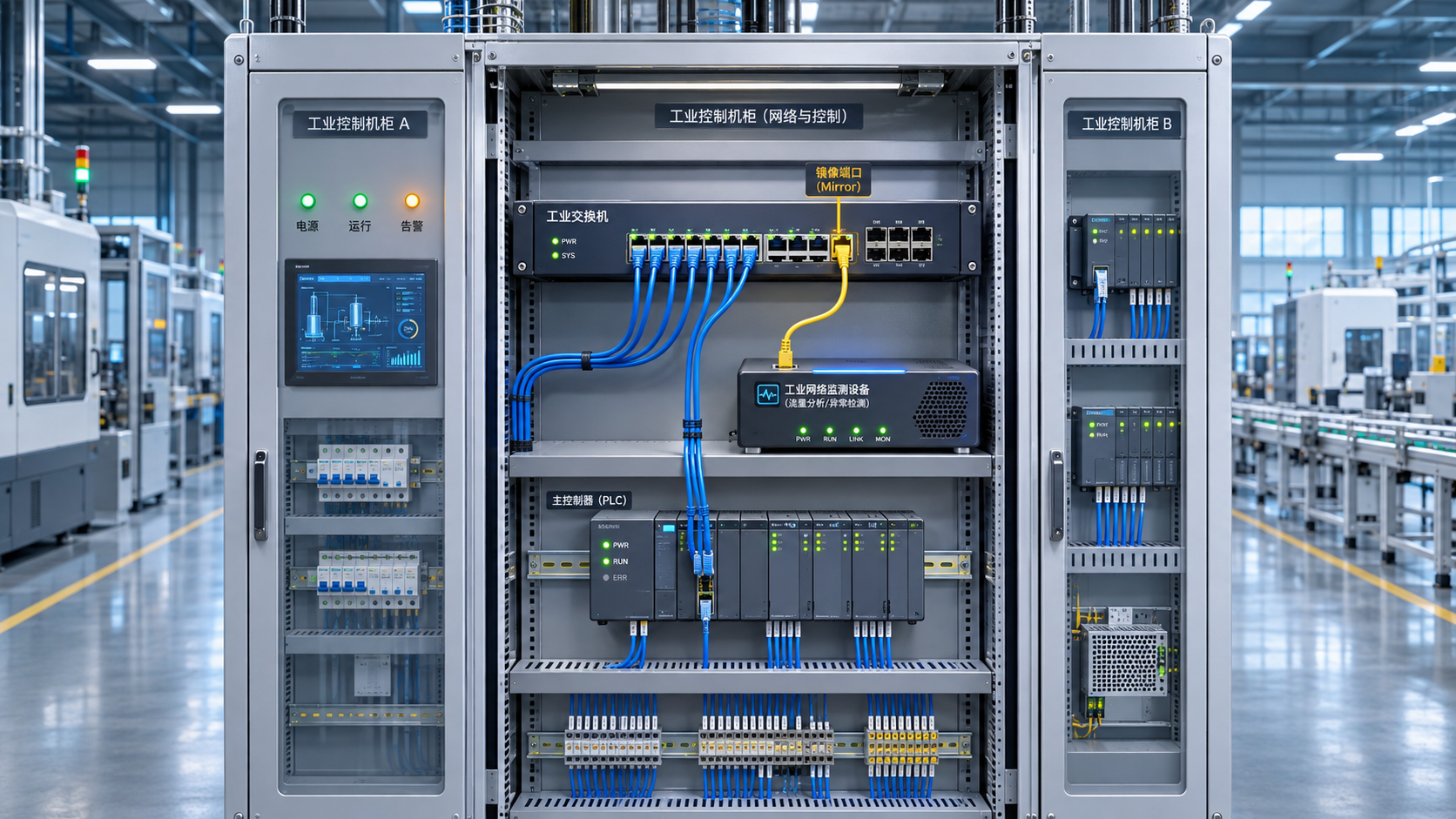
A network sensor needs a copy of traffic, commonly supplied through a switch mirror port or a network tap. Its position determines the evidence available to the detection engine. A sensor at a boundary between the enterprise and the industrial network may observe remote access and cross-zone traffic, while missing communication that stays within a control cell. Conversely, a sensor inside one cell may have little visibility into activity elsewhere.
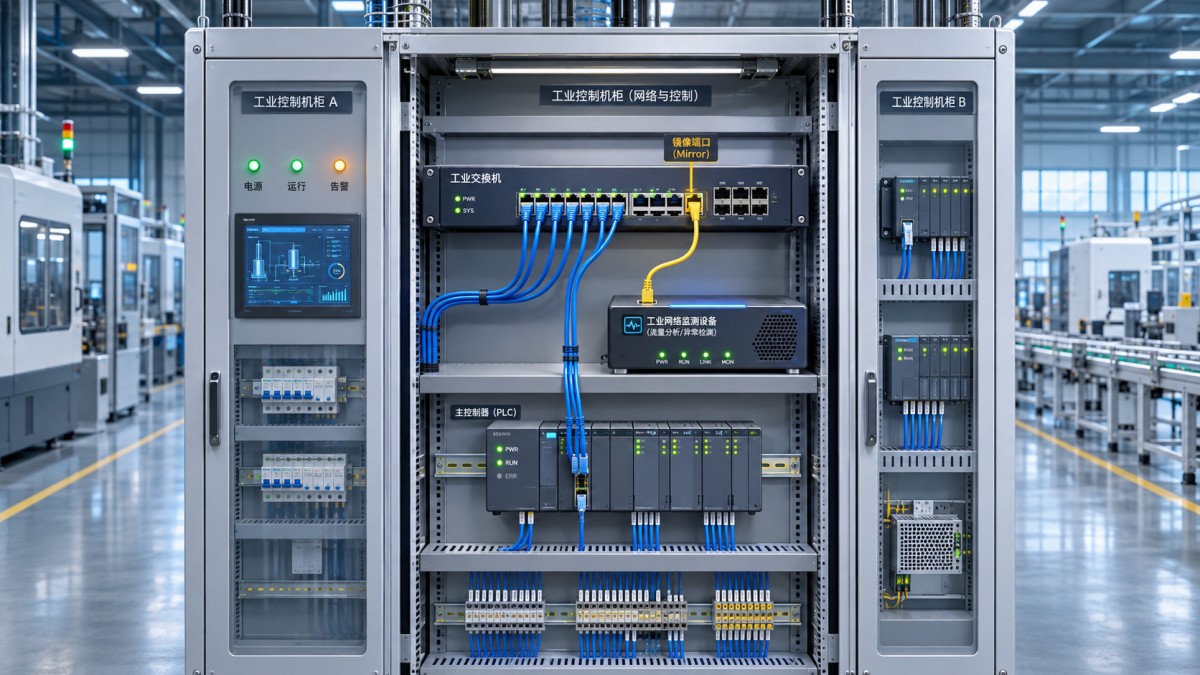
Before comparing detection features, draw the proposed observation points on a network diagram. Mark controllers, engineering workstations, operator interfaces, remote-access paths and connections to supervisory systems. Then identify which communications traverse each monitored link and which bypass it. Include wireless links, temporary maintenance connections and redundant paths where relevant.
A mirror port is not a guarantee of complete capture. Oversubscription, filtering, switch configuration or sensor capacity can cause packets to be missed. A tap also has physical installation and compatibility implications; introducing one into a live link can require an outage or an approved maintenance window. Confirm how each device behaves on loss of power and how the monitoring connection is isolated from production traffic.
Test coverage against actual workflows
Ask the vendor to trace a small set of representative activities through the proposed architecture: an operator accessing a supervisory system, an engineer connecting to a controller, a remote supplier session and an approved configuration change. For each, establish whether the sensor can see the session, identify the protocol and distinguish the relevant action. If the answer depends on additional configuration, record that dependency rather than counting the capability as already available.
Encryption can protect communications while limiting passive inspection. A sensor may still see endpoints, timing and connection patterns, but it may not see the command inside an encrypted session. Do not assume that traffic decryption is acceptable or supported in a control environment; evaluate alternative evidence, such as access-gateway records or approved endpoint logs, alongside any associated operational and security costs.
Evaluate detection in the context of the process
Asset discovery is useful, but an inventory alone does not establish threat detection. A meaningful evaluation should examine whether the platform can interpret the industrial protocols and device roles present in the environment, including relevant versions and proprietary extensions. Ask to see which fields it parses and which alerts rely only on generic network behavior.
Consider the difference between observing a connection to a controller and understanding what occurred within it. Depending on protocol visibility, a platform may identify a programming action, a mode change or a write command. It may not know whether that action was authorized, whether the change was safe for the process or whether it succeeded. Request the underlying evidence for each alert, not just the alert label.
Behavioral baselines need the same scrutiny. A new communication path or command can be suspicious, but it can also reflect a scheduled maintenance task, a product changeover or a rarely used recovery procedure. Ask how the system handles infrequent legitimate activity, how rules are tuned and whether an analyst can explain why an event was flagged. A baseline built during an unrepresentative period can normalize unwanted activity or generate excessive alerts later.
For a practical test, use approved historical traffic or a controlled, authorized activity that reflects the environment. Define the expected observation beforehand: which asset, communication, command or event should appear, and what evidence should accompany it. Avoid generating live control commands solely to test a product unless operations has explicitly approved the method and its consequences.
Separate monitoring risk from response risk
Non-disruptive collection can be undermined by an aggressive response integration. A platform might monitor passively but also offer to disable a switch port, block a connection or isolate an endpoint. Those actions can interrupt operator access, engineering work or controller communications. During an initial deployment, keep automated enforcement disabled unless each action has been separately assessed and authorized.
Define who receives an alert, who validates it against current operations and who can approve containment. An incident affecting a control network may require preserving a process state or maintaining visibility before a network change is made. The security team should have an agreed route to operations personnel, including outside normal working hours where the facility requires it.
Integration with a security information and event management system or ticketing platform should also be tested for failure behavior. A full log queue, unavailable collector or broken connection should not impair control traffic. Verify whether the sensor buffers events, drops them or generates a health alert, and establish who investigates missing telemetry.
Run a controlled evaluation before expanding
A pilot should answer deployment questions as well as detection questions. Choose a bounded segment that contains representative devices and traffic, but do not assume it represents every production cell. Obtain the current network diagram, confirm ownership of the switch or tap, and agree on a maintenance window for any physical or configuration changes.
- Set the operating boundary. Document which interfaces are receive-only, which management connections are permitted, and whether polling, agents, scanning or automated response are disabled. Include vendor remote access and update paths.
- Establish a baseline. Record relevant switch and sensor health, traffic volume, packet-drop indicators where available, and known operating conditions before and after connecting the monitoring equipment.
- Verify the traffic feed. Check that expected source and destination devices, protocols and directions of traffic are present. Compare observed traffic with the network diagram and investigate missing paths.
- Review detection evidence. Examine approved test events and ordinary operational activity with both security and operations staff. Record missed observations, ambiguous alerts and any tuning needed to make alerts actionable.
- Exercise failure and removal plans. Determine what happens if the sensor, management connection or upstream collector fails. Confirm the procedure for disconnecting the monitoring system and restoring the prior configuration.
Acceptance criteria should be agreed before the pilot begins. They might include visibility into specified links and protocols, no unauthorized active traffic, demonstrable alert evidence, acceptable resource use and a documented escalation route. The criteria should also state what remains unmonitored. An evaluation that discovers a blind spot is useful; presenting that blind spot as covered is not.
Questions to settle before selection
Ask for a deployment-specific bill of components and data flows rather than relying on a high-level architecture diagram. Determine where packet data and logs are stored, which personnel can access them, how long they are retained and whether traffic leaves the site. Industrial captures can reveal network topology, device identities and operational details even when they do not contain credentials.
Review ongoing maintenance as carefully as installation. Detection content, software updates and protocol parsers may change; establish how updates are tested, approved, scheduled and rolled back. Confirm support for the actual switch hardware, operating systems and industrial protocols in use, and identify any dependencies on device suppliers or existing support agreements.
Finally, compare the evidence against the operational constraint that prompted the evaluation. A passive system with incomplete visibility may be the safer initial choice for a fragile segment, provided its gaps are explicit. A richer collection method may be justified elsewhere after compatibility testing and approval. The defensible selection is the one whose detection coverage, operational interactions and response limits can all be demonstrated in the intended environment.
Deep Dive
Related Intelligence
 Cyber SecurityDo High-Net-Worth Buyers Prioritize Cyber Security Certifications When Sourcing Smart HVAC Controllers?Analyst:IT & Security Director
 Cyber SecurityWhat cybersecurity risks arise when integrating POS systems with building management platforms?Analyst:IT & Security Director
 Cyber SecurityHow do cyber security frameworks like NIST CSF apply to smart HVAC control networks in high-rise buildings?Analyst:IT & Security Director