How to verify EN 12810 compliance when buying scaffolding wholesale
Key Takeaways
- How to verify EN 12810 compliance when buying scaffolding wholesaleChief Civil Engineer
- OpenRouter Removes Three AI Inference Providers After Prompt TheftIT & Security Director
- How to verify supplier credentials in global chemical sourcingLead Materials Scientist
- National Cybersecurity Standards Committee Seeks Feedback on Three GuidelinesIT & Security Director
- How to verify specialty chemical exporters in IndiaLead Materials Scientist
- Trump Fires National Cyber Director, Names Kirsten Davies Acting DirectorIT & Security Director
- Can mobile POS systems accept payments without internet access?IT & Security Director
- Malaysia and US Deepen Sovereign AI Cloud Cooperation, With $50 Million in US SupportIT & Security Director
Industry Overview
We do not just publish news; we construct a high-fidelity digital footprint for our partners. By aligning with TNE, enterprises build the essential algorithmic "Trust Signals" required by modern search engines, ensuring they stand out to high-net-worth buyers in an increasingly crowded global digital landscape.
The lowest quotation for EN12810 scaffolding wholesale is useful only when it covers a system supported by evidence for the intended configuration. A certificate for a related product, a single load figure, or a sample test report cannot establish that the frames, decks, braces, ties, and accessories in the order work together as claimed. Resolve those differences before comparing delivered costs.
Ask for a document package that connects the named scaffold system to its components, tested configurations, classification, and assembly instructions. Then compare that package with the proposed bill of materials and the conditions on site. The result should be a traceable basis for acceptance, not simply a folder of certificates.
Define the scaffold configuration before reviewing certificates
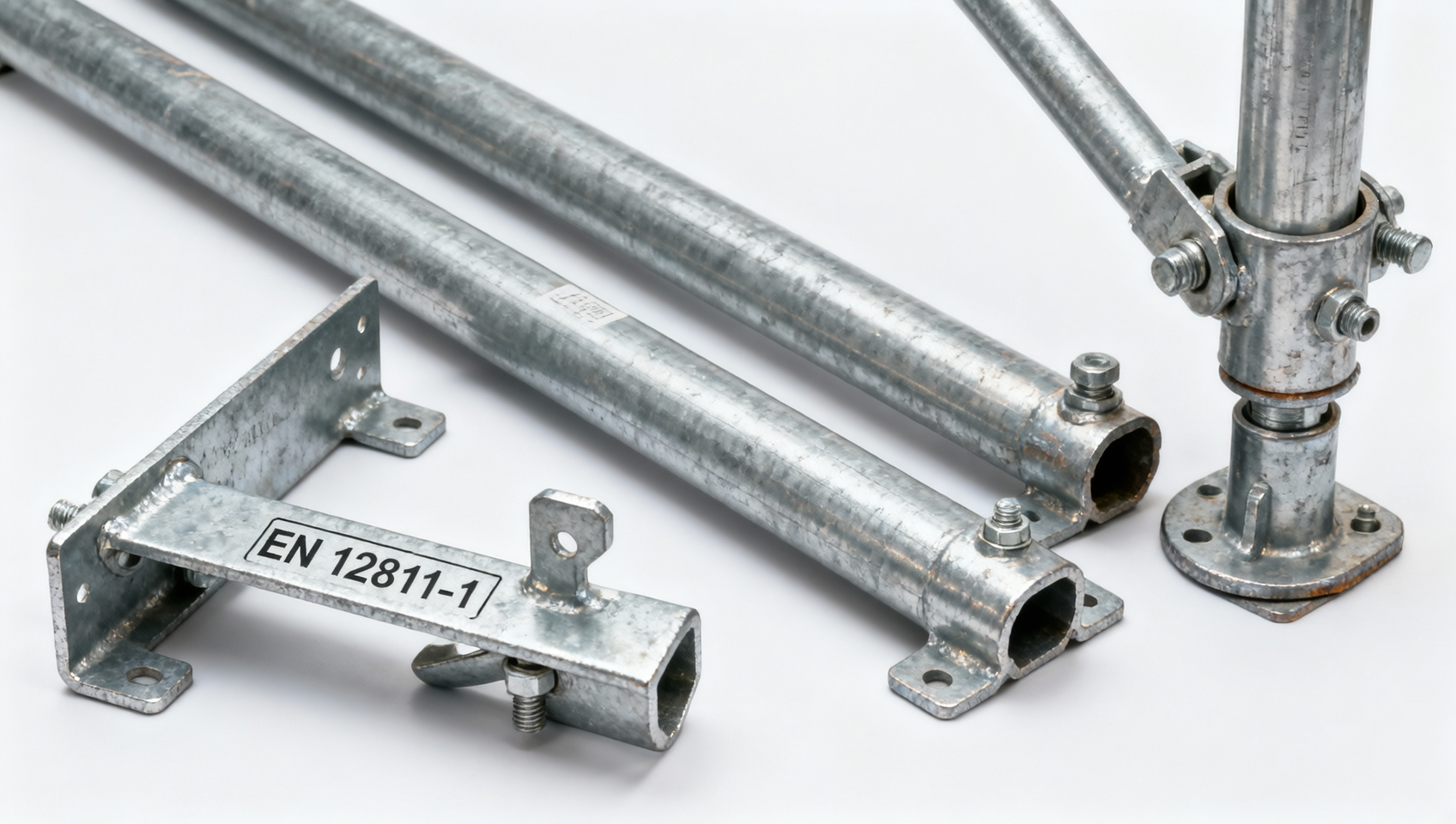
EN 12810 concerns prefabricated facade scaffolds and is structured around product specifications and particular methods of structural design. The relevant edition and applicable national requirements should be identified for the destination and contract. EN 12810 evidence also needs to be read alongside the applicable requirements for temporary works equipment, including EN 12811, where referenced. A supplier’s declaration of conformity, an independent assessment, and a legal approval are different forms of evidence; their status must be established for the market and project.
Describe the intended scaffold in enough detail to make the evidence review meaningful. Working height alone is insufficient. Record the bay lengths, lift heights, working widths, intended access, deck arrangement, loading, facade geometry, and proposed anchorage. State whether sheeting, netting, loading platforms, brackets, or protective fans are required: these features can alter forces and invalidate assumptions used for a basic arrangement.
System classification describes a defined configuration. A load class attached to a catalogue entry does not mean every deck, bay length, bracket, and working level in the quotation can carry that load under every site condition. Obtain the configuration and loading assumptions behind the classification, including any limits on the number of loaded working levels.
Connect certificates to the exact system being purchased
Request the complete certificate or assessment document, including schedules and appendices, rather than a cropped cover page. The issuing body, certificate holder, system designation, scope, status, and any conditions or exclusions should be visible. Confirm validity and scope through the issuer where a verification service is available; otherwise, request confirmation directly from the issuing body.
A certificate held by a trading company does not automatically cover goods from every factory it uses. Match the named manufacturer and production arrangements to the order, and resolve discrepancies in legal names, addresses, and system names. A change of manufacturer, component design, material grade, or production location warrants evidence that the certificate still applies. The precise effect of a change is determined by the issuer’s scheme and the document’s scope.
Read the document type carefully. A certificate may cover a product system, a factory production control process, or a management system. Each answers a different question. A management-system certificate alone does not establish that a scaffold design meets EN 12810. Similarly, a supplier declaration identifies the party making a claim; it does not by itself demonstrate independent certification.
Read test reports in the context of the complete system
Test reports should identify the laboratory, test method, specimens, relevant dimensions, and results. Compare specimen details with the ordered parts: a frame of a different section, a deck with a different hook, or an altered connection can behave differently even when the parts look interchangeable. Where a report uses a component family, obtain the basis for applying its results to the particular variants offered.
Distinguish an individual component test from evidence for the assembled arrangement. Deck capacity, frame strength, connector behavior, and overall stability address different failure modes. A strong deck cannot compensate for inadequate bracing or anchorage. Likewise, a connector’s reported resistance needs to be interpreted in the direction and arrangement in which it was tested.
Compare the supplier’s stated load class with the manual and supporting assessment. Concentrated loads, distributed working loads, and the total load on a scaffold are not interchangeable figures. If materials will be stored on decks or moved onto a loading platform, identify those actions separately and obtain a design check for the relevant arrangement.
Ask what happens when a standard arrangement changes. Removing a brace to clear an opening, extending a base jack, adding a side bracket, or tying into a different substrate can change the load path. The manual may permit a defined variation; arrangements outside its scope require an appropriate site-specific design and verification.
Match component markings and materials to the order
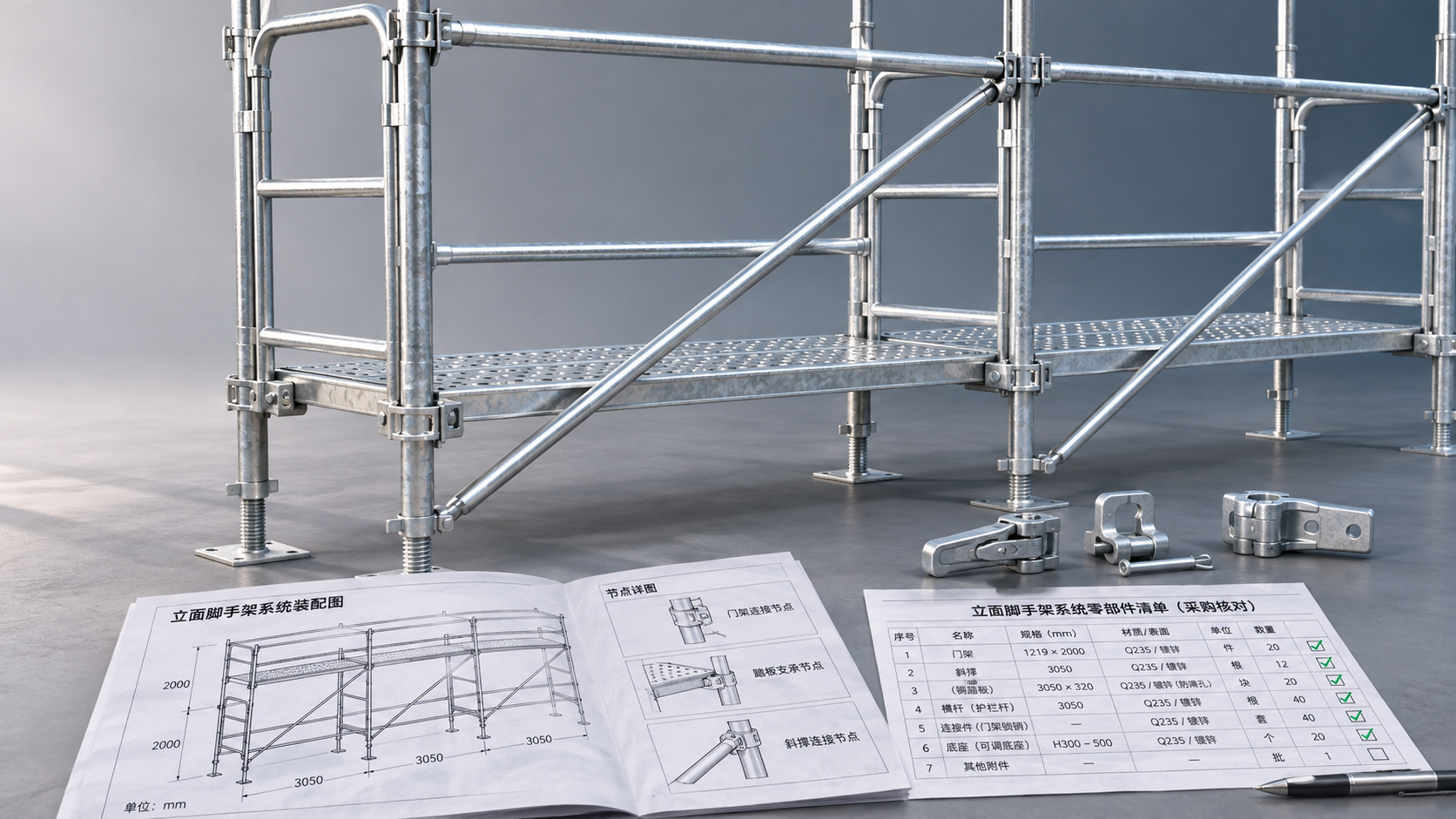
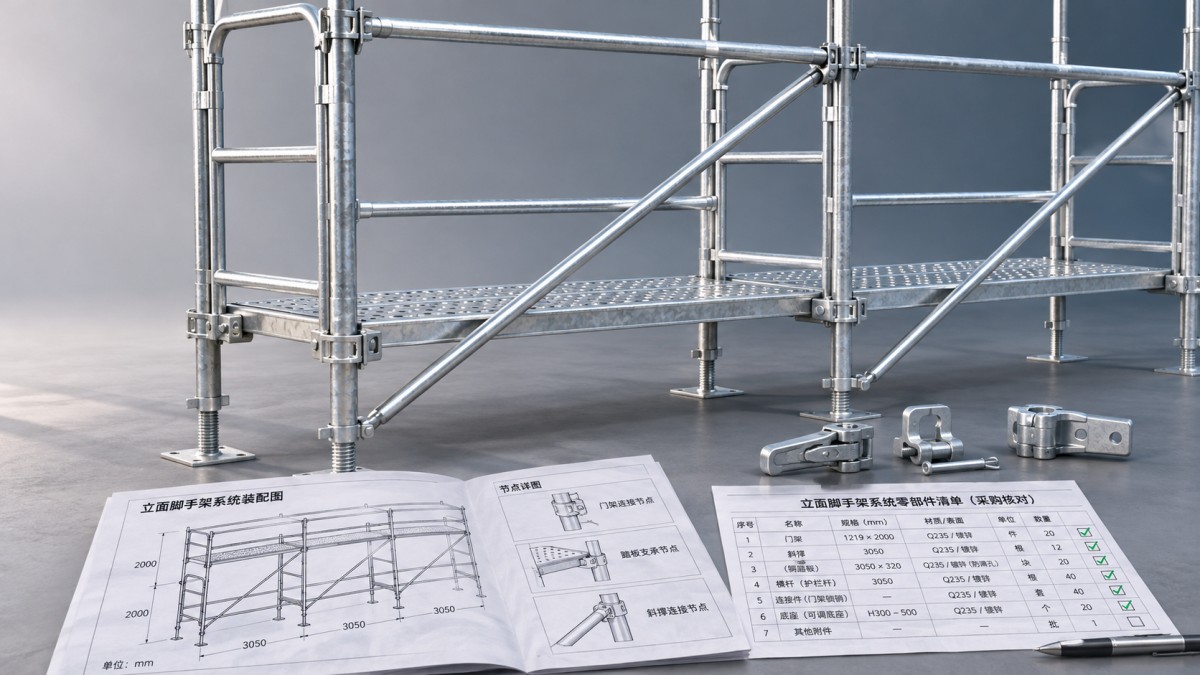
Obtain a component schedule with descriptions, part numbers, dimensions, and materials for frames or standards, ledgers, diagonal braces, decks, base plates, adjustable jacks, guardrails, toeboards, and access units. Include couplers, ties, anchors, and any accessories supplied as part of the quotation. The schedule should identify which items belong to the documented system and which require separate evidence or design confirmation.
Inspect markings against the technical documentation and the requirements applicable to the products. Markings can help trace an item to a manufacturer or system, but their presence alone does not prove conformity. Agree on the traceability records available for each component and batch, including how unmarked or small items will be identified at receipt.
- For steel parts, compare the specified material and section dimensions with the relevant drawings and available material records. A similar tube diameter alone does not establish equivalent performance.
- For aluminum decks or frames, confirm the identified alloy and component design where specified, along with the permitted spans and supports.
- Review weld locations, connection geometry, and coating requirements in the approved documentation. Coating thickness or appearance is not a substitute for evidence of structural capacity.
- Where timber or composite deck elements are included, obtain the applicable material, protection, inspection, and replacement requirements.
Mixed-source components deserve particular scrutiny. A coupler or deck that physically fits a frame can introduce different tolerances, stiffness, or load transfer. Substitution requires documented compatibility and, where necessary, a revised design assessment. Record approved alternatives by part number rather than accepting a general statement that components are compatible.
Review assembly instructions against site conditions
The technical manual should show the arrangements covered by the system, including bracing, tie patterns, access, guardrails, base arrangements, and permitted working platforms. Compare those drawings with the intended facade and the actual bill of materials. Missing ties or braces can make an apparently inexpensive package incomplete.
Pay close attention to assumptions about the supporting structure. Scaffold tie forces must be transferred into a suitable substrate through an appropriate anchorage; a documented tie pattern does not prove that a particular wall or fixing can resist those forces. Where the facade condition is uncertain, arrange substrate assessment and anchor verification before finalizing the design.
Wind exposure also changes the assessment. Netting and sheeting can increase wind loads, while openings, corners, and building geometry affect the forces and tie arrangement. Confirm whether the supplied documentation covers the intended enclosure and exposure. If it does not, obtain the necessary project-specific engineering before installation.
Ground conditions matter at the base. Adjustable jacks accommodate limited variation in level, but their extension and the bearing capacity of the ground affect stability. The site design must address base plates, sole boards where required, and the allowable jack extension shown in the system documentation.
Compare wholesale costs on an equivalent scope
Normalize quotations to the same scaffold geometry and operating assumptions before comparing unit rates. A price per tonne or per square metre can conceal differences in deck coverage, access, guardrails, ties, and the number of braces included. Request an itemized schedule that identifies quantities and part numbers, then cost the missing items needed for the specified arrangement.
Separate the initial supply price from costs needed to put the system into service. These can include freight, unloading, storage, design work, anchor verification, local documentation, inspection, and replacement parts. If a quotation excludes ties or assumes an unbroken facade, the apparent saving can disappear when the actual site layout is designed.
Delivery terms also affect the comparison. Confirm the delivery point, packing method, responsibilities for unloading, and treatment of damaged or short-shipped components. Ask how long replacement parts and matching accessories are expected to remain available, and record the basis of that commitment in the purchasing terms. A low initial price is difficult to evaluate if a damaged deck later requires a change to the documented system.
Set a clear rule for substitutions after award. A replacement component should be reviewed against the same system designation, technical evidence, and intended configuration as the original part. Unapproved substitutions discovered during erection can delay handover while compatibility is assessed or replacement stock is sourced.
Set acceptance conditions before delivery
Attach the agreed component schedule and document list to the purchase order. Identify the applicable standard edition, system designation, configuration assumptions, required documentation language, and evidence to be supplied before dispatch. Specify that changes to the manufacturer, production source, part numbers, or design require written review before shipment.
At receipt, reconcile quantities and markings with the delivery documents and approved schedule. Inspect for transport damage, deformation, damaged hooks, weld defects, and coating damage that affects the agreed acceptance criteria. Segregate questionable parts so they are not mixed into stock while their identity or condition is resolved.
Keep the certificate, reports, manual, approved substitutions, and delivery records linked to the order. This makes later inspection and replacement decisions easier, particularly when several scaffold systems are stored together. The final acceptance record should identify outstanding discrepancies and the evidence used to close them.
Deep Dive
Related Intelligence
 Site EquipmentConcrete batching plants with automated slump control — how accurate is it in humid climates?Analyst:Chief Civil Engineer
 Site EquipmentScaffolding wholesale: why EN 12811-1 compliance doesn’t guarantee site-level stabilityAnalyst:Chief Civil Engineer
 Site EquipmentConstruction cranes with AI-assisted load monitoring — what happens during signal loss?Analyst:Chief Civil Engineer