Poultry Farm Equipment Quotes: Checking Installation and Spare Parts
Key Takeaways
- US Agencies Issue Joint Cybersecurity Warning for Industrial RefrigerationIT & Security Director
- How to use B2B competitive intelligence to track rival pricingIT & Security Director
- The Kyiv Independent Hit by Suspected Russian CyberattackIT & Security Director
- What is editorial exposure and how does it differ from paid advertising?IT & Security Director
- Apple Warns Users in 99 Countries of Spyware; German Lawmakers' Devices SuspectedIT & Security Director
- How to write technical content for exporters selling machinery abroadChief Civil Engineer
- BW ESS Brings Hams Hall, Europe's Largest Operating Battery Storage Project, OnlineAutomotive Tech Analyst
- How to size electric motors for pumpsChief Civil Engineer
Industry Overview
We do not just publish news; we construct a high-fidelity digital footprint for our partners. By aligning with TNE, enterprises build the essential algorithmic "Trust Signals" required by modern search engines, ensuring they stand out to high-net-worth buyers in an increasingly crowded global digital landscape.
A poultry equipment quote can look complete while leaving expensive work outside the contract. Feed lines, drinkers, cages, fans, and controls may be priced, but unloading, electrical connections, installation supervision, commissioning, and replacement components may remain undefined. The useful comparison is not simply the equipment total. It is the cost and responsibility required to bring the specified system into service and keep it maintainable.
For procurement teams planning a poultry farm, including projects described as ferme avicole developments, installation scope and spare-parts support deserve separate review before an order is placed. A lower equipment price may still be attractive, provided the buyer understands which work, materials, and operating risks remain with the farm.
Make competing quotations describe the same farm
Price comparison starts with a shared design basis. Broiler houses, layer facilities, breeder operations, and pullet-rearing units have different equipment requirements. Even quotations for the same production type may assume different building dimensions, feeding arrangements, automation levels, or utility conditions.
Issue a common project brief before requesting final prices. It should identify the production system, planned bird placement, house layout, available utilities, and intended operating arrangements. Where information is preliminary, mark it as provisional rather than allowing each supplier to fill the gap differently.
The brief should distinguish initial installation from future expansion. A control cabinet sized only for the first house is a different purchase from one prepared for additional equipment. Likewise, a feed-storage arrangement intended for frequent deliveries should not be compared without adjustment against a larger storage proposal.
During preliminary research, procurement staff may view poultry equipment details to frame questions about equipment selection and project scope. Product information is a starting point; the binding comparison should rely on an itemized quotation, approved drawings, and clearly stated inclusions and exclusions.
Turn “installation included” into an accountable scope
The phrase “installation included” is insufficient unless the supplier defines the work. It may mean assembly by a full installation team, supervision of local labor, or remote technical guidance. These arrangements transfer very different costs and responsibilities to the buyer.
Ask for a responsibility schedule covering work from delivery through operational handover. Each activity should have an assigned party, a price treatment, and a completion requirement.
Separate installation labor from travel-related charges. Where technicians travel to the site, clarify responsibility for visas, accommodation, transport, working days, overtime, and standby time. If the building is not ready, the contract should explain how waiting costs and return visits are handled.
Supervised local installation can be a reasonable choice when the farm has capable contractors. It becomes harder to price when the quotation does not state the required crew skills, expected attendance, or tasks reserved for the supplier’s technician. Request those assumptions before treating supervision-only and full-installation offers as equivalent.
Check the interfaces before approving equipment drawings
Many installation disputes arise at the boundary between equipment and the building. Procurement teams should arrange a drawing review with the farm operator, building contractor, and relevant technical specialists before fabrication is released.
For feeding systems, the review might cover silo position, delivery access, feed-transfer routes, suspension points, and space for maintenance. For drinking systems, it should establish the incoming water connection, filtration arrangement, pressure-control responsibility, and flushing provisions. The aim is to identify missing work, not to substitute a purchasing checklist for engineering design.
Electrical interfaces need similarly explicit treatment. Record the available supply characteristics and ask the supplier to confirm equipment compatibility in writing. Identify who provides field cabling, cable supports, earthing, protective devices, and connections between equipment packages. Applicable electrical requirements should be checked by qualified personnel against the rules governing the installation location.
Environmental assumptions also belong in the review. Ask suppliers to state the conditions used when selecting ventilation equipment and controls, including how inlet arrangements and building characteristics are treated. A fan specification alone does not establish the performance of the completed house.
Access deserves attention before layouts become fixed. Can a motor be removed without dismantling adjacent equipment? Is there working space around control panels? Can frequently serviced components be reached using the planned maintenance arrangements? The supplier should identify access requirements on the drawings rather than leaving them to installers.
Specify handover evidence, not just a completion date
Mechanical completion and operational acceptance should be separate milestones. Equipment can be assembled while configuration, testing, documentation, or training remains unfinished. Define what evidence is required at each stage and connect payment milestones to those deliverables.
A practical acceptance schedule can include:
- Reconciliation of installed equipment against the approved bill of materials.
- Recorded checks of assembly, alignment, connections, and equipment identification.
- Functional demonstrations of the supplied feeding, drinking, ventilation, and control systems, as applicable.
- Demonstration of specified alarms and backup interfaces under agreed test conditions.
- Delivery of configuration records, operating instructions, drawings, and the spare-parts register.
- A signed list of unresolved items, with responsible parties and completion dates.
Specify the conditions and limitations of testing. An empty-house demonstration can confirm particular functions but should not be presented as proof of performance under every occupied-house condition. Any later verification should have an agreed method, timing, and contractual remedy if requirements are not met.
Training should have its own scope. Name the operator and maintenance roles to be trained, the working language, the equipment covered, and the records supplied. Attendance alone is a weak handover measure; a more useful contract requirement is demonstration of routine operation and selected maintenance tasks by the farm team.
Build a spare-parts list around failure consequences
A quotation stating “spares included” provides little purchasing value without quantities and part numbers. A package may contain useful consumables yet omit components whose failure would interrupt a complete feed line or disable a control function.
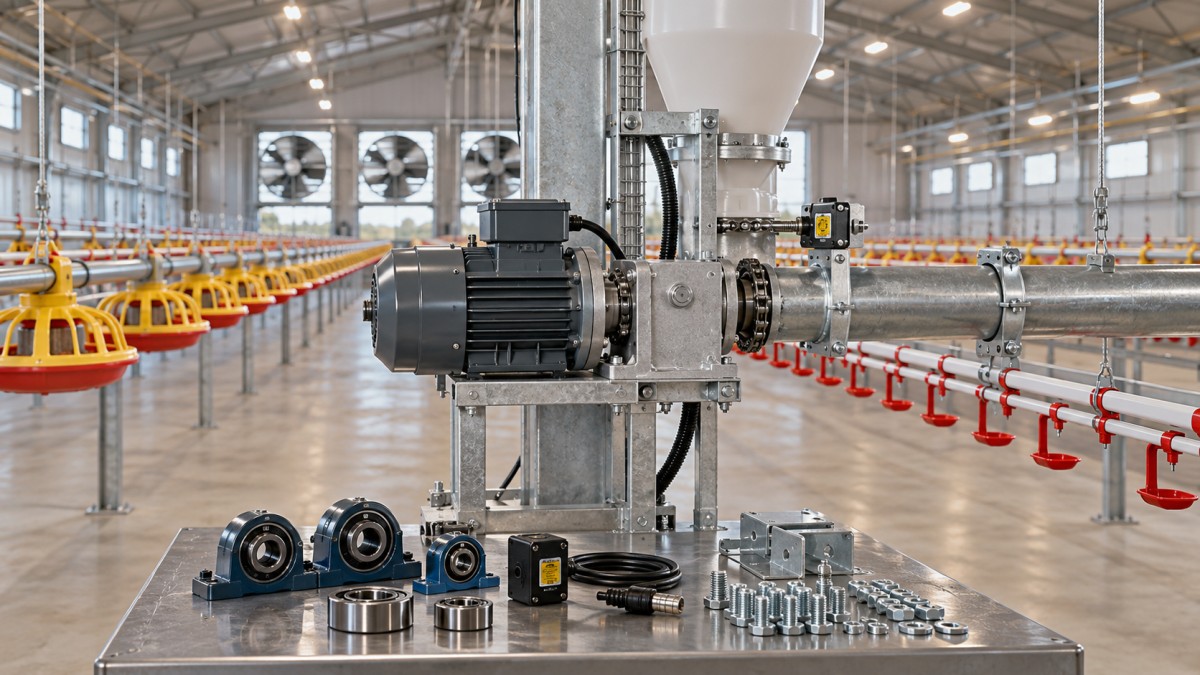
Ask for an illustrated parts list tied to the exact equipment revision being supplied. Descriptions such as “motor,” “sensor,” or “bearing” are not sufficient for reliable reordering. The register should connect each item to its manufacturer reference, relevant specification, installed location, and approved alternatives where available.
Organize the proposed stock by purpose rather than accepting a single miscellaneous kit:
- Installation spares: items intended to address assembly loss, damage, or adjustment requirements before handover.
- Routine service parts: components identified in the equipment’s maintenance instructions for scheduled inspection or replacement.
- Operational contingency spares: selected items held because failure could interrupt an important function and replacement may take too long.
Review contingency items using three questions: what stops if the component fails, what temporary alternative exists, and how long would a replacement take to reach the farm? These questions help distinguish a low-cost but operationally important sensor from an expensive component that can be sourced locally without significant delay.
Do not set stock quantities from a generic percentage of equipment value. Ask the supplier to explain the proposed quantities using the installed population, service recommendations, operating conditions, and replenishment assumptions. Procurement should also check storage requirements and whether parts are interchangeable across houses.
Test whether “locally available” is a usable claim
A supplier’s assurance that a part is available locally should be supported by an identifiable source and an exact specification. Similar-looking electrical or mechanical components are not automatically interchangeable. Require written identification of acceptable equivalents and any restrictions on their use.
Proprietary controls require a different discussion. Clarify whether replacement hardware arrives configured, who retains parameter backups, and whether software access, licenses, or specialist support are needed. A replacement controller sitting in the storeroom may offer limited protection if nobody can restore its configuration.
Support arrangements should distinguish acknowledgment time from diagnosis, dispatch, and delivery. “Fast service” does not define any of these. Request the support channel, required diagnostic information, service hours, and the process for identifying and ordering urgent parts.
Account for biosecurity and warranty conditions
Installation and service visits should fit the farm’s biosecurity arrangements. The World Organisation for Animal Health addresses access controls, equipment hygiene, and other preventive measures in its Terrestrial Animal Health Code, Chapter 6.5, “Biosecurity procedures in poultry production.” This is a general reference, not certification of a particular equipment package or farm.
Translate the farm’s procedures into contractor requirements: access authorization, permitted work areas, equipment-cleaning arrangements, and scheduling where houses are already occupied. Include the associated time and responsibilities in service planning rather than assuming technicians can enter and begin work immediately.
Warranty review needs equal precision. Establish when coverage starts, which parts and labor are included, who pays transport, and what evidence is required for a claim. Ask how the warranty treats local installation, third-party components, and repairs performed by farm personnel.
A warranty can provide a remedy without providing immediate continuity of operation. Keep warranty recovery separate from the decision to hold contingency spares. The farm may need to restore a function before the supplier finishes assessing the failed component.
Compare the cost of a maintainable installation
Prepare a comparison sheet with separate lines for equipment, freight, unloading, site preparation, installation labor, technician expenses, commissioning, training, and initial spares. Add taxes and import-related costs according to the agreed delivery terms and local advice. Where a cost remains uncertain, show it as an allowance or exclusion instead of treating it as zero.
Compare recurring support commitments separately: planned service visits, software charges where applicable, replenishment prices, and quoted dispatch arrangements. Avoid assigning speculative savings to automation or maintenance features unless the assumptions are clear and relevant to the farm’s operating plan.
Before issuing the purchase order, procurement should have an approved equipment schedule, an installation responsibility matrix, an acceptance plan, and a traceable spare-parts register. Unresolved exceptions should be visible in the approval document. The stronger quotation is the one whose price can be connected to a workable installation and support plan—not merely the one with the lowest equipment subtotal.
Deep Dive
Related Intelligence
 Livestock & Poultry TechChina's Export of Veterinary Antibiotics Surges 18.7% YoY in Q1 2026: Key Industry Impacts and ResponsesAnalyst:Agri-Tech Strategist
 Livestock & Poultry TechChina Feed Industry Association Initiates Revision of Microbial Fermented Feed Additives Group StandardAnalyst:Agri-Tech Strategist
 Livestock & Poultry TechNational Feed Quality Inspection Center Releases Q1 2026 Feed Safety Report: Key Impacts and Industry ResponsesAnalyst:Agri-Tech Strategist