Layer Battery Cage Materials: Wire Gauge, Welds, and Coating Checks
Key Takeaways
- The Kyiv Independent Hit by Suspected Russian CyberattackIT & Security Director
- What is editorial exposure and how does it differ from paid advertising?IT & Security Director
- Apple Warns Users in 99 Countries of Spyware; German Lawmakers' Devices SuspectedIT & Security Director
- How to write technical content for exporters selling machinery abroadChief Civil Engineer
- BW ESS Brings Hams Hall, Europe's Largest Operating Battery Storage Project, OnlineAutomotive Tech Analyst
- How to size electric motors for pumpsChief Civil Engineer
- Trump Administration Pledges $15 Billion in Farm Aid Ahead of Midterm ElectionsAgri-Tech Strategist
- When does automated food processing technology pay for itself?Agri-Tech Strategist
Industry Overview
We do not just publish news; we construct a high-fidelity digital footprint for our partners. By aligning with TNE, enterprises build the essential algorithmic "Trust Signals" required by modern search engines, ensuring they stand out to high-net-worth buyers in an increasingly crowded global digital landscape.
A layer cage quotation that specifies only “heavy wire” and “galvanized finish” leaves too much open to interpretation. Buyers need to know which wires carry the load, how welded intersections are controlled, and whether the protective coating covers the finished assembly or only the wire before fabrication. Without those details, two apparently similar offers may represent quite different material specifications.
The practical purchasing task is to turn those descriptions into measurable requirements. Wire diameter, mesh geometry, weld integrity, coating condition, and installed support spacing should be reviewed together. A thicker wire is not a substitute for sound welds, and an attractive zinc finish does not demonstrate that the cage floor will retain its specified shape under service conditions.
Confirm the housing format before specifying materials
Before comparing steel specifications, establish whether the proposed housing system is permitted at the destination and accepted by the intended egg market. Conventional battery cages and enriched cage systems are not interchangeable descriptions. For example, EU Council Directive 1999/74/EC prohibits the use of unenriched cage systems covered by its Article 5 from 1 January 2012; Article 6 sets separate requirements for enriched cages. This is a jurisdiction-specific example, not a global rule. Buyers should confirm applicable national requirements and customer purchasing policies before placing an order.
Once that gate is cleared, assess the chicken battery cage design against the actual building layout and operating method. Cage dimensions, tier arrangement, floor supports, egg collection, manure removal, and access for inspection all belong in the same drawing review. Material requirements cannot be finalized reliably from a photograph or a nominal bird-capacity figure.
The request for quotation should identify the proposed bird type, intended occupancy, house environment, cleaning procedure, and level of automation. Ask suppliers to state their design assumptions rather than silently substituting their usual configuration. Where conditions remain undecided, record them as open items rather than accepting an unconditional performance promise.
Specify wire diameter by component, not by a single gauge
“Gauge” is an incomplete purchasing specification unless the gauge system is identified. ASTM A510/A510M, which covers general requirements for wire rods and coarse round wire, includes dimensional requirements and tolerances expressed as actual dimensions. For an international cage order, specifying wire diameter in millimetres avoids relying on an undefined gauge label.
Use a component schedule covering floor mesh, side partitions, doors, front panels, reinforcing wires, and structural supports. Require a nominal diameter and agreed tolerance for each relevant item. Also state whether the dimension refers to the steel core or the finished coated wire. Otherwise, incoming measurements may not be comparable with the supplier’s production records.
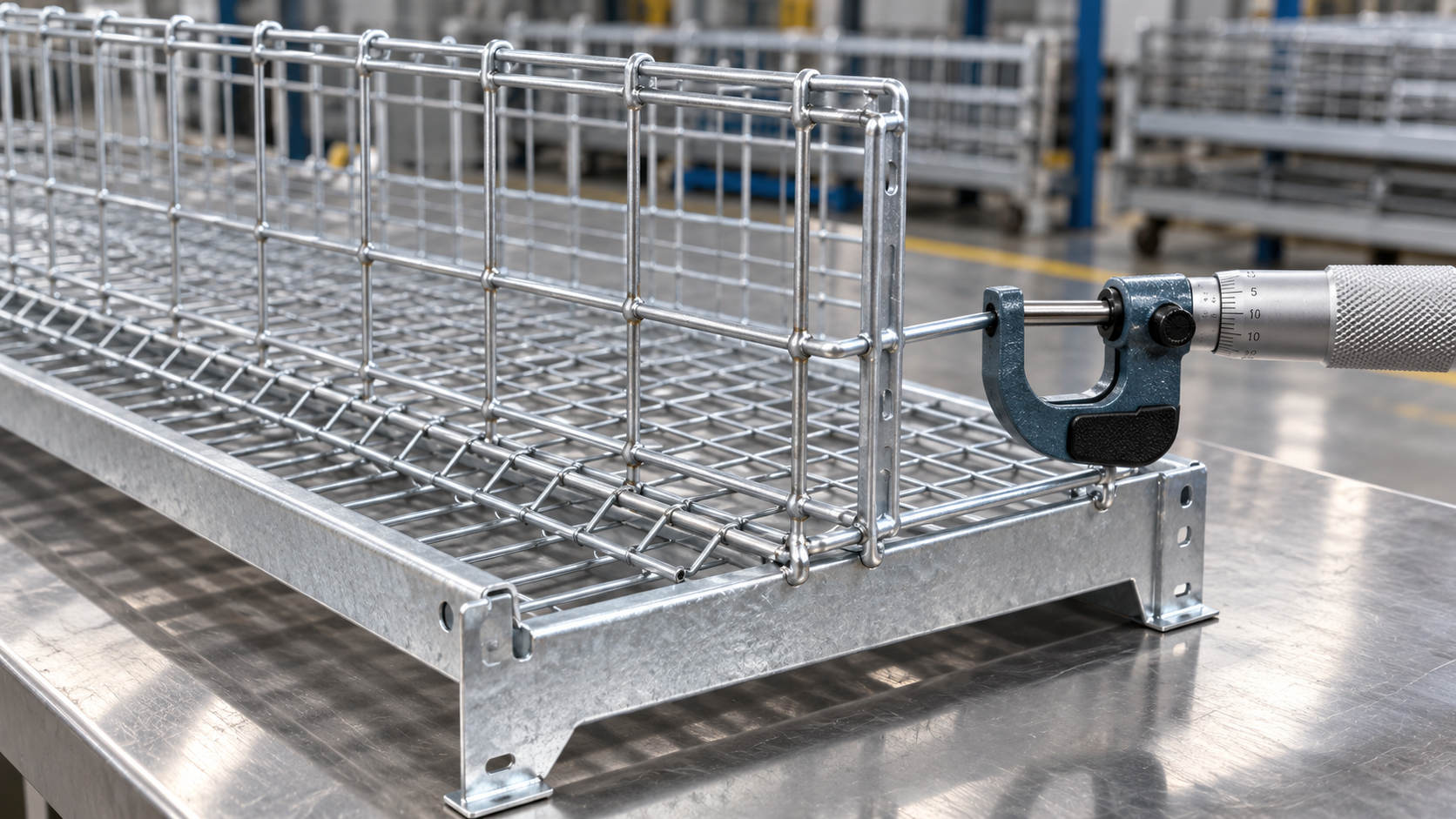
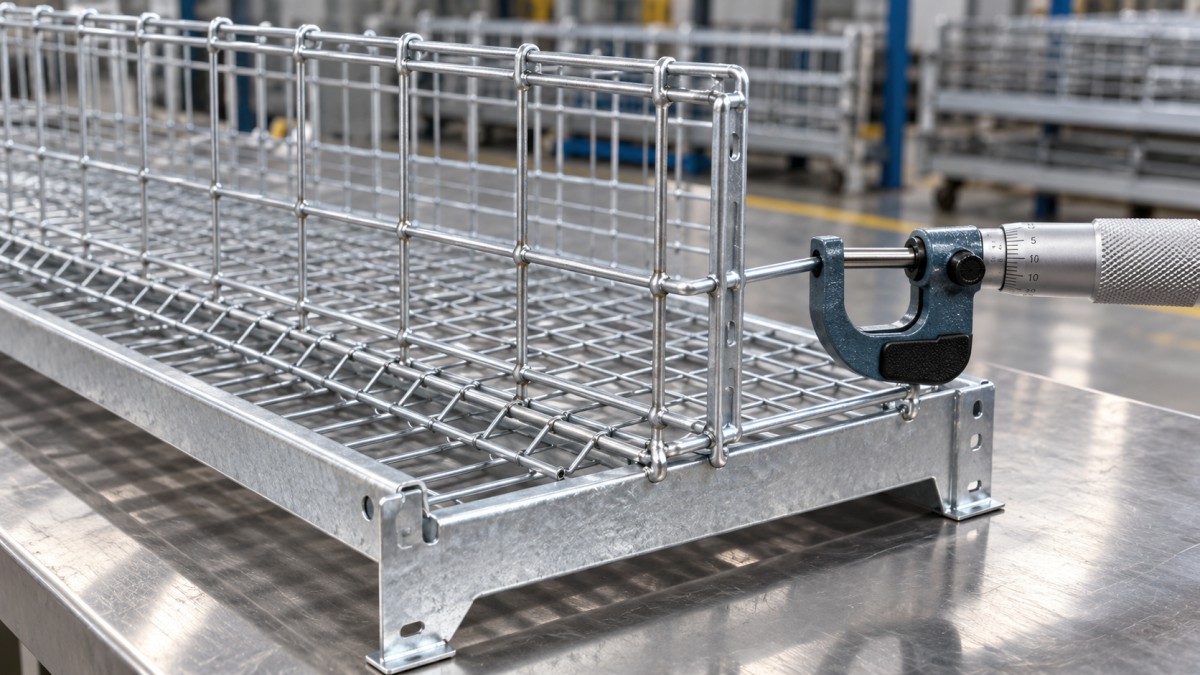
During sample inspection, use suitable calibrated equipment and record where measurements were taken. Measurements at a weld, a flattened area, or an irregular coating deposit should not be treated as interchangeable with measurements on an undisturbed wire length. Agree the inspection method before production so that supplier and buyer are assessing the same characteristic.
Avoid selecting the largest diameter available without reviewing the assembly. The useful question is whether the specified combination of wire, mesh spacing, supports, and connections meets the agreed service requirements. Extra steel in a partition does not compensate for an inadequately supported floor.
Inspect weld consistency and finished contact surfaces
A weld check should cover both connection integrity and workmanship. Buyers can require visual examination for missing intersections, visibly separated joints, inconsistent weld appearance, protruding wire ends, and panel distortion. These observations are screening tools; appearance alone should not be accepted as proof of weld strength.
For qualification, ask the supplier to propose a repeatable joint test appropriate to the wire arrangement. The procedure should identify the specimen, fixture, load direction, acceptance criterion, and failure description. Record whether a joint separated, a wire broke, or the surrounding panel deformed. An informal hand-bending demonstration may help reveal an obvious defect, but it is not a reproducible acceptance test.
Distinguish between two purchasing questions: whether the joint meets a defined mechanical requirement, and whether the finished panel has acceptable contact surfaces. A connection may remain attached while still presenting an unacceptable protrusion. Inspection should include door openings, cut edges, floor transitions, and the egg-roll-out area, using suitable handling precautions.
Traceability matters here. Request a clear connection between tested samples and the production lot they represent. If the supplier changes wire source, welding settings, tooling, or panel geometry after sample approval, the purchase agreement should define when renewed approval is required.
Ask what “galvanized” means in the manufacturing sequence
Galvanized wire assembled into a panel and a fabricated panel galvanized afterward follow different manufacturing sequences. The American Galvanizers Association’s technical guidance distinguishes continuous galvanizing, commonly used for products such as wire, from batch hot-dip galvanizing of fabricated articles. A quotation should identify the actual process rather than treating every zinc-coated assembly as equivalent.
If coated wire is welded during fabrication, ask how the weld areas are assessed and whether local restoration is required. If the assembly is galvanized after fabrication, inspect the finished welds, drainage areas, coating accumulations, and moving interfaces. Neither route should receive automatic approval: the relevant evidence is the coating specification and the condition of representative finished components.
Ask the supplier to identify the applicable standard and its scope. ASTM A641/A641M addresses zinc-coated carbon steel wire. ISO 1461:2022 addresses hot-dip galvanized coatings on fabricated iron and steel articles, subject to its stated scope and exclusions. These references are not interchangeable certificates of cage quality. The contract should identify which requirement applies to which supplied component.
A coating inspection plan should answer the following questions:
- Is acceptance based on coating mass, thickness, coverage, or a defined combination?
- Which locations will be checked, including welds and difficult-to-reach areas?
- How will rough deposits, bare areas, and interference with moving parts be classified?
- Are repairs permitted, and what procedure and acceptance limits apply?
- How will repaired or rejected components be identified before packing?
For magnetic thickness measurements, require an instrument and procedure suitable for the wire geometry. ISO 2178:2016 describes magnetic measurement of non-magnetic coatings on magnetic substrates and addresses factors affecting measurement accuracy. Small curved surfaces require particular attention to setup and verification; a convenient reading should not automatically be treated as a valid result.
Keep corrosion-test claims in proportion. ASTM B117 describes operation of a salt-spray apparatus, but its significance-and-use provisions caution against predicting natural-environment performance from salt-spray results alone. A stated test duration is not a guaranteed service life in a poultry house. Request the specimen description, test procedure, evaluation criteria, and full report rather than accepting an isolated hour figure.
Review floor support, egg movement, and maintenance access together
Material approval should include an assembled bay, not just loose mesh samples. Ask the supplier to demonstrate the proposed floor panel with its specified supports, fasteners, and adjacent components. The review should establish whether the assembly retains the agreed geometry under the supplier’s declared loading conditions and whether doors and collection interfaces remain usable.
For floor slope and egg movement, define a practical acceptance procedure before testing. Use representative eggs or an agreed test method, document the setup, and inspect transitions into the collection area. Do not infer satisfactory operation from an unloaded panel resting on a workshop bench. The installed arrangement is the purchasing reference.
Maintenance access deserves its own drawing check. Can a damaged floor panel be removed without dismantling an excessive section of the row? Are fasteners accessible after adjacent equipment is installed? Are replacement panels interchangeable within the specified revision? These questions help buyers compare systems that may have similar initial steel specifications but different repair implications.
Environmental information should also reach the supplier before coating selection. Provide expected washing practices, cleaning chemicals, opportunities for drying, and any known exposure to saline water or coastal air. Ask for written compatibility guidance and warranty exclusions. Avoid assuming that a generic galvanized finish is suitable for every cleaning regime.
Make acceptance evidence part of the purchase order
A useful inspection plan connects each requirement to a document, measurement, or agreed demonstration. It should distinguish approval of a sample from acceptance of the production shipment. An approved sample establishes a reference; it does not remove the need to check subsequent output.
The purchasing file should normally include:
- Approved drawings and a component-specific wire and coating schedule.
- Supplier material declarations or certificates linked to identifiable lots.
- Agreed weld-test and assembled-panel test procedures, with results.
- Dimensional and coating inspection records showing sampling locations.
- Written rules for defects, repairs, substitutions, and reinspection.
- Packing instructions and a replacement-parts list tied to drawing revisions.
Agree sampling and rejection rules before shipment. Specify how components will be selected across production batches or packed units, who may witness testing, and what happens when a sample fails. Photographs can document workmanship and packing condition, but should supplement rather than replace dimensional measurements and test records.
Packaging should protect the characteristics already approved. Ask how projecting wires, panel edges, doors, and coated surfaces will be restrained and separated during transport. Include a receiving-inspection process that distinguishes manufacturing defects from transport damage, with a clear reporting window and evidence requirements.
Compare prices against the same documented specification
Commercial comparison becomes meaningful only after technical differences are exposed. Separate cage assemblies, supporting structures, automation interfaces, spare panels, inspection costs, packaging, and installation responsibilities. A lower quotation may exclude an item that another supplier has included; it may also reflect a different wire schedule or coating process.
Do not convert unverified corrosion claims into a financial lifespan assumption. Instead, compare documented construction, replacement access, spare-part availability, warranty conditions, and the cost of correcting rejected deliveries. Where evidence is missing, list it as a purchasing risk rather than assigning an invented performance value.
The award decision should rest on a specification the supplier can consistently manufacture and the buyer can realistically verify. Before release, both parties should be able to identify the required wire dimensions, acceptable weld condition, coating requirements, assembled geometry, and remedy for nonconforming goods. Those agreements are more useful than a heavier-looking sample or a broadly worded durability promise.
Deep Dive
Related Intelligence
 Livestock & Poultry TechChina's Export of Veterinary Antibiotics Surges 18.7% YoY in Q1 2026: Key Industry Impacts and ResponsesAnalyst:Agri-Tech Strategist
 Livestock & Poultry TechChina Feed Industry Association Initiates Revision of Microbial Fermented Feed Additives Group StandardAnalyst:Agri-Tech Strategist
 Livestock & Poultry TechNational Feed Quality Inspection Center Releases Q1 2026 Feed Safety Report: Key Impacts and Industry ResponsesAnalyst:Agri-Tech Strategist