Wireless Livestock Monitoring: Which Data Points Matter Most on Large Farms?
On a large farm, the hard part is rarely getting more data. The hard part is deciding which signals are worth acting on when hundreds or thousands of animals are spread across multiple barns, paddocks, or grazing zones. That is where wireless livestock monitoring often becomes a selection problem instead of a simple technology purchase.
Many operations run into the same issue: a monitoring platform promises visibility, but not every metric improves herd decisions. If the wrong data points are prioritized, teams end up chasing alerts that do not matter, missing animals that do, or investing in devices that create more maintenance work than management value. For buyers comparing systems, the question is not which dashboard looks best. It is which data points consistently help prevent loss, improve timing, and reduce blind spots at scale.
Why this decision gets harder on large farms
Wireless livestock monitoring sounds straightforward until the size of the operation changes the economics of every decision. On a smaller site, staff can often compensate for weak data coverage through direct observation. On a large farm, that margin disappears. Distance, labor availability, weather exposure, and mixed herd conditions mean the monitoring system has to surface the right information early enough to matter.
A common mistake is evaluating sensors by the number of metrics they collect instead of the decisions those metrics support. More signals can look impressive during procurement, but on working farms the most valuable data points are usually the ones tied to daily intervention, breeding management, feed efficiency, welfare monitoring, and asset security. If a metric does not help a manager prioritize action, its value drops quickly.
This is why technical evaluators usually end up narrowing the list to a few practical questions: Can the system help locate animals quickly? Can it flag illness before symptoms become obvious? Can it show whether animals are eating, resting, moving, or cycling normally? And can all of that happen reliably across a large physical footprint without creating constant device failures or false alarms?
The data points that matter most in wireless livestock monitoring
Not every farm will rank these metrics in the same order, but for most large operations, a short list consistently matters more than the rest. These are the data points that tend to influence real decisions rather than just fill a dashboard.
1. Location and geofencing status
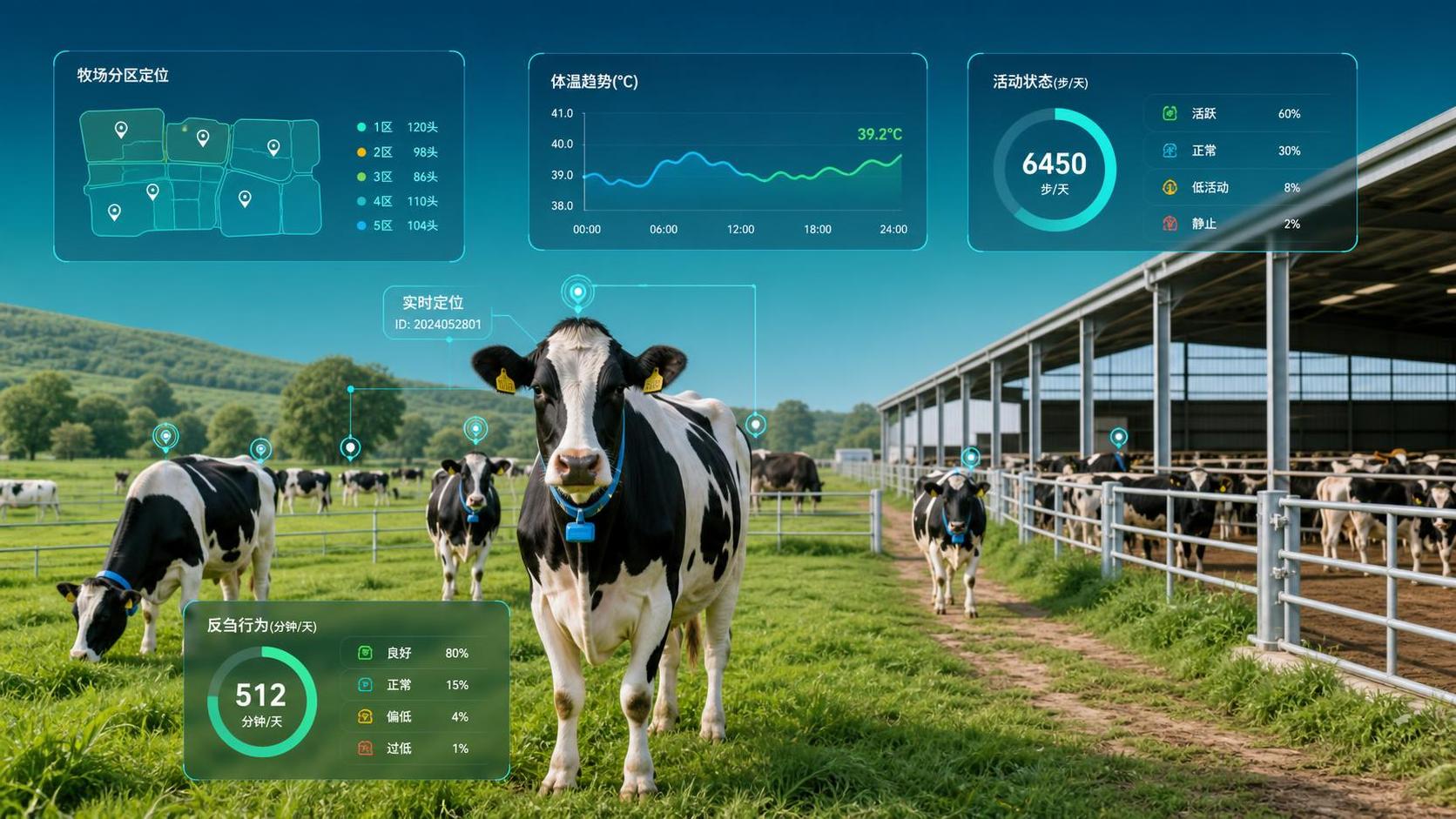
Location is usually the first filter because it supports both routine management and risk control. On extensive grazing operations, knowing where animals are within a paddock network, whether they have crossed a virtual or physical boundary, or whether a subgroup has stopped moving can save time and reduce loss. In confinement or mixed systems, location can also help verify whether animals are using designated feeding, watering, or resting zones as expected.
This metric matters most when retrieval time is costly, theft risk exists, fencing failures are possible, or sick animals need to be found quickly. For many farms, location is not the most biologically complex signal, but it is often one of the most operationally useful.
2. Body temperature or temperature trend
Temperature is valuable because it can indicate stress, infection, or recovery issues earlier than visual inspection alone. The key point for buyers is that temperature trend is often more useful than a single isolated reading. Large farms benefit when the system can highlight deviations from an animal's normal pattern rather than simply triggering on a broad threshold.
Temperature monitoring becomes especially important in herds where disease spread, calving complications, transport stress, or post-treatment follow-up are concerns. It should also be evaluated carefully, because temperature-based alerts can become noisy if sensor placement, environmental conditions, or reading intervals are not suitable for the production setting.
3. Activity and movement pattern
Activity data is one of the most flexible signals in wireless livestock monitoring because it supports several use cases at once. Sudden drops in movement may indicate lameness, illness, fatigue, or environmental discomfort. Unusually high movement may align with estrus, agitation, regrouping stress, or disturbance events. Over time, movement data also helps teams distinguish between healthy routine variation and behavior that deserves a closer look.
On large farms, activity becomes more useful when it is presented as trend-based insight rather than raw motion counts. Managers do not need a graph for every animal every hour. They need exceptions, comparisons, and confidence that the system can separate normal daily fluctuation from behavior that actually needs attention.
4. Rumination and feeding-related behavior
Rumination is often one of the strongest indicators of digestive health, feeding response, and general welfare, particularly in dairy and other ruminant systems. A drop in rumination can point to early health issues, ration changes, heat stress, or transition problems before those conditions become obvious during routine checks.
For selection purposes, this metric matters most when the operation wants to connect animal-level behavior with feed management and health surveillance. If feed costs are significant and the herd size makes manual observation inconsistent, rumination can become a high-value signal. It is less about watching every animal continuously and more about identifying deviations that justify intervention.
5. Breeding and estrus indicators
Breeding-related data has direct economic relevance because missed heats, poor timing, and delayed detection can quietly affect herd performance over long periods. Many large farms prioritize activity-linked estrus detection, but the best systems usually combine movement changes with other behavioral or physiological indicators rather than relying on one signal alone.
This is one of the clearest examples of why selection should focus on decision quality. An estrus alert is only useful if it is timely, interpretable, and trusted by the people scheduling breeding activity. A system that generates frequent doubtful alerts can create as much friction as one that misses events entirely.
6. Resting time and posture change
Rest patterns can reveal welfare and health issues that are hard to see across large groups. Changes in lying time, standing duration, or transitions between the two can support early identification of lameness, discomfort, overcrowding, bedding issues, or stress around environmental shifts. These signals are particularly useful when animals are housed in ways that make subtle visual changes difficult to spot.
Buyers should not treat this as a secondary luxury metric. In the right housing system, rest and posture data can be one of the fastest ways to detect a problem before productivity measures begin to slide.
Which signals are often overrated during system selection
When teams compare vendors, it is easy to overvalue novelty. Some data points sound advanced but add limited value if they are difficult to interpret, weakly validated in real farm conditions, or disconnected from farm workflows. This does not mean those metrics are useless. It means they should be ranked behind the core indicators that consistently support herd management decisions.
Three warning signs usually appear during evaluation. First, the platform emphasizes the quantity of measurements more than the quality of action those measurements enable. Second, the system produces highly granular data but weak prioritization logic. Third, the implementation burden is pushed back onto the farm team, which then has to decide what every signal means without operational guidance.
If your team is selecting wireless livestock monitoring for a large farm, it is usually better to have a reliable short list of high-confidence metrics than a long list of ambiguous ones. Operations staff need clarity, especially when alerts must compete with everyday labor, weather disruptions, equipment checks, and animal handling schedules.
How to decide which data points should lead your shortlist
The cleanest way to evaluate systems is to work backward from farm decisions. Instead of asking, "What can this device measure?" ask, "What are the recurring situations where delayed visibility costs us time, money, or animal welfare?" That shift usually makes the shortlist clearer.
- Map your highest-cost blind spots. Separate them into categories such as animal location, disease detection, breeding timing, feeding response, and welfare monitoring. Most farms find that only a few categories account for most of their monitoring urgency.
- Rank decisions by intervention value. A data point is more important if it changes what staff do today, not just what they review later. For example, rapid location recovery or early fever detection may justify immediate action, while some long-term trend metrics may mainly support periodic review.
- Check whether the metric fits the production system. Rumination may be central in one herd and less decisive in another. Geolocation may be essential for extensive grazing but less critical in tightly controlled indoor environments. There is no universal ranking without context.
- Evaluate alert usability. Ask whether the metric can be translated into a practical threshold, trend warning, or exception workflow. If a system produces data but the farm cannot turn it into a repeatable response, the metric has limited operational value.
- Assess device and network implications. Some data points require more frequent transmission, different power management, or denser infrastructure. A strong metric on paper can become weak in practice if battery life, signal consistency, or maintenance demands are unrealistic across a large site.
Different farm priorities call for different metric combinations
One reason selection gets confusing is that there is no single best metric stack for every livestock business. The right combination depends on the management model and the problems the farm is trying to solve first.
If the operation struggles most with visibility across distance, location and movement data usually deserve top priority. If disease pressure or transition management is the main concern, temperature trends combined with activity or rumination often matter more. If reproductive timing is a major economic lever, breeding indicators and activity pattern analysis may move higher on the list. If feed conversion and welfare consistency are central, rumination and rest behavior should receive closer attention.
This is also where a neutral industry intelligence source can be useful. A platform such as TradeNexus Edge is not a livestock monitoring device provider, but its role in a buying process can be practical: it helps technical buyers compare categories, understand supply-side claims in context, and avoid reducing the decision to feature lists alone. For complex B2B evaluation, that kind of structured comparison often shortens the time between early interest and a more disciplined shortlist.
What a good evaluation process usually looks like
Many teams make better decisions when they treat wireless livestock monitoring as an operations design choice rather than a gadget purchase. In practice, the evaluation process often works best when it stays narrow and evidence-based.
Start by defining no more than three primary use cases. For example: locating animals, detecting health deviations early, and improving breeding timing. Then compare candidate systems according to how well their data points support those use cases under your farm conditions. That includes device form factor, reading reliability, battery expectations, network requirements, data access, and alert logic.
It is also worth asking who on the farm will use the output. Herd managers, veterinarians, breeding teams, and general operations staff may all care about different views of the same signal. A system with strong data but weak role-based usability can stall after purchase because nobody fully trusts or acts on the information.
Finally, do not ignore exception handling. On large farms, the best monitoring setup is often the one that helps staff quickly identify which ten animals need attention out of a thousand, and why. That is more valuable than a platform that records everything but leaves the interpretation burden on the user.
Common Questions
Is location always the most important metric in wireless livestock monitoring?
Not always. It is often the most immediately useful on large or distributed farms, but some operations may get more value from temperature, rumination, or breeding indicators if health surveillance or reproductive timing is the bigger concern.
Should buyers choose the system with the most data points?
No. A longer feature list does not automatically mean better outcomes. The stronger choice is usually the system that produces reliable, actionable signals tied to specific farm decisions.
Which metrics are usually the easiest to turn into action?
Location, temperature trend, activity deviation, and estrus-related behavior are often the easiest to connect to clear next steps because they can trigger immediate checks, handling decisions, or scheduling changes.
How should large farms handle false alerts?
False alerts should be treated as a selection issue, not just a training issue. During evaluation, ask how the platform defines thresholds, uses trend baselines, and filters noise. Alert credibility is critical when labor teams need to respond quickly.
Can one monitoring setup serve every livestock production model?
No. Extensive grazing, dairy housing, mixed systems, and breeding-focused operations often need different metric priorities. The best shortlist is built around the farm's main blind spots and intervention needs.
Conclusion
The most important data points in wireless livestock monitoring are the ones that help a large farm act earlier and with more confidence. In most cases, that means giving priority to location, temperature trend, activity, rumination, breeding indicators, and rest behavior before looking at more specialized metrics.
If you are comparing systems now, start with the management decisions that most often suffer from delayed visibility. Then judge each metric by whether it improves those decisions at scale, under real operating conditions, and without creating alert fatigue. That approach usually leads to a better shortlist than choosing the platform with the longest specification sheet.