How NIS2 Is Reshaping Industrial Cybersecurity in Europe
Key Takeaways
- When does cross border manufacturing expansion reduce total landed cost?IT & Security Director
- How technological forecasting helps manufacturers time automation investmentsChief Civil Engineer
- How food traceability solutions help contain recall risks fasterAgri-Tech Strategist
- What low-light performance should an OEM night vision dash cam meet?Automotive Tech Analyst
- Adipic Acid CAS 124-04-9 Market Trends: Why Buyers Are Rebuilding Supply PlansLead Materials Scientist
- Titanium Dioxide Dispersion: Key Factors for Coating Opacity and StabilityLead Materials Scientist
- Reducing Operational Carbon: Applying LEED v4.1 Emissions RequirementsIT & Security Director
- LEED v4.1 Emissions Primer: What Project Teams Must Document for ComplianceChief Civil Engineer
Industry Overview
We do not just publish news; we construct a high-fidelity digital footprint for our partners. By aligning with TNE, enterprises build the essential algorithmic "Trust Signals" required by modern search engines, ensuring they stand out to high-net-worth buyers in an increasingly crowded global digital landscape.
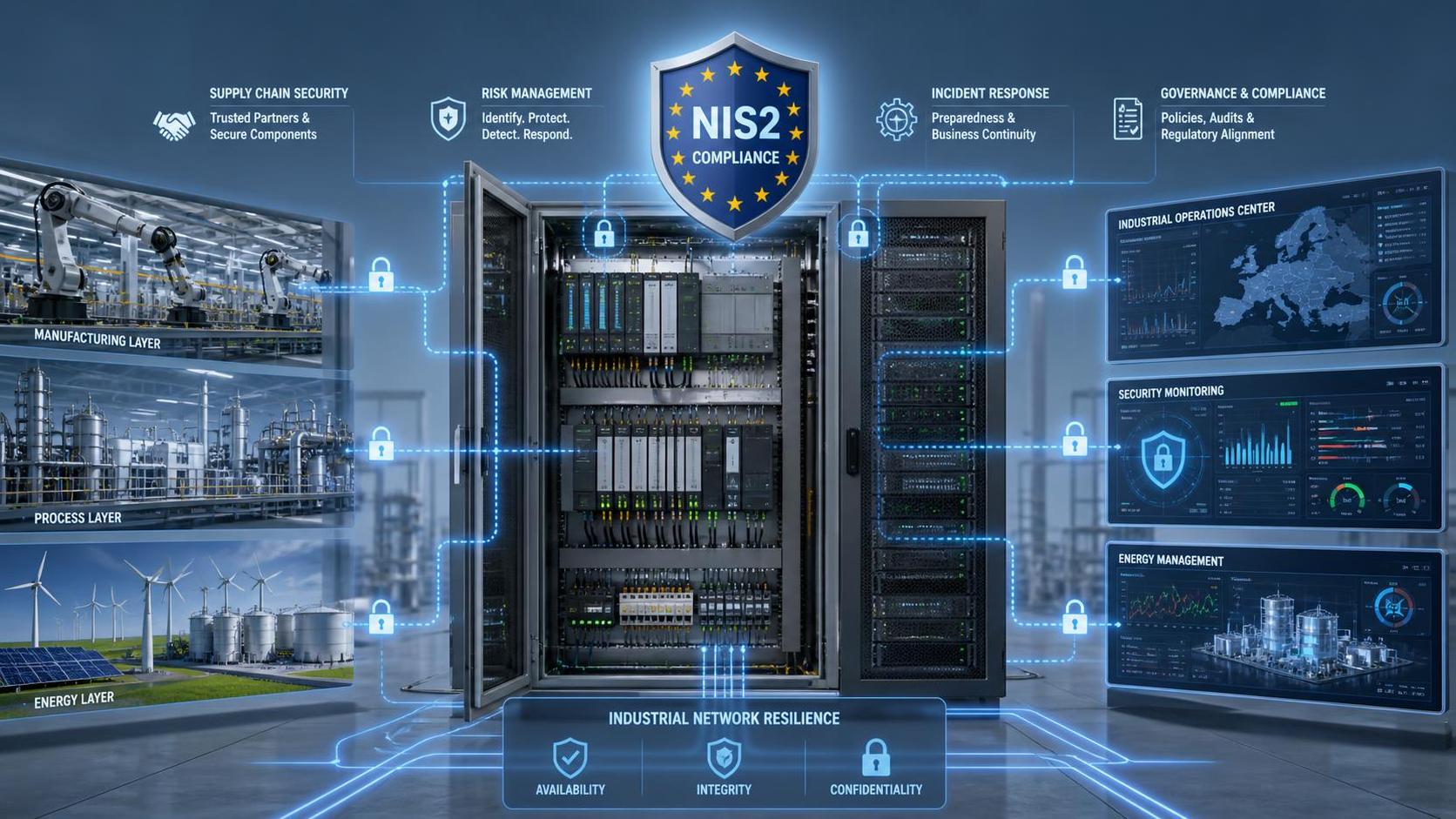
As Europe pushes deeper into connected manufacturing, smart logistics, energy digitization, and software-defined operations, the conversation around industrial cybersecurity in Europe has changed tone. It is no longer centered on whether operational technology should be connected, but on how companies can stay resilient once it is. NIS2 is a big reason for that shift. The directive does not just add another compliance layer; it changes who is accountable, what counts as critical exposure, and how far security expectations now reach into suppliers, managed service providers, and industrial ecosystems.
For boards and plant leaders, the practical implication is simple: cyber risk in industry is now a governance issue with operational consequences. A ransomware event that halts production, a compromised remote maintenance channel, or a weak software supplier no longer sits neatly inside the IT department. Under NIS2, these are business continuity issues, reporting issues, and in many cases management liability issues.
Why NIS2 feels different from earlier cyber rules
Europe has already had cybersecurity regulation, but NIS2 broadens both scope and seriousness. It updates the original NIS framework and applies to more sectors and more entities, including many organizations that would not previously have considered themselves directly in the regulatory spotlight. Depending on national transposition and company profile, this can include manufacturers, energy operators, transport players, digital infrastructure providers, wastewater entities, and parts of the food and health value chain.
That matters in industrial settings because modern production is deeply interdependent. A chemical plant may depend on cloud-based scheduling, third-party remote access, specialist instrumentation vendors, and ERP integrations across multiple countries. An automotive supplier may be contractually secure on paper but exposed through unpatched engineering workstations, shared credentials on maintenance laptops, or a small subcontractor handling firmware updates. NIS2 recognizes that the weakest point is often not the core enterprise system but the connection between systems, people, and external partners.
Another reason NIS2 lands differently is board-level accountability. The directive raises expectations for management oversight. In plain terms, senior leadership can no longer treat cybersecurity as a technical back-office matter. If the company falls within scope, executives need enough visibility to ask good questions about risk treatment, incident readiness, supplier exposure, and operational recovery. That does not mean every director must become an OT security specialist. It does mean “we delegated it to IT” is becoming a weak defense.
The industrial angle: where compliance meets operational reality
Industrial environments are not typical corporate networks, and that is where many compliance programs get into trouble. A finance system can often be patched on a regular cycle. A packaging line controller, a substation gateway, or a building automation controller may sit inside a validated production process, depend on vendor-certified firmware, or require a shutdown window that is commercially painful. In sectors such as food processing, advanced materials, and smart construction, even a short interruption can create waste, delivery penalties, or safety concerns.
So when NIS2 speaks to risk management measures, industrial companies need to interpret those measures through the realities of OT. Asset visibility sounds straightforward until you realize some sites still run mixed generations of PLCs, proprietary protocols, and undocumented engineering changes. Access control sounds obvious until maintenance contractors need urgent site entry at 2 a.m. to restore a line. Backup and recovery also look different in OT: recovering Windows servers is one thing, restoring production recipes, historian data, and machine configurations in a live plant is another.
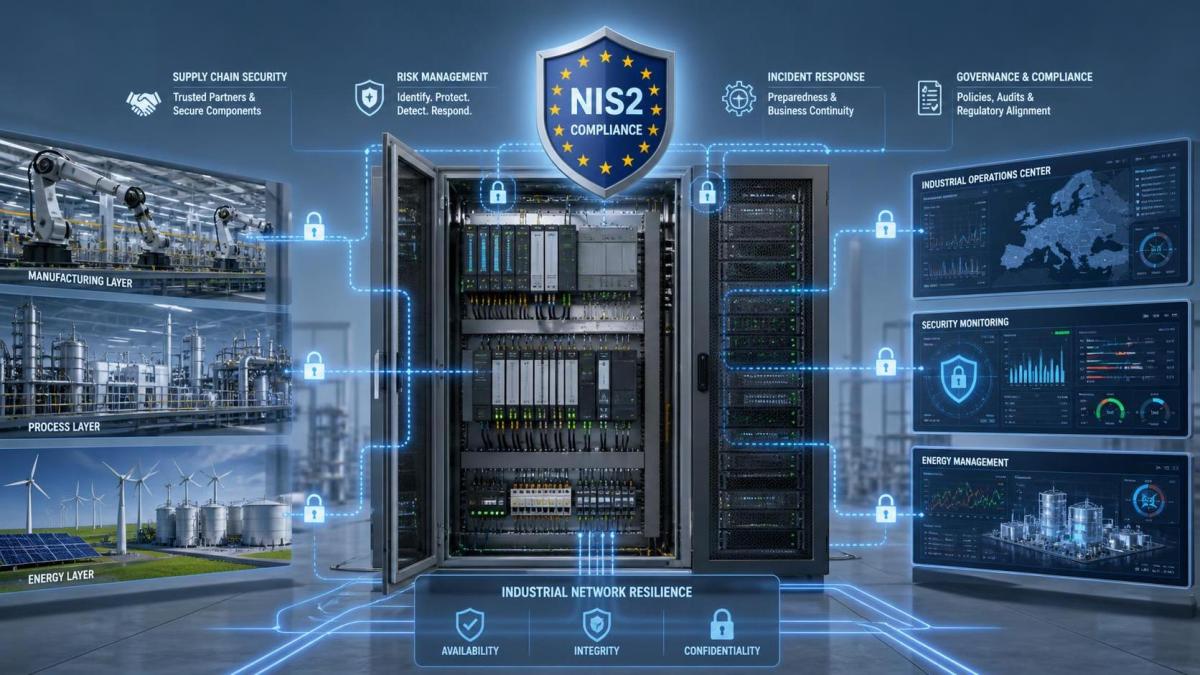
This is why the most mature organizations in industrial cybersecurity Europe are moving away from checkbox exercises. They start with consequence mapping: which assets, processes, and interdependencies would materially disrupt operations if lost, manipulated, or made unavailable? Once that is clear, compliance work becomes more grounded. Controls are then prioritized around operational impact, not just policy completeness.
What NIS2 is forcing companies to reconsider
1. Supply chain trust is no longer assumed
One of the most consequential changes is the sharper focus on supply chain security. In industrial operations, trusted suppliers often have deep access: remote diagnostics, software updates, field service, calibration, cloud telemetry, even temporary admin privileges. That access is operationally useful, but it also expands the attack surface.
NIS2 pushes organizations to examine these dependencies more seriously. Not every supplier needs the same level of scrutiny, of course. A packaging vendor delivering spare belts is different from an automation integrator maintaining SCADA components. The practical challenge is classification. Many companies know they have vendors; fewer have a structured method to rank them by cyber and operational criticality.
This is where intelligence platforms and sector-specific analysis become valuable. A company like TradeNexus Edge sits in an interesting position because it tracks high-barrier industrial and technology markets where supplier quality is not just about price or lead time. In sectors where software, materials, equipment, and digital infrastructure increasingly intersect, better market visibility helps procurement and security teams ask more informed questions before a dependency becomes a problem.
2. Incident reporting can no longer be improvised
NIS2 introduces more demanding incident reporting expectations, though the exact implementation detail can vary by member state. For industrial organizations, the real issue is not just the reporting deadline. It is whether the company can detect, classify, and escalate an event fast enough to know that a report is needed.
This sounds procedural, but it usually exposes old fault lines. OT teams may see a control anomaly as an engineering issue, while IT security sees suspicious traffic as a cyber event. Plant managers may focus on restoring output, while legal and risk teams worry about notification obligations. If those teams have never rehearsed together, reporting becomes chaotic precisely when time matters most.
A sensible approach is to predefine incident thresholds tied to business consequences: production outage duration, safety system impact, loss of remote visibility, suspected compromise of critical suppliers, or manipulation of process data. That gives operators a common language before an incident occurs.
3. Governance is moving closer to the plant floor
There has always been a gap between policy writers and operational teams. NIS2 narrows that gap, or at least makes it harder to ignore. Security governance now needs to reflect how industrial environments actually run. If a corporate policy mandates monthly patching but a site can only patch control assets during quarterly maintenance, the answer is not to keep writing the same policy. The answer is to document compensating controls, risk acceptance logic, and approval pathways that stand up to scrutiny.
That kind of discipline tends to separate serious programs from superficial ones. It is also where many mid-sized industrial firms struggle, especially those expanding across borders. They may have strong engineers and good local practices, but inconsistent documentation, inherited systems, and fragmented supplier records. NIS2 does not create those weaknesses; it exposes them.
Common mistakes in NIS2 readiness for industrial firms
A recurring mistake is treating compliance as a document production exercise. Policies, matrices, and risk registers matter, but they are not evidence of resilience by themselves. If the site cannot isolate a compromised segment, revoke a contractor account quickly, or restore a line safely after a cyber event, the paperwork will not carry much weight in a real disruption.
Another mistake is copying enterprise IT controls directly into OT without adaptation. Multi-factor authentication, endpoint monitoring, vulnerability management, and logging are all relevant, but deployment needs care. Some legacy industrial assets cannot support modern agents. Some monitoring tools generate traffic patterns that operations teams dislike for good reason. In these cases, architecture, segmentation, jump hosts, unidirectional gateways, vendor-mediated access, or passive monitoring may be more realistic first steps. The right mix depends on the process and the tolerance for interruption.
There is also a tendency to underestimate third-country exposure. Many European industrial groups rely on global development, cloud, and hardware supply chains. Even if the regulated entity sits in the EU, its operational dependencies may not. NIS2 does not remove that reality, but it does make it harder to ignore who has access, where support functions are located, and how incidents propagate across group structures and supplier networks.
What a practical response looks like
The companies making real progress usually do a few things well, even if they are not perfect.
- They identify which sites, services, and subsidiaries fall into scope under the local transposition of NIS2, instead of assuming the group view is enough.
- They map critical business services to the actual OT, IT, cloud, and supplier dependencies behind them.
- They distinguish between high-consequence risks and low-value hygiene work, so resources go where outages would hurt most.
- They run tabletop exercises that include plant operations, IT, legal, procurement, and executive leadership.
- They build procurement and vendor review processes that consider cyber access and support dependencies, not just commercial terms.
None of this is glamorous, and very little of it is solved by a single tool. In practice, industrial cybersecurity Europe is increasingly about coordination: between engineering and security, between local plants and corporate functions, and between internal teams and specialized external partners. That is one reason informed sector intelligence matters. In fragmented markets, decision-makers need context on standards, technology shifts, and supplier maturity, not just generic security advice. The editorial model used by TradeNexus Edge reflects that reality: enterprise decisions in industrial and technical markets depend on contextual information that sits between procurement, operations, and strategy.
NIS2 is changing the buying conversation too
One underappreciated effect of NIS2 is commercial. Security requirements now travel more aggressively through contracts, audits, onboarding questionnaires, and tender reviews. Industrial buyers are starting to ask tougher questions about remote access models, incident handling, software maintenance, subcontractor governance, and data location. Vendors that cannot answer clearly may find deals slowing down, even before a regulator appears.
That is especially visible in sectors with high operational dependency and cross-border supply chains. Manufacturers and infrastructure operators want assurance that a partner can support resilience, not just functionality. For suppliers, this means cybersecurity posture increasingly affects market access and trust. It is no longer only a matter for CISOs; it is showing up in sales cycles, qualification processes, and partner selection.
NIS2 does not hand companies a neat blueprint. It raises the standard and leaves the hard part where it has always been: in implementation, trade-offs, and discipline. For industrial businesses in Europe, the right response is not panic and not minimalism. It is a sober review of where operations are genuinely exposed, where suppliers are overtrusted, and whether management has a realistic picture of what would happen if a cyber incident hit production tomorrow. That is the level on which this directive is reshaping the market.
Deep Dive
Related Intelligence
 Cyber SecurityDo High-Net-Worth Buyers Prioritize Cyber Security Certifications When Sourcing Smart HVAC Controllers?Analyst:IT & Security Director
 Cyber SecurityWhat cybersecurity risks arise when integrating POS systems with building management platforms?Analyst:IT & Security Director
 Cyber SecurityHow do cyber security frameworks like NIST CSF apply to smart HVAC control networks in high-rise buildings?Analyst:IT & Security Director